

TL;DR:
- Emotional wellbeing involves understanding, accepting, and managing emotions daily.
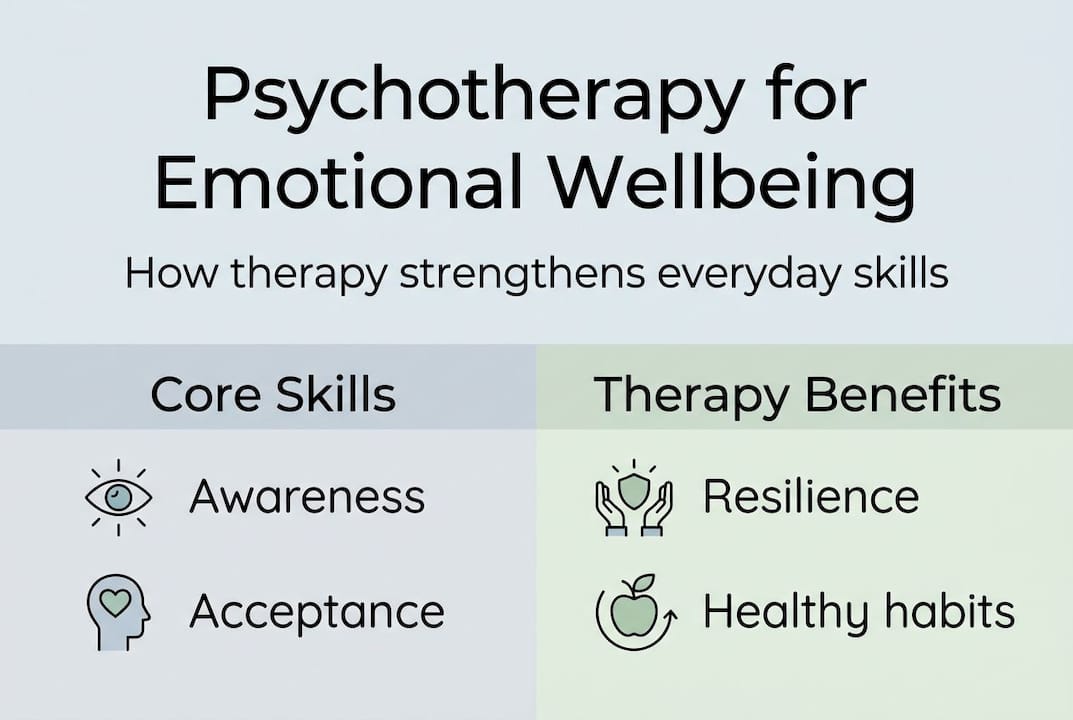
- Therapy builds skills like awareness, acceptance, and regulation for lasting emotional resilience.
- Progress is non-linear; ongoing effort and between-session practices are essential for growth.
Emotional wellbeing is not the same as simply avoiding a bad day. It goes far deeper than the absence of anxiety or depression. Emotional wellbeing is the ability to understand, accept, and effectively manage your emotions, shaping how you cope with stress, make decisions, and connect with others. Most people assume they’re doing fine emotionally as long as nothing is visibly wrong. But that standard sets the bar far too low. Psychotherapy offers research-backed tools to raise that bar, helping you build a richer, more resilient emotional life, whether you’re in crisis or simply ready to grow.
Table of Contents
- Defining emotional wellbeing: More than feeling ‘okay’
- Core skills of emotional wellbeing: Awareness, acceptance, and management
- How does psychotherapy support emotional wellbeing?
- Beyond quick fixes: Nuances, challenges, and what to expect in real life
- A therapist’s take: What most articles don’t say about emotional wellbeing
- Ready to take the next step in your emotional wellbeing?
- Frequently asked questions
Key Takeaways
| Point | Details |
|---|---|
| Beyond mental health | Emotional wellbeing means understanding and managing emotions, not just avoiding illness. |
| Therapy’s real impact | Evidence shows psychotherapy can greatly improve anxiety, depression, and overall wellbeing. |
| Progress is a journey | Lasting change takes time, patience, and flexibility, especially when facing setbacks. |
| Pick the right method | Different therapy types work better for different problems; personalization matters. |
| Stay engaged | Working on emotional wellbeing both in and outside therapy leads to the best outcomes. |
Defining emotional wellbeing: More than feeling ‘okay’
Having set the stage for why emotional wellbeing matters, let’s clarify what it actually is.
Many people confuse emotional wellbeing with mental health, using the terms interchangeably. They’re related, but they’re not the same thing. Mental health often refers to the presence or absence of diagnosable conditions like depression or anxiety disorders. Emotional wellbeing is a broader concept that includes how satisfied you feel with your life, how meaningfully you contribute to your community, and how effectively you navigate your inner world day to day.
The World Health Organization frames this distinction clearly. According to research on contrasting views on wellbeing, emotional wellbeing encompasses quality of life and societal contribution, going well beyond symptom checklists. You can be free of any diagnosable condition and still struggle to feel connected, purposeful, or emotionally steady.
“Emotional wellbeing is not a destination. It’s an ongoing relationship with your own inner life, one that requires attention, skill, and sometimes outside support.”
So what does emotional wellbeing look like on an ordinary Tuesday? It shows up in small but significant ways:
- Noticing you’re frustrated during a difficult conversation and choosing your words carefully instead of snapping
- Feeling sad after a loss and allowing yourself to grieve without shame
- Recognizing when stress is building and taking steps to address it before it becomes overwhelming
- Bouncing back from setbacks without getting stuck in self-criticism
These are not dramatic moments. They’re the quiet, daily expressions of a well-functioning emotional life. And they’re skills, not personality traits. That distinction matters enormously, because skills can be learned, practiced, and strengthened over time with the right support.
Emotional wellbeing also affects your physical health, your relationships, and your work performance. People with stronger emotional wellbeing tend to have better immune function, lower rates of chronic illness, and more stable interpersonal connections. This is why treating emotional wellbeing as a priority, not a luxury, is one of the most practical decisions you can make for your overall health.
Core skills of emotional wellbeing: Awareness, acceptance, and management
Now that the foundation is clear, let’s dig into what makes up emotional wellbeing.
Think of emotional wellbeing as a three-legged stool. Remove any one leg and the whole thing becomes unstable. The three legs are awareness, acceptance, and management. Each one builds on the others, and therapy is one of the most effective environments for developing all three.

Emotional awareness means noticing what you’re actually feeling, not what you think you should be feeling. Many people spend years operating on autopilot, reacting to situations without ever pausing to identify the emotion driving the reaction. Awareness is the first step toward change.
Acceptance is often misunderstood. It doesn’t mean approving of how you feel or resigning yourself to suffering. It means allowing an emotion to exist without fighting it, judging it, or pushing it away. Suppressing emotions doesn’t eliminate them. It stores them, and they tend to resurface in less helpful ways.
Management is where the practical skills come in. This includes strategies like pacing your breathing during a panic response, reframing a catastrophic thought, or stepping away from a conflict before saying something you’ll regret. These are the emotional regulation skills that therapy builds systematically.
Research from the APA shows that psychotherapy builds emotion regulation through skills training, mindfulness, and exposure, with 70 to 80 percent of clients showing reliable improvement. That’s a strong success rate, though it’s worth noting that 10 to 20 percent of people don’t respond to their first approach and may need to switch modalities.
- Journaling to track emotional patterns between sessions
- Mindfulness practices that sharpen present-moment awareness
- Cognitive restructuring to challenge distorted thinking
- Grounding techniques for managing acute distress
Pro Tip: Don’t wait for a crisis to start building these skills. The earlier you develop emotional awareness and regulation tools, the more resilient you’ll be when life gets genuinely hard.
How does psychotherapy support emotional wellbeing?
Learning the building blocks of emotional wellbeing sets us up to see how therapy puts them into practice.
Therapy isn’t one-size-fits-all, and that’s actually good news. Different approaches target different aspects of emotional wellbeing, and matching the right method to your specific challenges makes a real difference in outcomes.
Cognitive Behavioral Therapy (CBT) is one of the most well-studied approaches. It focuses on identifying and changing unhelpful thought patterns that drive emotional distress. Understanding CBT basics can help you see why it’s often the first recommendation for anxiety and depression.
Dialectical Behavior Therapy (DBT) was originally developed for borderline personality disorder but has expanded significantly. Research shows DBT is superior short-term for higher-functioning individuals with anxiety and shows promise for complex PTSD, particularly through its skills training component.
Trauma-Focused CBT (TF-CBT) is specifically designed for trauma survivors, addressing the emotional dysregulation that often follows traumatic experiences.
Psychodynamic Therapy (PDT) explores how past experiences shape current emotional patterns. Studies show PDT and CBT have equivalent efficacy for depression, which means your personal preference and therapist fit matter as much as the specific method.
| Therapy type | Best for | Key mechanism |
|---|---|---|
| CBT | Anxiety, depression | Thought restructuring |
| DBT | Emotional dysregulation, BPD | Skills training, mindfulness |
| TF-CBT | Trauma, PTSD | Trauma processing, coping skills |
| PDT | Depression, relationship patterns | Insight into past experiences |
Here’s a practical sequence for getting started:
- Identify your primary concern (anxiety, trauma, relationship patterns, low mood)
- Research which therapy types for emotional wellbeing align with that concern
- Schedule a consultation to discuss fit with a potential therapist
- Set a realistic timeline, most approaches show meaningful results within 12 to 20 sessions
- Monitor your progress and communicate openly about what’s working
Pro Tip: If you’re dealing with anxiety specifically, exploring psychotherapy techniques for anxiety before your first session can help you ask better questions and feel more prepared.
Beyond quick fixes: Nuances, challenges, and what to expect in real life
Understanding therapy’s advantages also means being aware of real-world complexities and challenges.
Here’s something most articles skip over: therapy doesn’t always feel good, especially at first. When you start examining emotions you’ve spent years avoiding, things can feel harder before they feel easier. That’s not a sign something is wrong. It’s often a sign the work is real.
That said, there are genuine cases where therapy isn’t working, and it’s important to recognize the difference between productive discomfort and actual deterioration.
“Monitoring your progress isn’t optional. It’s part of the process. Therapy should be a conversation, not a one-way transmission.”
Research shows that 5 to 15 percent of clients may experience some deterioration during treatment, and 10 to 20 percent may need to switch approaches entirely. These numbers aren’t meant to discourage you. They’re meant to empower you to stay engaged and speak up.
| Challenge | What it might mean | What to do |
|---|---|---|
| Feeling worse after sessions | Normal processing, or poor fit | Discuss with your therapist |
| No change after 8 to 10 sessions | Possible modality mismatch | Request a review of approach |
| Avoiding sessions | Resistance or therapeutic rupture | Address directly in session |
| New symptoms emerging | Needs clinical evaluation | Contact your therapist promptly |
Signs that therapy is working, even when it doesn’t feel that way:
- You’re noticing emotions you previously ignored
- You’re catching unhelpful thoughts before they spiral
- Relationships feel slightly less reactive
- You’re using coping strategies outside of sessions
Learning how to support your mental health between sessions is one of the most underrated factors in therapy success. What you do in the other 167 hours of the week matters enormously.
A therapist’s take: What most articles don’t say about emotional wellbeing
With the facts established, here’s a candid take from the therapy room.
Most content about emotional wellbeing presents it as a problem to be solved. Get the right tools, follow the right steps, and you’ll arrive somewhere stable and peaceful. That framing is incomplete, and honestly, it sets people up for unnecessary disappointment.
Emotional wellbeing is not a destination. Progress is rarely linear. Some weeks you’ll feel like you’re moving backward, and that’s not failure. That’s the actual texture of growth. The clients who make the most meaningful progress are not the ones who never struggle. They’re the ones who stay curious about their struggles instead of ashamed of them.
What most articles also miss is the power of what happens between sessions. Therapy is the map, but you’re the one doing the walking. Practicing skills, journaling, noticing patterns in daily life, and supporting your wellbeing between sessions are what turn insight into lasting change.
Adapting when a particular approach isn’t working isn’t giving up. It’s smart self-care. The goal is not to be loyal to a method. The goal is to build a life where your emotions inform you without controlling you.
Ready to take the next step in your emotional wellbeing?
If you’ve made it this far, you already understand something important: emotional wellbeing is worth investing in, and psychotherapy is one of the most effective ways to do it. Therapy isn’t only for people in crisis. It’s for anyone who wants to understand themselves better, manage stress more effectively, or build stronger relationships.

At Bergen County Therapist, our team works with individuals, couples, and families across Bergen County to build personalized treatment plans that fit your life and your goals. Whether you’re ready to explore therapy options, curious about individual counseling, or simply want to talk to someone who can help you figure out where to start, we’re here. Start therapy today with a free consultation and take the first real step toward a more emotionally grounded life.
Frequently asked questions
What is the difference between emotional wellbeing and mental health?
Emotional wellbeing is broader, focusing on life satisfaction and effective emotion management, while mental health typically refers to the absence of diagnosable illness. The WHO distinguishes emotional wellbeing by its emphasis on quality of life and societal contribution.
How do I know if I’m improving my emotional wellbeing in therapy?
Look for increased emotional awareness, better stress management, and direct feedback from your therapist. Research shows 70 to 80 percent of clients experience reliable improvement through psychotherapy.
What therapy is best for emotional wellbeing challenges like anxiety or trauma?
CBT is highly effective for anxiety and depression, TF-CBT works well for trauma, and DBT targets emotional dysregulation. Studies confirm CBT, TF-CBT, and DBT all yield large effect sizes for common emotional wellbeing challenges.
Can therapy ever make things worse?
A small percentage of clients, roughly 5 to 15 percent, may experience some initial worsening. Staying in honest communication with your therapist is the most effective way to catch and address this early.
Is emotional wellbeing a goal that can be reached, or a lifelong process?
Emotional wellbeing is a lifelong practice, not a finish line. Growth continues throughout life, and the skills you build in therapy serve you across every season of it.