

Many mental health professionals assume supervision happens behind closed doors in one-on-one sessions. Yet group supervision is a collaborative process where multiple therapists meet regularly with a supervisor to discuss cases, ethical dilemmas, and clinical challenges. This model offers diverse perspectives, reduces professional isolation, and builds accountability in ways individual supervision cannot. We’ll explore how group supervision works, which methodologies deliver the strongest outcomes, and how you can implement effective sessions that enhance both therapist competence and patient care.
Table of Contents
- What is group supervision and how does it work?
- Core methodologies of group supervision
- Group supervision vs. individual supervision: Pros, cons, and best uses
- Evidence-based outcomes and impact on therapist growth
- Challenges, risks, and solutions in group supervision
- Best practices for implementing effective group supervision
- Enhance your practice with personalized mental health support
- Frequently asked questions
Key Takeaways
| Point | Details |
|---|---|
| Peer accountability increases | Group supervision enables diverse input and peer review, which boosts professional accountability. |
| Multiple models available | Therapists can choose from supervisor-led, participative, cooperative, or peer-led group supervision methodologies. |
| Real-world impact is positive | Empirical data shows group supervision enhances competence, reduces isolation, and improves patient outcomes. |
| Risks are manageable | Common risks like confidentiality or group conflict can be managed through structure and best practices. |
| Practical session structure matters | Success depends on clear session formats, role rotation, and integration of multicultural and ethical considerations. |
What is group supervision and how does it work?
Group supervision brings together multiple clinicians under the guidance of a supervisor to review cases, refine skills, and address ethical questions. Unlike individual sessions, this format leverages peer input and shared learning. Optimal group size is 4-6 members to balance participation and depth.
A typical session follows a structured flow. It begins with brief check-ins where each member shares current challenges or wins. Next comes case presentation, where one therapist describes a client scenario in detail. The group then engages in facilitated discussion, offering observations, alternative approaches, and evidence-based strategies. Sessions close with reflections on key takeaways and action steps.
Confidentiality is non-negotiable. Every participant must agree to protect client and peer information. This trust allows honest dialogue about mistakes, uncertainties, and growth edges. Common goals include skill building, accountability, exposure to diverse clinical perspectives, and ethical reasoning. The format mirrors group therapy benefits by creating a supportive learning community.
Typical Group Supervision Session Structure
| Phase | Duration | Purpose |
|---|---|---|
| Check-in | 10-15 min | Share updates, set tone |
| Case presentation | 20-30 min | Deep dive into clinical scenario |
| Group discussion | 30-40 min | Peer feedback, supervisor guidance |
| Closing reflection | 10 min | Summarize insights, assign action steps |
Key elements that make group supervision effective:
- Structured agendas that allocate time fairly across members
- Rotating roles so everyone presents cases and practices facilitation
- Ground rules established collaboratively at the first session
- Supervisor expertise in both clinical work and group dynamics
This structure ensures every voice is heard while maintaining focus. The group counseling advantages you see in client work apply equally to professional development.
Core methodologies of group supervision
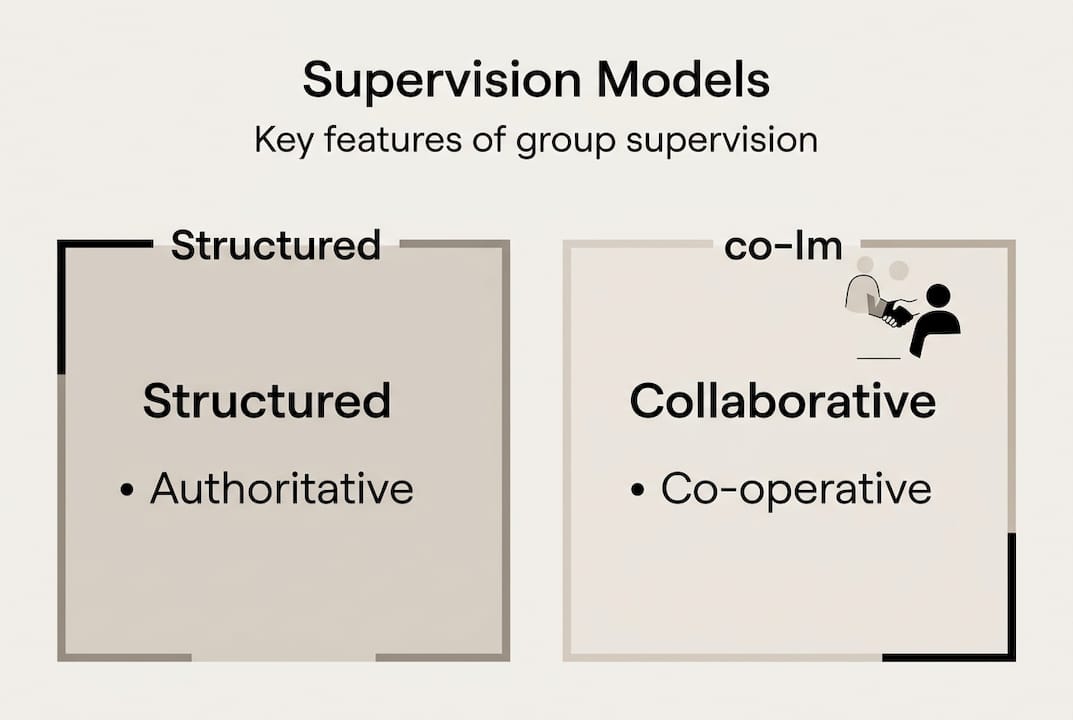
Four primary models shape how group supervision unfolds. Methodologies include authoritative, participative, co-operative, and peer-led approaches, each suited to different experience levels and team goals.
Authoritative supervision places the supervisor in a teaching role. The supervisor directs discussion, offers expert guidance, and ensures adherence to clinical standards. This model works best for novice therapists who need clear direction and frequent correction. Expert-led models reported 93% educational benefits in recent studies.

Participative supervision balances supervisor input with group dialogue. The supervisor facilitates rather than dominates, encouraging members to share observations before offering expert perspective. This approach suits mixed-experience groups where some members can mentor others.
Co-operative supervision shifts toward peer learning. The supervisor acts as a guide, but members take equal responsibility for case analysis and feedback. Experienced clinicians thrive in this model because it honors their expertise while still providing oversight.
Peer-led supervision, also called intervision, removes the formal supervisor entirely. Colleagues meet as equals to discuss cases and support each other’s growth. While peer-led models show 83% learning from peers, they lack the accountability and expert correction that licensure boards often require.
Comparison of Group Supervision Models
| Model | Best For | Supervisor Role | Key Strength |
|---|---|---|---|
| Authoritative | New therapists | Expert teacher | Clear guidance, skill building |
| Participative | Mixed experience | Facilitator | Balanced input, engagement |
| Co-operative | Experienced clinicians | Guide/consultant | Peer expertise, autonomy |
| Peer-led | Seasoned professionals | None (peer-run) | Cost-effective, flexible |
Choosing the right model depends on your team’s composition and goals. New graduates benefit from authoritative structure, while seasoned therapists often prefer co-operative formats that respect their clinical judgment. Many practices blend models, using authoritative supervision for licensure hours and peer-led groups for ongoing professional development.
Pro Tip: Rotate between models as your team matures. Start authoritative, shift to participative after six months, then introduce co-operative elements as confidence grows. This progression mirrors how group therapy facilitation tips evolve with client readiness. For specialized populations, adapt your approach as seen in teen group supervision models.
Group supervision vs. individual supervision: Pros, cons, and best uses
Both formats serve distinct purposes. Group offers diverse perspectives, community, and cost-effectiveness, while individual supervision provides personalized attention and confidential space for sensitive issues.
Advantages of group supervision:
- Multiple viewpoints on complex cases reduce blind spots
- Peer support combats isolation and normalizes struggles
- Efficiency allows one supervisor to guide several therapists simultaneously
- Real-time modeling of collaboration and ethical reasoning
- Cost savings for both supervisors and supervisees
Limitations of group supervision:
- Less individual attention means some concerns go unaddressed
- Confidentiality risks increase with more participants
- Dominant personalities can monopolize discussion
- Slower pace to accommodate multiple presenters
When to choose group supervision:
- Building community among new hires or trainees
- Exploring diverse treatment approaches for common diagnoses
- Developing ethical reasoning through group dialogue
- Meeting licensure requirements efficiently
When to choose individual supervision:
- Addressing personal countertransference or therapist vulnerabilities
- Working through highly sensitive or legally complex cases
- Providing intensive skill remediation
- Supporting therapists in crisis or facing burnout
Most effective supervision programs combine both. Use group therapy sessions for general skill building and peer learning, then schedule individual check-ins for personalized growth plans. Research confirms this hybrid approach maximizes both competence and confidence. If you’re wondering does group therapy work for professional development, the answer is yes when paired with individual support.
Group vs. Individual Supervision Comparison
| Factor | Group Supervision | Individual Supervision |
|---|---|---|
| Perspectives | Multiple viewpoints | Single expert view |
| Cost | Lower per person | Higher per person |
| Confidentiality | Moderate risk | High privacy |
| Personalization | Limited | Highly tailored |
| Peer learning | High | None |
| Best use | Skill building, community | Personal growth, sensitive cases |
Evidence-based outcomes and impact on therapist growth
Empirical research validates group supervision’s role in professional development. A meta-analysis of 32 studies shows small-medium effects on therapist competence, therapeutic alliance, and patient symptom reduction. While effect sizes vary, the overall trend favors supervision over no supervision.
Specific findings include:
- Therapist competence: Small to medium gains when compared to passive control groups
- Therapeutic alliance: Medium effect size in strengthening client-therapist relationships
- Patient outcomes: Small but significant symptom improvement linked to supervised therapists
- Professional satisfaction: Reduced burnout and increased confidence reported across studies
Group supervision enhances accountability and reduces isolation while building ethical practice. Peer review creates natural checkpoints that prevent drift from evidence-based protocols. Therapists report feeling less alone when they realize colleagues face similar challenges.
Key Research Findings on Group Supervision
| Outcome Measured | Effect Size | Clinical Significance |
|---|---|---|
| Therapist competence | Small-medium | Meaningful skill gains |
| Therapeutic alliance | Medium | Stronger client relationships |
| Patient symptoms | Small | Modest symptom reduction |
| Burnout prevention | Not quantified | Qualitative reports positive |
“Group supervision serves as a buffer against professional isolation and burnout, creating a community of practice that sustains therapists through difficult cases and ethical dilemmas.”
The data also reveals nuances. Supervision works best when supervisors receive training in facilitation and feedback delivery. Poorly run groups can increase anxiety or reinforce bad habits. Quality matters more than quantity. One well-structured monthly session outperforms four chaotic meetings.
For trauma-focused work, heal trauma with group supervision by creating space to process vicarious traumatization. Understanding group dynamics in supervision helps supervisors navigate conflict and maintain psychological safety.
Challenges, risks, and solutions in group supervision
Even well-designed group supervision faces predictable obstacles. Risks include dominance, confidentiality breaches, and group conflicts, but proactive strategies minimize these issues.
Top four risks and solutions:
- Dominant personalities overshadowing quieter members: Implement structured turn-taking and invite specific individuals to share. Use a talking piece or timer to equalize airtime.
- Confidentiality violations: Establish clear agreements at the first session. Require signed confidentiality statements and revisit expectations regularly.
- Unresolved interpersonal conflicts: Address tension immediately rather than letting it fester. Use conflict as a teaching moment for therapeutic skills.
- Unclear roles and expectations: Co-create ground rules collaboratively. Define what constitutes acceptable feedback and how to handle disagreements.
Technology enhances supervision quality. Video and audio feedback allows the group to review actual session clips rather than relying on therapist memory. This objective data reduces defensiveness and highlights patterns the presenter might miss.
Tailor your supervision style to group experience. Authoritative models work best for novices who need clear correction, while experienced clinicians prefer co-operative formats that honor their expertise. Mismatched styles create frustration and disengagement.
Pro Tip: Record a brief video clip from one of your sessions each month and bring it to supervision. Watching yourself work alongside peers normalizes imperfection and accelerates skill development. This mirrors techniques used in group therapy for difficult cases where direct observation reveals blind spots.
For specialized populations, adapt your approach. Support for teens in group settings requires different facilitation than adult-focused supervision. Recognize that what works for one demographic may not transfer directly.
Best practices for implementing effective group supervision
Successful group supervision requires intentional design and ongoing refinement. Follow these steps to build a sustainable program:
- Recruit the right mix: Aim for 4-6 members with similar experience levels or complementary specialties. Avoid groups larger than eight, which dilute participation.
- Establish ground rules collaboratively: In the first session, co-create agreements around confidentiality, feedback style, attendance, and conflict resolution. Write them down and revisit quarterly.
- Structure each session: Use the four-phase model (check-in, presentation, discussion, reflection) to maintain focus and ensure everyone contributes.
- Rotate roles: Assign different members to present cases, facilitate discussion, or take notes. This distributes responsibility and builds diverse skills.
- Integrate cultural and ethical discussion: Make diversity, equity, and ethical reasoning core to every case review. Mental health professionals must integrate theory, ethics, and multiculturalism into supervision.
- Schedule consistently: Monthly or bi-monthly meetings work best. Less frequent sessions lose continuity; more frequent ones create scheduling burden.
- Evaluate regularly: Every quarter, ask members what’s working and what needs adjustment. Use anonymous surveys if needed to surface honest feedback.
- Leverage technology: Use secure video platforms for remote supervision. Record sessions (with consent) for later review and skill tracking.
Pro Tip: Create a shared online folder where members upload case summaries, relevant research, or reflection prompts before each session. This preparation deepens discussion and respects everyone’s time. It also builds a resource library the group can reference long-term.
Cultural competence deserves special attention. Discuss how identity, power, and systemic oppression show up in clinical work. Invite members to share how their own backgrounds shape their therapeutic lens. This vulnerability models the self-awareness you want supervisees to develop with clients.
Enhance your practice with personalized mental health support
Group supervision strengthens clinical skills, but comprehensive professional development requires multiple support systems. At Dr. Stephen Oreski & Associates, we understand that mental health professionals need ongoing resources to sustain their practice and prevent burnout.
Our team offers consultative support for therapists seeking to deepen their expertise in psychotherapy options ranging from trauma-focused work to family systems. Whether you’re exploring new modalities or refining your current approach, we provide guidance tailored to your professional goals.
We also recognize that therapists benefit from the same tools we recommend to clients. Learning how to track your mental health helps you monitor your own well-being and model self-care for supervisees. For professionals balancing multiple responsibilities, online therapy benefits include flexible scheduling and reduced commute time, making it easier to prioritize your own therapeutic support.
Our practice serves as a resource for mental health professionals throughout Bergen County and beyond. We offer free consultations to discuss how our services might complement your professional development plan.
Frequently asked questions
How often should group supervision sessions be held?
Most experts recommend monthly or bi-monthly group supervision sessions for effective integration of insights and accountability. Optimal group size is 4-6 members meeting consistently to build trust and continuity.
Is group supervision effective for new therapists?
Yes, although authoritative models work best for novices who need clear guidance. Group supervision offers valuable exposure to diverse cases and normalizes the learning curve all new therapists experience.
What are the key risks in group supervision?
Risks include confidentiality breaches, dominance by stronger personalities, unresolved group conflict, and unclear expectations. Proactive ground rules and skilled facilitation minimize these issues.
How does group supervision benefit therapist well-being?
Group supervision enhances accountability and reduces burnout while supporting ethical development and skill growth. The peer community combats professional isolation that contributes to compassion fatigue.
Does group supervision work well online?
Research shows online models can be effective when sessions are structured and video or audio feedback is used. Secure platforms and clear tech protocols ensure confidentiality and engagement in virtual settings.