

TL;DR:
- Intergenerational conflict involves recurring family tensions rooted in differences in values and societal changes. Addressing these conflicts early through active listening and therapy can improve mental health and strengthen family bonds. Conflict, when managed well, can foster resilience, empathy, and deeper relationships.
Family arguments that repeat year after year, with neither side feeling truly heard, are more common than most people realize. Intergenerational conflict refers to disagreements between people of different generations, typically parents and children, rooted in clashing values, attitudes, behaviors, or life experiences. These tensions are not trivial. They shape mental health, fracture relationships, and can echo across decades if left unaddressed. This article breaks down what drives these conflicts, what the research actually says about their impact, and what families can do, starting today, to move toward understanding instead of resentment.
Table of Contents
- What is intergenerational conflict?
- What causes intergenerational conflict?
- How does intergenerational conflict affect families?
- Strategies for resolving intergenerational conflict
- Why conflict isn’t all bad: Positive sides to intergenerational tension
- Our perspective: What most advice on intergenerational conflict misses
- Find guidance for your family’s journey
- Frequently asked questions
What This Article Covers: Intergenerational Conflict Explained
| Point | Details |
|---|---|
| Definition clarified | Intergenerational conflict means tension between generations, often rooted in differing values or life experiences. |
| Real impacts | Unresolved conflict can lead to mental health challenges and strained family relationships. |
| Root causes matter | Cultural change, parenting styles, and technology often drive generational misunderstandings. |
| Proven strategies | Open communication, empathy, boundaries, and therapy can help resolve intergenerational conflict. |
| Positive outcomes | When managed constructively, conflict can strengthen family bonds and promote personal growth. |
What is intergenerational conflict?
Intergenerational conflict is not simply about arguing over dinner. It is a pattern of recurring tension between family members from different age groups, shaped by the fact that each generation grows up in a fundamentally different world. A grandparent who came of age during economic hardship carries different instincts about money than a grandchild who grew up with digital banking. A parent raised in a strict household may struggle to understand a teenager’s need for autonomy. These differences are not personal failures. They are structural.
Intergenerational conflicts often stem from differences in values, attitudes, behaviors, or interests, especially between parents and children. What makes these conflicts particularly sticky is that both sides usually believe they are right, and often, both sides are right within their own frame of reference.
Common triggers in family settings include:
- Values and traditions: One generation prioritizes cultural or religious customs; another sees them as outdated.
- Technology use: Older adults may view screen time as harmful, while younger generations see it as essential for connection and work.
- Parenting expectations: Grandparents may disagree with how their adult children raise grandchildren.
- Career and life choices: Expectations around education, marriage, or financial independence often collide.
- Communication styles: Directness, emotional expression, and even humor differ sharply across generations.
Generation gaps arise from birth cohort differences and rapid societal change. In other words, the world shifts fast enough that people born just 15 to 20 years apart can have profoundly different reference points for what is normal, safe, or respectful.
“Each generation imagines itself to be more intelligent than the one that went before it, and wiser than the one that comes after it.” — George Orwell
Understanding this dynamic is the first step toward real resolution. Families who engage in family therapy conflict resolution often report that simply naming the generational gap reduces defensiveness and opens the door to genuine dialogue.
What causes intergenerational conflict?
The root causes of intergenerational conflict go deeper than personality clashes. They are baked into history, culture, and the pace of social change.
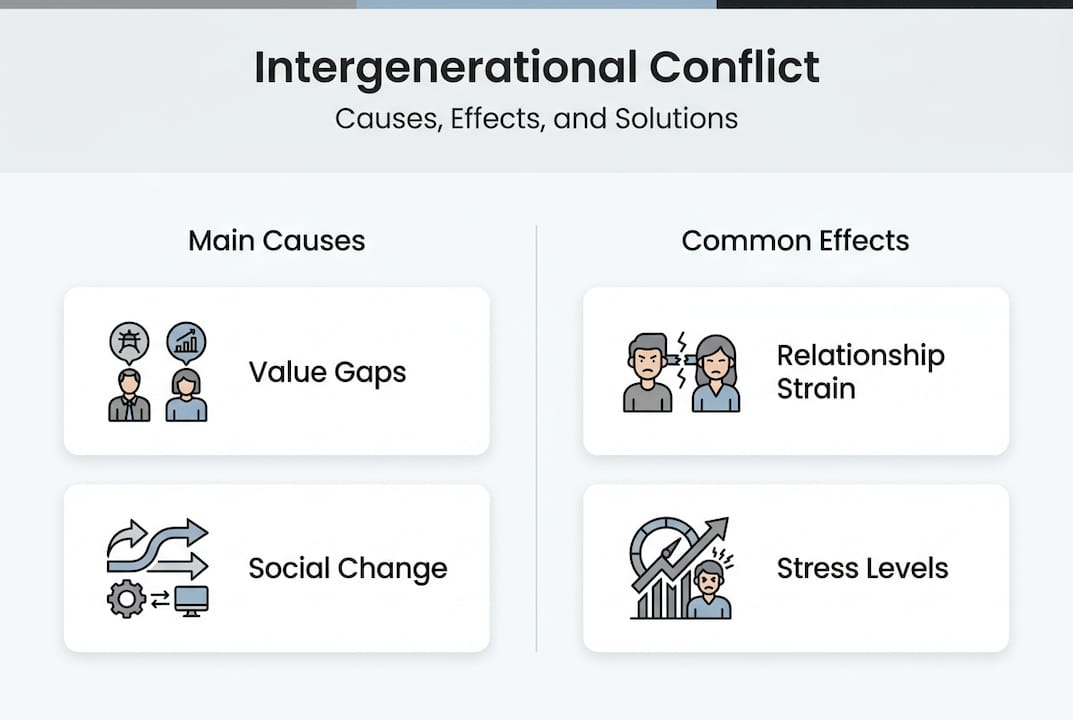
Differences in values, birth cohort experiences, and rapid social changes are primary contributors to generation gaps and the conflicts that follow. Each generation is shaped by the economic conditions, political events, and cultural norms present during their formative years, roughly ages 10 to 25. Those experiences become a kind of internal compass that feels obvious and correct, even when it directly contradicts another generation’s compass.
| Cause | How it shows up in families |
|---|---|
| Cultural shifts | Disagreements over gender roles, religion, or tradition |
| Technology | Conflict over screen time, social media, or remote work |
| Parenting styles | Tension between authoritative and permissive approaches |
| Financial expectations | Disagreements about independence, debt, or inheritance |
| Social norms | Clashing views on mental health, sexuality, or career paths |
Some additional contributing factors include:
- Immigration and acculturation: First-generation immigrant parents often hold tightly to home-country values, while their children adapt to a new culture, creating a painful middle ground.
- Mental health stigma: Older generations may dismiss therapy or emotional expression, while younger family members actively seek support.
- Economic pressure: Financial stress amplifies existing tensions, especially when adult children return home or need support.
Recognizing which of these forces is at play in your family can shift the conversation from blame to curiosity. Instead of asking “Why are you being so difficult?” the question becomes “What shaped this belief for you?”
Pro Tip: When a conflict feels circular, try tracing it back to a specific life experience each person had. Ask, “When did you first learn to see it that way?” This simple question often breaks the cycle of repetition.
Families navigating parenting challenges and age transitions frequently find that the causes of conflict shift as children grow, requiring families to revisit and renegotiate expectations at each stage.
How does intergenerational conflict affect families?
The stakes are higher than most families realize. Intergenerational conflict is not just uncomfortable. It is a measurable health risk.

Family conflict correlates strongly with adolescent depressive symptoms at a striking rate of r=0.580, and is linked to higher general psychopathology in U.S. adolescents. That is not a small effect. It means that chronic family tension is one of the strongest predictors of depression in young people, comparable to other well-known risk factors.
The impacts unfold across multiple levels:
- Adolescent mental health: Teens in high-conflict households show significantly higher rates of anxiety, depression, and behavioral problems.
- Parental well-being: Intergenerational estrangement harms maternal self-rated health, meaning mothers who are cut off from adult children report worse physical and emotional health.
- Relationship quality: Persistent conflict erodes trust and warmth, making it harder to repair bonds even when both sides want to.
- Long-term family structure: Unresolved conflict can lead to estrangement, reduced family contact, and fractured support networks in old age.
| Family environment | Likely outcomes |
|---|---|
| Supportive, low-conflict | Higher resilience, better mental health, stronger attachment |
| High-conflict, unresolved | Increased depression, anxiety, and risk of estrangement |
Opening family mental health conversations early, before tensions become entrenched, dramatically improves outcomes. Families who invest in the parent-child therapy process often find that even a few structured sessions can shift long-standing patterns.
The good news is that awareness itself is protective. Families who recognize the signs of chronic conflict and take action early tend to recover faster and build stronger bonds in the process.
Strategies for resolving intergenerational conflict
Knowing the consequences makes action feel more urgent. The good news is that effective strategies exist, and they do not require everyone to agree on everything.
Key strategies for resolution include active listening, empathy, compromise, clear boundaries, shared goals, therapy, and intergenerational programs. Each of these tools works best when applied consistently, not just during a crisis.
Here is what actually helps:
- Active listening: This means listening to understand, not to respond. Reflect back what you hear before offering your own view.
- Time-boxed conversations: Set a specific, limited time to discuss a difficult topic. This prevents conversations from spiraling and gives both sides a sense of control.
- Shared goals: Identify what both generations want, such as family closeness, safety, or respect, and build from there.
- Clear boundaries: Name what is and is not acceptable in how conflict is expressed. Yelling, stonewalling, and dismissiveness all escalate rather than resolve.
- Professional support: A trained therapist can provide structure that families cannot always create on their own.
One critical warning: aggressive conflict resolution and depressive symptoms can transmit from parents to children, meaning how you handle conflict teaches the next generation how to handle it. Modeling calm, respectful disagreement is itself a form of parenting.
Pro Tip: Before a difficult family conversation, agree on one ground rule together. Something simple like “no interrupting” can change the entire tone of the exchange.
Exploring types of family therapy can help you find the right fit. Some families benefit from structured group therapy for families, while others do better with a focused family therapy guide approach tailored to their specific dynamics.
Why conflict isn’t all bad: Positive sides to intergenerational tension
Here is something most family advice skips entirely: conflict, handled well, can actually strengthen a family.
Solidarity and conflict often coexist; ambivalence, meaning the experience of holding both love and frustration toward the same person, can lead to stronger, more resilient family ties. This is called intergenerational ambivalence, and it is far more common than the idealized version of family harmony that most people compare themselves to.
“The goal is not a conflict-free family. The goal is a family that knows how to move through conflict together.”
When families navigate disagreements with curiosity instead of contempt, several positive outcomes emerge:
- Empathy grows: Understanding a grandparent’s fear of change or a teenager’s need for independence builds genuine compassion.
- Adaptability increases: Families that practice working through differences become more flexible in the face of life’s inevitable challenges.
- Identity is strengthened: Younger generations who engage respectfully with family traditions, even while questioning them, develop a richer sense of self.
- Bonds deepen: Surviving a hard conversation together creates a kind of intimacy that easy agreement never does.
The key distinction is between destructive conflict, which involves contempt, avoidance, or aggression, and constructive conflict, which involves honesty, respect, and a genuine desire to understand. Families who learn this distinction often find that the benefits of family therapy extend well beyond conflict resolution into a broader sense of connection and trust.
Our perspective: What most advice on intergenerational conflict misses
Most mainstream advice on family conflict focuses on communication techniques: use “I” statements, listen actively, validate feelings. These tools matter. But they often fail in real families because they treat conflict as a problem to be solved rather than a relationship to be tended.
What we see in practice is that the families who make real progress are not the ones who memorize scripts. They are the ones who are willing to be vulnerable first. When a parent says, “I’m scared I’m losing you,” instead of “You never listen to me,” something shifts. That kind of honesty cannot be faked, and no technique replaces it.
We also think the timeline most families expect is unrealistic. Intergenerational patterns form over decades. They do not dissolve after one good conversation. Healing is slow, nonlinear, and requires patience from everyone involved. Learning to talk about mental health openly within your family is itself a years-long project for many people, and that is completely normal.
The families who do best are the ones who commit to the process, not the outcome.
Find guidance for your family’s journey
Intergenerational conflict is one of the most emotionally complex challenges a family can face. It carries the weight of history, love, and loss all at once.

At Bergen County Therapist, our team understands that no two families are alike. Whether you are navigating tension between parents and teens, adult children and aging parents, or multiple generations at once, we offer family therapy benefits tailored to your specific situation. You can start psychotherapy with a free consultation, or explore online family therapy if meeting in person is not possible. Reach out today and take the first step toward a family dynamic that actually works for everyone.
Frequently asked questions
What is intergenerational conflict in simple terms?
Intergenerational conflict is when people from different generations, like parents and children, disagree because of different values, beliefs, or life experiences. It is a normal part of family life, but it becomes harmful when left unaddressed.
How can families reduce intergenerational conflict?
Families can reduce conflict by practicing active listening, open communication, and setting clear boundaries. When those efforts stall, resolution strategies like family therapy or structured intergenerational programs can provide the support needed to move forward.
What are common examples of intergenerational conflict?
Common examples include disagreements over technology use, cultural traditions, household rules, career choices, or how grandchildren are raised. Generation gaps rooted in different cultural and life experiences fuel most of these disputes.
Can intergenerational conflict affect mental health?
Yes. Family conflict strongly correlates with adolescent depression and also affects parental health, particularly in cases of estrangement. The mental health effects are real and measurable across all generations involved.
Is some level of conflict healthy for families?
Yes, when handled constructively. Intergenerational ambivalence shows that mixed feelings of love and frustration are normal, and families that work through conflict respectfully often emerge with stronger, more resilient bonds.