

New Jersey holds the #3 spot nationally for overall mental health, which sounds reassuring until you look closer. Bergen County residents still face real barriers: provider shortages, rising loneliness, and stress patterns that no ranking fully captures. The good news is that a wave of innovation is reshaping how therapy is delivered, who can access it, and what personalized care actually looks like. This article breaks down the most important mental health trends affecting our community right now, what’s driving them, and how you can use emerging tools and local resources to support your own growth.
Table of Contents
- Setting the stage: Mental health in Bergen County and beyond
- Rising challenges: Workforce shortages and shifting stressors
- Therapeutic breakthroughs: AI, telehealth, and new methodologies
- Local application: Bergen County’s priorities and opportunities
- Find your next step: Connecting with Bergen County therapy resources
- Frequently asked questions
Key Takeaways
| Point | Details |
|---|---|
| Bergen County ranks high | Residents benefit from best-in-nation access, but still face growing demand and some shortages. |
| Tech accelerates support | AI, chatbots, and telehealth expand therapy access and improve engagement for local needs. |
| New stressors emerge | Loneliness, societal division, and misinformation fuel rising mental health concerns regionally. |
| Personalized care leads growth | Tailored therapy and compassionate, blended models are the future for Bergen County. |
| Be proactive in seeking help | Leverage digital and in-person resources early for better mental health outcomes. |
Setting the stage: Mental health in Bergen County and beyond
The global picture is sobering. Over a billion people worldwide live with a mental health condition, and suicide remains one of the leading causes of preventable death. These aren’t distant statistics. They reflect patterns that show up in our neighborhoods, schools, and workplaces right here in Bergen County.
New Jersey’s #3 national ranking reflects strong insurance coverage and provider availability compared to most states. But rankings don’t tell the whole story. Even in well-served areas, 14.62% of adults in New Jersey report being unable to see a doctor when needed due to cost. That gap matters.
“Access to care is only meaningful when people can actually use it. Cost, availability, and cultural fit all determine whether someone gets help or goes without.”
Here’s a snapshot of how key mental health indicators compare across different levels:
| Indicator | Global | United States | New Jersey |
|---|---|---|---|
| Adults with mental health conditions | ~13% | ~21% | ~18% |
| Unable to afford care | High | ~30% | 14.62% |
| Provider availability ranking | Varies | Varies | #3 nationally |
| Suicide as a concern | Critical | Elevated | Moderate |
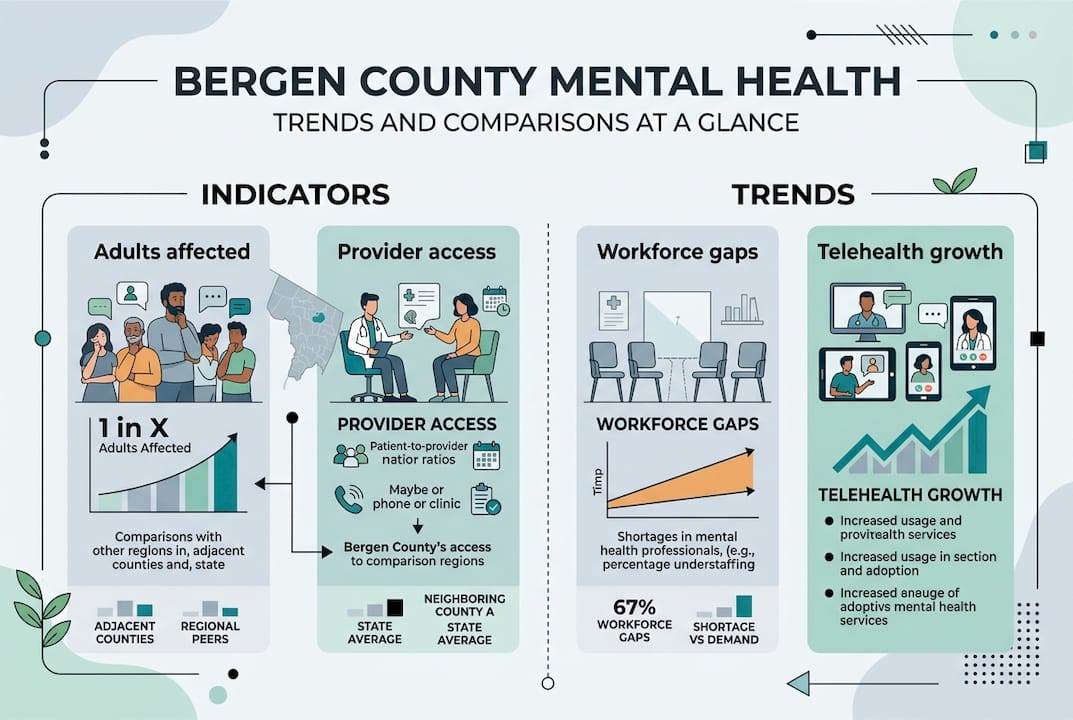
For Bergen County residents, the range of therapy options available locally is a genuine advantage. Neighboring communities like those served by Hudson County mental health resources face steeper access challenges, which puts our county in a relatively strong position. Still, strong is not the same as sufficient.
Key gaps that persist even in well-ranked states include:
- Cost barriers that prevent lower-income residents from using available services
- Cultural and language mismatches between providers and diverse communities
- Behavioral health workforce shortages that stretch wait times even in high-access areas
- Stigma that keeps many people from seeking help at all
With this regional perspective, let’s look at the challenges driving innovation.
Rising challenges: Workforce shortages and shifting stressors
The mental health workforce crisis is real and measurable. In New Jersey, only 53% of psychiatrists needed to meet demand are currently practicing, and average wait times for an appointment stretch to 48 days. That’s nearly seven weeks before someone in crisis can see a specialist.
The shortage isn’t limited to psychiatrists. Social workers, licensed counselors, and psychologists are all in short supply. Psychologist supply data shows that demand is outpacing the pipeline of new clinicians entering the field, a trend that won’t reverse quickly.
The stress landscape is also shifting. 62% of Americans report significant stress related to societal division, and loneliness is now strongly linked to depression and anxiety at a population level. These aren’t just personal struggles. They’re systemic pressures that require systemic responses.
Here’s how Bergen County compares to national averages on key workforce and stress indicators:
| Factor | National average | New Jersey | Bergen County |
|---|---|---|---|
| Psychiatrist supply (% of need met) | ~55% | 53% | Above state avg. |
| Average wait time for mental health appt. | 45+ days | 48 days | Varies by provider |
| Adults reporting loneliness | ~50% | Similar | Similar |
| Adults stressed by societal division | 62% | Similar | Similar |
For Bergen County, the path forward involves both innovation and intentionality. Here are the most pressing workforce and stress challenges to watch:
- Psychiatrist and therapist shortages driving longer wait times
- Burnout among existing mental health providers reducing capacity
- Loneliness and social disconnection increasing demand for support
- Misinformation about mental health creating barriers to help-seeking
- Underserved populations facing compounded access challenges
Approaches like Cognitive Behavioral Therapy are being adapted for digital delivery precisely because in-person capacity can’t keep up with demand. These pressures have sparked a wave of innovation, especially in tech-powered therapy.
Therapeutic breakthroughs: AI, telehealth, and new methodologies
Artificial intelligence is no longer a future concept in mental health care. It’s here, and it’s producing measurable results. Generative AI tools for CBT and chatbot-based interventions have shown improved engagement and symptom reduction in randomized controlled trials (RCTs), which are the gold standard for clinical evidence.
What makes this significant is scale. A skilled therapist can see a limited number of clients per week. An AI-supported platform can deliver structured CBT exercises, mood tracking, and psychoeducation to thousands of users simultaneously. That doesn’t replace human connection, but it extends reach in ways that matter.
AI innovations in mental health now include emotional AI chatbots that recognize distress signals in text and voice, and externalization tools that help clients visualize their thought patterns. These tools are redefining what the early stages of a therapeutic relationship can look like.
Pro Tip: If you’re curious about AI-assisted therapy, look for platforms that pair digital tools with licensed human oversight. The most effective models use AI to support, not replace, your therapist.
Here’s a quick comparison of emerging therapy modalities:
| Modality | Best for | Availability | Human oversight |
|---|---|---|---|
| AI-assisted CBT | Mild to moderate anxiety, depression | High (app-based) | Varies |
| Telehealth therapy | Ongoing individual or couples work | High in NJ | Always |
| Hybrid digital-human | Complex needs, trauma, transitions | Growing | Always |
| In-person therapy | Deep relational work, severe conditions | Moderate | Always |
For Bergen County’s diverse population, telehealth has been especially impactful. It removes commute barriers, increases scheduling flexibility, and opens access for residents who might otherwise avoid in-person settings. Local therapy innovations are increasingly blending these modalities to serve more people more effectively. This includes expanded options for LGBTQ individuals who benefit from affirming, flexible care formats.

Adopting these modalities locally comes with unique strengths and challenges worth exploring further.
Local application: Bergen County’s priorities and opportunities
Bergen County’s advantage is real, but it requires active use. New Jersey ranks #1 for access to mental health care nationally, yet local youth still face high stress levels and need specialized, culturally responsive solutions. Access without fit doesn’t produce outcomes.
Here’s how Bergen County residents can make the most of what’s available right now:
- Combine telehealth and in-person care. Use telehealth for routine check-ins and in-person sessions for deeper relational work. This hybrid approach maximizes both convenience and depth.
- Seek specialized support early. Whether it’s children’s therapy for a struggling child or divorce therapy during a major life transition, specialized care produces better outcomes than general support.
- Use digital tools between sessions. Apps for mood tracking, journaling, and CBT exercises extend the value of your therapy time without replacing it.
- Ask about cultural and linguistic fit. Bergen County’s diversity is a strength. Providers who match your background and language can make a significant difference in outcomes.
- Don’t wait for a crisis. Preventive mental health care, like regular therapy for personal growth, is far more effective than crisis intervention.
Pro Tip: If you’re unsure where to start, a free consultation with a local therapist is often the fastest way to identify the right fit and the right modality for your needs.
“The best mental health care isn’t the most advanced technology or the most prestigious provider. It’s the care that actually reaches you, fits your life, and helps you grow.”
Bergen County residents are in a genuinely strong position to benefit from both the latest innovations and a robust local provider network. The key is knowing what’s available and being willing to use it.
Find your next step: Connecting with Bergen County therapy resources
Understanding trends is valuable. Acting on them is what creates change. Whether you’re drawn to the flexibility of online therapy or want to explore the full range of types of psychotherapy available to you, the team at Bergen County Therapist is ready to help you find the right match.
Dr. Stephen Oreski and his team offer personalized treatment plans that draw on the latest evidence-based approaches, from CBT and trauma-focused therapy to couples and family work. With both in-person and virtual options, you don’t have to choose between convenience and quality.
Frequently asked questions
What mental health trend is most relevant for Bergen County residents now?
The most relevant trend is the use of telehealth and AI-powered therapies to address workforce shortages while making mental health care more accessible and flexible for local residents.
How does Bergen County compare to the rest of New Jersey for mental health access?
Bergen County matches New Jersey’s top national ranking for access, with a provider-to-population ratio of 326:1, which is better than most areas in the country, though some shortages remain.
What new therapies can Bergen County residents expect in the coming years?
Residents can expect wider adoption of AI-supported CBT and chatbots, along with blended digital-human therapy models that make care more personalized and available on flexible schedules.
Is loneliness really a big mental health issue here?
Yes. 50% of US adults report loneliness, which is closely linked to depression and anxiety, and Bergen County residents are not immune to this national pattern.
How can I find help quickly with current provider shortages?
Telehealth platforms and digital therapy tools offer quicker and more flexible access to care, and provider shortages make these options especially valuable for residents who can’t wait weeks for an in-person appointment.