

Social isolation poses a greater mortality risk than smoking 15 cigarettes daily. Yet many people overlook how deeply community connections shape mental health. Perceived social isolation increases early mortality risk more than widely recognized dangers. Community support offers powerful protection against depression, anxiety, and psychological distress. This article explores how family ties, friendships, neighborhood cohesion, and formal interventions work together to enhance well-being. You’ll discover evidence-based strategies to leverage community resources for better mental health outcomes and learn practical steps to strengthen your support network.
Table of Contents
- How Community Support Improves Mental Health Outcomes
- The Protective Roles Of Family, Friends, And Neighborhood Cohesion
- Balancing Formal And Informal Community Supports For Anxiety And Depression
- Challenges And Solutions For Community-Based Mental Health Interventions
- Explore Professional Psychotherapy Options And Community Support In Bergen County
Key takeaways
| Point | Details |
|---|---|
| Community reduces symptoms | Peer support programs decrease depression and anxiety by 20-30% through shared experiences and mutual encouragement. |
| Multiple support sources matter | Family, friends, and neighborhood cohesion each provide unique protective effects against psychological distress over time. |
| Formal and informal supports complement | Professional interventions and personal networks address different mental health needs and work best when combined strategically. |
| Implementation barriers exist | Stigma, resource limits, and motivation challenges can be overcome with integrated care and cultural responsiveness. |
| Recovery improves with community | Community-based interventions enhance outcomes for severe mental illness by fostering belonging and reducing isolation. |
How community support improves mental health outcomes
Community support addresses depression, anxiety, generalized distress, and recovery from severe mental illness through structured programs and organic social connections. Research demonstrates community support reduces depression and anxiety symptoms by 20-30% when individuals engage consistently with peer networks and group interventions. These improvements stem from validation, shared coping strategies, and reduced isolation.
The Danish “Paths to everyday life” trial showed peer support interventions significantly improve adult mental health by creating structured opportunities for connection and skill-building. Participants reported better emotional regulation, increased hope, and stronger sense of purpose. The program paired individuals with trained peer supporters who had lived experience with mental health challenges, creating authentic relationships that professional services alone cannot replicate.
Understanding the importance of community for mental health helps you recognize how different support types contribute to well-being. Community involvement delivers measurable benefits:
- Reduced feelings of loneliness and social disconnection
- Improved self-esteem through validation and acceptance
- Enhanced coping skills learned from peers facing similar challenges
- Greater motivation to engage in treatment and self-care
- Decreased hospitalization rates for severe mental illness
Experts emphasize that community support functions as a critical recovery factor, not merely a supplement to professional treatment. Dr. Kenneth Minkoff, a leading psychiatrist specializing in integrated treatment, notes:
Community support creates the foundation for sustained recovery by addressing the social determinants of mental health that clinical interventions alone cannot reach.
The evidence reveals community engagement works through multiple mechanisms. Shared experiences normalize struggles and reduce shame. Practical assistance with daily tasks decreases stress. Social activities provide structure and purpose. These combined effects create protective factors that buffer against symptom worsening during difficult periods.
The protective roles of family, friends, and neighborhood cohesion
Different social relationships protect mental health through distinct pathways, with family providing long-term stability, friends offering emotional validation, and neighborhood cohesion creating environmental safety. Longitudinal research tracking adults over a decade found that family support shows a protective effect against psychological distress, meaning stronger family connections predict significantly lower distress levels years later. This protection persists even when controlling for baseline mental health, income, and education.

Friend support operates differently, with immediate emotional benefits that help individuals navigate acute stressors. Cross-sectional analyses reveal that friend networks reduce current psychological distress through companionship, shared activities, and emotional reciprocity. While family ties provide enduring security, friendships offer flexibility and choice in relationships that can be particularly valuable during life transitions.
Neighborhood social cohesion demonstrates significant protective associations by creating environments where residents feel safe, connected, and mutually supportive. Communities with higher cohesion show lower rates of depression and anxiety across all demographic groups. This protection stems from informal social control, collective efficacy, and the sense that neighbors care about each other’s well-being.
| Support Type | Protective Effect (β) | Primary Mechanism | Time Frame |
|---|---|---|---|
| Family Support | −1.95 | Long-term stability, unconditional acceptance | 10+ years |
| Friend Support | −1.23 | Emotional validation, shared activities | Immediate to 5 years |
| Neighborhood Cohesion | −0.87 | Environmental safety, collective efficacy | 5-10 years |
Understanding family conversations about mental health helps you cultivate the open communication that strengthens protective family bonds. Regular check-ins, vulnerability sharing, and active listening build the trust that makes family support effective during crises.
The data reveals that having multiple support sources creates additive protection. Individuals with strong family ties, active friendships, and cohesive neighborhoods show 40% lower psychological distress than those with only one support type. This redundancy matters because different stressors require different support responses.
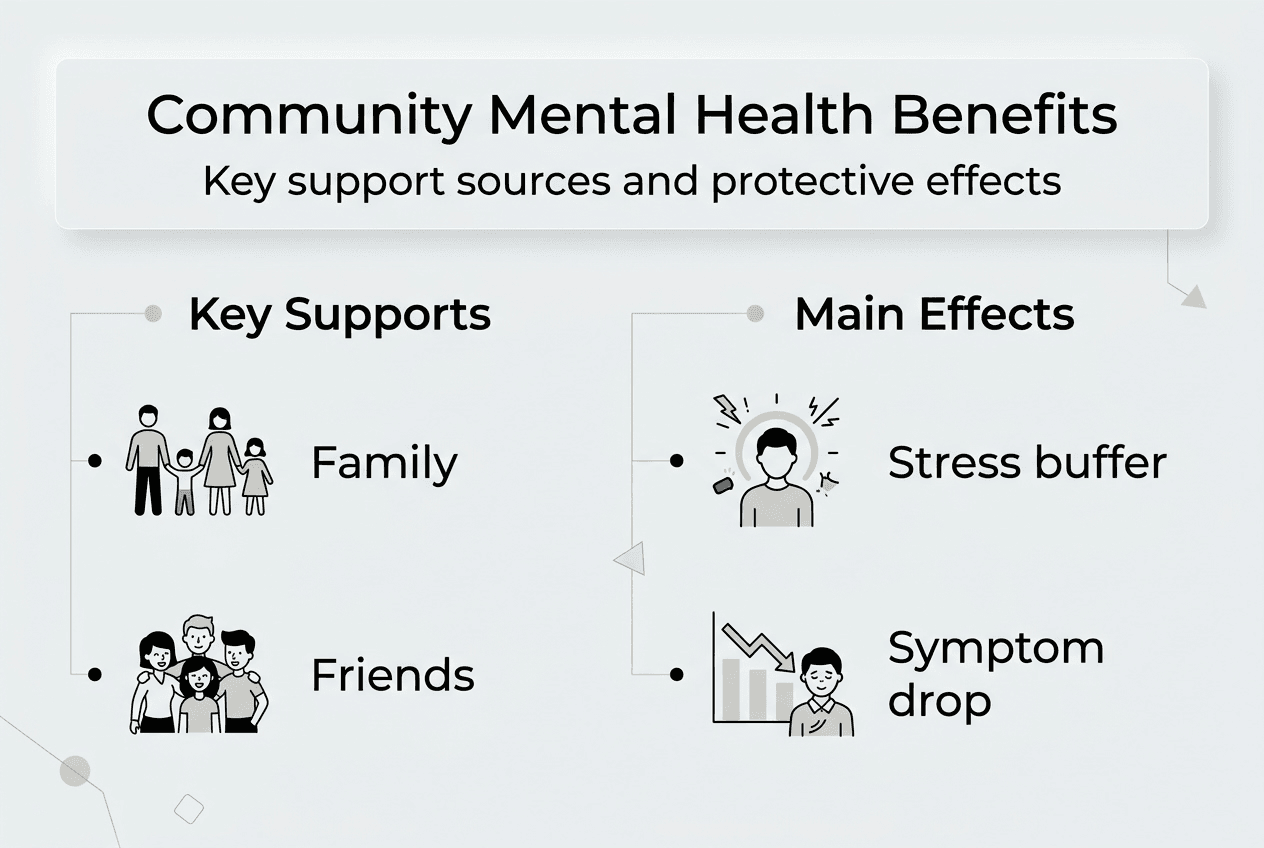
Pro Tip: Strengthen your social ties by scheduling regular connection time with family and friends, participating in neighborhood activities, and reciprocating support when others need help. Consistency matters more than intensity.
Recognizing the power of social connections empowers you to intentionally build relationships that protect your mental health. Quality trumps quantity, but maintaining diverse support sources ensures you have appropriate help for various challenges. Geographic proximity enhances neighborhood benefits, while emotional intimacy drives family and friend protection.
Balancing formal and informal community supports for anxiety and depression
Formal support involves licensed mental health professionals, structured treatment programs, and evidence-based interventions delivered through healthcare systems. Informal support encompasses family members, friends, community groups, religious organizations, and peer networks that provide emotional and practical assistance outside clinical settings. Both reduce symptoms, but through different mechanisms that complement each other.
Research demonstrates a preference for formal support links to greater depressive symptom reductions among individuals who value professional expertise and structured treatment approaches. These individuals benefit from cognitive-behavioral therapy, medication management, and systematic symptom monitoring that formal services provide. The clinical framework offers accountability and specialized interventions unavailable through personal relationships.
Conversely, informal family and community support is associated with greater anxiety symptom reductions for people who respond well to emotional connection and practical help from trusted relationships. Informal support addresses anxiety through companionship, distraction from worries, and assistance with daily stressors that trigger symptoms. The flexibility and availability of informal networks make them particularly valuable for managing acute anxiety episodes.
How each support type helps mental health differently:
- Formal support provides diagnostic clarity, evidence-based treatment protocols, and professional objectivity that personal relationships cannot offer.
- Informal support delivers immediate emotional comfort, practical daily assistance, and authentic connection without clinical boundaries.
- Formal interventions address severe symptoms and complex diagnoses requiring specialized expertise and medical management.
- Informal networks sustain recovery between clinical appointments through ongoing encouragement and accountability.
- Formal services teach skills and strategies, while informal supporters help practice and reinforce those techniques in real-world settings.
| Support Type | Depression Reduction | Anxiety Reduction | Best For | Potential Risk |
|---|---|---|---|---|
| Formal (Preferred) | 35-40% | 25-30% | Severe symptoms, structured treatment seekers | Dependency on professionals |
| Informal (Preferred) | 25-30% | 35-40% | Mild-moderate symptoms, relationship-oriented individuals | Boundary issues, burnout |
| Combined Approach | 45-50% | 45-50% | Most individuals, sustainable recovery | Coordination challenges |
Understanding community support and mental health helps you recognize when to seek professional help versus leaning on personal networks. Severe depression, suicidal thoughts, and debilitating anxiety require formal intervention. Daily stress management and emotional support work well through informal channels.
Pro Tip: Find your ideal balance by starting with a professional assessment to understand your needs, then building informal supports that complement your treatment plan. Regular check-ins with your therapist help adjust the mix as your situation evolves.
Exploring individual vs group therapy reveals how formal interventions can incorporate peer support elements. Group therapy bridges formal and informal support by providing professional facilitation within a peer community structure. This hybrid approach delivers clinical expertise while building the social connections that sustain recovery.
Research cautions against over-reliance on instrumental support, which involves practical assistance like financial help or task completion. While helpful in the short term, excessive instrumental support can undermine self-efficacy and create dependency. Emotional support through listening and validation proves more beneficial for long-term mental health outcomes. Balance practical help with encouragement for independent coping.
Challenges and solutions for community-based mental health interventions
Implementing effective community interventions faces systemic, organizational, and individual barriers that limit access and reduce effectiveness. Implementation faces barriers, including stigma, resource limits, and motivation issues across all community mental health programs. Stigma prevents individuals from seeking help and communities from prioritizing mental health funding. Resource constraints limit program availability, staff training, and service quality. Motivation challenges arise when individuals struggle to engage consistently or when community members lack awareness of available supports.
Systemic barriers include fragmented healthcare systems where mental health services operate separately from primary care, creating coordination problems and gaps in treatment continuity. Insurance coverage limitations restrict access to community programs for low-income populations. Policy frameworks often prioritize crisis intervention over prevention and community support, leading to underfunded programs.
Organizational challenges encompass inadequate staff training in trauma-informed care, cultural competency gaps that alienate diverse populations, and lack of standardized outcome measurement. Many community organizations struggle with sustainability due to grant-dependent funding models. Leadership turnover disrupts program consistency and stakeholder relationships.
Individual-level obstacles include transportation barriers, childcare needs, inflexible work schedules, and personal reluctance to participate in group settings. Language barriers and cultural mistrust prevent immigrant communities from accessing available services. Previous negative experiences with mental health systems create hesitancy about re-engagement.
Integrated care models and cultural responsiveness are essential for success, according to leading mental health organizations. Solutions require coordinated action:
- Integrate mental health services into primary care settings to reduce stigma and improve access through familiar healthcare touchpoints
- Develop culturally adapted programs that reflect community values, languages, and healing traditions
- Implement trauma-informed approaches that recognize how past experiences shape current help-seeking behavior
- Create flexible program formats, including virtual options, varied meeting times, and drop-in services that accommodate diverse schedules
- Build peer support specialist roles that leverage lived experience to bridge professional services and community members
- Establish cross-sector partnerships connecting healthcare, social services, schools, and faith communities for comprehensive support
Expert recommendations emphasize that successful community interventions require strong leadership and meaningful stakeholder engagement:
Sustainable community mental health programs emerge from authentic partnerships between providers, community members, and local leaders who share decision-making power and resource allocation.
Understanding the social environment and mental health connection reveals why community-level interventions must address environmental factors like housing stability, employment opportunities, and neighborhood safety alongside clinical treatment. Programs that ignore social determinants show limited effectiveness regardless of clinical quality.
Preparing yourself through a therapy preparation guide helps overcome individual barriers by clarifying expectations, reducing anxiety about first appointments, and building motivation for consistent engagement. Knowing what to expect increases follow-through rates significantly.
Communities can address implementation challenges by conducting regular needs assessments, collecting participant feedback, and adapting programs based on outcome data. Transparency about program limitations and continuous quality improvement build trust and effectiveness. Investing in staff training, particularly in cultural humility and trauma-informed practices, improves service delivery and participant satisfaction.
Explore professional psychotherapy options and community support in Bergen County
Now that you understand how community support enhances mental health, consider how professional guidance can help you build and leverage these connections effectively. Bergen County residents have access to comprehensive psychotherapy services tailored to diverse needs, from individual counseling to group therapy that combines professional expertise with peer support benefits.
Exploring psychotherapy options helps you identify approaches that align with your community support goals and personal preferences. Whether you benefit most from the focused attention of individual therapy or the shared experience of group settings, professional therapists can guide you toward the right balance of formal and informal supports. When you’re ready to begin therapy treatment, you’ll work with experienced clinicians who understand how to integrate your existing social networks into your treatment plan. Deciding between individual vs group therapy options becomes clearer when you consider your specific symptoms, support preferences, and recovery goals with a qualified professional.
Frequently asked questions
What are the most common benefits of community support for mental health?
Community support reduces depression and anxiety symptoms by 20-30%, improves overall well-being, and buffers against stress through validation and shared coping strategies. It decreases isolation, enhances self-esteem, and provides practical assistance during difficult periods. Recovery rates improve significantly when individuals engage with both peer networks and professional services.
How does family support specifically protect mental health over time?
Family support shows significant protective effects with β = −1.95 over 10 years, meaning stronger family connections predict substantially lower psychological distress long-term. This protection stems from unconditional acceptance, consistent emotional availability, and shared history that creates security during crises. Maintaining open family conversations about mental health fosters the trust and communication patterns that make family support most effective.
What is the difference between formal and informal community support?
Formal support involves licensed mental health professionals providing structured, evidence-based interventions through healthcare systems with diagnostic clarity and specialized treatment protocols. Informal support includes personal social networks like family, friends, and community groups offering emotional connection and practical help outside clinical settings. Both contribute uniquely to symptom reduction, with formal support excelling at severe symptom management and informal support providing daily emotional comfort and relationship-based healing. Understanding community support types helps you leverage both effectively.
How can individuals overcome barriers to community mental health interventions?
Seek culturally responsive services that reflect your values and communication preferences to increase comfort and engagement. Engage with trauma-informed care providers who recognize how past experiences shape current help-seeking behavior and create safe therapeutic environments. Build motivation gradually by starting with small commitments like attending one group session or reaching out to a single support person, then expanding as confidence grows. A therapy preparation guide reduces anxiety about first appointments and clarifies expectations to improve follow-through rates.
Recommended
- The Importance of Community for Your Mental Health – Dr. Stephen Oreski & Associates
- Strengthening Relationships: The Power of Social Connection – Dr. Stephen Oreski & Associates
- Social Environment & Mental Health: Find Support in 2025
- Mental Health: Importance of Family Conversations – Dr. Stephen Oreski & Associates