

TL;DR:
- Grief does not follow a fixed, linear process or strict stages.
- Modern models highlight oscillation, reconstruction, and individual differences.
- Self-compassion and professional support are key for healthy grieving.
Grief is one of the most universal human experiences, yet it remains one of the most misunderstood. Most people have heard of the five stages of grief: denial, anger, bargaining, depression, and acceptance. But the reality of grief rarely follows that tidy sequence. It twists, doubles back, and sometimes hits hardest when you least expect it. If you have ever felt like you were grieving “wrong,” this article is for you. We will break down what the stages actually mean, what modern research says about how grief really works, and what you can do to cope in a way that honors your unique experience.
Table of Contents
- What are the stages of grief?
- Beyond the stages: how grief really works
- When does grief become complicated or prolonged?
- Coping with grief: strategies and finding support
- Why grief needs a new conversation
- Find compassionate support for your grief journey
- Frequently asked questions
Key Takeaways
| Point | Details |
|---|---|
| Grief is not linear | Most people do not follow the five stages in order or experience every stage. |
| Personal and unique process | Your grieving experience is shaped by your life, context, and relationships. |
| Support is available | Therapy, support groups, and personal coping strategies can help at every stage of grief. |
| Watch for prolonged symptoms | Intense grief lasting many months may signal a need for specialized support. |
What are the stages of grief?
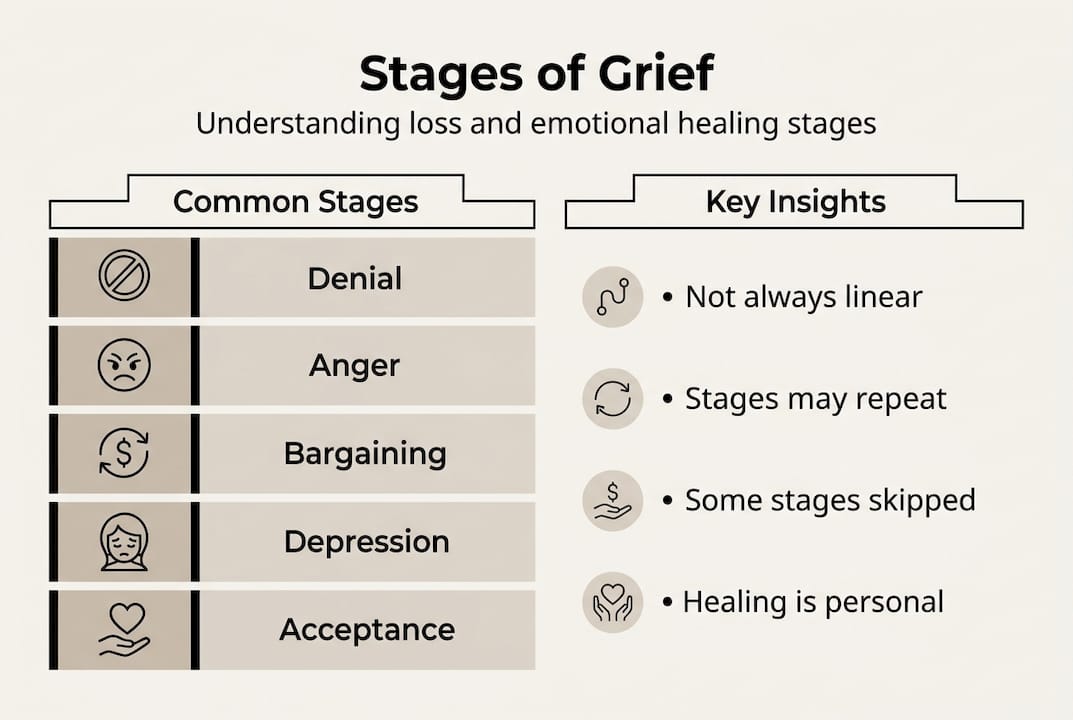
The five stages of grief come from psychiatrist Elisabeth Kübler-Ross, who introduced the model in her 1969 book On Death and Dying. The Kübler-Ross model outlines five stages: denial, anger, bargaining, depression, and acceptance. Here is what each stage generally looks like:
- Denial: Shock and disbelief that the loss has happened. You may feel numb or disconnected from reality.
- Anger: Frustration, resentment, or rage directed at yourself, others, or the situation.
- Bargaining: “What if” and “if only” thoughts, often trying to regain control or reverse the loss.
- Depression: Deep sadness, withdrawal, and a sense of hopelessness about the future.
- Acceptance: Acknowledging the reality of the loss and beginning to find a way forward.
Here is the part most people miss: this model was originally developed by observing terminally ill patients coping with their own impending death, not people experiencing bereavement. It was never designed as a universal roadmap for all types of loss, and it lacks empirical support as a one-size-fits-all framework.
“The stages model is descriptive, not prescriptive. It was meant to help people recognize emotions, not to define the correct order in which to feel them.”
| Common myth | Reality |
|---|---|
| You must go through all five stages | Many people skip stages entirely |
| Stages happen in order | Grief is often cyclical and overlapping |
| Acceptance means you are “over it” | Acceptance means adjusting to a new reality |
| Grief has a clear endpoint | Grief can resurface throughout life |
| Not crying means not grieving | Grief looks different for everyone |
If you are working through loss right now, learning about coping after loss and exploring grief management strategies can offer a more realistic and compassionate foundation than any stage-based checklist.
Beyond the stages: how grief really works
Now that the basics of the stages are clear, it is important to see why real-world grief is often not so tidy. Research confirms that grief stages are not linear: individuals may experience them in any order, skip stages, revisit them, or experience multiple simultaneously. You might feel acceptance on Monday and be swallowed by anger again on Thursday. That is not failure. That is grief.
Modern psychology has moved toward more flexible models that better capture this complexity. Contemporary grief research emphasizes oscillation, meaning reconstruction, and continuing bonds rather than completion or closure. Here are three models worth knowing:
- The Dual Process Model: Developed by Stroebe and Schut, this model describes grievers as oscillating between loss-oriented coping (focusing on the pain of loss) and restoration-oriented coping (adjusting to new roles and life changes). Neither is better. Both are necessary.
- Worden’s Tasks of Mourning: Instead of stages, William Worden proposed four active tasks: accepting the reality of the loss, working through the pain, adjusting to a world without the person, and finding an enduring connection while moving forward.
- Meaning-making approaches: Developed by Robert Neimeyer, this framework focuses on how people reconstruct their sense of identity and purpose after a significant loss. Grief is seen as a search for meaning, not a problem to solve.
Pro Tip: Do not judge your grief by whether it fits the stages. If you feel stuck, that does not mean you are broken. It may mean you need more support, not more willpower.
Some forms of grief are especially complex. People experiencing relationship loss after a divorce or breakup often find their grief minimized by others, even though it can be just as intense as bereavement. Caregivers who lose patients repeatedly may develop chronic sorrow, a persistent, recurring sadness that does not follow any stage model. Ambiguous loss, such as grieving someone who is still alive but cognitively absent, is another form that the traditional model cannot fully address. Understanding complicated grief can help you recognize when your experience goes beyond what the stages describe.
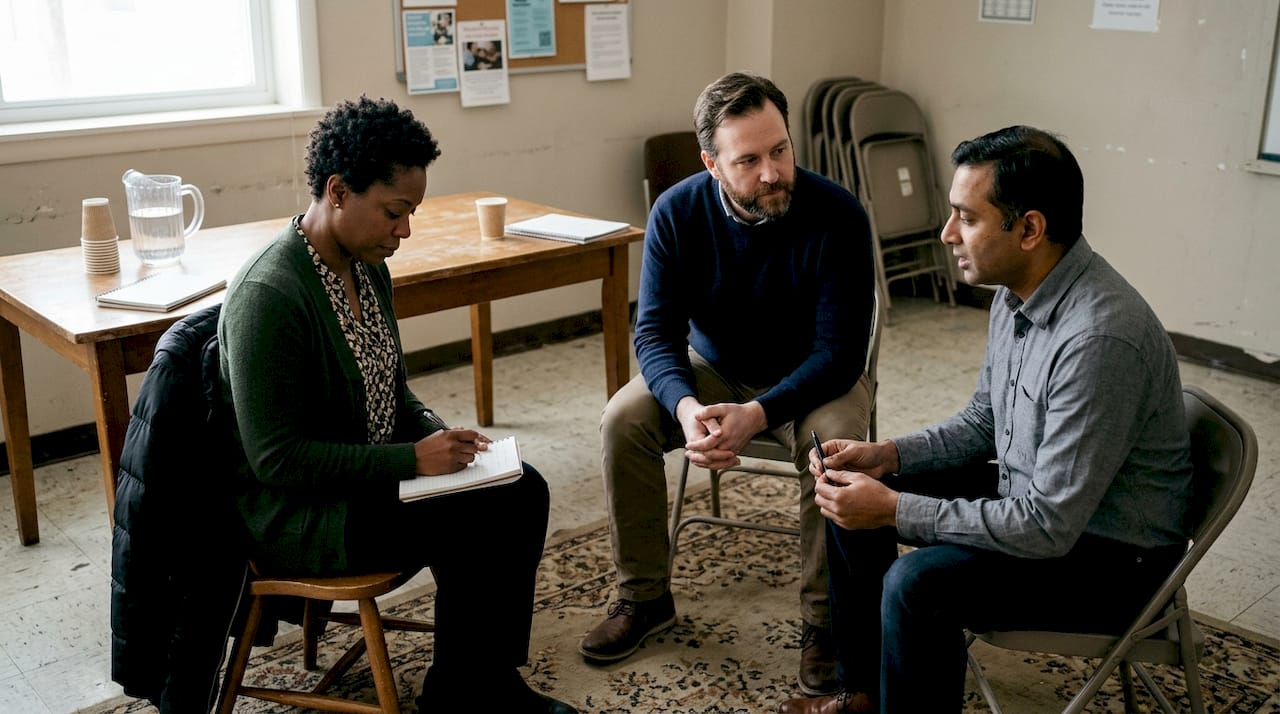
When does grief become complicated or prolonged?
Since everyone grieves differently, it helps to know when grief might be more severe or long-lasting than usual. Prolonged Grief Disorder, or PGD, is a clinical condition recognized in both the DSM-5-TR and ICD-11. Research shows that PGD affects approximately 3 to 13% of bereaved individuals, characterized by persistent yearning, intense emotional pain, and significant impairment lasting six to twelve months or more after the loss.
PGD at a glance:
| Factor | Details |
|---|---|
| Prevalence | 3 to 13% of bereaved individuals |
| Duration | Symptoms persist 6 to 12 months post-loss |
| Core symptoms | Intense yearning, emotional pain, difficulty accepting loss |
| Functional impact | Impairs work, relationships, and daily life |
| Clinical recognition | Recognized in DSM-5-TR and ICD-11 |
Not every difficult grief experience is a disorder. Grief is supposed to hurt. But certain risk factors for prolonged grief make some people more vulnerable, including younger age of the deceased, unexpected or traumatic death, female gender, pre-existing mental health conditions, and the centrality of the loss to one’s identity.
Warning signs that grief may need professional attention:
- Persistent inability to accept the loss months after it occurred
- Withdrawal from all social contact and relationships
- Feeling that life has no meaning or purpose without the person
- Intense bitterness or anger that does not ease over time
- Difficulty performing basic daily tasks for an extended period
If any of these resonate with you, exploring traumatic grief resources or connecting with a specialist in grief therapy techniques can be a meaningful first step toward healing.
Coping with grief: strategies and finding support
Understanding the shape of grief is only part of the journey. Knowing how to cope makes a real difference. The good news is that there are concrete, research-supported strategies that can help you move through grief without forcing yourself into a timeline.
Here are practical steps that many people find genuinely helpful:
- Acknowledge your emotions. Let yourself feel what you feel without labeling it as right or wrong. Suppressing grief tends to prolong it.
- Maintain routines. Small, consistent habits like morning coffee, a daily walk, or a regular bedtime create stability when everything else feels uncertain.
- Connect with others. Whether it is a trusted friend, a family member, or a grief therapy for families setting, shared support reduces isolation.
- Journal your experience. Writing about your grief helps externalize emotions and can reveal patterns in what triggers your pain.
- Honor the memory. Rituals, whether lighting a candle, visiting a meaningful place, or cooking a loved one’s favorite meal, create space to grieve with intention.
- Exercise gently. Movement reduces stress hormones and can lift mood even during the heaviest periods of loss.
- Seek professional help when needed. Psychotherapy is effective for Prolonged Grief Disorder and can provide tools that go far beyond what self-help alone can offer.
Pro Tip: Small rituals do not need to be elaborate. Even a five-minute daily practice of remembering your loved one can provide a stable anchor during chaotic grief.
If you are grieving the loss of a dream or a life path you expected, know that this kind of loss is real and deserves the same care. And if you are supporting someone else through loss, support after loss resources can help you show up for them without burning out yourself.
Why grief needs a new conversation
With practical strategies in mind, it is time to reframe what healthy grief actually means. Most mainstream advice still centers on the five stages as if they are a checklist to complete. But the stages model is descriptive, not prescriptive, and expecting linear progression can cause real distress by implying you are grieving the “wrong” way.
Here at Bergen County Therapist, we see this pressure play out constantly. People come in feeling ashamed because they are still crying two years later, or guilty because they felt relief after a loss, or confused because they never felt angry at all. None of those responses are wrong. They are all grief.
What actually helps is self-compassion, which means releasing the need to perform your grief according to anyone else’s timeline or expectations. Culture matters here too. Different communities mourn in deeply different ways, and there is no universal standard for how long grief should last or what it should look like. Comparing your grief to someone else’s is like comparing fingerprints. The shape is always different.
We also believe strongly in the value of support for caregivers, who often carry grief silently while holding space for others. Their losses deserve acknowledgment too. The most important shift you can make is from “Am I grieving correctly?” to “Am I being kind to myself?”
Find compassionate support for your grief journey
Grief does not follow a script, and neither should your healing. If you or someone you love is struggling with loss, reaching out for professional support can be the most powerful step you take.

At Bergen County Therapist, Dr. Stephen Oreski and our team offer personalized, compassionate care that meets you exactly where you are. We understand that grief is not a problem to fix but a process to navigate with the right support. Whether you are looking to explore therapy options for grief, work through trauma with trauma therapy, or simply take that first step, we are here. Start your journey with a free consultation today and find the support you deserve.
Frequently asked questions
Do you have to experience all five stages of grief?
No. Grief stages are not sequential: you may skip stages, revisit them, or experience several at once. There is no required order or complete set you must go through.
How do you know if grief has become a clinical disorder?
If intense symptoms like persistent yearning, emotional pain, and difficulty functioning last six to twelve months or longer after a loss, it may indicate Prolonged Grief Disorder and warrants a professional evaluation.
What helps most during difficult grief?
Acknowledge your feelings without judgment, lean on trusted people, maintain basic routines, and consider therapy or support groups for structured guidance when grief feels overwhelming.
Can grief come and go, even years later?
Yes. Grief reactions fluctuate daily and can be triggered by anniversaries, songs, or life milestones long after the initial loss, which is a completely normal part of the grieving process.