

TL;DR:
- Effective family communication involves understanding family styles and practicing active listening.
- Using “I” statements and open-ended questions fosters trust and meaningful conversations.
- Bergen County offers local resources like Parent Cafés and therapy for ongoing family support.
Getting your kids to open up can feel like trying to crack a safe without the combination. You say the right words, pick the right moment, and still get a shrug or a slammed door. For parents and caregivers in Bergen County, this frustration is real and common. The good news is that research-backed communication strategies can genuinely shift how your family connects, resolves conflict, and supports each other emotionally. This article walks you through practical tools grounded in evidence, from understanding your family’s communication style to tapping into local Bergen County resources that make lasting change possible.
Table of Contents
- Define your family’s communication style
- Practice active listening for fewer arguments
- Use ‘I’ statements and open-ended questions
- Adapt strategies for different ages and needs
- Leverage Bergen County resources for long-term support
- Why most family communication advice misses what really matters
- Transform your family’s communication with expert support
- Frequently asked questions
Key Takeaways
| Point | Details |
|---|---|
| Know your style | Recognize your family’s core communication pattern to address its strengths and challenges. |
| Practice active listening | Listening with full attention and empathy reduces family arguments and supports emotional health. |
| Use ‘I’ statements | Share feelings without blame to prevent defensiveness and encourage honest dialogue. |
| Adapt strategies by age | Tailor communication for toddlers, teens, and diverse families for the best results. |
| Access local supports | Resources like Parent Cafés and family counseling in Bergen County provide ongoing help. |
Define your family’s communication style
Now that you know what’s at stake, let’s start by understanding your family’s current communication habits. Most families fall into one of four patterns described by Family Communication Patterns Theory, which classifies families based on two dimensions: conversation orientation (how openly family members talk) and conformity orientation (how much the family expects agreement).
Here’s a quick breakdown:
| Communication style | Conversation | Conformity | Strengths | Challenges |
|---|---|---|---|---|
| Pluralistic | High | Low | Open debate, independent thinking | May lack structure |
| Consensual | High | High | Strong bond, shared values | Can suppress dissent |
| Protective | Low | High | Clear authority | Kids may not share feelings |
| Laissez-faire | Low | Low | High autonomy | Disconnection risk |
Knowing which style fits your family is genuinely useful. High conversation orientation, for example, is linked to lower rates of depression and anxiety in children. And according to family communication types research, 71% of family conflicts stem from poor communication habits rather than actual disagreements.
“When families create space for honest conversation, kids develop stronger problem-solving skills, higher self-esteem, and better emotional regulation.”
Use these questions to assess where your family stands right now:
- Do your children feel comfortable disagreeing with you?
- Are emotions named and discussed, or avoided?
- Who usually controls the conversation at home?
- Do family members feel heard after a conflict?
- Is silence used as punishment or as reflection?
Recognizing your style is step one. You cannot change what you have not named. Understanding the communication theory overview/06%3A_Communication/6.01%3A_Types_of_Communication) behind these patterns helps you see that no family is stuck. Patterns are learned, and they can be shifted with intention and practice.
Practice active listening for fewer arguments
Understanding your family’s style sets the stage; the next key skill is listening effectively. Active listening sounds simple, but most of us were never taught to do it well. It means giving your full attention, making eye contact, paraphrasing what you heard, and validating feelings without jumping in to fix, judge, or redirect. According to FCPS communication guidance, active listening is one of the most powerful tools for building trust between parents and children.
Families that consistently practice active listening experience 40% fewer arguments. That is not a small number. It means fewer blow-ups at the dinner table, fewer standoffs over homework, and fewer nights ending in frustration.
Here is how to put it into practice:
- Stop what you’re doing. Put down the phone. Turn off the TV. Physical presence signals emotional availability.
- Make eye contact. Get down to your child’s level if needed. Eye contact communicates respect.
- Listen without interrupting. Let them finish, even if it takes longer than you’d like.
- Paraphrase what you heard. Say, “So it sounds like you felt left out when your friend didn’t invite you. Is that right?”
- Validate the feeling. You don’t have to agree with the behavior to acknowledge the emotion behind it.
- Ask before advising. Try, “Would you like help figuring this out, or do you just need to vent?”
Pro Tip: When emotions are running hot, restate your child’s feelings before responding to the content of what they said. This one move can stop an argument before it starts.
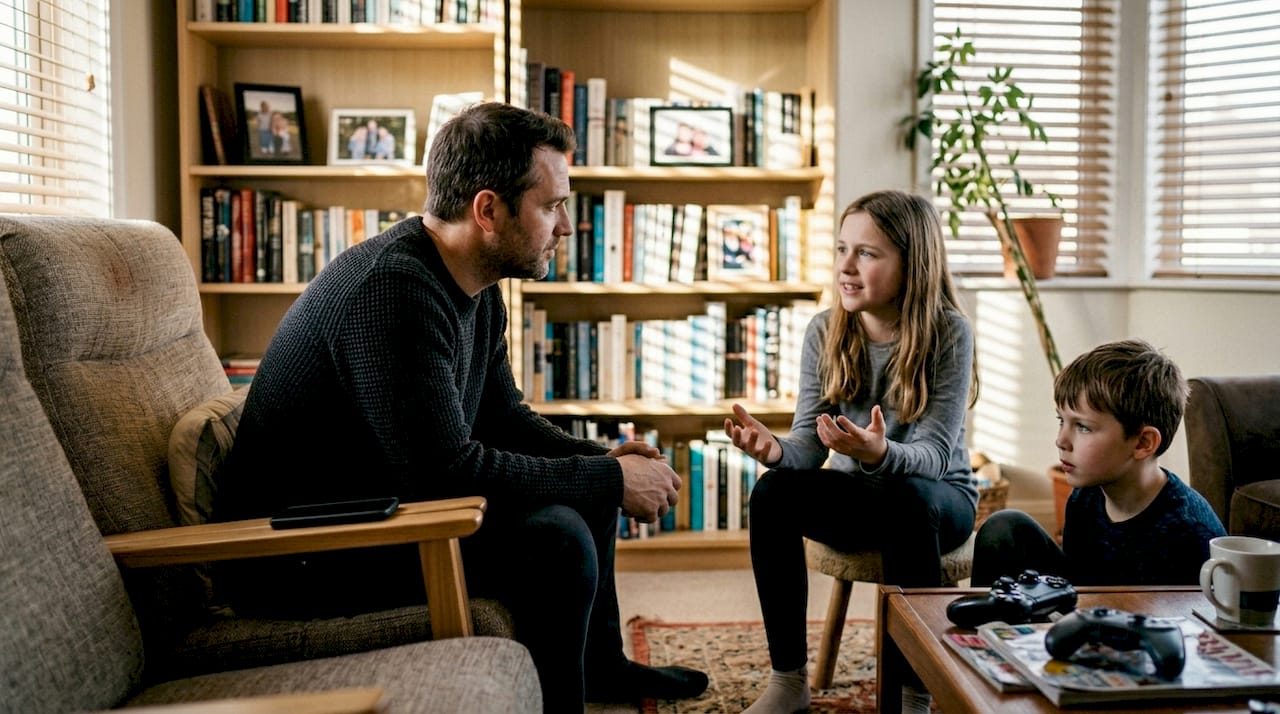
Here’s a real scenario: two siblings are fighting over screen time. Instead of stepping in as a referee, a parent sits down and asks each child to explain how they feel, without interrupting the other. Within minutes, both kids are proposing solutions. That’s active listening in action. It helps your family build stronger family connection over time, not just resolve today’s fight.
Use ‘I’ statements and open-ended questions
Listening well is only half the equation; how you respond also makes a difference. The language you choose either opens a conversation or shuts it down. Two tools that consistently work are “I” statements and open-ended questions.
“I” statements shift the focus from blame to experience. Instead of saying “You never listen to me,” you say “I feel unheard when I’m interrupted.” The FCPS guidance on communication is clear: using “I” statements reduces defensiveness and creates emotional safety, which is exactly what families need to have honest conversations.
Here’s a side-by-side comparison:
| Blame-based phrasing | ‘I’ statement alternative |
|---|---|
| “You always make me mad.” | “I feel frustrated when plans change last minute.” |
| “You never help around the house.” | “I feel overwhelmed when I’m managing everything alone.” |
| “You’re being so dramatic.” | “I notice you seem really upset. Can you tell me more?” |
| “Why do you always do this?” | “I feel worried when this keeps happening.” |
Open-ended questions are equally powerful. They prevent conversational dead-ends. “How was school?” gets a richer answer than “Was school good?” According to FCPS, shifting from “what” to “how” and “why” questions leads to richer, more meaningful conversations.
Strong openers to try:
- “What was the best and hardest part of your day?”
- “How did that situation make you feel?”
- “Why do you think that happened?”
- “What would you do differently next time?”
- “How can I support you right now?”
Pro Tip: Make “how” and “why” your default check-in words. They invite reflection instead of yes/no answers, which matters especially when open-ended questions with teens are your goal.
These strategies work across all ages. A five-year-old and a fifteen-year-old both respond better when they feel respected rather than interrogated.
Adapt strategies for different ages and needs
With a foundation in place, tailor your approach to every member of your family. What works for a toddler won’t land with a teenager, and what helps a neurotypical child may need adjusting for a child with different communication needs.
For toddlers and preschoolers (ages 0 to 5), the most powerful tool is serve-and-return interaction. This means responding to your child’s cues, sounds, gestures, and expressions with warmth and engagement. Serve-and-return literally builds brain circuits that support language, emotional regulation, and social skills. Name feelings out loud: “You look frustrated. That puzzle is tricky.”
For tweens and teens, the approach shifts. Collaborative problem-solving, sometimes called Plan B, invites them into the solution rather than imposing one. You validate their emotions first, then work together on boundaries and expectations. This is especially effective for communicating with teens who push back on authority but respond well to respect.
For multilingual or multicultural families, communication strategies need to honor the whole family’s background. Research on support for diverse families shows that including all voices and respecting cultural traditions strengthens family cohesion rather than creating conflict.
Practical adjustments by age group:
- Ages 0 to 5: Use simple words, name emotions, respond to nonverbal cues
- Ages 6 to 11: Use family meetings, encourage storytelling, model “I” statements
- Ages 12 to 17: Offer choices, respect privacy, use side-by-side activities for conversation
- All ages: Maintain eye contact, follow their lead, avoid lecturing
Pro Tip: Build family rituals like weekly dinners or evening walks. These low-pressure moments create natural openings for connection without the weight of a “serious talk.” Consistent rituals also signal safety, which is when real local communication support becomes possible.
If chronic communication struggles persist despite your best efforts, that’s a signal to seek outside help. It’s not a failure. It’s wisdom.
Leverage Bergen County resources for long-term support
Sustained improvement comes from combining skills with the right support. Here’s what’s available in Bergen County. You don’t have to figure this out alone, and the local resources are more accessible than most parents realize.
Bergen County’s Family Engagement Specialist program offers Parent Cafes and screenings that run virtually on a weekly basis, typically from 6 to 7 p.m. These are informal, judgment-free spaces where parents can share experiences, learn from facilitators, and connect with others navigating similar challenges. Developmental screenings and referrals are also available through this program.
Key resources available to Bergen County families:
- Parent Cafés: Virtual weekly sessions (6 to 7 p.m.) for peer support and skill-building
- Developmental screenings: Early identification of communication or developmental concerns
- Referral services: Connections to local therapists, counselors, and specialists
- Dr. Stephen Oreski and Associates: Family counseling, individual therapy, and online sessions
- Local therapy options: In-person and teletherapy for families across Bergen County
Therapy is not just for crisis moments. Many families work with a counselor to build communication skills before problems escalate. Dr. Oreski’s practice offers personalized treatment plans that meet families where they are, whether that’s in the office or through a screen from your living room.
Community support works best when it’s ongoing, not just a one-time fix. Think of these resources as part of your family’s long-term toolkit, not a last resort.
Why most family communication advice misses what really matters
Here’s an uncomfortable truth: most communication tip lists, including well-intentioned ones, treat family dynamics like a software update. Install the new behavior, reboot, and expect a different output. Real families don’t work that way.
What actually creates change is the willingness to repair after conflict, not just prevent it. Every family argues. The families that thrive are the ones that come back together afterward, acknowledge what went wrong, and try again. That repair process is where trust is actually built.
Generic advice also misses the mental health dimension. Poor communication doesn’t just create tension. It contributes to anxiety, depression, and low self-worth in children over time. This is why connecting with realistic support for families matters beyond just learning scripts and techniques.
Self-reflection is the real game-changer. Ask yourself honestly: Am I modeling the communication I want to see? That question alone can shift everything.
Transform your family’s communication with expert support
Sometimes the strategies you learn here are a great starting point, but breaking old patterns takes more than a checklist. If your family keeps hitting the same walls, professional support can make the difference between knowing what to do and actually doing it consistently.
Dr. Stephen Oreski and his team offer online family therapy as well as in-person sessions designed to help Bergen County families practice these skills in a safe, guided environment. Whether you’re working through communication breakdowns, parenting stress, or relationship strain, there’s a personalized path forward. You can also explore couples therapy to strengthen the partnership at the heart of your family. Learn more about local therapy options and schedule a free consultation today.
Frequently asked questions
What if my child refuses to talk, even when I use these tips?
Give them space and keep the door open with low-pressure invitations to connect. If silence becomes a pattern, collaborative problem-solving or working with a neutral counselor can help break the standoff.
Which communication tip helps most with sibling rivalry?
Active listening paired with family meetings gives siblings a structured space to feel heard. Active listening and rituals together reduce rivalry by building mutual respect over time.
Are these family communication strategies effective for teens?
Absolutely. Teens respond especially well to collaborative problem-solving, “I” statements, and emotional validation. Tailoring communication to their need for autonomy makes these tools even more effective.
How do I access Parent Cafés or local counseling in Bergen County?
Parent Cafés run virtually weekly from 6 to 7 p.m., and referrals to local therapy services including Dr. Oreski’s practice are available through Bergen County family resource programs.
Recommended
- Improve Family Communication: Step-by-Step Counseling Guide by Dr Stephen Oreski & Associates.
- Family communication: Build stronger bonds in Bergen County
- Improve Family Relationships: A Step-by-Step Guide by Dr Stephen Oreski & Associates.
- 6 Key Advantages of Family Therapy for Better Relationships
- Why Naming Your Feelings Helps — The Caia Journal
- Mindfulness per genitori: guida pratica per gestire lo stress