

- Codependency is a learned pattern where one person prioritizes managing or rescuing another at the expense of their own well-being and identity. It is not a clinical diagnosis but involves behaviors like low self-esteem, boundary issues, and excessive caretaking. Recovery involves recognizing enabling behaviors, setting boundaries, and focusing on rediscovering one’s own needs and self-worth through therapy.
Most people think codependency means being “too attached” or overly loving. That framing misses the point almost entirely. Understanding what is the definition of codependency matters because it names a specific pattern: one person organizing their identity, self-worth, and daily decisions around managing or fixing another person. It is not about love being too strong. It is about a relational dynamic in which one person’s sense of self quietly disappears into someone else’s needs, often without either person realizing it.
Table of Contents
- Key takeaways
- What is the definition of codependency
- Signs and symptoms to recognize
- Healthy relationships vs. codependent ones
- Where codependency comes from
- How to start unlearning codependent patterns
- My perspective on codependency and healing
- Ready to work through codependency with support?
- FAQ
Key takeaways
| Point | Details |
|---|---|
| Codependency is learned, not innate | It develops from early family environments and can be unlearned through focused therapeutic work. |
| Not a formal diagnosis | Codependency does not appear in the DSM-5 but is widely recognized by clinicians as a behavior pattern. |
| Identity loss is the core issue | A codependent person shapes their self-worth around another person’s behavior, not their own values. |
| Enabling keeps dysfunction alive | Shielding someone from consequences feels helpful but actually prolongs destructive cycles. |
| Recovery requires a self-focus shift | Progress comes from rebuilding your own boundaries and identity, not from changing the other person. |
What is the definition of codependency?
At its core, codependency is a learned relational pattern where one person becomes excessively dependent on managing, rescuing, or caretaking another person, at the direct cost of their own well-being and identity. The word “learned” is doing a lot of work in that sentence. This is not a personality defect or a character flaw. It is a set of behaviors and beliefs someone absorbs, often in childhood, and carries into adult relationships.
One thing worth knowing immediately: codependency is not in the DSM-5. It is not a clinical diagnosis, the way depression or anxiety is. What it is, however, is a widely recognized behavioral pattern that clinicians see across individual therapy, couples work, and family systems. Many therapists treat it as seriously as any formal diagnosis because the emotional damage it creates is just as real.
“Codependency requires at least two people. But the internal patterns, like low self-worth and compulsive caretaking, travel with the person even when the relationship ends.”
What codependency actually looks like is one person in a relationship taking on a disproportionate caretaking role. Their sense of purpose, value, and even daily mood becomes tied to how the other person is doing. If the other person is struggling, the codependent person feels responsible for fixing it. If the other person is happy, that becomes the source of the codependent person’s worth. Their own needs, preferences, and identity get placed on a permanent back burner.
Signs and symptoms to recognize
Knowing the signs is where theory becomes personal. Common symptoms include low self-esteem, inability to set boundaries, chronic guilt, and obsessive concern for others, paired with regular neglect of one’s own physical and emotional health. There is no single checklist that fits every person, since symptoms vary significantly across individuals and relationship types.
Here are five core patterns to watch for:
- Low self-esteem: Your self-worth depends entirely on whether you are useful to someone else. You rarely feel “enough” on your own terms.
- People-pleasing: Saying no feels dangerous or selfish. You agree to things that genuinely cost you peace just to avoid conflict or disapproval.
- Chronic caretaking: You spend more energy managing another person’s problems than addressing your own needs or goals.
- Boundary issues: You have trouble knowing where your responsibilities end and another person’s begin. Other people’s emotions feel like your emergency.
- Dependency on the relationship: Your mood, decisions, and identity feel tightly controlled by the state of the relationship, not by your own values.
These patterns do not always look dramatic. Sometimes codependency looks like the person who always “keeps the peace,” the partner who constantly makes excuses for someone else’s behavior, or the friend who cannot stop thinking about whether someone is angry with them.
Pro Tip: If you find yourself regularly exhausted from managing someone else’s life while neglecting your own, that exhaustion itself is data worth paying attention to.
Healthy relationships vs. codependent ones
Not all closeness is codependency. Healthy relationships have mutual support alongside individual identity, while codependent ones are unbalanced, with one person consistently giving and the other consistently receiving without accountability.
Here is a direct comparison:
| Healthy relationship | Codependent relationship |
|---|---|
| Both partners maintain individual goals | One partner abandons personal goals to focus on the other |
| Support is mutual and reciprocal | One person is always the caregiver, the other the receiver |
| Boundaries are respected | Boundaries are weak, absent, or constantly violated |
| Each person takes responsibility for their own emotions | One person manages both people’s emotional states |
| Independence is valued alongside togetherness | One person feels lost without the other’s presence or approval |
The most important distinction is how identity functions within the relationship. In healthy dynamics, both people bring a sense of self to the relationship. In codependent ones, one person’s self gets consumed by the relationship.
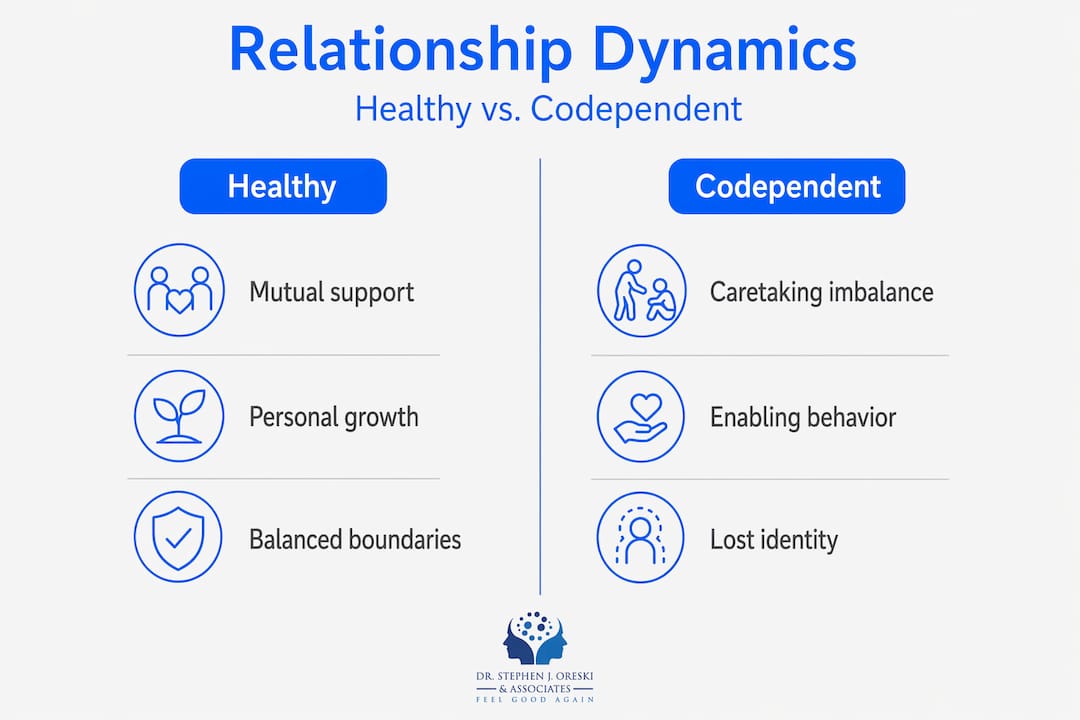
Enabling behavior is the mechanism that makes codependency self-perpetuating. When you shield someone from the consequences of their behavior, whether that is covering for them, making excuses, or handling what they should handle themselves, you remove the very friction that might motivate change. The other person’s dysfunction continues, your exhaustion grows, and the cycle repeats.
Where codependency comes from
Codependency does not appear out of nowhere in adulthood. It originates from learned childhood behaviors absorbed from parents or caregivers who were emotionally unavailable, struggled with addiction, or had their own unresolved boundary problems.

Children in those environments learn to adapt. They become hyper-attuned to the emotional state of adults around them. They learn that their safety, love, or approval depends on managing those adults’ moods and needs. That is not pathology in a child. That is smart survival.
The problem is what happens decades later. Many adults replay dysfunctional childhood dynamics in their intimate relationships, unconsciously seeking the resolution they never got as children. The survival adaptation that once protected them becomes the pattern that now holds them back.
Key contributing factors include:
- Growing up with a parent managing addiction or mental illness
- Emotional neglect or inconsistent parenting
- Being assigned the “responsible one” role too early
- Witnessing conflict that children were implicitly expected to smooth over
Pro Tip: Understanding where a pattern came from does not excuse it or lock you into it. It simply gives you a starting point for changing it.
How to start unlearning codependent patterns
The good news is direct: codependency can be unlearned through consistent therapeutic work. Recovery is not about eliminating care for others. It is about redistributing your energy so your own needs and identity receive genuine attention.
Here are practical steps to begin:
- Name the enabling behavior. Look honestly at where you are shielding someone from consequences. Recognizing enabling behavior is often the turning point that makes change possible.
- Practice setting one boundary. Start small. A boundary does not have to be dramatic. It can be as simple as not answering a call when you are not in an emotional space to do so.
- Redirect your energy inward. Spend intentional time on your own interests, friendships, and goals that have nothing to do with the other person.
- Work with a therapist. Solo efforts help, but attachment-informed therapy accelerates the process by addressing the root patterns, not just the surface behaviors.
- Expect discomfort. Breaking the pattern will feel wrong at first. The sense of being needed provides a real emotional reward, and losing it feels like a loss even when it is actually progress.
My perspective on codependency and healing
I have worked with people in codependent relationships for years, and the single biggest misconception I see is this: people believe that if they just love harder or give more, the other person will eventually change. That belief is the core of the trap.
What I have found is that framing codependency as a learned pattern rather than a character flaw changes everything about how people approach healing. It shifts the question from “what is wrong with me?” to “what did I learn, and what do I want to learn instead?” That shift is not small. It is the difference between shame and agency.
The hardest conversation I have in session is the one where someone realizes that their caretaking, despite feeling loving, has actually protected the other person from facing real consequences. That realization stings. But it is also the moment real recovery can begin. Change is entirely possible. It just requires turning attention back toward yourself, which is the one thing codependency trains you to resist.
— Dr Stephen Oreski LCSW
Ready to work through codependency with support?
Recognizing these patterns in yourself is a meaningful first step. Taking action is where lasting change actually happens.

At Bergencountytherapist, our therapists work specifically with relational patterns like codependency through individual and couples psychotherapy designed to help you rebuild boundaries, reconnect with your own identity, and stop the cycles that have kept you stuck. If you are ready to stop managing everyone else and start investing in yourself, begin your therapy journey with a free consultation today.
FAQ
What is the definition of codependency?
Codependency is a learned relational pattern where one person excessively organizes their identity and self-worth around managing, rescuing, or caretaking another person, at the cost of their own well-being. It is not a formal DSM-5 diagnosis but is widely recognized by clinicians.
What does it mean to be codependent in a relationship?
Being codependent means your sense of purpose, value, and emotional stability depends on another person’s behavior rather than your own values. It typically involves chronic caretaking, people-pleasing, and losing your own identity within the relationship.
Is codependency the same as being loving or supportive?
No. Healthy support is mutual and preserves individual identity. Codependency is unbalanced, with one person consistently giving while neglecting their own needs and enabling the other’s dysfunctional behavior without accountability.
Can codependency be treated?
Yes. Codependency can be unlearned through therapy focused on building boundaries, developing self-worth, and recognizing enabling patterns. Progress requires shifting attention from fixing others to understanding and meeting your own needs.
Where does codependency come from?
Codependency most often develops from childhood environments where a child learned to manage an adult’s emotional state to feel safe or loved. These survival adaptations become harmful relational patterns in adult relationships.