

TL;DR:
- Complicated grief is a persistent, disabling condition lasting over a year in adults.
- Effective treatments include Prolonged Grief Therapy and Grief-Focused CBT.
- Early recognition and specialized support are crucial for recovery and healing.
Grief is not a problem you simply wait out. For most people, the sharpest pain of loss softens over months as they slowly rebuild their daily lives. But for roughly 4 to 15 percent of bereaved adults, grief does not soften. It stays just as raw and disabling a year or more after the loss, making it nearly impossible to work, connect with others, or imagine a future. This is called complicated grief, and it is not a sign of weakness or a failure to cope. It is a recognized condition with clear symptoms and effective treatments. This article explains what complicated grief is, how to spot it, and how to find real support right here in Bergen County.
Table of Contents
- What is complicated grief?
- Complicated grief vs. normal grief, depression, and PTSD
- Common signs and symptoms of complicated grief
- Effective treatments and finding help in Bergen County
- Why recognizing complicated grief early matters for healing
- Connect with expert grief support in Bergen County
- Frequently asked questions
Key Takeaways
| Point | Details |
|---|---|
| Not all grief fades | Complicated grief persists and can seriously impact daily life if not addressed. |
| Distinct from depression | Complicated grief is different from depression and PTSD—unique treatments are needed. |
| Early help improves outcomes | Seeking specialized therapy or local support can lead to real healing and prevent long-term struggles. |
| Effective treatments exist | Prolonged Grief Therapy and Grief-Focused CBT are proven to help most people recover. |
What is complicated grief?
Complicated grief, now formally called Prolonged Grief Disorder (PGD) in the DSM-5-TR, is a condition where grief becomes persistent and disabling rather than gradually easing. Think of normal grief as a wound that slowly closes. Complicated grief is that same wound staying wide open, becoming infected, and preventing you from functioning. The loss stays at the center of every thought, every day, long after others around you expect you to have “moved on.”
The DSM-5-TR criteria are specific. In adults, a diagnosis requires that intense grief symptoms persist for more than 12 months after the loss. In children, the threshold is more than 6 months. The symptoms must also cause significant distress or impairment in daily functioning.
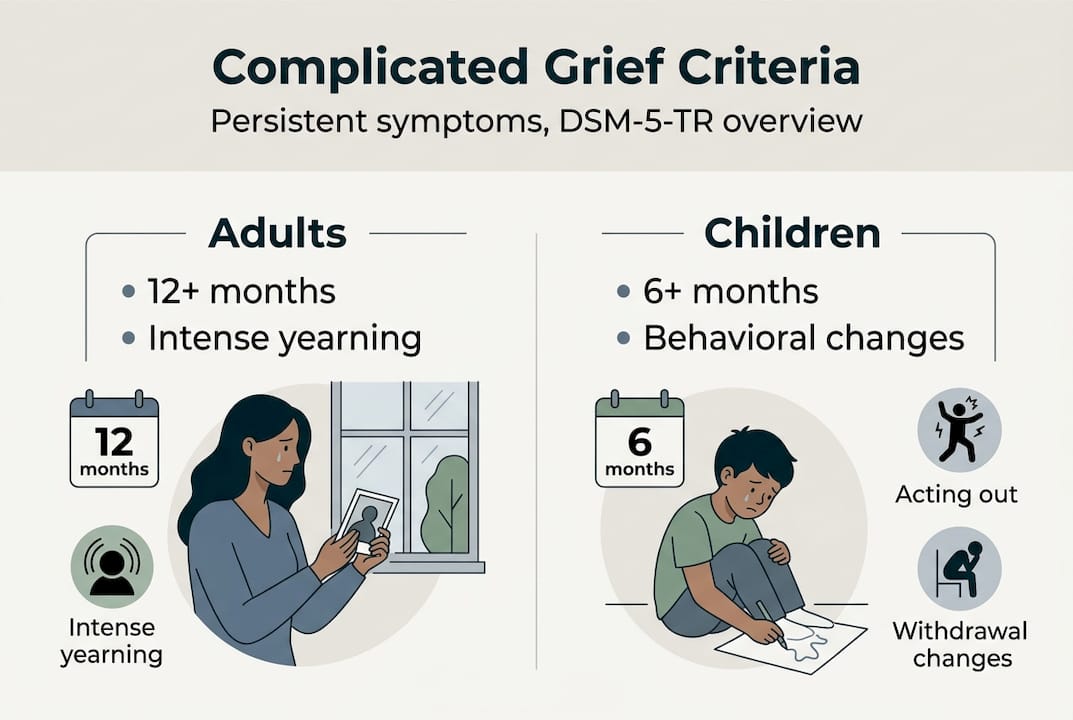
Here is a quick look at how complicated grief compares to what most people experience:
| Feature | Healthy grief | Complicated grief (PGD) |
|---|---|---|
| Duration | Gradually improves | Persists beyond 12 months (adults) |
| Daily function | Mostly maintained | Significantly impaired |
| Emotional intensity | Waves of sadness | Constant, overwhelming pain |
| Acceptance | Builds over time | Continuous disbelief |
| Future outlook | Hope returns | Feels meaningless or impossible |
Core symptoms of complicated grief include:
- Intense yearning for the person who died, almost every day
- Identity disruption, feeling like part of yourself died with them
- Persistent disbelief that the loss actually happened
- Avoidance of reminders, or the opposite, obsessive focus on them
- Emotional numbness or feeling disconnected from life
- Difficulty finding meaning or purpose going forward
- Deep loneliness, even when surrounded by people
You can read more about complicated grief explained to understand how these symptoms show up in real life. Prevalence is higher after sudden, violent, or unexpected losses, which is an important factor for anyone who has lost someone to suicide, accident, or homicide.
Complicated grief vs. normal grief, depression, and PTSD
One of the most important things to understand is that complicated grief is not the same as depression or PTSD, even though they can look similar on the surface. Misidentifying the condition leads to the wrong treatment, which means people suffer longer than they need to.
Normal grief adapts over time. The pain is real, but it gradually becomes less sharp as you integrate the loss into your life. Complicated grief stays intense and prevents that integration from happening. Distinguishing complicated grief from other conditions requires looking at what is driving the distress.
Here is how the three conditions differ:
| Condition | Core experience | Key feature |
|---|---|---|
| Complicated grief | Persistent, disabling grief | Yearning, identity loss, stuck in loss |
| Depression | Generalized sadness and anhedonia | Loss of pleasure in most activities |
| PTSD | Fear-based responses to trauma | Hypervigilance, flashbacks, avoidance of threat |
As research on differentiating grief from depression and PTSD makes clear, complicated grief is distinct from both. Depression involves a broad loss of pleasure and motivation across all areas of life. PTSD is rooted in fear and threat responses. Complicated grief is specifically tied to the loss itself, with the person unable to accept or integrate it.
Some key patterns that maintain complicated grief include:
- Maladaptive thoughts like “I can never be happy without them” or “Moving on means betraying them”
- Avoidance behaviors that prevent processing the reality of the loss
- Memory and meaning issues that make it hard to form a new sense of self
There is a real risk of overpathologizing grief, meaning labeling normal mourning as a disorder. But the evidence is equally clear that untreated complicated grief leads to poor long-term outcomes, including increased risk of suicide, physical illness, and social isolation. Exploring different grief therapy approaches can help you understand which path fits your specific experience.
Common signs and symptoms of complicated grief
Understanding the symptoms can help you recognize if your grief experience goes beyond expected mourning. These are not just feelings of sadness. They are specific patterns that disrupt your ability to live your life.
Here are the most common signs, based on DSM-5-TR symptom criteria:
- Persistent longing for the deceased, not just occasional sadness but an almost constant ache
- Preoccupation with the loss, where thoughts of the person dominate your day
- Difficulty accepting that the death actually happened, even months or years later
- Intense emotional pain, including bitterness, anger, or guilt tied directly to the loss
- Numbness or emotional detachment, feeling like you are watching your life from a distance
- Avoidance of reminders, such as places, people, or activities associated with the deceased
- Feeling that life is meaningless without the person, with no sense of purpose going forward
- Profound loneliness, even when you are not physically alone
- Identity disruption, not knowing who you are now that this person is gone
- Functional impairment, struggling to work, maintain relationships, or care for yourself
Two of the most telling markers are identity disruption and the inability to find meaning. Most people who experience normal grief find that their sense of self eventually rebuilds. In complicated grief, that rebuilding feels impossible.

Children show these symptoms differently. They may not talk about yearning or identity loss in those terms. Instead, watch for changes in play, regression to earlier behaviors like bedwetting or clinginess, declining school performance, or physical complaints like stomachaches with no medical cause.
Pro Tip: If you are unsure whether what you are feeling is complicated grief, ask your therapist about screening tools like the PG-13-R, a validated questionnaire designed for early identification. Early screening leads to faster, more targeted care. You can also explore resources on coping after loss as a starting point.
Effective treatments and finding help in Bergen County
If you see these signs in yourself or a loved one, knowing about treatment options and support is crucial. The good news is that complicated grief responds well to specific, targeted therapies. General counseling or antidepressants alone are often not enough.
The two most effective evidence-based treatments are:
- Prolonged Grief Therapy (PGT), also called Complicated Grief Treatment (CGT): A structured, 16-session protocol that helps you process the loss, rebuild your identity, and reengage with life. Large treatment effects have been documented, with effect sizes between d=1.4 and 1.7, which is considered very strong in clinical research.
- Grief-Focused Cognitive Behavioral Therapy (CBT): Targets the maladaptive thoughts and avoidance behaviors that keep grief stuck. Available in both individual and group formats.
Group therapy deserves special mention. It is cost-effective, reduces isolation, and provides peer support from others who genuinely understand the experience. Research shows group formats are particularly helpful for older adults who may have lost a spouse or long-term partner.
Pro Tip: When interviewing a potential therapist, ask directly: “Do you use Prolonged Grief Therapy or Grief-Focused CBT?” A therapist who specializes in grief will know exactly what you mean. General talk therapy has its place, but complicated grief needs a specialized approach.
For Bergen County residents, here is how to find finding specialized care and local support:
- Browse Bergen County grief therapy options for providers trained in PGT and CGT
- Use the APA referral tools at APA Prolonged Grief Disorder Resources to locate certified specialists
- Join a grief support group for community connection alongside individual therapy
- Talk to your primary care physician about local mental health referrals
- Learn practical strategies through resources on managing grief locally
Knowing how to find a grief therapist in your area is the first concrete step toward healing.
Why recognizing complicated grief early matters for healing
Here is something most people do not hear enough: time alone does not heal complicated grief. That is not pessimism. That is the clinical reality. Complicated grief is not a phase that passes if you are patient enough. Without targeted intervention, symptoms tend to persist and compound, affecting your physical health, your relationships, and your sense of self.
One of the biggest problems we see is misdiagnosis. People with complicated grief are often told they are depressed or anxious, given a general prescription, and sent on their way. The treatment does not fit the condition, so it does not work, and the person concludes that nothing can help them. That conclusion is wrong, but it is understandable given the gap in care.
Early identification using validated tools like the PG-13-R changes this trajectory. When complicated grief is caught early and treated with the right approach, people regain their ability to connect, find meaning, and build a life that honors the person they lost without being consumed by that loss.
Community matters too. Isolation is both a symptom and a driver of complicated grief. Connecting with others who understand the experience, whether in a support group or through a skilled therapist, creates the relational foundation that healing requires. Exploring grief therapy techniques can give you a clearer picture of what that process actually looks like.
Connect with expert grief support in Bergen County
If what you have read here resonates with you or someone you love, please know that specialized help is available and it works.

At bergencountytherapist.com, Dr. Stephen Oreski and his team offer personalized care for people navigating complicated grief. Whether you are looking for grief therapy support through individual sessions, the connection of a local support group, or the focused attention of one-on-one therapy, there is a path forward designed for your specific experience. You do not have to keep waiting for time to do what only the right support can. Reach out today for a free consultation and take the first step toward healing.
Frequently asked questions
How long does complicated grief last?
In adults, complicated grief is diagnosed when symptoms persist for more than 12 months after a loss. In children, the threshold is more than 6 months, reflecting their different developmental timelines.
What is the main difference between complicated grief and depression?
Complicated grief centers on persistent yearning and feeling trapped in the loss itself, while depression brings a general loss of pleasure and motivation across all areas of life, not just around the deceased.
Can children experience complicated grief?
Yes. Children can develop complicated grief when intense symptoms last more than 6 months, and they often show it through changes in play, regression, school difficulties, or unexplained physical complaints rather than verbal expressions of yearning.
What treatments work best for complicated grief?
The most effective therapies are Prolonged Grief Therapy and Grief-Focused Cognitive Behavioral Therapy, both of which show large clinical effects and are specifically designed for this condition rather than general grief or depression.
Where can I find complicated grief help in Bergen County?
Start with specialized grief therapists trained in PGT or CBT, explore local support group options, or ask your primary care physician for a referral to a mental health provider with grief expertise in Bergen County.