

TL;DR:
- Consent education is an ongoing, layered process starting in early childhood and evolving through adolescence.
- Effective programs teach boundaries, communication skills, digital safety, and include trauma-informed delivery.
- Long-term success depends on community buy-in, cultural sensitivity, and consistent, high-quality implementation.
Most people picture consent education as a single awkward talk somewhere in middle school, usually sandwiched between a film strip and a fire drill. That mental image is not just outdated; it misses the entire point. Modern consent education is an ongoing, layered process that begins in early childhood and evolves through adolescence, teaching far more than a simple “yes or no.” Recent evidence shows that interactive, developmentally appropriate programs improve decision-making, reduce harmful myths, and build the kind of relational skills that last a lifetime. This guide walks through what consent education actually is, how effective programs are structured, what the research says, and how you can apply it at home or in your classroom.
Table of Contents
- What is consent education and why does it matter?
- Key components of effective consent education
- What research shows: Outcomes and challenges
- Practical strategies for parents and educators
- A fresh perspective: Why consent education must go beyond ‘yes or no’
- Support for families and educators: Next steps
- Frequently asked questions
Key Takeaways
| Point | Details |
|---|---|
| Comprehensive approach | Effective consent education uses interactive, age-appropriate, and ongoing methods. |
| Measured outcomes | Programs show improved understanding and reduced harmful beliefs when well implemented. |
| Addressing challenges | Community dialogue and trauma-informed strategies help overcome controversy and resistance. |
| Role of families | Parent involvement and open conversations are essential to successful consent education. |
| Beyond verbal cues | Real consent skills must include self-advocacy, emotional intelligence, and cultural awareness. |
What is consent education and why does it matter?
Consent education is the practice of teaching people to understand, communicate, and respect personal boundaries across all types of relationships. That includes friendships, family dynamics, and online interactions, not just romantic or sexual situations. Framing it this way matters, because when children learn to honor boundaries in everyday life, the skills transfer naturally to more complex situations as they grow.
The goals of consent education are clear and practical:
- Prevent abuse by giving children language and awareness before harmful situations arise
- Build healthy relational skills such as listening, empathy, and assertiveness
- Empower speaking up so young people know they have the right to say no and that others’ boundaries deserve the same respect
- Correct misconceptions including the outdated “no means no” framing, which has largely been replaced by an affirmative “yes means yes” standard that emphasizes enthusiastic, ongoing agreement
One crucial point: age-appropriate curricula with modules on consent skills, healthy relationships, and bystander intervention sit at the center of effective consent education. This is not a lecture; it is a skill-building process.
The connection to violence prevention is significant. Children who learn to recognize and name boundary violations are better equipped to disclose abuse, seek help, and support peers. For children who have already experienced trauma, this education intersects directly with healing, which is why trauma therapy is sometimes a meaningful companion to school-based consent programs.
Key components of effective consent education
Knowing why consent education matters is one thing. Knowing what a well-built program actually looks like is another. The most effective frameworks share a clear set of components.
| Component | What it involves | Why it matters |
|---|---|---|
| Interactive lessons | Role-play, discussion, scenarios | Builds practical skills, not just knowledge |
| Bystander training | How to intervene safely | Extends responsibility beyond oneself |
| Digital safety modules | Online boundaries, sharing images | Addresses modern risks |
| Responding to disclosures | Scripts for listening, reporting | Reduces shame and isolation |
| Parent resources | Take-home guides, family exercises | Reinforces messages at home |
| Facilitator training | Trauma-informed delivery | Ensures psychological safety |
Programs are also designed differently depending on age. Elementary-age children focus on body autonomy, naming feelings, and respecting personal space. Middle schoolers move into peer pressure, digital citizenship, and healthy vs. unhealthy relationship patterns. High school programs address more complex dynamics including power, gender norms, and bystander responsibility.

Research confirms that trauma-informed, structured programs with trained facilitators and meaningful parent involvement show the strongest outcomes. Fidelity, meaning consistent, high-quality delivery every time, is the factor that most predicts success. A program taught inconsistently or by an unprepared facilitator loses most of its impact. Understanding how child trauma therapy approaches integrate similar trauma-sensitive principles can help educators appreciate why that delivery quality matters so deeply.
Pro Tip: When evaluating a consent education program for your school or child, ask specifically whether facilitators receive ongoing training and whether the curriculum has been adapted for cultural and linguistic diversity. These two factors significantly predict whether a program actually changes behavior rather than just checking a box.
The role of trauma therapy is also worth understanding here. Some children enter these programs already carrying unprocessed experiences. Trauma-informed delivery means educators recognize distress signals, avoid re-traumatizing students, and know when to refer a child for additional support.
What research shows: Outcomes and challenges
The evidence base for consent education has grown substantially in recent years. A French CapCons pilot found improved consent understanding and reduced rape myths after program participation. Studies in Nigeria and China showed higher sexual and reproductive health knowledge along with sustained behavior change that extended months beyond the program itself. Taken together, these findings suggest that well-run programs produce real-world shifts, not just quiz scores.
Here is a quick summary of what research consistently finds:
- Knowledge improves across virtually all age groups after structured programs
- Harmful myths decrease, particularly beliefs that victims are responsible for their own abuse
- Decision-making improves, especially when programs include scenario-based practice
- No backfire effects have been observed in well-run programs, meaning consent education does not make risky behavior more likely
That last point deserves emphasis, because it addresses one of the most common objections from worried parents.
However, real-world implementation faces genuine obstacles. Some parents and educators view consent curricula as age-inappropriate or politically charged. Religious objections are common in some communities, and critics sometimes argue that consent-focused curricula miss the bigger picture, particularly when discussions of marriage, family values, or specific cultural norms are excluded. These concerns are legitimate and deserve respectful dialogue rather than dismissal.
“Long-term benefits depend on program fidelity and whole-school or community buy-in. Isolated lessons do not produce lasting change.”
Community dialogue is not just a nice idea; it is a practical necessity. Schools that invite parents into curriculum reviews, offer transparent materials, and create space for questions tend to implement programs with far less resistance. For families navigating the emotional side of these conversations, recognizing trauma in children is a useful starting point for understanding why some students respond to these topics with heightened anxiety or withdrawal.
Practical strategies for parents and educators
Evidence and frameworks are only useful when they translate into real conversations. Here is a step-by-step approach you can start using right now.
- Start small and early. With young children, use everyday moments: talk about personal space, ask before hugging relatives, and name the feeling of discomfort when someone pushes past a boundary.
- Use age-appropriate language. Preschoolers understand “your body belongs to you.” Tweens can handle conversations about pressure and the difference between peer encouragement and coercion.
- Invite questions without judgment. Create a household norm where any question gets a thoughtful answer. Children who feel safe asking you will come to you when something feels wrong.
- Collaborate with schools. Ask your child’s teacher or counselor what consent-related topics are covered and how you can reinforce them. Program effectiveness improves when parent involvement is part of the design.
- Integrate media literacy. Watch movies or social media content together and ask questions like, “Did that character ask before doing that?” or “What would you have done in that situation?” These conversations build critical thinking in context.
- Address gender norms directly. Comprehensive approaches that address agency and gender norms, especially for boys, show stronger long-term outcomes. Talk openly with all children about what respect looks like regardless of gender.
Pro Tip: For teens, tie digital consent to real scenarios they are already navigating, like screenshotting messages, tagging friends in photos, or sharing content. Ask, “Did you get permission before posting that?” It normalizes checking in without lecturing. Mindfulness and trauma healing techniques can also help teens regulate the anxiety that sometimes arises during these conversations.
A fresh perspective: Why consent education must go beyond ‘yes or no’
After years of working with families and young people navigating trauma and relational harm, one thing stands out clearly: most consent programs still focus too narrowly on verbal cues. “Did you say yes? Did they say no?” These are important questions, but real-life boundaries are far more layered than a spoken word.
A child who has been taught to suppress their feelings, or who has grown up in a household where their preferences were routinely dismissed, may not even know how to recognize their own discomfort. Teaching them to say “yes” or “no” without addressing emotional literacy or agency first is like teaching someone to swim without letting them feel the water.
Truly effective consent education builds lifelong skills. That means weaving in conversations about gender roles, digital citizenship, self-advocacy, and emotional intelligence. It means educators and caregivers modeling respectful boundary-setting in their own behavior, not just delivering a lesson and moving on. Children learn more from what they observe than what they are told.
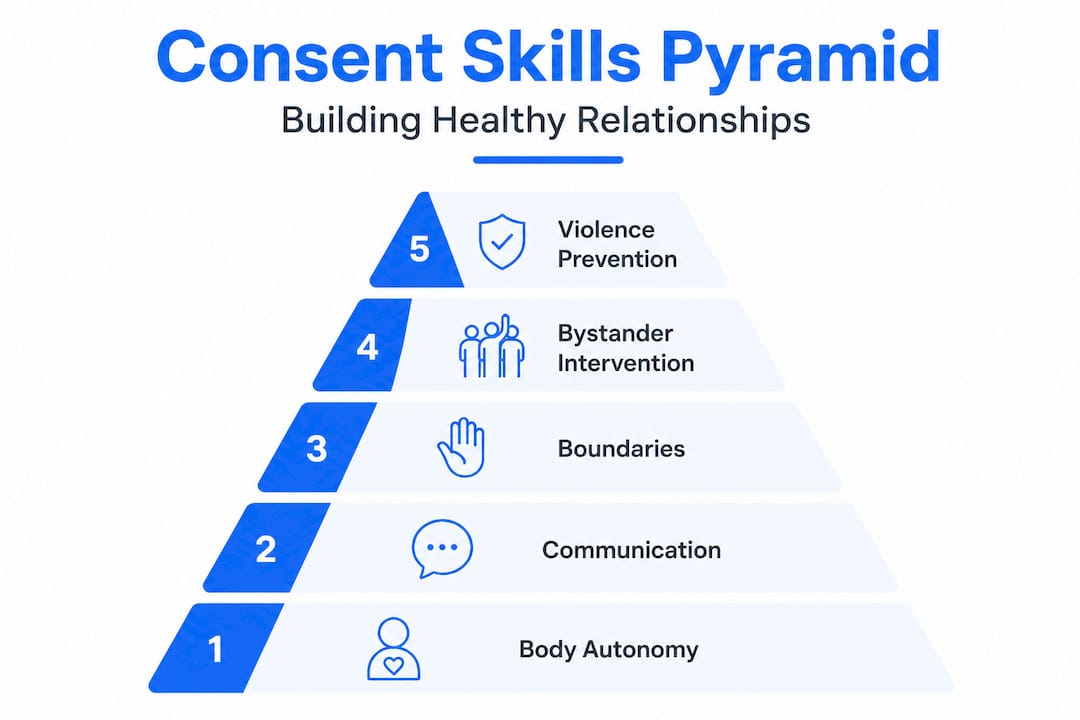
A trauma-informed lens matters here more than people realize. Some children have already experienced boundary violations before they ever enter a classroom lesson. Meeting them where they are, without assumptions or one-size-fits-all scripts, is what makes education feel safe rather than threatening. A broader trauma healing guide can help families and educators understand what that kind of sensitivity looks like in practice.
The bottom line is this: the best violence prevention is not a lesson about saying yes or no. It is a culture of ongoing, honest communication built by adults who take boundaries seriously in every part of a child’s life.
Support for families and educators: Next steps
Consent education opens important conversations, and sometimes those conversations surface things that need more support than a classroom or kitchen table can provide.

At Bergen County Therapist, Dr. Stephen Oreski and his team offer compassionate, individualized support for children, teens, and families navigating the emotional landscape that consent education often brings up. Whether a child needs help processing past experiences, a family wants to strengthen communication, or an educator needs guidance on trauma-sensitive approaches, professional therapy creates a safe space for that work. Explore childhood trauma therapy options or learn how family communication therapy can support ongoing, healthy dialogue at home. A free consultation is available to help you find the right fit.
Frequently asked questions
At what age should consent education start?
Consent education can begin as early as preschool, using simple lessons about personal space, body autonomy, and listening, since age-appropriate curricula with consent skills modules are effective at these early stages.
Does consent education increase risky behavior?
No. Studies consistently show no backfire effects in well-run programs; most children and teens actually develop healthier knowledge and attitudes after participating.
How is consent education different from sex education?
Consent education specifically focuses on mutual respect, communication, and boundaries across all kinds of relationships, while sex education covers a broader range of topics including biology, reproduction, and physical health.
What if I disagree with the values taught in consent curricula?
Many programs offer opt-out or adaptation options, and some parents and educators with religious or cultural concerns have successfully worked with schools to find approaches that feel aligned with their values.
How can I talk to teens about digital consent?
Ground the conversation in real scenarios your teen is already experiencing, such as sharing photos, tagging friends, or forwarding messages, and ask whether permission was given before any of that content was shared.
Recommended
- Understanding peer pressure: Strategies for teens and parents
- How to Talk to Your Child About LGBTQ People – Dr. Stephen Oreski & Associates
- Teen Counseling: A Guide by Dr. Oreski (2025)
- How to Discuss Gender Identity With Your Child – Dr. Stephen Oreski & Associates
- Tipuri de drepturi ale copilului: ghid esențial pentru părinți