

TL;DR:
- Process groups focus on real-time interactions to foster emotional growth and relationship skills.
- They are as effective as individual therapy for issues like anxiety, depression, and social isolation.
- Suitable for individuals and families seeking deeper connection, self-awareness, and improved communication.
Most people picture group therapy as a circle of strangers awkwardly sharing their problems while a therapist nods along. That picture could not be further from the truth, especially when it comes to process groups. Research confirms that group therapy, including process-oriented formats, is as effective as individual therapy for conditions like anxiety and depression. This guide walks you through exactly what process groups are, how they work, who benefits most, and why Bergen County residents are finding them to be one of the most powerful tools available for lasting personal growth and genuine community connection.
Table of Contents
- What is a process group?
- How process groups promote growth and connection
- Process groups vs. skills-based therapy
- Who benefits from process groups?
- Why process groups succeed where individual therapy sometimes falls short
- Explore process groups and community therapy options in Bergen County
- Frequently asked questions
Key Takeaways
| Point | Details |
|---|---|
| Process groups defined | Process groups focus on real-time discussion and relational learning for personal growth. |
| Group cohesion matters | Strong group bonds are tied to better therapy outcomes for anxiety and depression. |
| Balancing approaches | Combining process and skills-based methods creates more effective group therapy. |
| Who should join | Those seeking connection, healing, and improved relationships are ideal process group participants. |
| Local options available | Bergen County offers a range of group therapy opportunities to support individuals and families. |
What is a process group?
Process groups are a specific type of group therapy where the focus is not on learning a skill or following a curriculum. Instead, the real work happens through the interactions among members themselves. Think of it as a living laboratory for relationships, where what unfolds between people in the room becomes the material for growth and healing.
Here is how a typical process group works in practice:
- A trained therapist guides the group but does not dominate the conversation
- Members share what they are experiencing emotionally, both inside and outside the group
- The group reflects on patterns, reactions, and dynamics that emerge in real time
- Feedback flows between members, not just from therapist to client
- Sessions often feel like honest conversations more than structured lessons
Common goals include building self-awareness, improving how you communicate in relationships, reducing the isolation that comes with anxiety or depression, and experiencing a sense of genuine community support. Process-oriented group therapy is particularly effective for interpersonal issues such as social anxiety, making it a strong fit for people who find that their mental health challenges play out most clearly in how they relate to others.
Pro Tip: When evaluating a process group, ask the group leader how they create psychological safety. The best facilitators actively encourage honest discussion while setting clear boundaries around respect and confidentiality. If a leader cannot answer that question clearly, keep looking.
How process groups promote growth and connection
With a clear picture of what process groups are, it is worth getting specific about the benefits they offer, particularly for individuals and families in Bergen County looking for more than symptom relief.
One of the most significant drivers of progress in a process group is group cohesion, which simply means the sense of trust, belonging, and mutual commitment that develops among members over time. Research shows that cohesion in group therapy predicts positive outcomes, especially for interpersonal issues like social anxiety. When you genuinely feel that you belong to a group and that others understand your experience, you are far more likely to take the relational risks that lead to real change.
“Cohesion in group therapy predicts positive outcomes, especially for interpersonal issues like social anxiety.” — Research summary from current clinical literature
Here is a closer look at the concrete benefits members typically report:
- Decreased anxiety and depression through regular, structured social connection
- Improved mood from the validation of knowing others share similar struggles
- Stronger relationships built by practicing honest communication in a safe setting
- Reduced isolation as members experience genuine acceptance from peers
- Greater self-awareness through feedback that mirrors blind spots you cannot see on your own
Families can also use process-based formats to strengthen how they communicate with each other. Understanding the benefits of group therapy for your specific situation, including how it might address anxiety patterns within family systems, can help you decide whether a process group or another format is the right next step. For those whose primary concern centers on worry and fear, group therapy for anxiety offers targeted support in a community setting.

Process groups vs. skills-based therapy
Many options exist for group therapy, so understanding the differences can help you find your best fit.
Skills-based groups are structured around teaching practical coping tools. You might learn breathing techniques, cognitive restructuring strategies, or specific frameworks for managing distress. These groups follow a curriculum, and every session has a clear learning objective. Process groups, by contrast, are fluid. The content of each session is generated by the members themselves, and the therapist’s job is to help the group make meaning from what emerges.
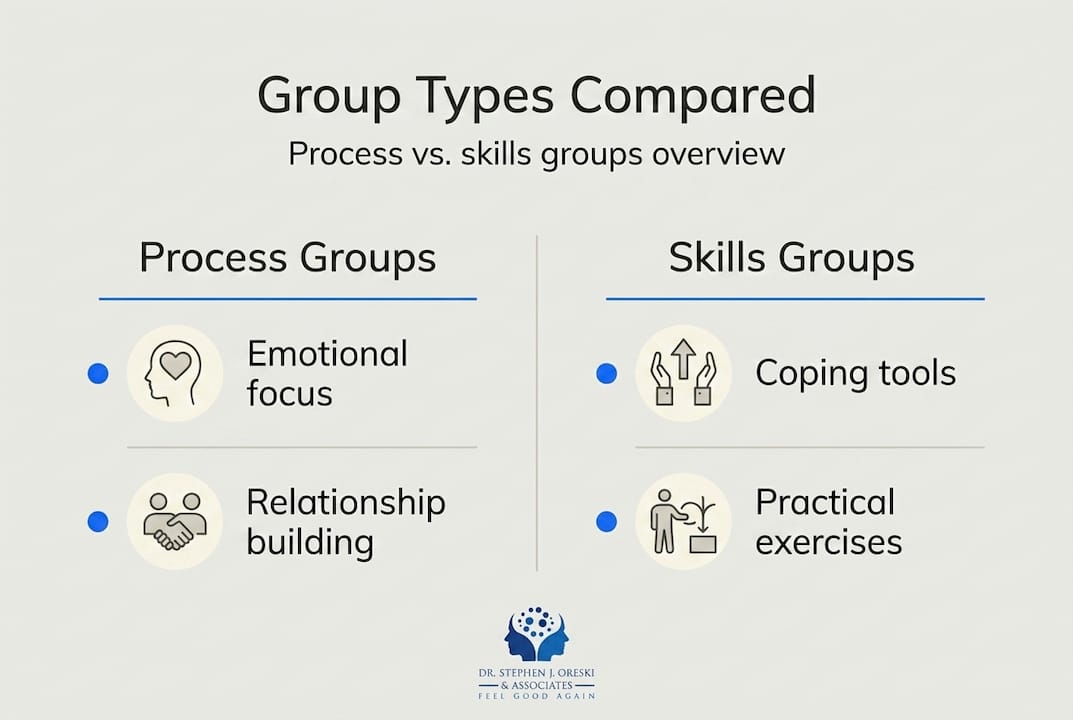
Here is a side-by-side comparison:
| Feature | Process groups | Skills-based groups |
|---|---|---|
| Focus | Emotional experience and relationships | Practical coping methods |
| Structure | Open-ended and member-driven | Curriculum-based |
| Best for | Deeper interpersonal change | Immediate tools and techniques |
| Therapist role | Facilitator and observer | Teacher and guide |
| Typical participants | Those wanting relational growth | Those needing structured skill building |
When should you choose one over the other? If you need immediate strategies for managing panic attacks or intrusive thoughts, a skills-based group gives you usable tools right away. If you want to understand why you keep repeating the same patterns in relationships, a process group offers something deeper. Experts recommend balancing pure process with skills integration for greater cohesion and better outcomes, because unprocessed emotions left entirely unaddressed can lead to acting out behaviors that undermine progress. Group supervision techniques and group therapy for trauma both illustrate how blending these approaches can produce more complete healing.
How to choose wisely:
- Identify whether your main need is immediate tools or deeper relational understanding
- Ask potential therapists how their group format handles emotional material
- Consider whether you have already done individual therapy and want a complementary experience
- Reflect on how comfortable you are with open-ended conversation versus structured learning
- Talk to a counselor about which format aligns with your specific goals
Pro Tip: Ask any therapist you are considering how their group integrates both process and skills elements. The best programs do not treat these as competing approaches but as complementary tools for the same goal.
Who benefits from process groups?
After comparing approaches, it is worth pinpointing who will thrive most in a process group setting.
Group therapy is highly effective for anxiety, depression, and interpersonal growth, especially when cohesion is strong. But the research findings are even more useful when applied to real situations.
| Who typically joins | Issues addressed | Expected outcomes |
|---|---|---|
| Adults feeling socially isolated | Anxiety, loneliness, low confidence | Increased connection and self-esteem |
| People with relationship difficulties | Communication struggles, conflict patterns | Improved relational skills |
| Families wanting better dynamics | Miscommunication, tension, boundary issues | Healthier and more honest interactions |
| Individuals in life transitions | Grief, career change, identity shifts | Clarity and community support |
You might especially benefit from a process group if several of the following ring true for you:
- You feel isolated even when surrounded by people
- You notice the same relationship patterns showing up repeatedly
- You want honest feedback from peers, not just a therapist
- You struggle to communicate your needs clearly
- You are managing anxiety or depression but want more than one-on-one sessions
- You feel ready to engage in community rather than work only in private
The benefits of group counseling extend beyond what any individual can build alone. Families, in particular, can use group therapy for family dynamics to shift longstanding patterns in a way that one-on-one sessions often cannot replicate.
Why process groups succeed where individual therapy sometimes falls short
Here is the perspective that most mainstream articles on this topic miss entirely: individual therapy, for all its value, has a structural limitation. It asks you to describe your relationships from memory, inside a room with only one other person. The therapist sees your report of how you relate to others, not the actual relating itself.
Process groups change that equation completely. When you get frustrated with another group member and say so, that is the therapy. When you notice yourself going quiet instead of speaking up, and the group names it, that is real-time relational feedback that no amount of talking about the past can replicate.
Conventional wisdom in mental health still leans heavily toward individual sessions because privacy feels safer. But for many people, private sessions keep them practicing self-awareness in isolation. Real change often requires observed experience, moments when someone else witnesses your pattern and reflects it back to you with care and honesty. That is exactly what a well-facilitated process group delivers.
The discomfort is real. Sitting with eight or ten people and sharing something vulnerable is harder than doing the same with one therapist behind a closed door. But that discomfort is precisely where the growth lives. Group therapy tips consistently emphasize one principle above all others: lean into the discomfort rather than retreat from it, because breakthroughs happen when you fully engage in the group process rather than observe it from a safe distance.
Explore process groups and community therapy options in Bergen County
You have learned what process groups are, how they compare to other formats, and who benefits most. Taking the next step does not have to feel overwhelming.
At Bergen County Therapist, Dr. Stephen Oreski and his team offer a range of group and individual therapy options designed to match your unique situation. Whether you are weighing individual vs. group counseling or looking for a process group that fits your schedule and goals, the practice provides free consultations to help you find the right path. Both in-person and online options are available, making it easier than ever to connect with a supportive community in Bergen County. Reach out today and take the first step toward the growth and connection you have been looking for.
Frequently asked questions
Is group therapy as effective as individual therapy?
Yes, group therapy is as effective as individual therapy for mental health issues including anxiety and depression, particularly in process-oriented formats.
What happens during a process group session?
Members share their experiences and emotional reactions, receive honest feedback from peers, and explore the group dynamics that emerge, all guided by a trained therapist.
Who can benefit most from joining a process group?
People managing anxiety or depression, seeking deeper connection, or wanting to improve their relationships benefit most, especially when group cohesion is strong.
How do process groups differ from skills-based groups?
Process groups focus on emotional interactions and relational patterns, while skills groups teach practical coping strategies, though balancing both approaches tends to produce the best outcomes.
Are process groups suitable for families?
Yes, families can participate in or benefit from process-based group formats to shift communication patterns and build healthier dynamics together.