

- Narcissism is a structured psychological pattern involving grandiosity, admiration needs, and empathy deficits that impair relationships. It manifests as grandiose or vulnerable types, requiring different approaches for recognition and treatment. While treatment can reduce symptoms through therapies like schema-focused therapy, progress is slow and depends on genuine motivation from the individual with NPD.
Narcissism is defined as a personality pattern involving grandiosity, an intense need for admiration, and a significant deficit in empathy that shapes how a person relates to everyone around them. Clinically, this pattern is recognized as Narcissistic Personality Disorder (NPD) when five or more of nine specific criteria are present in a pervasive, enduring way that causes real impairment. The DSM-5 sets this threshold deliberately high because explaining narcissism well means separating a diagnosable condition from ordinary selfishness or vanity. Resources like Simply Psychology and Psychology Today both emphasize that NPD is not a character flaw. It is a structured psychological pattern with identifiable causes, measurable effects on relationships, and evidence-based treatment options.
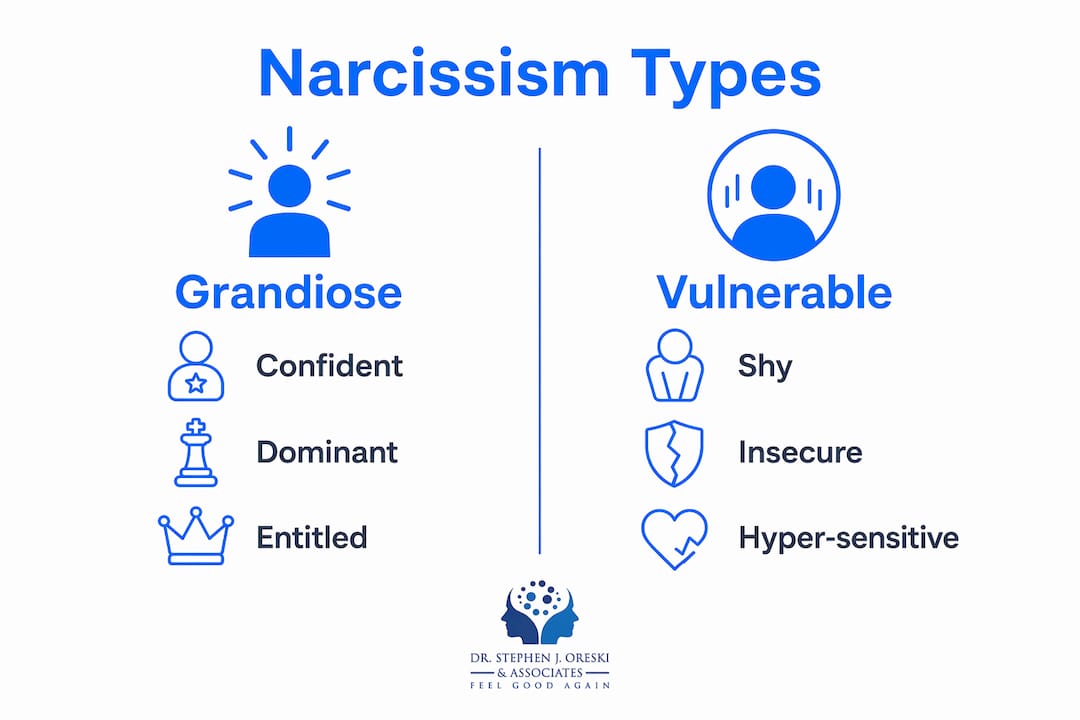
What are the main types of narcissism?
Not all narcissism looks the same, and that difference matters enormously in relationships. Clinicians recognize two primary presentations: grandiose narcissism and vulnerable narcissism. Both share the core features of entitlement and empathy deficits, but they express them in opposite ways.

| Feature | Grandiose narcissism | Vulnerable narcissism |
|---|---|---|
| Outward presentation | Confident, dominant, attention-seeking | Shy, withdrawn, hypersensitive |
| Response to criticism | Dismissive or aggressive | Shame, resentment, collapse |
| Social behavior | Openly entitled, seeks the spotlight | Covertly entitled, avoids exposure |
| Relationship pattern | Controls through dominance | Controls through guilt or victimhood |
Grandiose narcissism is the version most people picture: the loud, self-promoting person who expects special treatment and rarely apologizes. Vulnerable narcissism is subtler and often harder to recognize. A person with vulnerable narcissism may appear fragile or misunderstood, yet still exploit interpersonal relationships and react to perceived slights with intense, prolonged resentment.
Pro Tip: If your partner rarely takes responsibility but frames every conflict as something done to them, you may be seeing vulnerable narcissism rather than grandiose narcissism. The presentation differs; the relational damage does not.
Research confirms that different narcissistic presentations require tailored communication strategies and therapeutic approaches. Treating them as identical leads to misreading the behavior and responding in ways that escalate rather than resolve conflict.
How does narcissism develop?
Narcissistic traits do not emerge from a single cause. The developmental pathway involves an interaction of genetic, temperamental, and environmental factors that shape how a person learns to manage self-worth and relationships.
Key contributing factors include:
- Genetic and temperamental influences. Heritability studies suggest a meaningful genetic component to personality disorders, meaning some individuals are born with temperamental traits that increase vulnerability.
- Childhood neglect or emotional unavailability. When caregivers are inconsistent or emotionally absent, children may develop a grandiose self as a defense against an underlying sense of shame and worthlessness.
- Excessive or conditional praise. Parenting that ties love to achievement or appearance teaches children that their value is performance-based, which can produce the same split between inflated self-image and fragile inner identity.
- Cultural factors. Societies that reward status, individual achievement, and self-promotion over relational values create conditions in which narcissistic traits are reinforced rather than corrected.
No single factor produces NPD. The condition emerges when multiple influences converge over time, which is why two people raised in similar households can develop very different personality structures.
Why do narcissists struggle with empathy?
Empathy deficits sit at the center of every narcissistic relationship problem, but the science here is more specific than most people realize. Empathy has two distinct components: cognitive empathy, which is the intellectual ability to understand what another person feels, and affective empathy, which is the capacity to actually feel something in response to another person’s emotional state.
NPD involves deficits primarily in affective empathy, not cognitive empathy. Neuroimaging research shows reduced activation in the anterior insula and anterior cingulate cortex, brain regions associated with emotional resonance. This means a person with NPD can often read a room accurately and understand that someone is hurt. They simply do not feel moved by it.
This distinction explains a pattern that confuses many partners:
- The narcissistic person seems perceptive and even caring in the early stages of a relationship.
- Over time, their responses to your pain feel hollow or calculated rather than genuinely warm.
- Conflicts escalate because arguing facts alone triggers shame and devaluation cycles rather than resolution.
- Partners are left feeling unseen, even when the other person clearly understands what was said.
Empathy deficits in narcissism are clinically significant, differentiating emotional ‘feeling with’ from intellectual ‘understanding,’ which is often intact. — Psychanatomy Research Overview
The good news is that cognitive empathy can improve with therapy, and for some motivated individuals, emotional empathy develops later as a secondary gain from sustained therapeutic work.
How to identify narcissism in relationships
Recognizing narcissistic patterns in a relationship requires looking at behavior across multiple contexts over time, not reacting to a single difficult moment. Situational selfishness is human. Persistent, cross-situational patterns are clinically meaningful.
Common patterns to watch for include:
- Idealization followed by devaluation. A partner who initially treats you as exceptional but gradually becomes critical, dismissive, or contemptuous is showing one of the most consistent narcissistic relationship cycles.
- Entitlement and lack of reciprocity. Relationships feel one-directional. Your needs are minimized or reframed as burdens.
- Controlling behavior. Control may be overt (monitoring, criticism) or covert (guilt, emotional withdrawal, playing the victim).
- Exploitation without awareness. The person uses your resources, time, or emotional labor without recognizing it as taking.
You can learn more about recognizing these patterns across different relationship types to build a clearer picture of what you are experiencing.
Pro Tip: Collect specific examples across different situations before drawing conclusions. Effective assessment of narcissism requires a pattern across multiple life contexts, not a single incident, to distinguish NPD from situational stress.
The emotional toll on partners is real. Chronic exposure to idealization-devaluation cycles produces self-doubt, anxiety, and a distorted sense of what healthy relationships feel like. Firm, consistent boundaries are not cruelty toward a narcissistic partner. They are a requirement for your own psychological stability.
What treatment options exist for NPD?
Treating NPD is possible, but it is slow, nonlinear, and requires genuine motivation from the person with the disorder. Two evidence-based approaches have the strongest research support.
A randomized controlled trial of 114 participants with a 12-month follow-up compared schema-focused therapy (SFT) and the unified protocol (UP). Both reduced NPD symptoms, but they targeted different clusters. SFT was more effective at reducing grandiosity, while UP targeted vulnerability and emotional dysregulation more directly. This means the type of narcissism matters when choosing a therapeutic approach.
| Therapy | Best suited for | Primary mechanism |
|---|---|---|
| Schema-focused therapy (SFT) | Grandiose narcissism | Restructures core maladaptive schemas |
| Unified protocol (UP) | Vulnerable narcissism | Targets emotional dysregulation |
| Long-term insight-oriented therapy | Both presentations | Reduces defenses, builds relational stability |
Long-term insight-oriented therapy can produce reduced narcissistic defenses, improved empathy, and more stable relationships for motivated patients. The therapeutic alliance is difficult to build because grandiosity functions as a defense against the vulnerability that therapy requires. Progress is real, but it demands patience from everyone involved. You can explore therapy options for NPD in more detail to understand what realistic outcomes look like.
Key takeaways
Narcissism is a structured psychological pattern, not a character flaw, and understanding its clinical features, presentations, and treatment options is the most direct path to protecting your own mental health in a relationship affected by it.
| Point | Details |
|---|---|
| NPD has a clinical threshold | Diagnosis requires five or more of nine DSM-5 criteria in a pervasive, enduring pattern. |
| Two distinct presentations exist | Grandiose and vulnerable narcissism share core traits but require different responses and therapies. |
| Affective empathy is the core deficit | Narcissists often understand emotions intellectually but do not feel them, which explains the hollow quality of their responses. |
| Patterns matter more than incidents | Identifying narcissism requires consistent behavior across multiple contexts, not a single selfish act. |
| Treatment is possible but slow | Schema-focused therapy and the unified protocol both reduce symptoms; progress requires motivation from the person with NPD. |
What I’ve learned from working with narcissism in relationships
After years of working with individuals and couples affected by narcissistic dynamics, the single most important shift I see clients make is this: they stop trying to explain themselves more clearly and start paying attention to the pattern instead.
Most people caught in a relationship with a narcissistic partner believe that if they could just find the right words, the right argument, or the right moment, their partner would finally understand. That belief keeps them stuck. NPD behaviors originate from deep self-protective systems, not from a failure of communication on your part. You cannot logic someone out of a defense they built before they were old enough to choose it.
What I recommend is this: recognize the pattern, name it for yourself, and set boundaries that protect your psychological stability, regardless of whether your partner changes. Hope for change is reasonable. Waiting for change before taking care of yourself is not.
Change does happen for motivated individuals in good therapy. I have seen it. But it is slow, and it requires the person with NPD to want something different for themselves, not just to keep a relationship from ending. If you are the partner, your job is not to be the catalyst for their growth. Your job is to stay grounded in your own reality.
— Dr Stephen Oreski LCSW
Ready to get support from a therapist who understands narcissistic dynamics?
If this article has helped you recognize patterns in your relationship or in yourself, the next step is to speak with a therapist who specializes in these dynamics. At Bergencountytherapist, Dr. Stephen Oreski and his team work with individuals and couples navigating the specific challenges that narcissistic traits create in relationships and personal growth.

Whether you are working through the effects of a narcissistic relationship on your own sense of self or trying to rebuild trust and communication as a couple, personalized support makes a measurable difference.
Explore individual therapy for personal healing or learn how couples therapy can help you and your partner build a healthier foundation. Free consultations are available to help you find the right fit.
FAQ
What is narcissistic personality disorder?
Narcissistic personality disorder (NPD) is a clinical diagnosis defined by a pervasive pattern of grandiosity, need for admiration, and lack of empathy, meeting at least five of nine DSM-5 criteria. It is not the same as ordinary selfishness or high self-confidence.
How do I know if my partner is a narcissist?
Look for persistent patterns across multiple situations: idealization followed by devaluation, entitlement, lack of reciprocity, and controlling behavior. A single difficult episode is not enough to identify narcissism. Consistent patterns over time are the clinical signal.
Can narcissism be treated?
Yes. Schema-focused therapy and the unified protocol both reduce NPD symptoms in clinical trials. Progress is slow and requires genuine motivation from the person with NPD, but long-term therapy can improve empathy and relational stability.
What is the difference between grandiose and vulnerable narcissism?
Grandiose narcissism presents as confident, dominant, and openly entitled. Vulnerable narcissism appears shy and hypersensitive but carries the same core entitlement and empathy deficits. Both affect relationships significantly, but they require different therapeutic and communication approaches.
Why does a narcissist seem caring sometimes?
Narcissists often have intact cognitive empathy, meaning they can intellectually understand emotions, while affective empathy is impaired. This produces moments of apparent understanding that feel hollow over time because they are not accompanied by genuine emotional resonance.