

- Resilience is a skill that can be developed through intentional practice and learned behaviors, not an innate trait.
- Building resilience involves cultivating emotional flexibility, social support, and adaptive coping strategies over time.
Resilience is not something you either have or don’t. Many people assume that some individuals are simply wired to handle stress, loss, or adversity better than others, as if emotional toughness is a personality type handed out at birth. The truth is far more encouraging. Resilience can be strengthened through learned behaviors and intentional practice, which means that wherever you are right now, growth is possible. This guide breaks down what resilience building actually is, how it works in everyday life, and what concrete tools can help you move forward.
Table of Contents
- Understanding resilience building
- Core components and paths to resilience
- How resilience building works in real life
- Who benefits from resilience building?
- Resilience is not about never feeling pain: What most people get wrong
- Where to get support for resilience building in Bergen County
- Frequently asked questions
Key Takeaways
| Point | Details |
|---|---|
| Resilience is learnable | You can build resilience with practice and the right strategies, regardless of your starting point. |
| Multiple paths exist | Recovery, bouncing back, and adapting with support are all valid resilience outcomes. |
| Practical steps matter | Frameworks like V→BAM and therapy-backed methods turn resilience into everyday habits. |
| Facing feelings is part | Emotional pain is normal—resilience means managing, not avoiding, difficult emotions. |
Understanding resilience building
Resilience building is the active process of developing your ability to adapt when life gets hard. Most people picture resilience as simply snapping back after something bad happens, like a rubber band returning to its original shape. But that image misses the fuller picture. Resilience is the process of adapting successfully to adversity, not a fixed personality trait you either possess or lack.
Think of it less like a built-in feature and more like a muscle. You train it deliberately, and it grows stronger over time with the right conditions. This matters because it shifts the conversation from “Am I a resilient person?” to “What am I doing to build resilience?”
“Resilience is not about avoiding stress or difficulty. It is about developing the tools, relationships, and inner resources to navigate difficulty more skillfully.”
Research confirms this view. Resilience is a dynamic process shaped by both personal qualities and social resources, meaning your environment, relationships, and support systems all play a role alongside your internal strengths.
Key ways resilience shows up in real life include:
- Regulating strong emotions without shutting down
- Asking for help when you need it
- Finding meaning or learning in difficult situations
- Recovering gradually (not necessarily instantly) from setbacks
- Using past experiences to respond more flexibly in the future
If you’ve experienced significant trauma or loss, understanding trauma therapy models can help clarify how professional support fits into the resilience-building process.
Core components and paths to resilience
Defining resilience is just the start. Next, let’s look at the building blocks and how experts approach strengthening resilience over time.
Resilience is not one thing. It is composed of overlapping factors that experts organize differently depending on their theoretical model. Resilience theories disagree on definitions and methods, with some focusing on personal traits, others on context, relationships, and adaptation over time. Here is a quick comparison of the major frameworks:
| Framework | Focus | Key idea |
|---|---|---|
| Trait model | Internal characteristics | Some people are more naturally resilient |
| State model | Current capacity | Resilience fluctuates based on context |
| Process model | Development over time | Resilience grows through experience and support |
Each model offers something useful. The process model is especially relevant here because it treats resilience as learnable and improvable, not fixed.
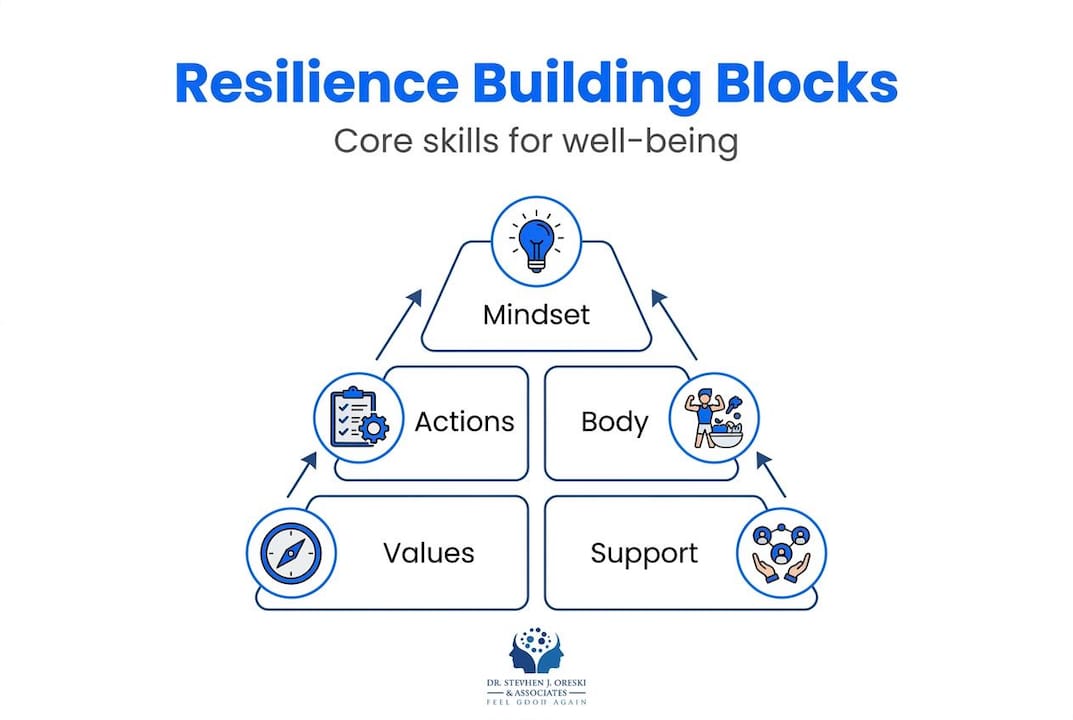
The main building blocks of resilience include:
- Values — knowing what matters most to you, which guides decisions under pressure
- Body awareness — using physical practices like sleep, movement, and breathing to regulate stress
- Actions — taking small, purposeful steps even when motivation is low
- Mind — noticing and challenging unhelpful thought patterns
- Social support — maintaining relationships that provide safety and encouragement
Pathways to building resilience in trauma recovery often address all five of these areas together rather than focusing on just one. Similarly, group therapy for anxiety can strengthen resilience by building the social support component in a structured, safe environment.
Pro Tip: Start with just one building block. If your social support feels thin right now, reaching out to one trusted person this week is a real resilience-building action, not a small thing.
How resilience building works in real life
Understanding frameworks is helpful, but what does resilience building look like in daily practice? Here’s how it shows up in real life and therapy.
One well-known approach is the APA’s V→BAM framework (Values, Body, Actions, Mind), which organizes resilience skills into four interconnected areas that reinforce each other. When you work on your body through sleep and exercise, your mind becomes easier to manage. When your actions align with your values, you feel more grounded even during stress.
An important reality check: emotional pain after adversity is normal, and resilience is about learning to respond to those feelings productively, not suppressing them or pretending everything is fine. This distinction is critical. Many people think that feeling overwhelmed, sad, or anxious means they are failing at resilience. It does not. It means they are human.
| Resilience myth | What’s actually true |
|---|---|
| Strong people don’t struggle | Struggle is part of the process |
| Resilience means being positive | It means being flexible and honest |
| Recovery should be fast | Gradual healing is completely valid |
| You need to figure it out alone | Social support is a core component |
Everyday practices that support resilience building include:
- Setting realistic expectations for yourself rather than demanding perfection
- Building a small daily ritual that grounds you, like a short walk, a breathing exercise, or journaling
- Using emotional regulation strategies to process difficult feelings without avoiding them
- Accessing psychotherapy for emotional well-being when you need structured guidance
- Practicing stress management tools that work for your specific situation
Pro Tip: Resilience-building is not a weekend project. Research consistently shows that small, consistent practices over weeks and months produce more lasting change than one-time intensive efforts.
Who benefits from resilience building?
Seeing how resilience building works leads naturally to the key question: who stands to gain the most from these practices?
The honest answer is everyone, but certain groups see especially significant benefits. Children navigating school pressure, social stress, and family challenges can build lifelong emotional tools early. Teens facing identity development and peer pressure benefit from structured resilience programs. Adults managing work demands, relationship strain, or major life transitions can strengthen their coping capacity at any stage of life.
No one is too old or “too set in their ways” to grow. Research backs this up. School-based resilience programs show small but significant improvements in young people, though outcomes vary across individuals and intervention types. The same principle applies to adult programs: results differ by person, context, and the quality of support available, but growth is consistently possible.
People who stand to gain most from resilience-focused support include:
- Those navigating grief, loss, or sudden life changes
- Individuals living with anxiety, depression, or trauma history
- Caregivers and parents managing high-stress responsibilities
- Teens and young adults establishing adult identities
- Anyone who feels stuck in reactive patterns and wants to respond differently
Resources like tips for mental well-being and stress strategies for adults offer practical starting points for many of these groups.
Resilience is not about never feeling pain: What most people get wrong
Here’s what clinical practice teaches us over and over again: the people who struggle most with resilience are often not the ones who have experienced the most hardship. They are the ones who believe that feeling pain means something is wrong with them.
This belief is everywhere. Culture sends constant messages that strong, resilient people stay positive, keep moving, and don’t let things get to them. But that version of resilience is a performance, not a reality. Emotional pain after major adversity is normal, and genuine resilience is about navigating those feelings with skill, not avoiding them entirely.
What we’ve seen in therapy settings is that the most important shift isn’t learning a new technique. It’s giving yourself permission to feel hard things without interpreting that as failure. From there, everything else, the coping tools, the social support, the structured practices, can actually take hold.
The second misconception is that resilience is a solo achievement. In reality, community and connection are some of the strongest predictors of resilience outcomes. Learning better ways of coping with stress often happens in relationship with others, whether that’s a therapist, a group, or even a trusted friend.
Resilience is not emotional armor. It is emotional flexibility. That flexibility is built through experience, reflection, support, and the willingness to stay present even when things are uncomfortable.
Where to get support for resilience building in Bergen County
If you or someone you know in Bergen County wants professional guidance with resilience, here’s how to start.
Building resilience on your own is possible, but working with a skilled therapist accelerates the process significantly. A therapist can help you identify which building blocks are weakest for you personally and tailor strategies to your specific life circumstances.

At Bergen County Therapist, Dr. Stephen Oreski and his team offer a range of support options designed around your needs. Whether you prefer online therapy for its flexibility and privacy, or in-person sessions, you can explore the full range of psychotherapy options available. When you’re ready to take a concrete next step, starting therapy is straightforward, beginning with a free consultation to match you with the right support for where you are right now.
Frequently asked questions
Can resilience really be learned, or is it just something you’re born with?
Resilience is a skill set you can develop through intentional practice and learning, not just an innate trait. Resilience can be strengthened through learned behaviors, which means anyone can improve their capacity to adapt.
What’s the difference between resilience and just “bouncing back”?
Bouncing back is one way resilience shows up, but resilience also includes gradual recovery and long-term adaptation. Resilience includes recovery and adaptation through both personal qualities and social resources over time.
Do resilience programs work for adults as well as children?
Both adults and children can benefit from resilience-building programs, though individual outcomes vary. School-based interventions show positive but variable effects, and the core principles translate well to adult learning contexts.
Can therapy help with building resilience?
Yes, therapy provides structured strategies and personalized support for strengthening resilience in real, everyday situations. Evidence-based resilience training often includes formal programs that a therapist can adapt to your specific needs and goals.