

- Managing trauma triggers involves recognizing personal patterns and responding with grounding techniques to prevent escalation. Therapeutic approaches like TF-CBT and EMDR target underlying beliefs, providing long-term relief through consistent practice. Daily habits such as sleep, movement, and creating safe spaces support ongoing healing and resilience.
Trauma triggers are defined as sensory or emotional stimuli that prompt trauma-related memories and intense emotional reactions, often making the past feel present. Learning how to manage trauma triggers means building awareness of what sets off your responses and responding with intentional coping methods rather than being overwhelmed by them. Tools like trigger charts, grounding exercises, and trauma-focused therapies give you real control over your reactions. The strategies in this article draw on current clinical research from RAINN, the MSD Manual, and Oxford Health NHS Foundation Trust trials to give you a clear, practical path forward.
How can you identify and understand your trauma triggers?
Trauma triggers provoke emotional and behavioral reactions that resemble a recurrence of the original trauma, even when you are physically safe. They can take the form of sights, sounds, smells, physical sensations, specific emotions, or situational events. A car backfiring, a particular cologne, or even a certain time of year can activate the nervous system in ways that feel completely out of proportion to the present moment.
Understanding your personal triggers starts with paying attention to your body. Before your mind consciously registers a trigger, your body often signals it first through a racing heart, shallow breathing, muscle tension, or a sudden urge to flee. These physical cues are your early warning system, and learning to read them is the foundation of effective emotional regulation.
Common trigger categories include:
- Sensory triggers: Sounds, smells, tastes, or visual cues linked to the traumatic event
- Emotional triggers: Feelings of helplessness, shame, or fear that echo the original experience
- Situational triggers: Anniversaries, crowded spaces, conflict, or specific locations
- Physical triggers: Touch, pain, or bodily sensations that mirror trauma-related experiences
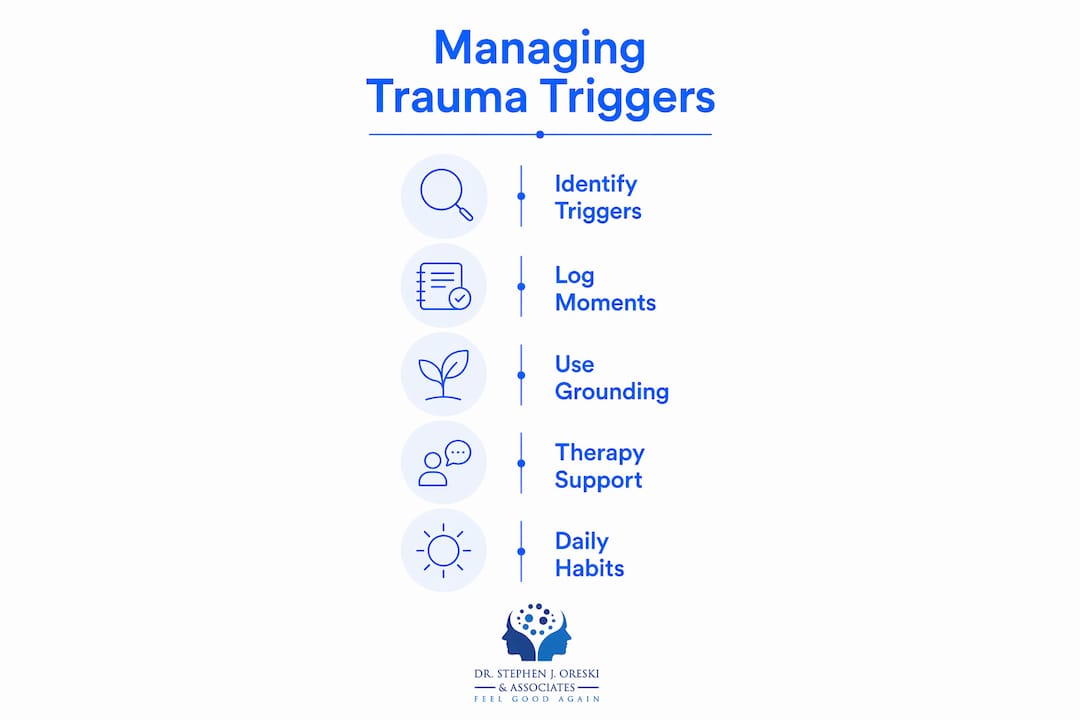
A trigger chart lists identifiable triggers alongside emotional responses and bodily sensations, giving you a concrete map of your patterns. This awareness lets you anticipate reactions before distress escalates, replacing reactive overwhelm with a mindful, prepared response.
Pro Tip: Keep a small notebook or use a notes app to log trigger moments within an hour of experiencing them. Record the situation, your physical sensations, and the emotion that followed. Patterns will emerge within two to three weeks.
What immediate strategies help when a trigger hits?
When a trigger activates your nervous system, the goal is to signal safety to your brain as quickly as possible. Breathing, meditation, and relaxation techniques reduce PTSD symptom severity and are among the most accessible tools you have available in any moment. These are not passive suggestions. They are physiological interventions that directly interrupt the stress response.
Use these steps when you feel a trigger response beginning:
- Slow your breath. Inhale for four counts, hold for four, exhale for six. The extended exhale activates the parasympathetic nervous system and signals your body to calm down.
- Use the 5-4-3-2-1 grounding method. Name five things you can see, four you can touch, three you can hear, two you can smell, and one you can taste. This technique anchors your attention to the present moment and interrupts the flashback cycle.
- Apply progressive muscle relaxation. Tense each muscle group for five seconds, then release. Start at your feet and work upward. This reduces the physical tension that amplifies emotional distress.
- Engage a positive distraction. Call a trusted person, listen to a specific playlist, or hold a meaningful object. Distraction is not avoidance when used intentionally and briefly.
- Use supportive self-talk. Remind yourself: “I am safe right now. This feeling will pass. I have gotten through this before.” These statements are not denials. They are accurately reoriented to the present.
Pro Tip: Practice the 5-4-3-2-1 method when you are calm, not just during a trigger. The more familiar it feels in low-stress moments, the more automatically it activates when you actually need it.
Which therapies support long-term trigger management?
Coping with trauma triggers in the moment is necessary, but overcoming trauma responses at their root requires structured therapeutic work. Three evidence-based approaches stand out for their documented effectiveness.
| Therapy | How it works | Best for |
|---|---|---|
| Trauma-focused CBT (TF-CBT) | Restructures negative beliefs tied to trauma memories through gradual exposure and cognitive reframing | Adults and adolescents with PTSD from any trauma type |
| EMDR (Eye Movement Desensitization and Reprocessing) | Uses bilateral stimulation while processing traumatic memories to reduce their emotional charge | Individuals with single-incident or complex trauma |
| Guided self-help via structured programs | Delivers CBT modules online with therapist support, matching face-to-face outcomes | Those with limited access to in-person care |
The RAPID trial found that guided self-help therapy using structured online modules is as effective as individual CBT over 16 weeks, with improvements sustained at 52 weeks. This matters because it means effective trauma treatment is not limited to those who can access weekly in-person sessions.
The STOP-PTSD trial adds an important nuance: trauma-focused internet therapy outperforms general stress management CBT because it directly targets the negative meanings and intrusive memories that sustain PTSD. General relaxation skills help, but they do not change the underlying cognitive architecture of trauma. Therapy that addresses flashbacks and negative beliefs produces greater and more durable relief. You can explore trauma-focused treatment options to understand which modality fits your specific history and needs.
How daily habits and safe environments support healing
Managing anxiety after trauma is not only a clinical task. The structure of your daily life either supports or undermines your nervous system’s ability to recover. Regular sleep, nutrition, and exercise are foundational self-care practices that directly affect how intensely you experience triggers and how quickly you recover from them.
Practical daily habits that build resilience include:
- Consistent sleep schedule: Go to bed and wake at the same time daily. Sleep deprivation amplifies emotional reactivity and lowers your threshold for trigger responses.
- Physical movement: Even a 20-minute walk reduces cortisol and increases GABA, the brain’s primary calming neurotransmitter. You do not need an intense workout to get the benefit.
- Limiting avoidable exposure: Reduce time spent on news cycles, social media content, or conversations that reliably activate your trauma responses. This is not permanent avoidance. It is strategic protection while you build skills.
- Creating a personal safe space: Designate a physical area in your home where you go specifically to calm down. Pair it with sensory anchors like a specific scent, soft lighting, or a weighted blanket.
- Expressive outlets: Journaling, art, and music give the nervous system a channel to process emotion without verbal confrontation. Mindfulness-based practices integrated into a daily routine also reduce the frequency and intensity of trigger responses over time.
Self-care during trauma recovery is multifaceted, involving practical safety, daily structure, and reducing exposure to avoidable trauma reminders. The goal is not a perfect routine. It is a consistent enough structure that your nervous system begins to predict safety.
Key takeaways
Managing trauma triggers requires identifying your personal patterns, applying immediate grounding techniques, and engaging trauma-focused therapy to change the underlying beliefs that sustain your reactions.
| Point | Details |
|---|---|
| Identify triggers systematically | Use a trigger chart to map sensory, emotional, and situational cues alongside bodily responses. |
| Use grounding in the moment | The 5-4-3-2-1 method and controlled breathing interrupt the stress response quickly and reliably. |
| Choose trauma-focused therapy | TF-CBT and EMDR outperform general stress management by targeting flashbacks and negative beliefs directly. |
| Build daily structure | Consistent sleep, movement, and reduced exposure to avoidable triggers lower your overall reactivity. |
| Expect gradual progress | Multi-week engagement with skills and therapy produces sustained improvement, not overnight change. |
What I’ve learned about triggers that most people get wrong
Here is the misconception I see most often in clinical practice: people believe the goal is to eliminate their triggers entirely. They white-knuckle their way through avoidance, reorganizing their lives around what they cannot face. And for a while, it feels like control. It is not.
Avoiding all triggers is both unrealistic and counterproductive. The nervous system learns safety through graduated exposure, not permanent retreat. Every time you successfully navigate a trigger, even imperfectly, you build evidence that you can survive it. That evidence accumulates. That is what healing actually looks like.
What I tell clients at Bergencountytherapist is this: reframe the trigger as a signal, not a threat. It is your nervous system doing its job, flagging something it learned to fear. Your work is not to silence it. Your work is to update the information it relies on.
The other thing I want you to hear is that consistent practice over weeks, not days, is what produces real change. The RAPID trial showed sustained improvement at 52 weeks, not 52 hours. Be patient with yourself. The skills work when you give them time.
— Stephen
Ready to take the next step in your trauma recovery?
The strategies in this article give you a strong foundation, but working through trauma triggers with professional support accelerates and deepens the process significantly.

At Bergencountytherapist, Dr. Stephen Oreski and his team offer personalized individual therapy for trauma tailored to your specific history, triggers, and goals. Whether you are just beginning to understand your responses or have been managing them on your own for years, one-on-one counseling provides the structured, evidence-based support that self-help strategies cannot replace. You can also begin therapy today with a free consultation to find the right fit for your needs. Bergen County residents can access both in-person and virtual sessions.
FAQ
What are trauma triggers exactly?
Trauma triggers are stimuli, including sights, sounds, smells, emotions, or situations, that activate trauma-related memories and emotional reactions. RAINN defines them as responses that can make past trauma feel as though it is happening in the present moment.
How do I start identifying my own triggers?
Begin by keeping a trigger log that records the situation, your physical sensations, and the emotion that followed each distressing reaction. A trigger chart that maps these patterns over two to three weeks gives you a clear picture of your personal responses.
Can I manage trauma triggers without therapy?
Grounding techniques, breathing exercises, and daily self-care routines can reduce the intensity of trigger responses. However, trauma-focused therapy produces deeper and more sustained improvement by addressing the negative beliefs and flashback memories that keep triggers active.
How long does it take to see improvement?
Clinical trials like the RAPID study show sustained symptom reduction over 16 to 52 weeks of consistent engagement with therapeutic skills and structured support. Progress is gradual and cumulative, not linear.
Is online therapy effective for trauma triggers?
Yes. The RAPID trial demonstrated that guided self-help delivered through structured online modules produces outcomes equivalent to face-to-face CBT for PTSD, with improvements maintained at one year.