

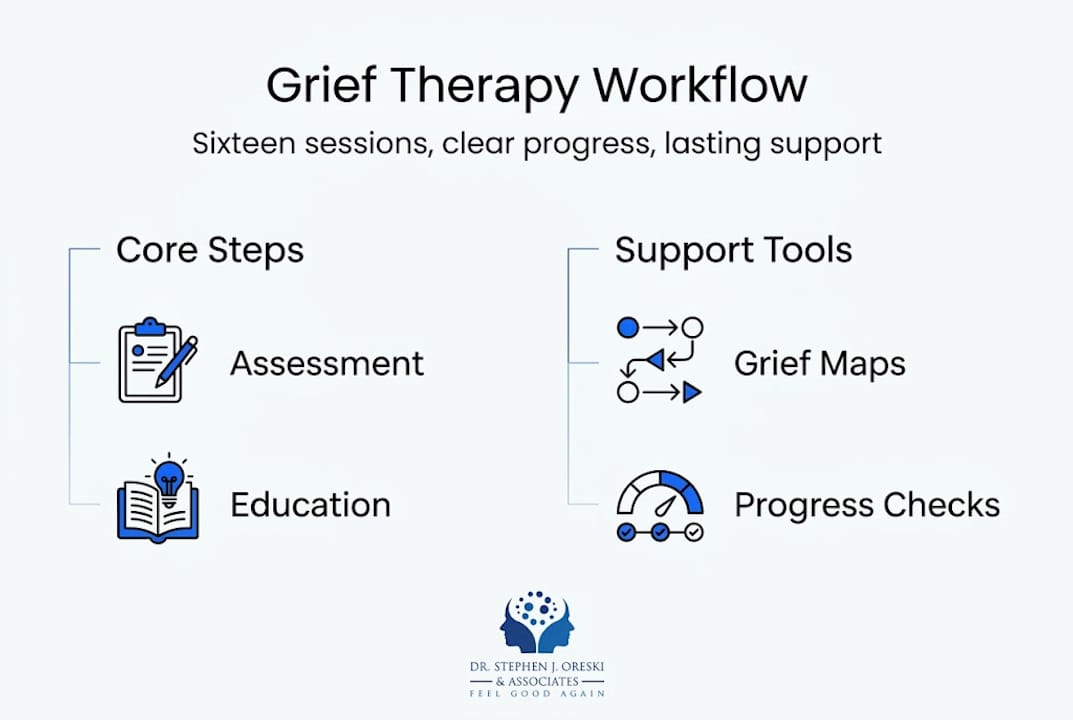
- Structured grief therapy provides a clear, evidence-based path with measurable milestones.
- Assessments like the Inventory of Complicated Grief help tailor treatment and track progress.
- Most individuals experience significant symptom reduction and improved daily functioning through this approach.
Grief after a significant loss can feel like falling into quicksand. The harder you push against it alone, the more exhausted you become. For many people in Bergen County, the pain does not fade with time, the way others promise it will. Structured grief therapy offers something informal support simply cannot: a clear, evidence-based path forward with measurable milestones along the way. This guide walks you through what a grief therapy workflow actually looks like, which tools therapists use, and how you can start expecting real, lasting progress.
Table of Contents
- Understanding prolonged grief and the need for structured therapy
- Key tools and assessments in a grief therapy workflow
- Step-by-step walkthrough: The 16-session grief therapy workflow
- What to expect: Outcomes, progress tracking, and next steps
- A therapist’s perspective: What most advice misses about grieving
- Explore grief therapy and support options in Bergen County
- Frequently asked questions
Key Takeaways
| Point | Details |
|---|---|
| Structured workflows speed healing | Evidence shows a clear therapy workflow improves outcomes for prolonged grief. |
| Assessment tools guide therapy | Tools like the ICG help therapists target sessions to your needs. |
| Milestone tracking enables progress | Grief therapy works by setting and achieving healing steps over 16 sessions. |
| Adapt your path as needed | Individual pacing and therapy adjustments ensure lasting, meaningful recovery. |
Understanding prolonged grief and the need for structured therapy
To understand how workflow-based therapy can help, it is essential to first see why structured healing matters.
Grief is a natural response to loss, but for some people it becomes something more serious. Prolonged Grief Disorder (PGD) is a clinical condition recognized in the DSM-5-TR, characterized by intense longing for the deceased, difficulty accepting the loss, and impaired daily functioning lasting more than 12 months after bereavement. This is not just “still being sad.” It is a diagnosable condition with specific symptoms that do not resolve on their own without targeted treatment.
Research shows that about 7% of bereaved individuals develop PGD, and that evidence-based structured therapies like Prolonged Grief Therapy show sustained symptom reduction, while individual cognitive behavioral therapy demonstrates medium to large effect sizes for prolonged grief and PTSD. These are not small numbers. They represent thousands of people who could heal faster with a proper therapeutic framework rather than waiting it out.
Many people in grief reach out to friends, clergy, or informal support groups, and those connections are genuinely valuable. But they are not a substitute for the kind of work that happens in understanding grief therapy. Structured therapy gives you a therapist trained to identify where you are stuck, which specific patterns are keeping you in pain, and what targeted interventions will actually move the needle.
Understanding what complicated grief means is the first step toward getting the right kind of help. Here are some clear reasons why a structured workflow outperforms informal support:
- Defined session goals reduce the feeling of wandering without direction
- Validated screening tools pinpoint your grief severity so treatment is appropriately matched
- Stepwise milestones give you something concrete to work toward and celebrate
- Regular progress tracking shows you that the work is actually making a difference
- Evidence-based techniques have a proven track record in clinical trials, not just anecdotes
If you are unsure what path is right for you, reviewing therapy options for grief can clarify your choices before your first appointment.
Key tools and assessments in a grief therapy workflow
Once you know that a structured approach is beneficial, the next step is understanding the tools and assessments central to an effective workflow.
A grief therapy workflow does not begin with session one and end at session sixteen on autopilot. It begins with careful assessment. The most widely used clinical tool is the Inventory of Complicated Grief (ICG), a 19-item grief severity scale that asks about specific emotional and behavioral symptoms. Scores above 25 indicate clinical significance, meaning the grief is intense enough to warrant structured intervention. Scores above 30 signal that targeted therapeutic intervention is urgently needed.

Here is how the ICG fits alongside other assessment tools:
| Assessment tool | Purpose | When it is used |
|---|---|---|
| ICG (19 items) | Measures grief severity and clinical significance | Intake and periodic check-ins |
| PHQ-9 | Screens for co-occurring depression | Initial evaluation |
| GAD-7 | Identifies anxiety symptoms alongside grief | Initial and follow-up |
| UCLA Loneliness Scale | Measures social isolation related to loss | Mid-therapy and discharge |
Therapists use these tools together to build a full picture of where you are emotionally. An ICG score alone does not capture everything. Depression and anxiety frequently co-occur with PGD, and missing those layers can slow your progress. Regular reassessment throughout treatment also lets your therapist adjust the approach if something is not working.
Identifying complicated grief early is critical because the longer PGD goes unaddressed, the harder it can become to treat without more intensive support. The good news: assessment is painless, usually completed at intake, and gives both you and your therapist a roadmap from day one.
Understanding the specific therapy techniques for grief that follow from these assessments makes the work feel far less mysterious.
Pro Tip: Start keeping a grief journal before your first therapy session. Write each day briefly about your mood, thoughts about your loved one, and what felt difficult or manageable. Your therapist can use these notes to identify patterns much faster, saving valuable session time.
Step-by-step walkthrough: The 16-session grief therapy workflow
Understanding the tools, you can now follow the actual workflow most evidence-based grief therapists use.
Prolonged Grief Therapy (PGT) is a 16-session, semistructured integrative psychotherapy developed specifically for PGD. It helps clients achieve six key healing milestones. These milestones are not arbitrary checkboxes. They reflect what research shows must shift inside a grieving person for lasting improvement to occur.
Here is how the 16-session structure unfolds at a high level:
| Session range | Primary focus |
|---|---|
| Sessions 1 to 4 | Psychoeducation, establishing safety, and grief mapping |
| Sessions 5 to 8 | Processing the story of the loss and emotional avoidance |
| Sessions 9 to 12 | Rebuilding identity and reconnecting with life goals |
| Sessions 13 to 16 | Consolidating gains, relapse prevention, and closing rituals |
The six healing milestones targeted across these sessions are: accepting the reality of the loss, processing the emotional pain, adjusting to a changed world, finding a new connection to the deceased, rebuilding personal identity, and re-engaging with meaningful activities and relationships.
Here is a numbered walkthrough of the first five core steps:
- Grief mapping: Your therapist helps you describe the loss in detail, identifying the moments of most intense pain and avoidance behaviors.
- Psychoeducation: You learn what PGD is, why your brain and body respond as they do, and why avoidance actually maintains grief rather than reducing it.
- Situational revisiting: You gradually approach avoided reminders of the loss, building tolerance and reducing the emotional charge tied to them.
- Processing the death story: You revisit the circumstances of the death in a structured way to process trauma-related aspects of the grief.
- Future orientation: You begin rebuilding a sense of who you are and what your life can look like without the person you lost.
Types of grief therapy vary widely, and some people benefit from combining individual PGT with group grief counseling to reduce isolation and build community support alongside the structured work.
The CGT/PGT efficacy evidence from randomized controlled trials consistently confirms that this structured approach outperforms less organized forms of grief support.
Pro Tip: Before each session, write down one goal you want to accomplish or one question you want to bring to your therapist. Even a single sentence helps you arrive focused and use the time well.
What to expect: Outcomes, progress tracking, and next steps
After completing the workflow, it is important to check where you are, what to expect, and what comes next.
The research on structured grief therapy outcomes is genuinely encouraging. Randomized trials show a 70% response rate for Complicated Grief Treatment compared to just 30% for Interpersonal Psychotherapy. That is a meaningful gap, and it reinforces why working with a therapist trained in PGT specifically gives you better odds than a more generalized approach.
“Sustained symptom reduction, improved daily functioning, and renewed connection to meaningful activities are the measurable signs that grief therapy is working.”
Progress is tracked in therapy through repeated ICG administrations, therapist observations, and your own self-reported changes in functioning. Here is a summary of what improvement generally looks like across the therapy timeline:
| Stage | What you may notice |
|---|---|
| Early sessions | Reduced avoidance, slightly more willingness to talk about the loss |
| Mid-therapy | Lower ICG score, improved sleep or appetite, less intense longing |
| Final sessions | Reconnection with goals, reduced impairment at work or in relationships |
Signs your grief therapy is actively working include:
- You find yourself able to think of your loved one without the same intensity of pain
- Daily tasks feel more manageable and less overwhelming
- Social connections are gradually rebuilding
- Your coping with loss toolkit feels fuller and more accessible
- You can imagine a future that still holds meaning
If you finish the 16 sessions and feel healing is incomplete, that is not a failure. It is clinical information. Your therapist may recommend a booster phase, a referral for medication evaluation, or a transition to a different modality. Knowing how to find a qualified grief therapist who can guide that next step is essential. Strategies for managing grief as an adult can also extend your progress between sessions and after formal therapy ends.
A therapist’s perspective: What most advice misses about grieving
Most grief resources focus heavily on the structure, and that structure is genuinely useful. But the most important thing we have observed in practice is that grief does not follow a calendar. Two people can move through the same 16-session workflow and arrive at very different places at session eight. Neither is doing it wrong.
The real pitfall we see is self-comparison and self-judgment. People measure their grief against what others seem to feel or what they believe they “should” feel by now. That comparison is the silent enemy of healing. The workflow provides a container, but you set the pace of emotional processing inside it.
Honoring your unique journey, including the moments when the old pain surfaces unexpectedly, is not a setback. It is part of the process. Learning healing techniques for grief that are calibrated to your personality and history matters far more than forcing yourself through a rigid template.
Explore grief therapy and support options in Bergen County
Understanding the workflow is a strong first step. Taking that step with a trained local therapist makes it real.

At Bergen County Therapist, Dr. Stephen Oreski and his team offer personalized grief therapy and free initial consultations to help you find the right fit. Whether you are navigating fresh loss or a grief that has lingered far too long, our therapists build treatment plans around your specific needs. You can also use tools to track your mental health between sessions, and if grief is intertwined with depression, our depression therapy services offer targeted support. Connect with our Bergen County therapists today to start a path toward genuine healing.
Frequently asked questions
What is the main goal of a grief therapy workflow?
A grief therapy workflow guides you through structured healing milestones, with PGT targeting six key outcomes for lasting symptom relief and improved functioning.
How is progress tracked in grief therapy?
Therapists use validated instruments like the 19-item ICG alongside regular check-ins to monitor changes in grief severity throughout treatment.
What if I don’t feel better after finishing the workflow?
Incomplete recovery after 16 sessions is clinical information, not failure. You may benefit from booster sessions, a different modality, or additional resources, since structured therapy helps most but not all individuals equally.
What are the signs that grief therapy is working?
Expect to see sustained symptom reduction, greater ability to engage in daily life, and improved capacity to think about your loved one without being overwhelmed.