

TL;DR:
- Grief often arrives unexpectedly and can linger longer than anticipated, leaving individuals feeling confused and isolated.
- Processing grief involves actively working through difficult emotions at a manageable pace, often with professional support, rather than avoiding or suppressing them.
Grief has a way of arriving without warning and staying far longer than anyone expects. Whether you’ve lost a spouse, a parent, a close friend, or even a job or relationship, the emotional weight can feel impossible to organize or understand. Many people in Bergen County reach out feeling confused, isolated, and unsure whether what they’re experiencing is “normal.” The good news is that Worden’s four tasks are a commonly used framework in adult grief work, giving both therapists and individuals a structured, compassionate roadmap for working through loss.
Table of Contents
- What is processing grief?
- The four tasks of mourning: a step-by-step overview
- Therapeutic and support options for grief in Bergen County
- What about complicated grief or difficult relationships?
- How to know if you’re healing (or need more support)
- What most guides get wrong about grief
- Support for your grief journey in Bergen County
- Frequently asked questions
Key Takeaways
| Point | Details |
|---|---|
| Evidence-based frameworks | Worden’s four tasks provide a proven structure for processing grief that adapts to individual needs. |
| Local support options | Therapists and expert-led groups in Bergen County offer effective help and a vital sense of connection. |
| Healing isn’t linear | Grief comes and goes; setbacks are normal, and progress varies from person to person. |
| Therapy can help when stuck | If grief feels overwhelming or you feel ‘stuck,’ professional support can guide you through challenging moments. |
What is processing grief?
Processing grief does not mean forcing yourself to feel better or simply waiting for time to heal everything. It means actively working through difficult emotions rather than pushing them aside or avoiding them entirely.
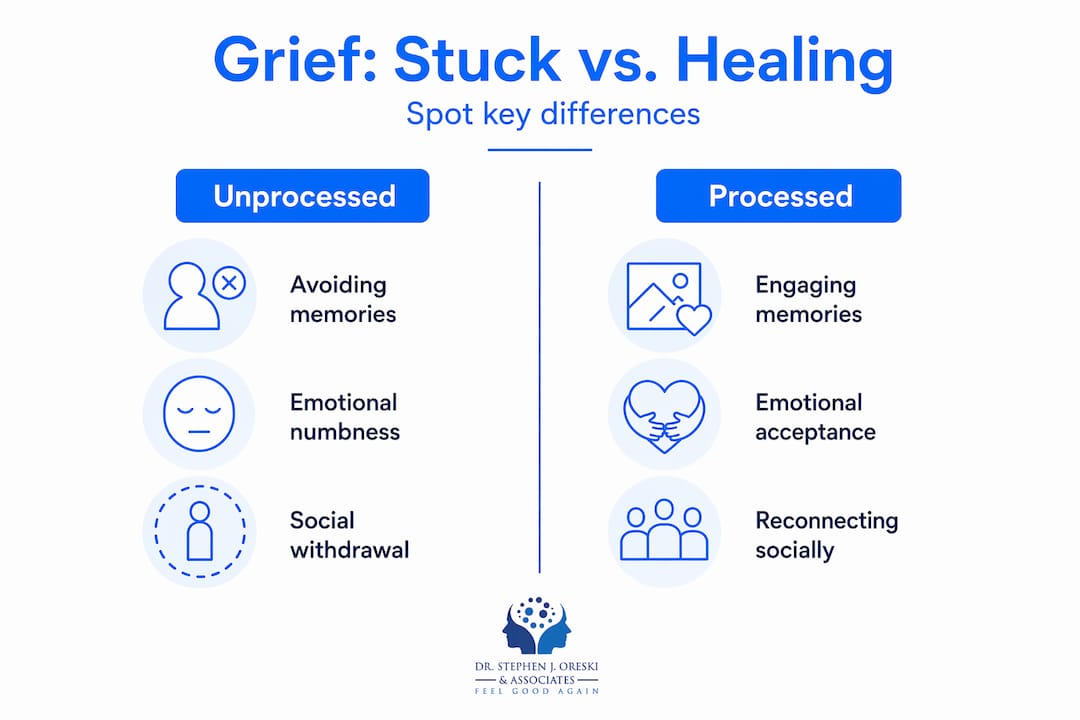
When grief goes unprocessed, a person can become “stuck.” This looks different for everyone. Some people avoid places or people that remind them of who they lost. Others throw themselves into constant busyness to escape the pain. Both strategies feel protective in the short term, but reducing avoidance of painful memories and situations is actually central to healthy grief processing.
Professional grief therapy focuses on identifying where someone is stuck, then gently helping them re-engage with difficult memories and emotional experiences at a manageable pace. This is very different from “forcing” emotions. A skilled therapist creates a safe environment where you can approach pain without becoming overwhelmed by it.
Here are some common signs that grief is going unprocessed:
- Persistent numbness or emotional shutdown lasting more than several weeks
- Avoiding talking about the person who died
- Refusing to visit meaningful places or look at photos
- Increased use of alcohol, substances, or other numbing behaviors
- Feeling that life has permanently lost all meaning or purpose
| Unprocessed grief | Processed grief |
|---|---|
| Avoidance of memories | Gradual re-engagement with memories |
| Emotional numbness | Fluctuating but present emotions |
| Social withdrawal | Rebuilding connections over time |
| No sense of moving forward | Slow integration of the loss |
For more on managing grief in adults and how therapy can guide this process, there are resources tailored specifically for Bergen County residents. You can also explore grief therapy techniques that therapists use in evidence-based treatment.
The four tasks of mourning: a step-by-step overview
One of the most respected frameworks in grief counseling is the four-task model developed by psychologist J. William Worden. Unlike the popular “five stages” model, which can feel rigid and sequential, Worden’s four tasks framework is widely used in therapeutic settings precisely because it treats mourning as active work rather than passive stages you pass through.
Here are the four tasks:
- Accept the reality of the loss. This is more than intellectually knowing the person is gone. It means letting that reality sink in emotionally over time.
- Work through the pain of grief. Allow yourself to experience the full range of emotions, including sadness, anger, guilt, and fear, rather than bypassing them.
- Adjust to the world without the deceased. This includes practical adjustments (new responsibilities) and deeper identity shifts (who am I now that this person is gone?).
- Find an enduring connection while moving forward. This final task is often misunderstood. It is not about “letting go.” It is about finding a meaningful, healthy way to carry your loved one with you while still re-engaging with life.
| Common myth | What the four tasks actually say |
|---|---|
| “You need to let go to heal” | Find a lasting bond, not erasure |
| “Grief follows a set timeline” | Tasks can be revisited at any point |
| “Moving on means forgetting” | Meaning is built around the loss |
| “Grief is purely emotional” | Includes practical and identity work |
Pro Tip: If you feel like you’ve “moved on” but still find yourself overwhelmed during anniversaries or milestones, you may simply be revisiting one of the tasks. This is completely normal and not a sign of failure.
Exploring grief therapy options and the types of grief therapy available can help you figure out which approach aligns best with where you are in the mourning process.
Therapeutic and support options for grief in Bergen County
When it comes to choosing the right kind of help, it’s important to understand what the evidence actually says. Psychotherapy and support groups show moderate strength of evidence for relieving grief symptoms, making them two of the most reliable options available.
Here’s a breakdown of the main options:
- Individual psychotherapy: Working one-on-one with a trained therapist allows for deep, personalized exploration of your grief. Approaches like Cognitive Behavioral Therapy (CBT) and Complicated Grief Treatment (CGT) are well-supported by research.
- Expert-facilitated support groups: Groups led by a licensed professional offer a structured space to share, listen, and normalize your experience with others who understand loss firsthand.
- Peer-led or self-help groups: These can provide meaningful community connection, though their clinical effectiveness is less well established compared to professionally led interventions.
- Online therapy: For those with busy schedules or transportation challenges in Bergen County, virtual therapy has expanded access to quality care significantly.
Important: Not all grief support is equally effective. The quality and training of the facilitator matters enormously. When seeking a group, ask whether it is led by a licensed mental health professional.
There are grief support group listings for Bergen County and surrounding areas, including Hackensack, that can help you identify local options quickly.
Pro Tip: Combining individual therapy with a support group often works better than either approach alone. Individual therapy goes deep; group support normalizes and connects.

If you’re weighing your choices, learn more about local grief support groups and the group grief counseling benefits that many adults in Bergen County have found helpful.
What about complicated grief or difficult relationships?
Not every loss fits the “simple” grief mold. Sometimes the relationship with the person who died was complicated by conflict, estrangement, abuse, or ambivalence. In these situations, the healing process can take on an entirely different character.
The fourth task of mourning, forming an enduring connection with the deceased, can be particularly challenging when the relationship was difficult or abusive and may require professional help to navigate safely. Trying to build a “positive memory” of someone who hurt you without guidance can actually deepen emotional harm.
Signs that your grief may be more complicated:
- Persistent inability to accept the loss weeks or months after the death
- Intense bitterness or anger that does not shift over time
- Feeling that life is meaningless or that you cannot function
- Avoiding all reminders to an extreme degree for an extended period
- Grief that seems to be getting worse rather than gradually shifting
“Complicated grief, also called prolonged grief disorder, affects an estimated 7 to 10 percent of bereaved individuals and typically requires specialized therapeutic intervention to resolve.”
Recognizing these signs early means you can reach out for the right level of support before grief becomes more deeply entrenched. Learning more about understanding complicated grief and complicated grief support available in Bergen County is an important first step.
How to know if you’re healing (or need more support)
Healing from grief rarely looks like a straight upward line. Good days and hard days will often alternate, sometimes for a long time. The key distinction is whether the overall trajectory is gradually shifting toward greater functioning, or whether things feel stuck or worsening.
Here are concrete indicators that healing is progressing:
- You can think about the person who died without being completely destabilized.
- You are re-engaging with activities, relationships, or goals you had withdrawn from.
- You experience genuine moments of joy, humor, or peace alongside the sadness.
- Your sleep, appetite, and daily functioning are gradually improving.
- You feel capable of making plans for the future, even small ones.
On the other hand, if symptoms are prolonged and worsening rather than evolving, reaching out to a professional is a strong, proactive choice. Expert-facilitated interventions show moderate strength of evidence for lessening grief symptoms, and starting earlier tends to produce better outcomes.
Pro Tip: Keeping a simple journal of your emotional state once a week can help you see patterns you might miss day to day. Progress in grief is often only visible when you look back over time.
If you’re ready to take that next step, resources on how to find a grief therapist in Bergen County can simplify the process significantly.
What most guides get wrong about grief
Most grief guides focus heavily on stages or timelines, which can leave people feeling like they’re “doing it wrong” when their experience doesn’t fit the model. Here’s the truth from our perspective: grief is one of the most personal human experiences there is, and no framework should make you feel broken.
The pressure to “move on” is one of the most damaging things a grieving person can encounter. Healing is not about erasing the past or reaching a finish line. It is about learning to carry your loss in a way that does not prevent you from living fully. That looks completely different from one person to the next.
We also want to name something that doesn’t get discussed enough: grief in the context of a complicated or painful relationship is often harder and lonelier than grief after an uncomplicated loss, precisely because others may not fully validate it. Losing someone you had unresolved conflict with, or someone who hurt you, can produce a unique form of pain that many people don’t know how to name.
What we’ve seen in our work with adults across Bergen County is that community and guided support make a real, measurable difference. Grief does not have to be a solitary experience. Whether through therapy or a facilitated group, having someone walk alongside you can change the entire quality of your healing. Explore real-world Bergen County grief support options if you’re ready to stop navigating this alone.
Support for your grief journey in Bergen County
Grief is hard enough without having to figure out the next step by yourself. At Bergen County Therapist, Dr. Stephen Oreski and his team offer compassionate, evidence-based support for adults navigating loss of every kind.

Whether you’re drawn to individual grief therapy for personalized, one-on-one care or you’re interested in the community connection offered by grief support groups, we have options designed to meet you where you are. You can also use mental health tracking tools to better understand your own healing progress between sessions. Reach out today for a free consultation, and let us help you find the right path forward.
Frequently asked questions
How long does it take to process grief?
Grief has no fixed timetable; healing is unique to each person and can take months or even years, depending on the nature of the loss and the support available.
What if I feel stuck and can’t move forward?
Processing grief often involves reducing avoidance of painful memories, and both individual therapy and expert-facilitated support groups have demonstrated real benefit for people who feel unable to move forward on their own.
Are support groups or therapy more effective for grief?
Moderate evidence exists for both support groups and psychotherapy; the most effective choice depends on the individual, the type of loss, and the quality of facilitation provided.
Can complicated relationships with the deceased make grieving harder?
Yes, when the relationship was difficult or abusive, forming a healthy enduring bond can require specialized professional support to navigate safely and without causing additional emotional harm.