

TL;DR:
- Setting boundaries with narcissists involves establishing clear behavioral consequences that protect your well-being rather than trying to change them. Using clinician-approved techniques, such as enforcing behavioral limits instead of requests and employing neutral, repetitive phrases, prevents escalation and maintains your emotional safety. Planning exits in advance and building a strong support system reinforces your boundaries, fostering self-trust and resilience despite ongoing challenges.
Setting boundaries with narcissists means establishing clear, behavioral consequences that protect your well-being rather than attempting to change who they are. Narcissistic Personality Disorder (NPD) is the clinical term for the pattern you are dealing with, and understanding it changes everything about how you set limits. Standard negotiation fails because narcissists do not respond to emotional appeals or logical reasoning the way most people do. The strategies that work focus entirely on your actions and your follow-through, not on their cooperation. This guide covers exactly how to set boundaries with narcissists using clinician-approved techniques, specific scripts, and a support structure that holds.
How to set boundaries with narcissists that actually hold
The most common mistake people make is treating a boundary like a request. Boundaries are consequences you enforce yourself. Telling a narcissist “I need you to respect my feelings” is a rule that requires their cooperation. Saying “When you yell, I leave the room” is a boundary you control entirely.

This distinction matters because narcissists are skilled at reframing rules as negotiable. When you set behavioral limits instead of emotional requests, you remove their ability to argue about whether the limit is fair. You are not asking for agreement. You are stating what you will do.
Understanding narcissism in relationships is the foundation. Once you recognize the pattern, you stop expecting empathy and start building a structure that protects you regardless of their response.
Boundary doors vs. walls: which type works best?
Not all boundaries look the same, and the type you choose affects your psychological health as much as your safety. Psychology Today describes two models: doors and walls.
| Boundary Type | What It Does | Best Used When |
|---|---|---|
| Boundary Door | Allows selective interaction on your terms | You must maintain contact (family, work) |
| Boundary Wall | Cuts off all contact | Abuse is severe or safety is at risk |
| Adaptive Door | Adjusts based on behavior in the moment | Relationship has occasional positive value |
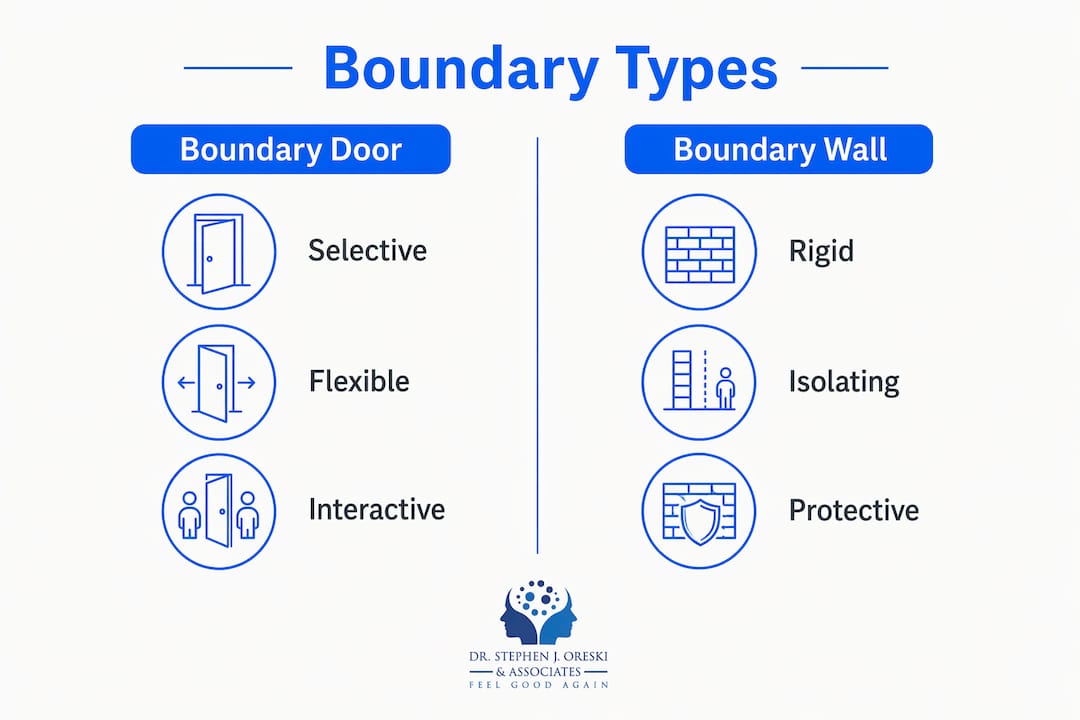
Dynamic boundary doors are more effective than rigid walls for most ongoing relationships. Walls can isolate you and mirror the avoidance patterns seen in PTSD, which creates its own psychological cost. Doors let you navigate around harmful behavior while preserving your ability to engage when it is safe.
Adaptive boundaries represent the mature middle ground. You are not pretending the relationship is healthy. You are choosing when to open the door and when to close it, based on what is actually happening in the moment.
Pro Tip: Before any interaction with a narcissist, decide in advance which door setting you are using. Going in without a plan means their behavior sets the terms, not you.
Why you should never JADE with a narcissist
JADE stands for Justify, Argue, Defend, and Explain. It feels like self-advocacy. It is actually a trap.
Stopping JADE is one of the most critical skills in dealing with narcissists. Every reason you give becomes a new angle for them to attack. Every explanation extends the argument. You end up spending your energy proving your point instead of protecting yourself.
The alternative is the “broken record” technique. You choose one short, neutral phrase and repeat it without variation:
- “That doesn’t work for me.”
- “I’m not going to discuss this further.”
- “I’ve said what I have to say.”
- “This conversation is over for now.”
Repeating neutral phrases word for word removes attack angles. There is nothing new for the narcissist to grab onto. The conversation stops escalating because you are not feeding it.
Scripts should be practiced out loud before you need them. Rehearsed, boring, non-reactive phrases prevent emotional leakage under pressure. When you are calm and prepared, the narcissist cannot gain leverage through your reactions.
Pro Tip: Write your three go-to boundary phrases on a notecard and read them before any high-stakes interaction. Familiarity with the words makes them easier to access when emotions run high.
How to plan for high-risk in-person interactions
Family holidays, work meetings, and shared custody exchanges are the hardest situations for setting limits with narcissists. Emotional pressure is high, audiences are present, and the stakes feel enormous. Planning in advance is the only reliable defense.
- Decide your exit condition before you arrive. Choose a specific trigger: “If he raises his voice twice, I leave.” Do not negotiate this with yourself in the moment.
- Rehearse your exit script. A simple “I need to step out” or “I have another commitment” requires no explanation and gives no opening for argument.
- Arrange your own transportation. Depending on the narcissist for a ride removes your ability to leave on your terms.
- Set a time limit. Tell yourself you will stay for 90 minutes maximum. Having a hard stop reduces the pressure to endure escalating behavior.
- Enforce limits privately when possible. Removing the audience takes away the narcissist’s incentive to perform for others. A quiet, private statement lands differently than a public confrontation.
Pre-authorizing exit conditions removes emotional bargaining in the moment. You are not deciding whether to leave while you are already upset. You decided before you walked in the door.
Why your support system is your most underrated tool
Boundaries with narcissists erode when you are isolated. The narcissist’s primary tactic is gaslighting: making you doubt your own perception of events. A strong support system is your defense against that.
- Trusted confidants: One or two people who know the full picture and can reflect reality back to you when you start to doubt yourself.
- A therapist or counselor: Professional support gives you a space to process without burdening friends and builds the skills you need for coping with narcissist recovery.
- Documentation: Keep a private log of incidents, dates, and exact words used. This anchors your memory and counters the narcissist’s rewriting of events.
- Self-esteem resources: Narcissistic abuse targets your sense of worth. Addressing self-esteem challenges directly accelerates your recovery.
External validation is unreliable when it comes from the narcissist. Self-trust built through private journaling and trusted relationships is what sustains boundary strength over time. You are building an internal compass, not waiting for their approval.
Key takeaways
Effective boundary-setting with narcissists requires behavioral consequences you control, not emotional requests that depend on their cooperation.
| Point | Details |
|---|---|
| Boundaries are your actions | State what you will do, not what you need them to do. |
| Doors beat walls | Adaptive boundary doors protect you without the isolation cost of total cutoff. |
| Stop JADE-ing | Never justify, argue, defend, or explain. Use short, repeated neutral phrases instead. |
| Plan exits in advance | Decide your exit condition before high-risk events to remove in-the-moment bargaining. |
| Build your support system | Trusted people and documentation protect your reality against gaslighting. |
Boundaries are for you, not for them
I have worked with many clients who came in exhausted from trying to make a narcissistic partner, parent, or colleague finally understand why their behavior was harmful. They were not failing at communication. They were using the wrong tool for the job.
The shift that changes everything is this: you stop trying to get through to them and start building a structure that protects you regardless of their response. That is not giving up. That is clarity.
I have seen clients hold firm boundaries for months before the narcissist in their life adjusted, and I have seen clients hold firm boundaries and eventually walk away entirely. Both outcomes were wins. The boundary was never about changing the other person. It was about the client knowing their own limits and trusting themselves enough to enforce them.
The hardest part is usually the guilt. Narcissists are skilled at making you feel responsible for their reactions. You are not. Their response to your boundary is their responsibility. Your job is to stay consistent, stay supported, and stay honest with yourself about what you can and cannot tolerate.
If you are reading this and thinking “I’ve tried all of this and I’m still struggling,” that is not a sign you are doing it wrong. It is a sign you may need more support than an article can provide. That is completely normal, and it is exactly what therapy is for.
— Stephen
Ready to build boundaries that actually stick?
Setting limits with narcissists is one of the most emotionally demanding skills you can develop. Reading about it is a strong first step. Practicing it with professional support is what makes it last.

At Bergencountytherapist, Dr. Stephen Oreski and his team specialize in helping individuals build the emotional resilience and communication skills needed to protect themselves in difficult relationships. Whether you prefer in-person sessions in Bergen County or the flexibility of online therapy, personalized support is available. Explore your psychotherapy treatment options and take the next step toward lasting well-being.
FAQ
What is the difference between a boundary and an ultimatum?
A boundary is a consequence you enforce yourself, such as leaving the room when someone yells. An ultimatum demands the other person change their behavior, which narcissists typically ignore or weaponize.
Why does explaining yourself make things worse with a narcissist?
Providing reasons gives narcissists new angles to argue against. Every explanation extends the conflict rather than ending it, keeping you trapped in a proving loop.
How do you set a boundary with a narcissist without a fight?
Use short, neutral, repeated phrases and refuse to elaborate. The broken record technique removes the fuel narcissists need to escalate a confrontation.
Should you set boundaries with a narcissist in public?
Private boundary enforcement is more effective. Public settings give narcissists an audience to perform for, which increases the likelihood of escalation and reduces your control over the outcome.
When is it time to stop setting limits and walk away?
When a pattern of abuse continues despite consistent boundary enforcement, walking away is a valid and protective choice. A therapist can help you assess safety and make that decision with clarity.