

- Using blame, ultimatums, and accusatory language in marriage counseling damages honest communication and stalls progress. Replacing harmful phrases with specific, ownership-based statements fosters understanding and moves relationships forward.
Blaming, ultimatums, and accusatory language are the most damaging things you can bring into marriage counseling. These phrases do not just hurt feelings. They shut down the honest communication that therapy depends on. Knowing what not to say in marriage counseling is as important as knowing what to say, because the wrong words can derail an entire session and deepen the very wounds you came to heal. The good news is that once you recognize these patterns, you can replace them with language that actually moves your relationship forward.
What are the most damaging phrases to avoid in marriage counseling?
Certain phrases consistently block progress in couples therapy, regardless of the underlying issue. Therapists across frameworks like Emotionally Focused Therapy (EFT) and the Gottman Method identify the same culprits again and again.
The most common offenders include:
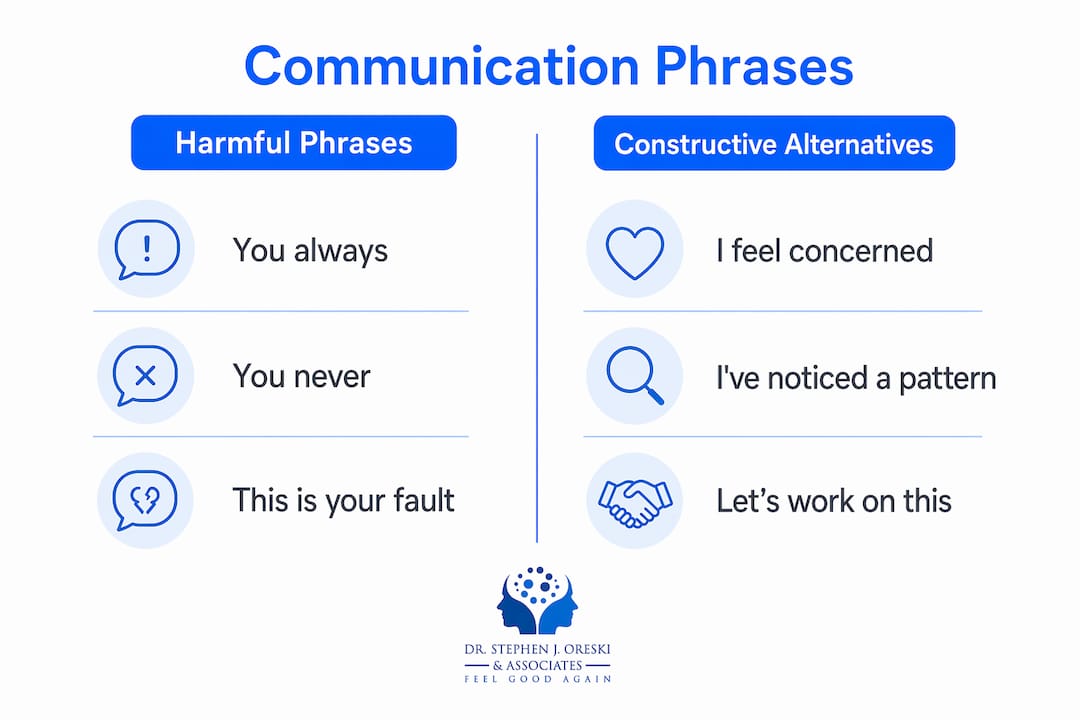
- “You always” or “You never” — These generalizations trigger immediate defensiveness. Your partner stops listening to the concern and starts building a counter-argument.
- “This is your fault” — Blaming statements create a reactive, defensive posture that closes down honest communication.
- Ultimatums and threats — Phrases like “If you don’t change, I want a divorce” escalate tension and signal that the session is a courtroom, not a safe space.
- Weaponized therapy language — Misusing terms like “gaslighting” or “trauma” as weapons damages trust and hinders constructive growth.
- Comparisons to family members — “You’re just like your mother” is a personal attack, not a concern. It deepens wounds instead of addressing behavior.
Pro Tip: Before your next session, write down your three biggest concerns as “I feel” statements. This simple preparation prevents blame language from slipping in when emotions run high.
Character attacks and sweeping generalizations share one thing in common: they make your partner feel judged rather than heard. When a person feels judged, they defend rather than reflect. That defensive cycle is exactly what therapy is designed to break.
How should couples respond when hurtful things are said in therapy?
Even with the best intentions, hurtful comments happen in sessions. The way you respond in that moment determines whether the session recovers or spirals.
The most effective response strategies include:
- Pause before reacting — A few seconds of silence prevent an escalating exchange that the therapist then has to manage.
- Ask the therapist to help reframe — Remaining calm and asking for clarification is best practice when a hurtful statement lands hard.
- Use “I” statements — “I felt dismissed when you said that” is far more productive than “You always dismiss me.”
- Look for the emotion underneath the words — Anger is almost always fear or hurt in disguise. Recognizing that shifts your response from defensive to curious.
- Stay focused on the shared goal — You are both there because you want the relationship to work. Keeping that in mind prevents the session from becoming a debate.
Pro Tip: If your partner says something that stings, try saying “Can we slow down here?” rather than firing back. That phrase signals to both your partner and the therapist that you need a moment, not a fight.
Withdrawal is just as harmful as retaliation. Defensive mechanisms like avoidance protect you from vulnerability but block the authentic connection that therapy is built on. Naming your discomfort out loud, even imperfectly, keeps the session moving.

Why does coming to therapy with a “win” mindset block real progress?
Treating marriage counseling like a courtroom is one of the most common and least recognized mistakes couples make. Approaching sessions with prepared “receipts” and rehearsed speeches triggers partner defensiveness and shuts down progress before the session even begins.
The “win” mindset assumes that one partner is right and the other is wrong. Therapy does not work that way. The goal is not to validate one side’s version of events.
Therapy aims to go beneath the argument to the emotional needs of both partners. When you stop trying to prove your case and start asking what your partner actually needs, the entire dynamic shifts. That shift is where healing begins.
Couples therapy works best when both partners are willing to feel uncertain, even lost, for a while. Vulnerability is not a weakness in this context. It is the mechanism through which new understanding becomes possible. Seeing your partner as someone with unmet needs rather than an opponent changes what you say, how you listen, and what you are willing to hear.
Emotionally Focused Therapy and the Gottman Method both treat the emotional bond as the primary target of treatment, not the surface argument. Couples who debate logistics while their emotional connection is suffering add fuel to the fire instead of addressing the real problem.
Practical tips: what to say in marriage counseling instead
Replacing harmful phrases with constructive ones is a learnable skill. The following substitutions make a measurable difference in how sessions unfold.
- Replace “You always” with a specific observation. “I felt unheard last Tuesday when I brought up the budget” is specific, time-bound, and about behavior, not character.
- Own your part. “I know I shut down when I’m stressed, and that makes things harder for you” disarms defensiveness immediately.
- Express needs, not demands. “I need us to set aside time to talk without phones” is a request. “You never pay attention to me” is an accusation.
- Acknowledge your partner’s feelings, even when you disagree. “I can see this has been really painful for you” costs nothing and builds enormous trust.
- Ask for clarification on clinical terms. If your partner uses a term like “gaslighting” and you are unsure whether it applies, ask the therapist to define it. Confusing “boundaries” with rigid demands undermines trust and closes dialogue.
- Name your own emotions explicitly. Naming underlying emotions is more productive than maintaining a facade of control.
Pro Tip: Practice the phrase “What I hear you saying is…” before responding to your partner’s concern. It slows the conversation and signals that you are listening, not just waiting to reply.
The table below shows common harmful phrases alongside their constructive alternatives.
| Harmful phrase | Constructive alternative |
|---|---|
| “You always do this.” | “I’ve noticed this pattern and it worries me.” |
| “This is your fault.” | “I think we both contributed to this situation.” |
| “You’re just like your mother.” | “When you do X, I feel Y.” |
| “If you don’t change, I’m done.” | “I need us to work on this together.” |
| “You’re gaslighting me.” | “I feel like my experience isn’t being acknowledged.” |
Key Takeaways
Avoiding blame, ultimatums, and weaponized language is the single most effective way to protect the progress you make in couples therapy.
| Point | Details |
|---|---|
| Avoid sweeping generalizations | Phrases like “You always” trigger defensiveness and shut down honest dialogue. |
| Drop the “win” mindset | Therapy uncovers shared emotional needs; it does not declare one partner right. |
| Use “I” statements | Expressing feelings rather than accusations keeps sessions productive and safe. |
| Name emotions explicitly | Stating fear or hurt directly is more effective than avoidance or sarcasm. |
| Replace blame with ownership | Acknowledging your own role disarms your partner and opens real conversation. |
What I’ve learned from watching couples talk their way out of progress
After years of working with couples at Bergencountytherapist, the pattern I see most often is not cruelty. It is fear dressed up as certainty. One partner arrives with a list of grievances, convinced that if they can just present the evidence clearly enough, the therapist will confirm they are right. The other partner senses the setup and goes silent or defensive before the session even finds its footing.
The couples who make the fastest progress are not the ones who communicate perfectly. They are the ones who are willing to say, “I don’t fully understand what’s happening between us, and I want to.” That admission of uncertainty is more powerful than any prepared argument.
I have also watched well-meaning couples derail sessions by misusing clinical language. When “gaslighting” becomes a reflex accusation rather than a precise description, it stops the conversation cold. The other partner feels labeled rather than understood. Understanding what gaslighting actually means before using it in a session protects the trust that therapy depends on.
The couples who shift from “I need to be heard” to “I need to understand” are the ones who leave therapy with something real.
— Stephen
Couples therapy at Bergencountytherapist: building better communication
If you recognize any of these patterns in your own sessions or conversations, you are not alone. Most couples arrive in therapy having already practiced the harmful habits described here for months or years.
At Bergencountytherapist, Dr. Stephen Oreski and his team work with couples to identify the specific communication patterns that are keeping them stuck. Sessions focus on emotional processing, not just conflict management, using frameworks that address the bond beneath the argument. Whether you prefer in-person or online sessions, the first step is a free consultation to find the right fit. Start couples therapy with a team that understands how much the right words, and the right silence, can change.
FAQ
What phrases should you never say in marriage counseling?
Avoid “You always,” “You never,” “This is your fault,” and any ultimatums or threats. These phrases trigger defensiveness and block the honest communication that therapy requires.
Is it okay to bring up past grievances in couples therapy?
Past events are relevant when they reveal patterns, but presenting them as evidence to “win” an argument is counterproductive. The therapist’s role is to help both partners understand the emotional needs behind those events, not to judge who was right.
How do “I” statements help in marriage counseling?
“I” statements focus on your own feelings rather than your partner’s behavior, which reduces defensiveness. Saying “I felt dismissed” opens a conversation; saying “You dismissed me” closes one.
Can misusing therapy terms like “gaslighting” hurt a session?
Yes. Misusing clinical terms as accusations shifts the focus from understanding to labeling, which damages trust and derails progress. Ask your therapist to define any term before using it as a description of your partner’s behavior.
When is the best time to start couples therapy?
Couples therapy works best as a proactive investment, before resentment or emotional disengagement sets in deeply. Starting earlier gives both partners more emotional resources to work with.