

- Reflective practice is a structured, intentional, and ongoing process that transforms experiences into learning. It involves outside collaboration, frameworks, and honest self-examination to foster growth. Effective reflection leads to better empathy, self-awareness, cultural humility, and improved therapy outcomes.
Most people think reflection means sitting quietly and thinking about what happened. That framing sounds reasonable, but it misses almost everything that makes reflection genuinely useful. Real reflective practice is structured, intentional, and action-oriented. In therapy, it can mean the difference between a session that was merely completed and one that actually changed something. Whether you are a therapist building your skills or a client curious about how good therapists think, understanding reflective practice opens a door to deeper, more meaningful growth.
Table of Contents
- Defining reflective practice: Beyond simple reflection
- Core models of reflective practice: Frameworks in action
- Why reflective practice matters in therapeutic settings
- Applying reflective practice effectively: Steps and pitfalls
- Why true reflective practice is harder and more rewarding than it seems
- Connect with expert support for your reflective journey
- Frequently asked questions
Key Takeaways
| Point | Details |
|---|---|
| True reflective practice | Reflective practice is an ongoing, purposeful process that drives personal and professional learning. |
| Frameworks matter | Using structured models like Gibbs or Kolb clarifies and deepens your reflection. |
| Therapeutic benefits | Applying reflective practice can enhance therapist skills and client outcomes. |
| Collaboration is key | Feedback and supervision make reflective practice more effective than solo reflection alone. |
| Start small, build habits | Implementing even brief, regular reflection steps fosters long-term growth and resilience. |
Defining reflective practice: Beyond simple reflection
Reflective practice is not the same as replaying a conversation in your head before you fall asleep. It is a deliberate, ongoing process that turns everyday experiences into learning opportunities. As one widely cited definition puts it, reflective practice is “the ability to reflect on one’s actions to engage in a process of continuous learning.” That sounds simple, but the word continuous carries most of the weight.
Continuous learning means you do not just reflect once and move on. You return to your experiences, examine them from different angles, and use what you find to actually change how you behave next time. This is very different from rumination, which loops through the same negative thoughts without producing new insight. It is also different from casual self-reflection, which tends to be unstructured and easy to abandon when things get uncomfortable.
What makes reflective practice effective comes down to three qualities:
- Intentionality: You set aside time and mental space specifically for reflection, rather than letting it happen accidentally.
- Structure: You use a framework or set of guiding questions to keep your thinking focused and productive.
- Collaboration: You bring in outside perspectives, whether through clinical supervision, peer consultation, or feedback from colleagues.
That last point matters more than most people expect. Solo reflection, without any outside input, can quietly reinforce the very blind spots you are trying to address. In therapy specifically, supervision is not just a professional requirement. It is the mechanism that gives reflective practice its teeth.
“Reflective practice is not about finding fault with yourself. It is about honest inquiry into how you show up for the people you serve, and what you might do differently tomorrow.”
Skipping structure is the most common mistake. Without a guiding framework, reflection tends to drift toward self-criticism or self-justification rather than genuine learning. Both traps feel like reflection from the inside, but neither one moves you forward.
Core models of reflective practice: Frameworks in action
Understanding the frameworks is vital, because the right model gives your reflection direction and keeps it from becoming circular. Several well-established models are used in therapeutic and educational settings, and each one serves a slightly different purpose.
Donald Schön introduced two concepts that remain foundational today: reflection-in-action, which means adjusting your approach in real time during a session or interaction, and reflection-on-action, which means reviewing what happened after the fact. Both are essential. A therapist who can notice mid-session that their client seems shut down and then gently shift their approach is practicing reflection-in-action. Writing case notes afterward and asking why did that shift work? is reflection-on-action.
Beyond Schön, common methodologies include Gibbs’ Reflective Cycle, Kolb’s Experiential Learning Cycle, and Driscoll’s What? model. Here is a quick comparison:
| Model | Best used for | Core question |
|---|---|---|
| Gibbs’ Reflective Cycle | Structured post-session review | What happened, and what will I change? |
| Kolb’s Experiential Learning Cycle | Learning from experience over time | How does this experience inform future action? |
| Driscoll’s What? Model | Quick, focused check-ins | What? So what? Now what? |
| Schön’s Reflection-in-Action | In-the-moment adjustment | What am I noticing right now, and how should I respond? |
To get started with any of these, try this simple sequence:
- Choose one specific experience to reflect on, not a vague category like “how sessions went this week.”
- Describe what happened as factually as possible before adding any judgment.
- Explore what you were feeling and thinking at each stage.
- Ask yourself what worked, what did not, and why.
- Identify one concrete change you can test in your next session or interaction.
- After trying it, return to step one and start the cycle again.
Pro Tip: Start with Driscoll’s three questions (What? So what? Now what?) if structured frameworks feel overwhelming. It takes less than five minutes and builds the habit before you add complexity.
Why reflective practice matters in therapeutic settings
Understanding the frameworks is vital, but why does reflective practice matter so much in therapy specifically? The short answer is that therapy requires a level of self-awareness that most professions simply do not demand. What you bring into the room, your assumptions, your emotional reactions, your cultural lens, directly shapes what your client experiences.

Research consistently supports this connection. SP/SR programs for CBT therapists from minoritized ethnic backgrounds show significant improvements in key clinical skills, including those related to addressing ethnicity in sessions. This matters because cultural competence in therapy is not a fixed trait you either have or lack. It is an ongoing practice of noticing, questioning, and adjusting how you understand and respond to clients from backgrounds different from your own.
Studies on psychiatric nursing add another layer. Reflective practice research among psychiatric nurses shows that higher levels of reflection correlate directly with better caring behaviors and improved patient outcomes. The more consistently nurses reflected on their practice, the more attuned and responsive they became to patient needs.
Common benefits that show up across professions include:
- Improved empathy: Reflection helps you notice when you have made assumptions about a client’s experience rather than truly listening.
- Greater self-awareness: You start to recognize patterns in your reactions, both helpful and unhelpful.
- Cultural humility: Regular reflection surfaces unconscious biases before they affect care.
- Reduced burnout: Processing difficult sessions through structured reflection prevents emotional buildup over time.
If you are exploring therapy approaches like CBT, it helps to know that the therapists who practice most effectively are usually the ones who reflect most consistently on their own work.
Pro Tip: Build reflective practice into your supervision agenda. Bring one specific session moment each week rather than general updates. This creates a habit and makes feedback more concrete.
Applying reflective practice effectively: Steps and pitfalls
To put reflective practice into action, here is how to make it effective in real life and what to avoid. The most important thing to understand upfront is that reflective practice only works when it produces change. Reflection that ends with insight but no action is incomplete.
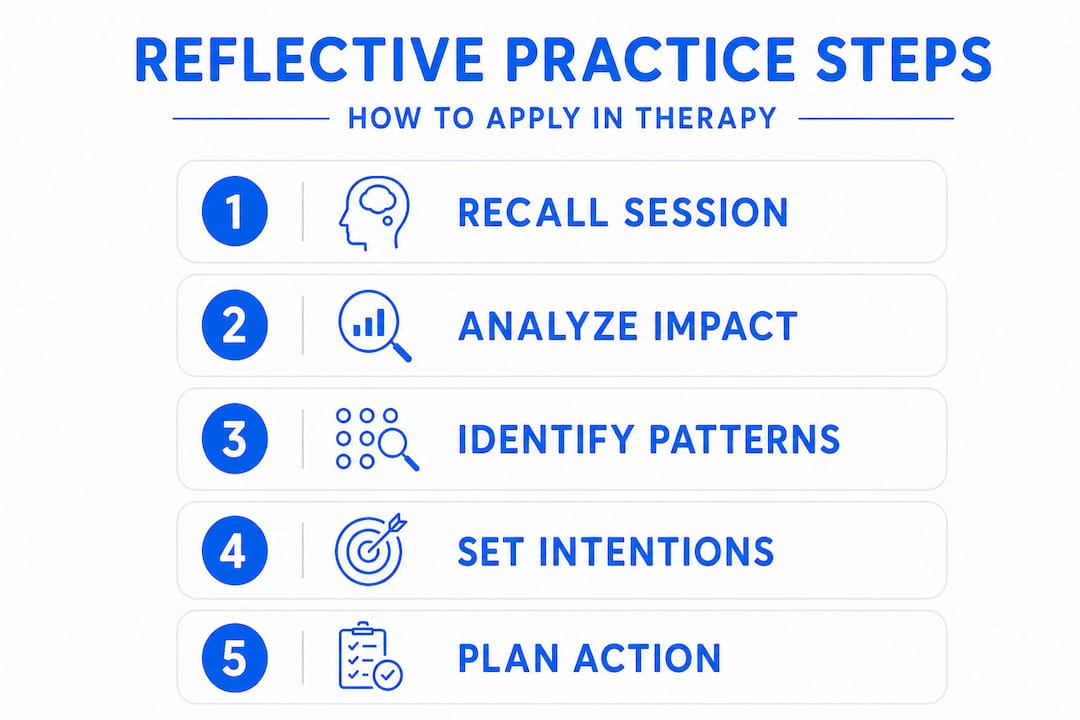
Here is a practical daily routine:
- After each session or significant interaction, spend five minutes writing brief notes using Driscoll’s model: What happened? Why does it matter? What will I do differently?
- Review those notes weekly to spot patterns across multiple interactions.
- Bring the patterns you notice into supervision or peer consultation for feedback.
- Set one specific behavioral intention for the following week based on what you discovered.
- Revisit that intention the next week and evaluate whether it worked.
Research adds an important caution here. One randomized controlled trial found no significant difference between video-based and memory-based self-reflection methods, suggesting that the format matters less than the guidance and feedback you receive. In other words, reflecting alone on a video of yourself is not necessarily more powerful than reflecting from memory, if neither approach includes structured feedback.
Common pitfalls to watch for:
- Overthinking without acting: Endless analysis without behavioral change becomes its own form of avoidance.
- Reflection without feedback: Without outside input, you are more likely to reinforce existing patterns than to challenge them.
- Irregular practice: Reflecting only after difficult sessions misses the learning available in ordinary ones.
- Skipping countertransference awareness: Your emotional reactions to clients are data. Ignoring them leaves a critical source of information untapped.
Pro Tip: Use brief written check-ins immediately after sessions rather than relying on memory at the end of the week. Memory fades and tends to smooth over the moments that would be most useful to examine.
Why true reflective practice is harder and more rewarding than it seems
Most guides to reflective practice present it as a clean, linear process. Follow the steps, fill in the framework, grow as a professional. That picture is appealing, but it is also misleading. The real challenge is not learning the steps. It is tolerating the discomfort of honest self-examination when you would rather move on.
Superficial reflection tends to confirm what you already believe about yourself. Deep reflection surfaces things you might prefer not to see. A therapist who reflects honestly will sometimes discover that they missed something important, or that their reaction to a client was more about their own history than the client’s needs. That discovery is uncomfortable. It is also where genuine growth actually lives.
The practices that produce real change are not solo ones. They involve trusted supervisors, honest colleagues, and a workplace culture that treats vulnerability as a strength rather than a liability. Reflective practice embedded in team culture is categorically more powerful than a private journaling habit, not because the journal does not matter, but because growth requires friction.
If you are willing to go beyond the surface and do reflective practice with genuine honesty and outside support, the rewards accumulate over time in ways that are hard to predict but impossible to ignore.
Connect with expert support for your reflective journey
Reflective practice is most powerful when it is guided, structured, and supported by professionals who understand both the theory and the human side of growth.

If you are ready to move beyond surface-level self-examination and build a real foundation for personal and professional growth, our team at Bergen County Therapist is here to help. You can explore your psychotherapy options and find an approach that fits your goals, or take the first step and start therapy with a free consultation. Growth does not have to happen alone.
Frequently asked questions
What is the difference between reflection and reflective practice?
Reflection is simply thinking about an experience, while reflective practice is a structured, ongoing process aimed at continuous learning and improvement in professional behavior.
Which reflective model is best for therapists?
The best model depends on your context and learning style. Gibbs, Kolb, and Driscoll are all widely used, with Driscoll’s simple three-question format being easiest to start with.
Does reflective practice actually improve therapy outcomes?
Yes. Higher reflective practice correlates with better therapist caring behaviors and improved client outcomes across multiple professional settings.
Can I do reflective practice alone, or do I need supervision?
Solo reflection offers benefits, but research shows that self-reflection alone may require additional guidance and feedback to produce meaningful change and reduce the risk of reinforcing bias.
Recommended
- 7 Practical Examples of Affirming Therapy for Growth
- The Therapist’s Role in Healing: Approaches and Growth with Dr Stephen Oreski & Associates.
- 7 Group Therapy Tips for Growth: Dr Stephen Oreski & Associates.
- How to Start Therapy for Personal Growth and Healing
- How to Choose the Best Coaching Model for Personal Growth