

TL;DR:
- Telehealth therapy is as effective as in-person care for many conditions and offers greater convenience.
- It requires a secure platform, licensed NJ therapist, and insurance verification, with most sessions being quickly accessible.
- Not suitable for crisis situations or severe symptoms; environmental factors and technology issues can pose challenges.
Most Bergen County residents assume that sitting across from a therapist in person is always the gold standard for mental health care. That assumption is worth questioning. Research increasingly shows that for a wide range of conditions, virtual therapy delivers results that rival face-to-face sessions, and in some situations, it performs even better. If you’ve been hesitant to try telehealth because you’re not sure it’s “real” therapy, or you’re worried about privacy and technology, this guide breaks down what actually matters so you can make a confident, informed decision for your mental health.
Table of Contents
- What is telehealth therapy and how does it work in Bergen County?
- Pros of telehealth therapy: Why Bergen County residents choose virtual care
- Cons of telehealth therapy: Limitations and challenges for Bergen County
- How to decide: Is telehealth therapy right for you?
- A therapist’s take: What most people overlook about telehealth therapy
- Explore your options with Bergen County therapists
- Frequently asked questions
Key Takeaways
| Point | Details |
|---|---|
| Telehealth matches in-person results | For most mental health concerns, telehealth is just as effective as traditional office visits. |
| Convenience and privacy | Virtual sessions fit busy lives and let you seek support from home with licensed Bergen County therapists. |
| Not suitable for urgent needs | In-person care remains crucial for crises and severe psychiatric cases where immediate response is required. |
| Verify insurance coverage | Most plans cover telehealth, but confirm with your provider to avoid billing surprises. |
What is telehealth therapy and how does it work in Bergen County?
Telehealth therapy is a licensed mental health service delivered through digital channels rather than a physical office. For Bergen County residents, that means working with a New Jersey-licensed therapist over a secure video platform, by phone, or in some cases through encrypted messaging. The session content is identical to in-person care: you talk, your therapist listens and responds, and together you work through whatever you’re dealing with.
To access telehealth in New Jersey, you must use a therapist who holds a valid NJ license. Out-of-state providers, even highly credentialed ones, cannot legally provide therapy to you as a New Jersey resident unless they are licensed here. As noted in guidance on booking virtual therapy, telehealth requires NJ-licensed therapists and is widely available, with most insurance covering sessions.
Here’s what you typically need to get started:
- A smartphone, tablet, or computer with a working camera and microphone
- A stable internet connection (broadband or strong mobile data)
- A private, quiet space where you won’t be interrupted
- An account or link for the therapy platform your provider uses
- Your insurance card and any referral information if required
Common platforms used by Bergen County providers include Doxy.me, SimplePractice, and Zoom for Healthcare, all of which use end-to-end encryption to protect your privacy.
| Platform | Insurance compatible | NJ provider availability | Session type |
|---|---|---|---|
| Doxy.me | Yes (varies by plan) | High | Video |
| SimplePractice | Yes | High | Video, messaging |
| Zoom for Healthcare | Yes | Moderate | Video |
| Phone sessions | Yes (many plans) | High | Audio only |
Insurance compatibility matters more than most people realize. Before your first session, call your insurer and ask specifically whether telehealth mental health visits are covered, and whether your provider is in-network. Telehealth outcome data from peer-reviewed research confirms strong clinical results across platforms, making the choice of platform less critical than ensuring your therapist is licensed and your insurance is verified.
Once confirmed, most practices allow you to book online, complete intake forms digitally, and start your first session within days. That speed is one of telehealth’s most underappreciated advantages.
Pros of telehealth therapy: Why Bergen County residents choose virtual care
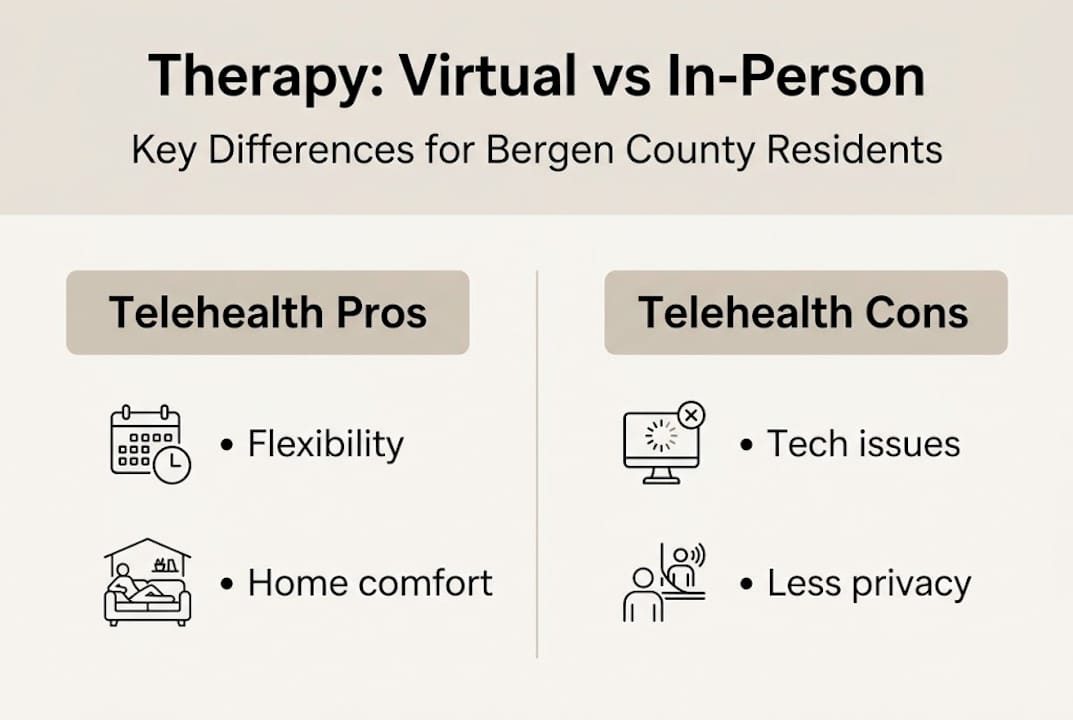
Bergen County is one of the most commuter-dense counties in New Jersey. Between work, school pickups, and packed schedules, carving out time for an in-person appointment often feels impossible. That’s exactly where telehealth shines. The benefits of online therapy go well beyond simple convenience.
For mild to moderate depression, anxiety, PTSD, and ongoing maintenance therapy, telehealth is as effective as in-person sessions for most conditions, including symptom reduction and client satisfaction. VA studies and comparable outcomes research confirm this finding across diverse populations.
Here’s a quick summary of what makes virtual therapy practical:
- No commute: Sessions happen wherever you are, cutting out drive time and parking stress
- Flexible scheduling: Early morning and evening slots are more common with telehealth providers
- Greater therapist access: You’re not limited to providers within a few miles of your zip code
- Lower barrier to start: Some people find it easier to open up from the comfort of home
- Continuity of care: Travel, illness, or bad weather won’t cancel your session
- Privacy from stigma: No waiting room means no running into someone you know
New Jersey has strong insurance parity laws, meaning that most NJ insurance plans cover telehealth at the same rate as in-person visits. The mental health benefits available under NJ-based insurance plans make telehealth financially comparable to office visits for most Bergen County residents.
Telehealth also tends to perform well for working parents, people managing chronic conditions alongside therapy, and anyone using therapy for personal growth rather than crisis intervention. It’s particularly well-suited for cognitive behavioral therapy (CBT), which follows structured, skill-based sessions that translate naturally to a screen.
Pro Tip: Always call your insurance provider before booking to confirm your specific telehealth benefits. Ask whether your therapist’s NPI number is in-network, not just whether the practice is listed.
Cons of telehealth therapy: Limitations and challenges for Bergen County
Despite the significant upsides, not all sessions or needs are suited for telehealth. Here are the primary concerns you should know.
The most common frustration is technology. A lagging video feed, a dropped connection mid-session, or a device that won’t cooperate can disrupt the therapeutic flow at the worst possible moments. For Bergen County residents in areas with inconsistent broadband, this is a real and recurring issue, not just a minor annoyance.
Beyond tech, there are clinical limitations worth understanding:
- Reduced nonverbal cues: Therapists read body language, posture, and subtle facial expressions. A small camera frame reduces that information significantly.
- Privacy at home isn’t guaranteed: Thin walls, roommates, or curious children can make it hard to speak freely.
- Not suitable for crisis: If you’re experiencing suicidal ideation, a psychiatric emergency, or severe symptoms, telehealth is not the right venue. In-person or emergency care is needed.
- Out-of-state provider risk: Using a provider not licensed in NJ could void your insurance coverage and create legal complications.
- Session intimacy: Some clients simply find it harder to connect emotionally over a screen, which can slow progress.
“Telehealth is a powerful tool for ongoing care, but clinical judgment must always guide the decision. Certain presentations, including active crisis and complex trauma work requiring somatic interventions, are better served in person. The platform should match the clinical need, not the other way around.”
Telehealth safety evidence consistently shows that while outcomes are strong for most cases, technology issues and limited nonverbal cues remain genuine drawbacks. If you’re dealing with something severe, explore in-person options before defaulting to virtual care.

Pro Tip: Before your first session, test your camera, microphone, and internet connection. Choose a room with a closed door and let anyone in your home know you need 50 uninterrupted minutes.
For a broader picture of how Bergen County residents are approaching mental health today, local mental health trends show a significant increase in telehealth adoption alongside continued demand for in-person care.
How to decide: Is telehealth therapy right for you?
With a balanced understanding of both pros and cons, here’s how to decide if telehealth is your best option or if in-person therapy makes more sense.
Start with these questions:
- Do you have a stable internet connection and a private space at home?
- Are your symptoms mild to moderate, rather than severe or crisis-level?
- Is your schedule making it difficult to attend in-person appointments consistently?
- Does your insurance cover telehealth at parity with in-person visits?
- Are you comfortable using video technology for communication?
- Have you had a recent psychiatric evaluation confirming your diagnosis is stable?
If you answered yes to most of those, telehealth is likely a strong fit. If you’re unsure about insurance or clinical fit, review therapy selection tips before committing. Empirical studies show high satisfaction and comparable outcomes for many, but clinical fit matters as much as preference.
| Criteria | Telehealth | In-person |
|---|---|---|
| Convenience | High | Moderate |
| Insurance coverage (NJ) | Usually at parity | Standard |
| Privacy at home | Variable | Guaranteed in office |
| Crisis suitability | Not appropriate | Recommended |
| Technology required | Yes | No |
| Nonverbal communication | Reduced | Full |
| Therapist access | Broader range | Geographically limited |
For structured, skills-based approaches like CBT for telehealth, the format translates especially well to video sessions. For trauma work or family therapy with young children, in-person settings often offer better results.
Your next step is simple: verify your insurance, identify whether your symptoms are a clinical fit, and reach out to a licensed NJ therapist for a consultation. Most practices offering virtual care will help you determine the right format during that first conversation.
A therapist’s take: What most people overlook about telehealth therapy
After working with many Bergen County clients, both in person and virtually, one thing stands out clearly: the debate about telehealth versus in-person care is almost never really about quality. It’s about fit.
The clients who struggle most with telehealth are usually those who chose it out of convenience alone, without considering whether their environment or clinical needs actually support it. A noisy apartment, a roommate who works from home, or severe symptoms that need hands-on crisis management make telehealth the wrong choice regardless of how effective it is on paper.
On the other hand, some clients genuinely do better in virtual sessions. They feel less self-conscious at home. They open up more quickly. Consistency improves when there’s no commute acting as a barrier.
The practical wisdom here: give it three to four sessions before deciding it’s not working. One awkward session with a tech glitch is not a verdict on telehealth as a whole. If after a few sessions something still feels off, talk to your therapist about switching formats. Hybrid arrangements, alternating between virtual and in-person, are increasingly common and can work well.
Telehealth is highly effective for ongoing therapy, but edge cases and crisis care require in-person professional support. Keeping that boundary clear protects you. The broader picture of how Bergen County residents navigate these choices is visible in local mental health trends, where hybrid models are becoming a practical norm.
Pro Tip: If you’re undecided, start with telehealth for general therapy and reserve in-person sessions for moments when you need more direct support. Flexibility is a feature, not a compromise.
Explore your options with Bergen County therapists
If you’re considering telehealth therapy, here’s how you can get started or explore more support options in Bergen County.

At Bergen County Therapist, Dr. Stephen Oreski and his team work with individuals, couples, families, and teens through both in-person and virtual sessions, matching each client to the format and therapist that actually fits their needs. Whether you’re drawn to telehealth for its flexibility or prefer the structure of an in-office visit, support is available on your terms. Explore the benefits of online therapy, review the different types of psychotherapy offered, or take the first step and find support by booking a free consultation today.
Frequently asked questions
Is telehealth therapy covered by insurance in Bergen County?
Most insurance plans in Bergen County cover telehealth at the same rate as in-person visits, but verifying with your specific provider before your first session is always required.
Is telehealth as effective as in-person therapy for mental health?
For mild to moderate conditions, research confirms that telehealth therapy matches face-to-face care in symptom improvement and client satisfaction.
Are there situations where telehealth isn’t appropriate?
Yes. Crisis care and severe cases require in-person or emergency treatment, and telehealth is not recommended when urgent safety concerns are present.
What technology do I need for telehealth therapy?
You’ll need a reliable internet connection, a private space, and a device with video and audio capability to access telehealth therapy in Bergen County.
Recommended
- How to book virtual therapy in Bergen County: A guide
- Comprehensive Psychotherapy & Counseling Services in Bergen County – Dr. Stephen Oreski & Associates
- Hudson County, NJ Therapists | Counseling & Mental Health Care
- How to choose an online therapist in Bergen County 2026
- Télémedecine : quels vrais gains au cabinet ?