TL;DR:
- Gender dysphoria involves significant distress from a mismatch between gender identity and assigned sex.
- Causes are multifactorial, including genetic, prenatal, neurological, and environmental factors.
- Support and treatment are personalized, ranging from therapy and social transition to medical interventions.
Gender dysphoria is not simply disliking your body or feeling uncomfortable in your own skin on a bad day. It is a recognized clinical condition defined in the DSM-5 as a marked incongruence between one’s experienced gender and the gender assigned at birth, lasting at least six months and causing significant distress or impairment in daily life. Many people, including families trying to support loved ones, carry misconceptions about what this experience actually involves. This article walks through what gender dysphoria really means, what causes it, how it shows up in everyday life, and what support options exist today.
Table of Contents
- What is gender dysphoria?
- Common signs and experiences
- What causes gender dysphoria?
- Treatment approaches and support options
- Special considerations for youth and families
- A more nuanced perspective on gender dysphoria
- Support options and care at Bergen County Therapist
- Frequently asked questions
Key Takeaways
| Point | Details |
|---|---|
| Distinction matters | Gender dysphoria is the distress caused by gender incongruence, not the incongruence itself. |
| Support is flexible | People can benefit from psychosocial support, therapy, and affirming care, with options tailored to the individual. |
| Youth outcomes vary | Many children outgrow gender dysphoria, and non-medical support is often effective. |
| Science is evolving | The causes and best treatments for gender dysphoria are still being researched, and approaches may differ by region. |
What is gender dysphoria?
Gender dysphoria is one of those terms that gets used loosely, but its clinical meaning is specific. The DSM-5 and the American Psychological Association define it as the distress that arises when a person’s deeply felt gender identity does not match their sex assigned at birth. The key word here is distress. Not every person who feels a mismatch between their identity and their assigned sex will experience gender dysphoria.
This distinction matters enormously. Gender incongruence is not a disorder; it simply describes a mismatch between gender identity and assigned sex. Dysphoria is the distress caused by that mismatch, and it is only diagnosed when it causes significant impairment in a person’s social, occupational, or other areas of functioning.
“Not everyone who experiences gender incongruence will develop gender dysphoria. The diagnosis centers on clinically significant distress, not identity itself.”
The diagnostic criteria also differ depending on age. For children, criteria include strong desire to be another gender, preference for cross-gender roles or toys, strong dislike of one’s sexual anatomy, and these signs must persist for at least six months with accompanying distress. For adolescents and adults, criteria focus on a strong desire for the sex characteristics of another gender, a belief that one has the emotions and responses of another gender, and a desire to be treated as another gender.
| Feature | Gender incongruence | Gender dysphoria |
|---|---|---|
| Definition | Mismatch between identity and assigned sex | Distress caused by that mismatch |
| Requires diagnosis? | No | Yes, if causing impairment |
| Present in all trans individuals? | Yes | Not necessarily |
| Treated with therapy? | Not required | Often beneficial |
You can read more about therapy options for gender dysphoria to understand what professional support looks like in practice.
Common signs and experiences
With a clinical understanding in place, it is important to recognize how gender dysphoria can show up in daily life. The experience is deeply personal and varies widely from person to person, but certain patterns appear consistently across research and clinical practice.
For children, signs often include a persistent and intense desire to be a different gender, strong preferences for clothing, toys, and activities typically associated with another gender, and distress when asked to conform to their assigned gender role. These signs look different from ordinary childhood experimentation because they are consistent, insistent, and persistent over time.

For adolescents and adults, strong desire for sex characteristics of another gender is common, along with significant anxiety or depression tied to one’s body, a desire to be socially recognized as another gender, and distress in environments that constantly reinforce the assigned gender.
Common experiences reported by individuals include:
- Persistent discomfort with one’s body, especially during puberty
- Anxiety, depression, or withdrawal in social situations tied to gender expectations
- Strong identification with peers of another gender
- Desire to change one’s name, pronouns, or physical appearance
- Relief or comfort when expressing a different gender identity
Pro Tip: Pay attention to persistent distress rather than temporary discomfort. Everyone has moments of uncertainty about identity. Gender dysphoria involves ongoing, significant distress that interferes with daily functioning.
Families and friends often wonder whether what they are seeing is a phase or something more significant. The LGBTQIA+ psychotherapy guide at Bergen County Therapist offers helpful context, and affirming therapy support can provide a safe space to explore these questions without pressure or judgment.
What causes gender dysphoria?
Understanding what gender dysphoria looks like is vital, but many also want to know why it happens. The honest answer is that no single cause has been identified, and researchers believe the origins are multifactorial.
Current research points to a combination of genetic, prenatal, and neurological factors. Twin studies offer some of the clearest data. Genetic heritability estimates range from 0 to 62% depending on the study, with monozygotic (identical) twin concordance at around 21% and dizygotic (fraternal) twin concordance at about 8.7%. This tells us genetics plays a role, but it is far from the whole story.
Prenatal hormone exposure and brain development differences have also been studied as possible contributors. Some research suggests that variations in how the brain processes gender-related information may be present from early development, though this area remains an active field of inquiry.
| Factor | Evidence level | Notes |
|---|---|---|
| Genetics | Moderate | MZ concordance ~21%, heritability 0-62% |
| Prenatal hormones | Preliminary | Possible influence on brain development |
| Brain differences | Emerging | Some structural differences reported |
| Environment/culture | Considered | Influences expression, not sole cause |
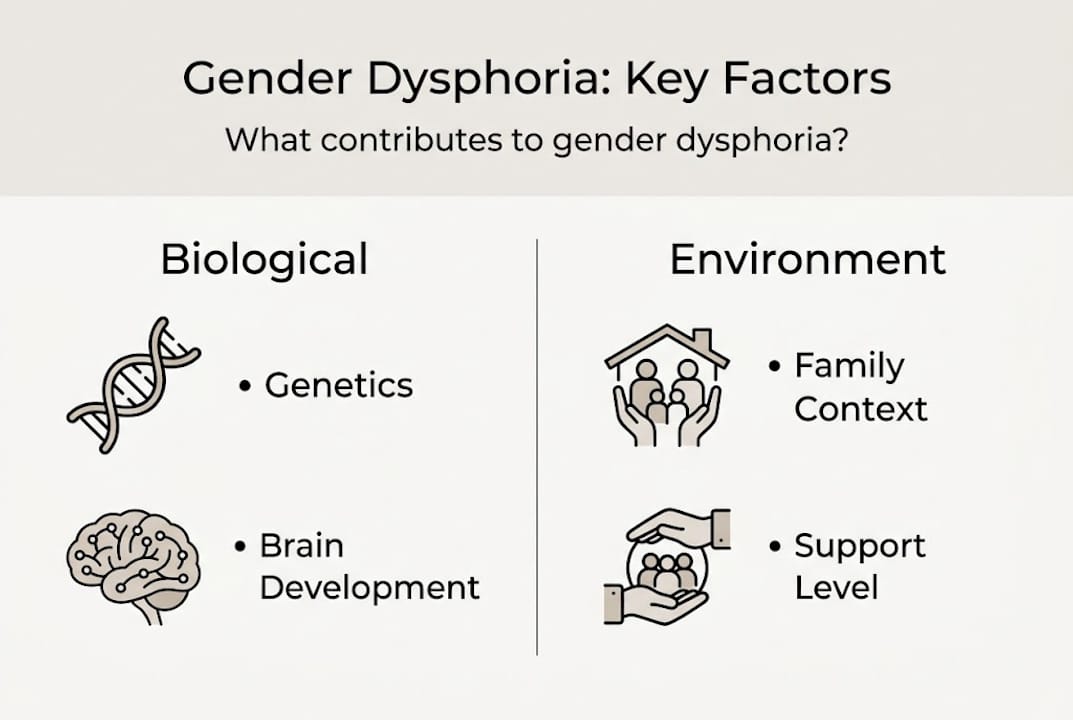
Key statistic: Identical twins share the same genetic code, yet the concordance rate for gender dysphoria is only around 21%. This strongly suggests that biology alone does not determine whether someone will experience gender dysphoria.
Environmental and family context also matter, though not in the way some people assume. A supportive or unsupportive environment does not cause gender dysphoria, but it does shape how distress is experienced and expressed. One thing is clear: experiencing gender dysphoria is not anyone’s fault. It is not caused by parenting choices, trauma alone, or social influence in isolation. Learning more about affirmative therapy for LGBTQIA+ individuals can help families understand how to respond with care rather than blame.
Treatment approaches and support options
Once gender dysphoria is recognized, knowing what support and treatment pathways exist is crucial. There is no single correct path, and the best approach depends on the individual’s age, the severity of distress, and personal goals.
Treatment goals center on alleviating distress through gender-affirming care, which can include psychosocial support, social transition, hormone therapy, and in some cases surgery. The WPATH (World Professional Association for Transgender Health) Standards of Care outline an informed consent model that guides medical decisions.
Here is a general overview of the staged options:
- Psychosocial support: Individual or family therapy to process feelings, reduce distress, and build coping strategies.
- Social transition: Changing name, pronouns, clothing, and social presentation without medical intervention.
- Hormone therapy: For adolescents and adults, hormone treatment to align physical characteristics with gender identity.
- Surgical options: Considered after thorough assessment and, typically, a period of hormone therapy.
- Ongoing mental health support: Continued therapy throughout any transition process to monitor wellbeing.
Pro Tip: Focus on distress reduction and individualized care. There is no timeline that works for everyone. Moving at a pace that feels right for the individual, with professional guidance, tends to produce the best outcomes.
It is worth noting that significant debate exists in the field, particularly regarding youth. Some reviews urge caution for medical interventions in young people, citing low evidence quality and ethical concerns about long-term effects. European health authorities have shifted toward therapy-first models for youth, while WPATH continues to support affirming care. This is an evolving conversation, and staying informed matters. Exploring therapy for LGBTQIA+ individuals and reviewing LGBTQIA+ therapy services can help you understand the range of options available.
Special considerations for youth and families
Youth and their families often have unique questions, so let’s clarify what research suggests for children, teens, and caregivers.
One of the most discussed findings in this area is desistance, which means the experience of gender dysphoria resolving over time without medical intervention. Research shows that many childhood cases resolve before or during puberty, and most youth benefit from non-medical support. However, adolescents who persist in their gender dysphoria into and through puberty are more likely to continue identifying as transgender into adulthood.
A Swedish cohort study found that legal gender stability was 98% at ten years among those who had undergone legal gender transition, while desistance after medical treatment was rare.
| Group | Desistance likelihood | Recommended support |
|---|---|---|
| Young children | Higher | Non-medical, watchful support |
| Adolescents with persistent dysphoria | Lower | Multidisciplinary evaluation |
| Adults | Rare | Individualized affirming care |
Clinicians also note rising rates of gender dysphoria among adolescent females, sometimes referred to as rapid-onset cases, and higher rates of comorbidities such as autism spectrum disorder and trauma histories. These factors make thorough evaluation especially important.
Steps families can take to support a child or teen:
- Validate feelings without immediately pushing toward or away from any particular path
- Seek a multidisciplinary evaluation that includes mental health professionals
- Monitor for comorbid conditions like anxiety, depression, or trauma
- Create an affirming home environment that prioritizes emotional safety
- Stay engaged with your child’s mental health over time, not just at the point of crisis
Reaching out for LGBTQIA+ counseling early can make a meaningful difference in how families navigate this process together.
A more nuanced perspective on gender dysphoria
Stepping back, it is worth considering why so many competing perspectives exist in this field and what that means for those seeking support.
Both affirming care models and therapy-first approaches have real merits, and both have real limitations. Affirming care prioritizes the individual’s sense of self and reduces distress quickly, which matters enormously when someone is suffering. Therapy-first models prioritize caution, especially for younger patients, because the long-term data on medical interventions is still developing.
The uncomfortable truth is that neither approach has a complete answer. Science is still catching up. What we do know is that every person’s experience of gender dysphoria is shaped by a unique combination of biology, psychology, family, culture, and timing. Treating these journeys as identical does a disservice to everyone involved.
Labels can help people find community and language for their experience, but they can also create pressure to fit a particular narrative. Our view, informed by working with individuals and families navigating these questions, is that the most helpful thing a clinician or family member can do is listen first. The psychotherapy guide for LGBTQIA+ individuals reflects this philosophy: start with the person, not the protocol.
Support options and care at Bergen County Therapist
After exploring the complexities and support approaches for gender dysphoria, here is how to take the next step if you or a loved one seeks help.
At Bergen County Therapist, Dr. Stephen Oreski and his team offer compassionate, non-judgmental care for individuals and families navigating gender identity questions. Whether you are looking for a safe space to process your own experience or want to better support someone you love, our therapists are trained to meet you where you are.
Our guide to psychotherapy for LGBTQIA+ individuals is a great starting point. You can also explore individual therapy support to understand how one-on-one counseling works, or use our mental health tracking resources to monitor your wellbeing over time. Reach out today to schedule a free consultation.
Frequently asked questions
Is gender dysphoria a mental illness?
Gender dysphoria is a recognized condition in the DSM-5, but it is diagnosed based on distress and impairment, not on gender identity itself. Gender incongruence is not a disorder; the diagnosis applies only when that incongruence causes significant distress or functional impairment.
Can gender dysphoria go away without medical intervention?
Yes, particularly in children. Many childhood cases resolve before or during puberty, and empirical data shows most youth benefit from non-medical support rather than immediate medical intervention.
What’s the difference between gender incongruence and gender dysphoria?
Gender incongruence is a mismatch between a person’s gender identity and their assigned sex at birth. Dysphoria refers to the distress caused by that mismatch and is only diagnosed when it causes significant impairment in daily life.
Are there risks to starting treatment early, especially in youth?
This is an active area of debate. Some reviews urge caution for youth medical interventions due to unclear long-term effects and concerns about whether benefits outweigh potential harms, which is why thorough evaluation before any medical steps is strongly recommended.
Recommended
- Affirming LGBTQ+ Therapy | Dr Stephen Oreski & Associates.
- CBT for LGBTQIA+ Individuals: Find Support and Healing with Dr Stephen Oreski & Associates.
- The Essential Guide to Psychotherapy for LGBTQIA+ – Dr. Stephen Oreski & Associates
- LGBTQIA+ Counseling: Find Help – Dr Stephen Oreski & Asso
- Why Naming Your Feelings Helps — The Caia Journal