

TL;DR:
- Identity exploration is a lifelong process involving questioning, integrating, and committing to different aspects of oneself at any age. It encompasses multiple domains, such as gender, career, and relationships, which may be at different stages simultaneously, and uncertainty often signals growth rather than confusion. Seeking therapy and practicing small, intentional self-inquiries can support deeper understanding and stronger, more durable commitments over time.
Many people assume identity exploration is something teenagers do before they “figure themselves out,” but that belief leaves a lot of adults feeling confused about why they still feel unsettled about who they are. The truth is that identity exploration is a lifelong process, and it looks different at every stage of life. Whether you are questioning your gender, your career path, your relationships, or your values, you are doing something deeply human. This guide breaks down what identity exploration actually means, what research says about how it unfolds, and how you can use that knowledge to move forward with greater confidence and clarity.
Table of Contents
- What is identity exploration?
- Identity exploration in adolescence and adulthood
- Identity domains: More than one path
- Putting identity exploration into practice: Next steps for personal growth
- Why most guides miss the most empowering truth about identity exploration
- Explore your journey with Bergen County therapists
- Frequently asked questions
Key Takeaways
| Point | Details |
|---|---|
| Identity exploration is lifelong | People of all ages can benefit from revisiting and integrating aspects of their identity. |
| Uncertainty can promote growth | Temporary uncertainty may help set up stronger commitments in different domains. |
| Multiple domains, unique patterns | Identity exploration varies across domains like relationships, career, gender, and more. |
| Therapy supports clarity | Affirming therapy can provide guidance and structure for meaningful identity exploration. |
What is identity exploration?
Identity exploration is the active process of questioning, examining, and integrating different aspects of who you are. It is not a crisis. It is not a phase. It is the ongoing effort to understand yourself more fully, which psychologists recognize as central to healthy development across the entire lifespan.
Think of identity as your internal life story. It includes your values, your roles, your sense of belonging, and the commitments you have made or are working toward. When you explore your identity, you are essentially asking: “Who am I, and who do I want to become?” That question does not have a single final answer.
Key facets of identity exploration include:
- Questioning: Challenging assumptions you or others have made about who you are
- Integrating: Weaving together different aspects of your experiences and beliefs into a coherent sense of self
- Committing: Making meaningful choices about values, relationships, and directions in life
- Connecting: Understanding how your identity relates to your community, culture, and relationships
“Identity exploration can be ongoing in adulthood, and identity statuses can remain stable for many people while still allowing continued development processes.”
This is important because it challenges the popular assumption that adulthood means your identity is “done.” Stability and growth are not opposites. You can have a stable foundation while still expanding and refining who you are. For many people in Bergen County, working through this with the support of individual therapy provides the structure and safety to do that exploration at their own pace.
Identity exploration in adolescence and adulthood
Adolescence is the life stage most people associate with identity work, and for good reason. Teenagers often face intense pressure to define themselves while simultaneously experiencing rapid changes in their social worlds, bodies, and responsibilities. But adults face their own distinct challenges, including career transitions, relationship changes, loss, and major life events that can prompt deep questions about who they are.

Research supports a nuanced picture: identity reconsideration during adolescence may actually set the stage for stronger and more meaningful commitments later. In other words, going through a period of uncertainty is not a sign of failure. It is often preparation for clarity.
Here is a comparison of how exploration typically looks across life stages:
| Domain | Adolescent experience | Adult experience |
|---|---|---|
| Career/education | Exploring options, uncertainty about the future | Reconsidering goals, career pivots, retraining |
| Relationships | Forming first deep bonds, testing social roles | Evaluating long-term partnerships, chosen family |
| Gender and sexuality | Initial questioning, social discovery | Deeper integration, coming out at any age |
| Values and beliefs | Challenging family or cultural norms | Refining values after major life experiences |
Steps in identity exploration by life stage:
- Adolescents often begin by noticing tension between who others expect them to be and who they feel they are
- That tension leads to active questioning across social, educational, and personal domains
- Over time, adolescents test different roles and relationships to gather feedback
- Adults frequently re-enter exploration after a disruption (divorce, job loss, grief, or a shift in values)
- Adult exploration tends to be more targeted, often focused on one or two specific domains rather than identity as a whole
- Both groups benefit when they move from passive uncertainty to active inquiry, especially with support
Pro Tip: Not all uncertainty is a warning sign. A five-year longitudinal study found that uncertainty can actually precede stronger commitment in certain identity domains. Sitting with questions, rather than rushing to answers, is often exactly what leads to growth.
If you are a young person or a parent wondering how professional support fits in, understanding the role of a therapist in adolescence can clarify how therapy can support rather than interrupt that natural process of becoming.
Identity domains: More than one path
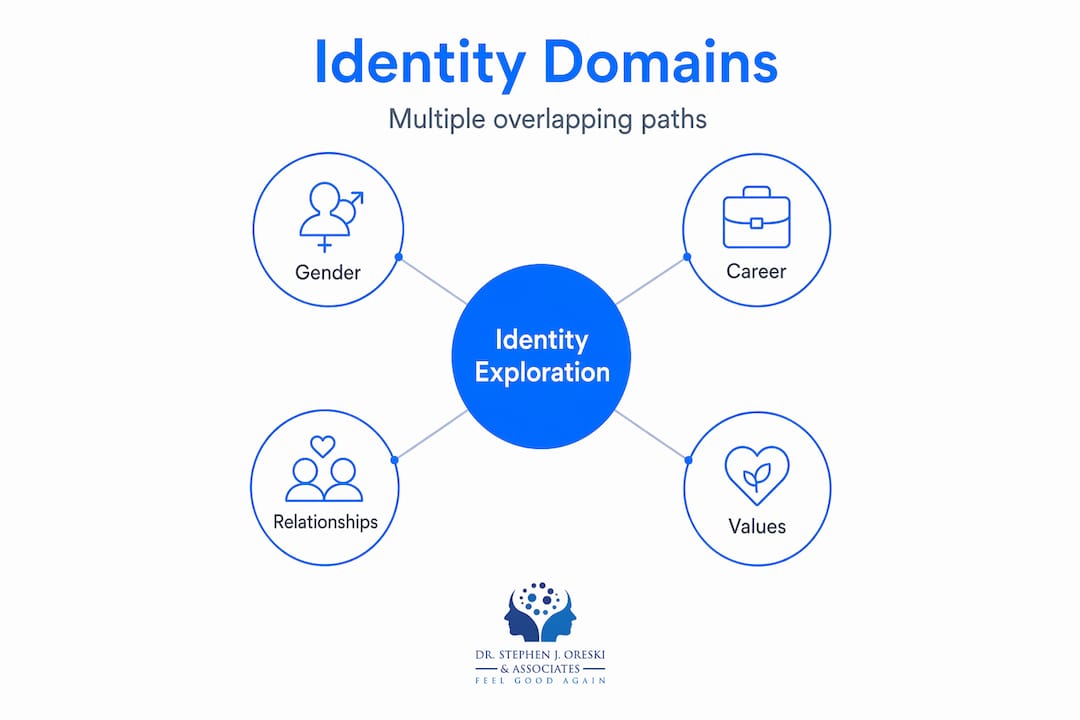
Here is something that surprises many people: your identity is not one unified thing. It is made up of multiple overlapping domains, and each one can be at a completely different point in the exploration and commitment cycle at the same time. You might feel deeply settled in your professional identity while simultaneously questioning your gender expression or your spiritual beliefs. That is not inconsistency. That is how identity actually works.
Researchers draw a critical distinction: exploration and commitment are separate processes, and different domains show different patterns across time. Exploration in your career does not automatically translate to exploration in your relationships. Each domain has its own rhythm.
| Domain | Exploration looks like | Commitment looks like |
|---|---|---|
| Gender identity | Questioning labels, trying new expressions | Embracing a consistent gender identity |
| Sexuality | Noticing attractions, exploring community | Owning your orientation with confidence |
| Career | Trying different roles or industries | Choosing a clear professional direction |
| Relationships | Exploring connection styles, attachment | Building stable, values-aligned relationships |
| Spirituality | Questioning inherited beliefs | Adopting a personal belief system |
Common misconceptions about identity exploration:
- “It means you are confused”: Exploration is active and purposeful, not passive confusion
- “It ends in your 20s”: Many people revisit major identity questions in midlife and beyond
- “Uncertainty means instability”: Uncertainty is often a productive step, not a permanent state
- “Identity exploration is selfish”: Understanding yourself more fully actually improves your relationships and empathy for others
For LGBTQIA+ individuals, identity exploration often touches multiple domains at once, including gender, sexuality, relationships, community belonging, and sometimes cultural or family identity. This layered experience deserves a layered response. Learning about affirming therapy approaches and LGBTQIA+ specific support can make a significant difference in how supported and understood you feel throughout that process.
Putting identity exploration into practice: Next steps for personal growth
Understanding the theory is one thing. Putting it into practice is another. The good news is that identity exploration does not require a dramatic life overhaul. It begins with small, intentional habits of self-inquiry.
Concrete strategies to start your identity exploration:
- Journaling with intention: Write not just what happened, but how you felt and what it revealed about your values or desires
- Notice contradictions: When you feel tension between how you act and how you want to act, that tension is information
- Seek out community: Connecting with others who share parts of your experience (including LGBTQIA+ communities) can validate and expand your self-understanding
- Challenge inherited scripts: Ask which parts of your identity were chosen by you versus assigned by family, culture, or circumstance
- Set small identity experiments: Try a new role, a new community space, or a new way of expressing yourself, and notice how it feels
- Allow revision: Changing your mind is not weakness. It is evidence that you are actually paying attention
Pro Tip: Affirming therapy can significantly accelerate identity clarity, especially for those navigating LGBTQIA+ experiences or emotional challenges. A skilled therapist helps you reflect, challenge assumptions, and integrate experiences in ways that solo journaling cannot always achieve.
Research confirms that identity development in adulthood is possible and meaningful. Seeking individual therapy for personal challenges is not an admission that something is wrong. It is a strategic decision to accelerate growth with a trained guide.
Why most guides miss the most empowering truth about identity exploration
Most content about identity exploration focuses on relieving anxiety. It tells you that uncertainty is normal, which is true, but stops short of something even more useful: uncertainty is often the precondition for your most meaningful commitments.
Evidence shows that for adolescents, reconsideration and uncertainty can precede stronger future commitment in certain domains, even if the pattern varies. What this means clinically is that the discomfort you feel when you are questioning is not a problem to be solved. It is a signal that you are engaging in exactly the kind of active reflection that leads to a richer, more grounded identity.
In our experience working with clients across Bergen County, the people who try to rush past their uncertainty by locking in an identity too quickly often end up revisiting those same questions years later under more difficult circumstances. The ones who learn to sit with the discomfort, who ask better questions and seek honest support, tend to arrive at commitments that are far more durable and personally meaningful.
Uncertainty is not the enemy of identity. It is the doorway. And understanding that changes everything about how you approach your own growth. The goal is not to eliminate the discomfort but to become someone who can move through it with increasing skill and support. Learning how to support teens in therapy can also offer insight for adults supporting younger people in their lives who are in the thick of this process.
Explore your journey with Bergen County therapists
Identity exploration can feel like a solitary process, but it does not have to be. Whether you are navigating questions about gender, sexuality, career, relationships, or simply trying to understand yourself better, professional support can make the journey clearer and more grounded.
At Bergen County Therapist, Dr. Stephen Oreski and his team offer a range of services designed to meet you where you are. You can explore different types of psychotherapy to understand which approach fits your needs. If you are part of the LGBTQIA+ community, our psychotherapy for LGBTQIA+ individuals provides an affirming space where your full identity is honored. Ready to take the next step? Begin your therapy journey with a free consultation and connect with a therapist who genuinely gets it.
Frequently asked questions
Is identity exploration only for adolescents?
No, research confirms that identity exploration is ongoing throughout adulthood, helping people anchor meaningful commitments even while their overall identity remains relatively stable.
How is identity exploration different from uncertainty?
Exploration is an active, purposeful process of examining alternatives and integrating experiences, while uncertainty refers more to a lack of direction. Research shows they interact differently across identity domains, and one does not always imply the other.
Can therapy help with identity exploration?
Yes, affirming therapy provides a structured space to clarify your values and commitments, work through emotional challenges, and integrate new self-understanding with the support of a trained professional.
Does identity exploration differ by domain (like gender or career)?
Absolutely. Research demonstrates that the exploration and commitment patterns vary significantly across domains like gender, relationships, and education, which is why a one-size-fits-all approach rarely works.