

TL;DR:
- Minority stress is a chronic, identity-based stress resulting from discrimination and societal stigma.
- It impacts mental and physical health through external and internal stressors, leading to heightened anxiety and health issues.
- Support from affirming communities, therapy, and safety-building strategies enhance resilience and well-being.
Minority stress is not just occasional discomfort from a rude comment or an awkward situation. It is a chronic, relentless form of stress tied directly to who you are. Chronic stress from stigma shapes the daily lives of LGBTQIA+ individuals through prejudice, discrimination, and the painful absence of social support. This article breaks down where minority stress comes from, how it affects your mental and physical health, and what evidence-backed strategies can help you cope and build real resilience.
Table of Contents
- What is minority stress?
- The minority stress model: Types of stressors and impacts
- Critiques, alternative theories, and changing perspectives
- Coping with minority stress: Resilience and support
- Why minority stress deserves nuanced understanding and action
- Connect with expert support for minority stress
- Frequently asked questions
Key Takeaways
| Point | Details |
|---|---|
| Minority stress explained | Chronic stress arises from stigma and discrimination tied to minority identity. |
| Model shows stressors | The minority stress model distinguishes external and internal triggers linked to health issues. |
| Resilience matters | Community support and affirming therapy can reduce negative impacts of minority stress. |
| Critiques spur progress | Alternative theories and new data are expanding how mental health disparities are understood. |
What is minority stress?
Minority stress is not a personality flaw or a sign of weakness. It is a documented psychological phenomenon that emerges when people belong to groups that society stigmatizes or marginalizes. For LGBTQIA+ individuals, this stress does not take a day off. It accumulates quietly, shaping decisions about where to go, who to trust, and whether to be honest about who you are.
Stress from stigmatized identity operates differently from ordinary life stress because it is rooted in identity itself. You cannot simply remove the source. That persistent quality is what makes it so damaging over time.
Minority stress comes from two broad directions. External stressors push in from the outside world, while internal stressors develop as a person tries to navigate and survive in that world.
Common sources of minority stress include:
- Discrimination in housing, employment, or healthcare
- Rejection from family or community
- Experiences of harassment or violence
- Concealing your identity to stay safe
- Constant vigilance about how others may react
- Internalized shame connected to societal stigma
Research consistently links minority stress to elevated anxiety, higher blood pressure, depression, and reduced physical health. These are not abstract statistics. They reflect real consequences experienced by real people navigating hostile or indifferent environments every day.
For LGBTQIA+ individuals, these stressors are often compounded by family rejection and disconnection, which removes one of the most protective forces available to most people. Seeking affirming care for trauma is often a critical step toward healing when these wounds run deep.
The minority stress model: Types of stressors and impacts
Researchers have worked to map exactly how minority stress operates. The result is the minority stress model, developed by psychologist Ilan Meyer. This framework distinguishes distal and proximal stressors to explain how external events and internal psychological processes each contribute to health outcomes.
| Stressor type | Definition | Examples |
|---|---|---|
| Distal (external) | Events or conditions in the environment | Discrimination, hate speech, rejection |
| Proximal (internal) | Psychological responses to minority status | Concealment, vigilance, internalized shame |
The model helps explain a consistent pattern seen in research. Here is how the chain typically unfolds:
- A person faces discrimination or stigma from their environment.
- They develop heightened vigilance as a protective response.
- Over time, they may begin concealing their identity to avoid harm.
- Internalized shame or hopelessness can develop.
- These combined pressures accumulate into chronic stress.
- Chronic stress produces measurable mental and physical health impacts.
For students, this process can be especially visible. LGBTQ school challenges often mirror exactly this progression, with harassment triggering concealment, which deepens isolation and emotional distress.
The health consequences are not minor. Chronic activation of the stress response system raises cortisol levels, disrupts sleep, and strains cardiovascular health. CBT for LGBTQIA+ individuals has shown promise in breaking some of these cycles by targeting the internal stressor patterns that sustain chronic stress.

Critiques, alternative theories, and changing perspectives
The minority stress model has shaped research and clinical practice for decades. But science evolves, and so does our understanding of stigma and mental health.
Recent clinical reviews confirm the model is empirically supported, yet critique it for not fully explaining mental health disparities. Social stigma has decreased in many regions over recent decades, but mental health statistics for LGBTQIA+ populations have not improved proportionally. That gap demands better explanations.
One emerging framework is social safety theory, which focuses less on stress exposure and more on whether a person feels safe and accepted in their social environment.
| Feature | Minority stress model | Social safety theory |
|---|---|---|
| Focus | Stress from stigma and discrimination | Perceived social belonging and safety |
| Core mechanism | Stressor accumulation | Threat detection and safety signals |
| Strength | Decades of empirical backing | Explains resilience and context better |
| Limitation | Does not fully explain persistent disparities | Still developing evidence base |
This does not mean abandoning the classic model. It means recognizing that human experience is complex.
Key areas where alternative perspectives add value:
- Explaining why some individuals thrive despite high stressor exposure
- Accounting for the role of community belonging and identity pride
- Addressing gaps in how measurement tools capture lived experience
Psychological support for LGBTQIA+ communities benefits when practitioners stay current with evolving frameworks. Affirmative therapy that integrates safety and belonging, not just stress reduction, tends to be more responsive to individual needs.
Pro Tip: Do not assume one theory explains everything about your experience. Stay open to frameworks that better reflect your reality, and bring that curiosity into your work with a therapist.
Coping with minority stress: Resilience and support
Understanding stress is useful. Building the tools to live well despite it is essential.
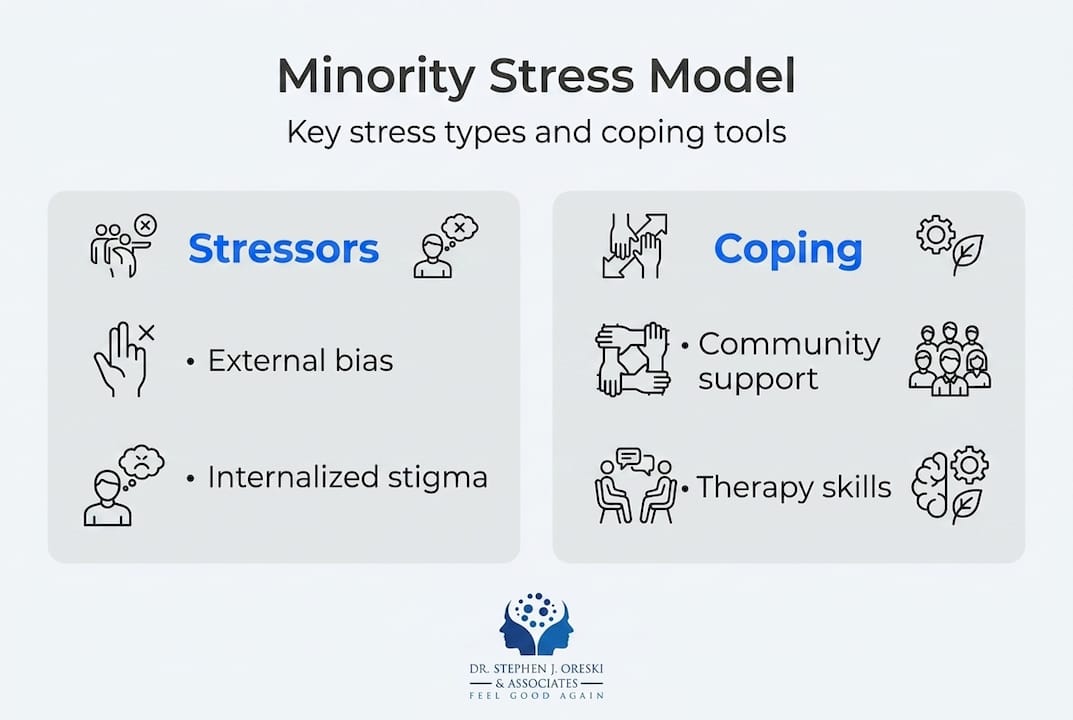
Resilience factors like community and affirming therapy consistently stand out in research on minority stress coping. Resilience is not about being invulnerable. It is about having enough support, skill, and self-awareness to recover and grow.
Evidence-backed coping strategies include:
- Connecting with affirming LGBTQIA+ community spaces, in person or online
- Seeking therapy with a provider who understands minority stress
- Practicing identity affirmation, naming and honoring your identity openly
- Using structured stress management techniques like mindfulness and grounding
- Setting boundaries with people or environments that are consistently harmful
- Engaging in regular physical movement, which helps regulate the stress response
Therapy specifically designed for LGBTQIA+ experiences offers something general therapy often cannot. A psychotherapy guide for LGBTQIA+ individuals can help you understand your options and find an approach that fits your needs.
If you are unsure where to start, exploring LGBTQIA+ counseling can clarify how specialized support differs from general mental health care and why that difference matters.
Pro Tip: Prioritize environments where you do not have to perform or hide. Safety is not a luxury. It is a basic condition for psychological growth.
Why minority stress deserves nuanced understanding and action
Here is something worth sitting with: the minority stress model gave us a common language for experiences that were previously dismissed or minimized. That matters enormously. But frameworks are maps, not territory. Your experience may not fit neatly into any model, and that is not a problem with you.
Mental health disparities in LGBTQIA+ communities are real and persistent, and coping effectively requires both individual resilience and structural support. Community belonging, culturally affirming care, and access to quality psychotherapy support are not optional additions. They are central to outcomes. Staying curious about evolving science and finding providers who share that curiosity makes a genuine difference.
Connect with expert support for minority stress
Learning about minority stress is a meaningful first step. Taking action is what creates change.

At Bergen County Therapist, Dr. Stephen Oreski and his team offer LGBTQIA+ affirming psychotherapy designed to address the specific stressors and experiences covered in this article. Whether you are exploring different types of psychotherapy or ready to start treatment today, compassionate and informed support is available. Free consultations make it easy to take the next step without pressure.
Frequently asked questions
How does minority stress differ from general stress?
Minority stress involves chronic, identity-based stressors stemming from stigma and discrimination, while general stress typically arises from situational challenges unrelated to identity or group membership.
What are examples of proximal stressors?
Proximal stressors include internalized homophobia, hypervigilance about how others perceive you, and the ongoing effort of concealing your identity to avoid discrimination or rejection.
Can therapy help reduce the effects of minority stress?
Yes. Therapy, especially LGBTQIA+ affirming approaches, builds resilience through community connection and equips you with practical tools to manage the ongoing effects of minority stress.
Why don’t decreasing stigma rates always improve mental health statistics?
Minority stress alone does not account for all mental health disparities; emerging alternative theories and additional contextual factors help explain why improvements in social stigma do not always translate into better outcomes.
Recommended
- Coping with Stress – Dr. Stephen Oreski & Associates
- Stress Reduction Strategies for Busy Lives – Dr. Stephen Oreski & Associates
- Practical Stress Management Tips for Bergen County Adults
- Stress Management Techniques for People of Color Dealing with Microaggressions – Dr. Stephen Oreski & Associates
- Emotional Overload and Why It Happens — Caia Evergreen