

- Peer pressure influences adolescent behavior through social instincts, affecting both positive and negative actions.
- Vulnerable teens such as those with low self-esteem or poor family connections are most susceptible to peer influence.
- Building strong relationships, setting boundaries, and seeking professional support can foster resilience against peer pressure.
Peer pressure is not a sign of weakness, and it is not something that only affects shy or insecure teens. Research shows that peer influence operates through deeply wired social instincts, meaning virtually every adolescent is susceptible at some level. Whether you are a teen trying to figure out who you are, or a parent watching your child navigate friendships you are not entirely sure about, understanding what peer pressure actually is and how it works can make an enormous difference in outcomes. This guide breaks down the science, identifies the real risks, and offers concrete strategies you can start using today.
Table of Contents
- What is peer pressure and why does it matter?
- Who is most affected by peer pressure?
- The real-life impact: Mental health, risk, and resilience
- How to respond: Practical strategies for teens and parents
- Our perspective: The hidden power of peer relationships
- Get support: Resilience is possible
- Frequently asked questions
Key Takeaways
| Point | Details |
|---|---|
| Types of peer pressure | Peer pressure includes direct, indirect, and positive influences that can shape behavior in different ways. |
| Risk factors | Teens with less support or lower self-esteem are more vulnerable to negative peer pressure. |
| Mental health links | Peer pressure increases risks for substance use and emotional challenges, but strong support networks protect well-being. |
| Resilience strategies | Assertive communication, supportive relationships, and positive parenting help teens resist harmful pressures. |
What is peer pressure and why does it matter?
Peer pressure is the social influence that people your own age exert on your attitudes, values, and behavior. It feels compelling because humans are wired to seek belonging. During the teen years, especially, social acceptance is not just nice to have; it feels essential to survival in a very real emotional sense.
Psychologists identify three main types of peer pressure:
| Type | How it works | Example |
|---|---|---|
| Normative | Wanting to fit in with a group | Wearing certain clothes to match friends |
| Informational | Looking to peers for guidance | Copying how classmates handle a new school |
| Coercive | Direct threats or manipulation | Being told “do this or you’re out of the group” |
Most people focus on coercive pressure because it is the most obvious. But normative and informational pressure are far more common, and because they feel natural, they are actually harder to notice and resist.
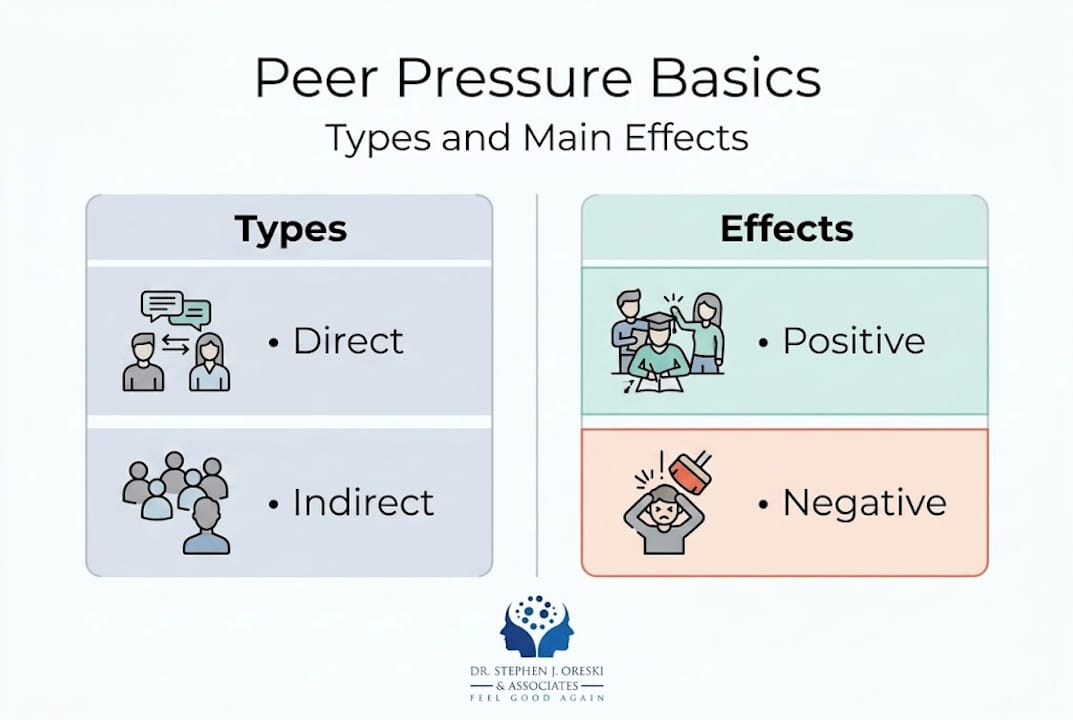
Peer pressure is not always destructive. Consider the teen who starts exercising because her friend group is into running, or the student who raises his grades because his close friends take academics seriously. These are real examples of positive peer pressure, and they show up more often than many people expect.
- Negative: Pressure to try substances, skip school, shoplift, or exclude others
- Positive: Motivation to study harder, volunteer, or practice healthy habits
- Passive: Simply observing what peers do and adjusting to match without any direct push
- Active: A peer directly encouraging or challenging you to do something
Pro Tip: If your teen has a friend who challenges them to be a better student, athlete, or person, that relationship is worth nurturing. Not all peer pressure points in the wrong direction, and recognizing good influence is just as important as spotting the bad.
Who is most affected by peer pressure?
Now that you understand what peer pressure is, the more pressing question is: who is most likely to be seriously affected by it?
The short answer is that adolescents in general are more vulnerable than adults, simply because of where they are developmentally. The teen brain is still building the connections between impulse and consequence. Teens are actively seeking identity and autonomy, which makes them both open to influence and hungry for peer approval.
That said, certain characteristics increase susceptibility significantly:
- Low self-esteem — Teens who feel unsure of their own worth are more likely to conform to gain acceptance.
- High impulsivity — Acting before thinking reduces the mental space to evaluate peer suggestions critically.
- Poor family connection — When teens do not feel safe or heard at home, they lean harder on peers for validation.
- Seeking autonomy without guidance — Teens pushing for independence without adult support may look entirely to peers for direction.
- Social anxiety — Fear of rejection can make saying “no” feel impossible.
Family dynamics matter enormously here. Research shows that psychological control by parents, such as guilt-tripping or withdrawing love, actually increases a teen’s vulnerability to peer pressure by reducing their sense of autonomy and belonging. Boys, in particular, show a stronger response to this type of control. On the flip side, parental warmth and support act as a genuine buffer.
| Risk factor | Who it affects most | Why it matters |
|---|---|---|
| Low self-esteem | All teens, especially girls | Drives conformity for acceptance |
| Psychological parental control | Boys more strongly | Undermines sense of self and autonomy |
| Weak school connection | All adolescents | Leaves peers as the only belonging source |
| Impulsivity | Teens with ADHD or trauma history | Reduces ability to pause and assess |
Understanding the parenting challenges that emerge at different ages can help families build the kind of connection that protects teens before problems start. Parents who know how to guide child behavior positively tend to raise teens who feel secure enough to push back when peers push them in the wrong direction.
The real-life impact: Mental health, risk, and resilience
Knowing who is vulnerable is important, but what does peer pressure actually lead to? The data is sobering, and every parent and teen deserves to know it clearly.
Studies confirm that peer pressure is linked to higher rates of substance use among teens, especially when peer victimization and emotional difficulties are also present. When a teen feels bullied or excluded, the risk of turning to substances to cope climbs sharply. On the other hand, teens with strong relationships with parents and teachers, and a genuine sense of belonging at school, show far lower rates of risky behavior.
“57% of U.S. teen girls felt persistently sad or hopeless, and nearly 30% seriously considered suicide.” — CDC Youth Risk Behavior Survey, 2023
That number should stop you for a moment. More than half of all teen girls are carrying a weight of persistent sadness, and peer dynamics play a significant role. Peer victimization, which includes bullying, exclusion, and online harassment, dramatically amplifies mental health struggles.
Here are the major consequences and warning signs to watch for:
- Sudden changes in friend groups, especially if a teen pulls away from longtime friends
- Declining grades or a new disinterest in activities they once loved
- Mood swings, irritability, or withdrawal that go beyond typical teen behavior
- Signs of substance use, including changes in sleep, appetite, or energy
- Increased secrecy about online activity or whereabouts
- Expressions of hopelessness or feeling like they do not belong
Learning how to support teen mental health is not a one-time conversation. It is an ongoing commitment to staying aware. If a teen has already experienced emotional abuse or trauma, peer pressure effects are often compounded. Understanding how emotional abuse affects mental health can help parents and teens recognize when professional help is the next step.
How to respond: Practical strategies for teens and parents
Knowledge without action only goes so far. Here is what actually helps, broken into strategies for teens and strategies for parents.
For teens:
- Know your values before the pressure arrives. When you already know what matters to you, saying “no” becomes easier because you have a reason, not just a feeling.
- Practice assertive communication. You do not have to be aggressive to hold your ground. A calm, clear “that’s not something I want to do” is enough.
- Choose your inner circle carefully. Research on peer relationships and prosocial climate confirms that the norms of your closest group shape your behavior over time. Being selective is not antisocial; it is smart.
- Build relationships with trusted adults. The APA emphasizes that teens need supportive adults in their lives. Peer support matters, but it cannot replace the stability that a trusted adult provides.
- Ask for help without shame. Needing support is not a weakness; it is exactly how resilience gets built.
For parents:
- Foster genuine connection at home. A teen who feels truly heard at home is far less likely to make dangerous choices to earn belonging elsewhere.
- Encourage autonomy without abandoning guidance. Giving teens real choices and respecting their preferences builds the confidence they need to resist outside pressure.
- Avoid psychological control. Guilt, conditional love, and emotional manipulation backfire badly during adolescence.
- Know the warning signs listed above and ask about them directly. Open questions beat silence every time.
- Model boundary-setting for yourself. Teens watch how you handle uncomfortable situations with other adults.
Explore natural ways to support teen mental health for additional evidence-based approaches that work well as daily habits rather than emergency responses.
Pro Tip: Teens who have at least one trusted adult outside their immediate family, such as a coach, counselor, or therapist, show measurably better outcomes when facing peer pressure. Building that relationship early, before a crisis, is one of the best investments a parent can make.
Our perspective: The hidden power of peer relationships
Most articles about peer pressure treat it like a threat to be managed and minimized. We think that framing misses something important.
Peer relationships are among the most powerful developmental tools available to a young person. When teens are surrounded by peers who value effort, kindness, and integrity, they tend to grow into those qualities themselves. The question is not how to shield teens from peer influence entirely; it is how to cultivate environments where positive peer norms become the default.
This means paying attention to the social environments that shape mental health, not just the individual choices a teen makes. A school with a strong sense of belonging, a sports team with a culture of accountability, or a friend group built on mutual respect can do as much good as years of reactive intervention. We encourage parents and teens alike to think proactively about building those environments rather than waiting for a problem to fix.
Get support: Resilience is possible
Understanding peer pressure is the first step. But sometimes, the patterns run deeper than strategies and conversations can reach on their own.

If you or your teen is struggling with peer pressure, social anxiety, or related mental health challenges, professional support can make a real difference. Our team at Bergen County Therapist offers individual therapy for teens that is tailored to each person’s needs and goals. Exploring the different types of psychotherapy can also help families choose the approach that fits best. You do not have to figure this out alone, and reaching out is a sign of strength, not surrender.
Frequently asked questions
What is the difference between positive and negative peer pressure?
Positive peer pressure encourages healthy choices like studying, exercising, or volunteering, while negative peer pressure pushes teens toward risky or harmful behavior. Both operate through the same social mechanisms, which is why recognizing each type early matters.
How can parents help teens resist peer pressure?
Parents can build open communication, model healthy boundaries, and foster autonomy at home. Authoritative parenting in particular, which balances warmth with clear expectations, is strongly linked to greater peer pressure resilience.
Why do some teens give in to peer pressure more than others?
Teens with low self-esteem, poor family relationships, or high impulsivity are more susceptible because they have fewer internal and relational resources to draw on when resisting social influence.
Can peer pressure affect long-term adulthood outcomes?
Yes. Research shows that high adolescent peer pressure predicts lower functional independence in adulthood and a greater likelihood of ending up in coercive romantic relationships, making early intervention especially important.