

- Marriage and family therapists are licensed professionals who diagnose and treat emotional and relational disorders within family systems. They focus on systemic patterns, intergenerational trauma, and social structures to address complex family and relationship issues. Their methods lead to significant improvements in emotional health and relationship functioning.
Marriage and family therapists (MFTs) are licensed mental health professionals who diagnose and treat emotional, mental, and relational disorders within the context of family systems and intimate relationships. Understanding what marriage and family therapists do helps you make informed decisions about seeking care for personal, couple, or family challenges. MFTs are recognized in all 50 states, averaging 13 years of clinical experience, and work across hospitals, private practices, schools, and community clinics. Their defining feature is a systemic lens: they treat your symptoms as part of a larger relational pattern, not as isolated individual problems.
What do marriage and family therapists do differently from other clinicians?
MFTs differ from general therapists by focusing on entire family ecosystems rather than individual psychology alone. They actively assess intergenerational trauma and communication patterns that shape current behavior. A person struggling with anxiety, for example, may carry communication habits learned from a parent’s unresolved conflict style. That systemic perspective is what separates MFTs from most other licensed counselors.
The core framework MFTs use is systems theory. It treats every client as part of an interconnected web of relationships, where one person’s distress affects everyone around them. Three major models guide this work:
- Structural therapy: Examines family hierarchy and boundaries to identify where roles have broken down or become rigid.
- Strategic therapy uses specific interventions and assignments to shift stuck behavioral patterns between family members.
- Intergenerational therapy: Traces emotional and behavioral patterns across multiple generations to identify their origin.
MFTs also assess social structures outside the home, including friendships, work relationships, and cultural influences. Clients may be asked to bring family members to sessions specifically to surface hidden dynamics that individual sessions cannot reveal.
Pro Tip: If your therapist asks you to bring a partner or parent to a session, treat it as a clinical tool, not a sign that you are the problem. Observing live interaction gives the therapist data no self-report can match.

Common roles and tasks of marriage and family therapists
MFTs perform a wide range of clinical duties each day. They move between individual, couple, and family sessions and rely on peer supervision for complex cases. That flexibility requires both clinical skill and strong situational judgment.
Their day-to-day responsibilities typically include:
- Evaluating and diagnosing mental and emotional disorders within a relational context, using DSM-5 criteria alongside family history.
- Designing treatment plans that set specific, measurable goals for individuals, couples, or entire family units.
- Delivering evidence-based therapy using methods like Emotionally Focused Therapy (EFT), brief solution-focused therapy, and structural family therapy.
- Building client skills in communication, conflict resolution, and emotional regulation through guided exercises and between-session assignments.
- Coordinating care with psychiatrists, school counselors, or medical providers when a client’s needs extend beyond relational therapy.
Brief, solution-focused therapy is one method MFTs pioneered. It sets defined goals and concludes when those goals are met, unlike open-ended psychoanalytic approaches. That makes MFT treatment efficient and measurable. Knowing what type of therapist fits your needs before your first appointment saves time and improves outcomes.
What are the benefits of marriage and family therapy?
The outcomes from MFT treatment are well-documented and significant. Almost 90% of clients report improvement in emotional health after working with a licensed MFT. That figure reflects both individual and relational gains, not just symptom reduction.
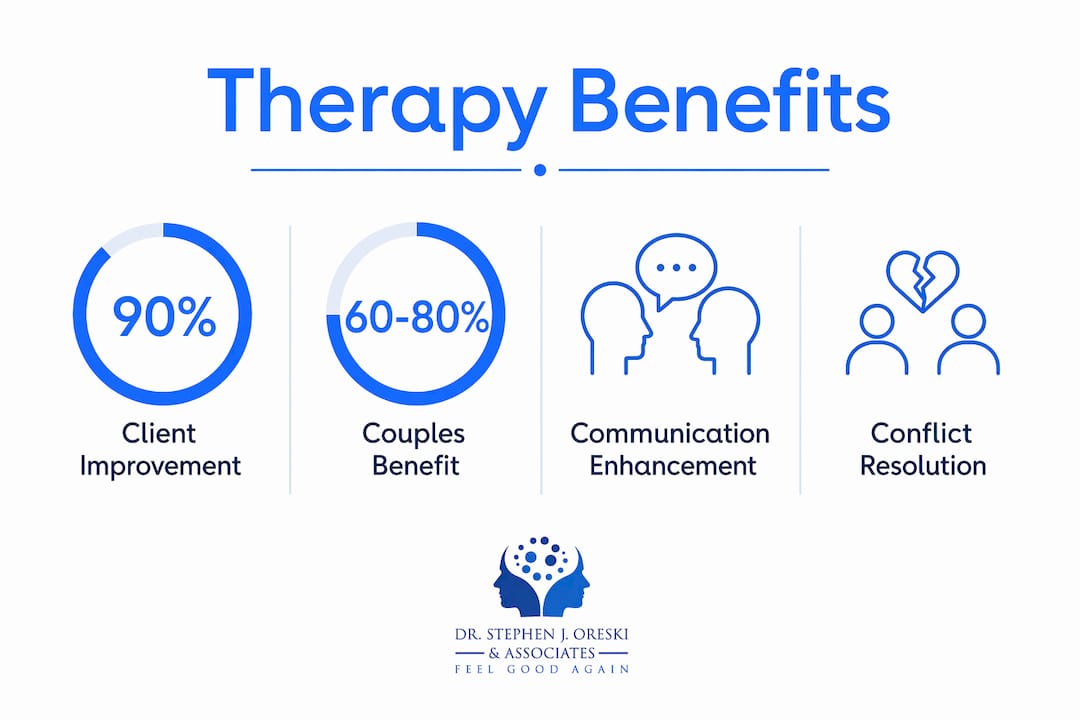
For couples specifically, the results are equally strong. 60% to 80% of couples report benefits from marriage counseling, with some approaches showing improvement rates as high as 90%. Meta-analyses show that couples therapy clients function better than 80% of untreated couples. Those numbers make a compelling case for seeking help rather than waiting for problems to resolve on their own.
| Benefit area | What therapy delivers |
|---|---|
| Couples communication | Structured tools to discuss difficult topics without escalation |
| Individual mental health | Treatment for anxiety, depression, and trauma within a relational context |
| Family dynamics | Clearer roles, boundaries, and conflict resolution patterns |
| Emotional regulation | Skills to manage stress, grief, and life transitions |
Beyond the statistics, MFT also addresses complex life challenges that other therapy formats often miss. Blended families navigating loyalty conflicts, adult children managing aging parents, and couples recovering from infidelity all benefit from the systemic frame MFTs bring. Learning about the benefits of marriage counseling before your first session helps you set realistic expectations and commit more fully to the process.
What to expect in family therapy sessions
A typical MFT session runs 45–60 minutes and may involve one person, a couple, or a full family group depending on the treatment plan. Sessions are not free-form conversations. The therapist acts as a facilitator and guide, not a referee or judge. Their job is to create structure so that difficult topics can be discussed productively.
Therapy effectiveness depends on active engagement and willingness to change. Clients who treat sessions as a venting space rather than a skill-building environment see slower progress. Common session activities include:
- Guided conversation with therapist-directed prompts to keep discussion focused
- Skill-building exercises such as active listening drills or structured problem-solving
- Between-session homework like journaling, practicing a communication technique, or completing a shared task
- Progress reviews are where the therapist and clients assess movement toward stated goals
Session frequency typically starts at once per week and decreases as goals are met. Couples therapy often follows a similar arc: intensive early sessions to establish safety and trust, followed by less frequent check-ins as skills solidify. Families working through acute crises may meet more often at the start.
Key Takeaways
Marriage and family therapists deliver measurable improvements in emotional health by treating relational and individual problems as part of the same interconnected system.
| Point | Details |
|---|---|
| Systemic approach | MFTs assess family dynamics, intergenerational patterns, and social structures, not just individual symptoms. |
| Evidence-based methods | Techniques like Emotionally Focused Therapy and brief solution-focused therapy produce defined, measurable outcomes. |
| Strong success rates | Nearly 90% of MFT clients report improved emotional health; up to 90% of couples benefit from counseling. |
| Active client role | Therapy works best when clients engage fully, complete homework, and commit to specific goals. |
| Broad application | MFTs treat anxiety, depression, trauma, communication breakdown, and complex family transitions. |
Why I believe early intervention changes everything
Most people wait too long before calling a therapist. Waiting until a crisis occurs makes therapy longer and harder. By the time a couple sits down in my office after years of unresolved conflict, they have often built thick walls of resentment that take real work to dismantle. The same problems, caught six months earlier, resolve in a fraction of the time.
The systemic approach is not just a theoretical preference. It is the most accurate model for how human beings actually function. No one struggles in a vacuum. The person sitting across from me carries the communication patterns of their parents, the stress of their workplace, and the unspoken rules of their family of origin. Treating only the individual, without examining that context, is like fixing one gear in a broken machine and calling it done.
My advice: choose a therapist trained specifically in family systems models. General counselors are skilled, but an MFT’s training in structural, strategic, and intergenerational approaches gives you tools that individual-focused therapy simply does not offer. And before your first session, write down two or three specific goals. Clients who arrive with clarity about what they want to change move faster and feel the difference sooner.
— Dr Stephen Oreski LCSW
Bergencountytherapist: personalized therapy for couples and families
Bergencountytherapist, led by Dr. Stephen Oreski and his team, offers couples therapy, family therapy, and individual counseling for people in Bergen County and online. Whether you are working through a communication breakdown, anxiety, depression, or a major life transition, the practice matches you with a therapist suited to your specific situation.

Free consultations are available to help you find the right fit before committing to a full session. The practice also offers tools to help you track your mental health between appointments, so progress stays visible and measurable. If depression is part of the picture, dedicated depression therapy services are available in Paramus. Bergencountytherapist makes professional support accessible, whether you prefer in-person or virtual sessions.
FAQ
What is a marriage and family therapist?
A marriage and family therapist is a licensed mental health professional trained to diagnose and treat emotional, mental, and relational disorders within the context of family systems and intimate relationships. MFTs are recognized in all 50 states and average 13 years of clinical experience.
How does marriage therapy work?
Marriage therapy uses structured sessions and evidence-based techniques like Emotionally Focused Therapy to help couples identify communication patterns, resolve conflict, and rebuild trust. Sessions typically run 45–60 minutes and include skill-building exercises and between-session assignments.
What are the goals of family therapy?
The goals of family therapy include improving communication, clarifying roles and boundaries, resolving conflict, and addressing individual mental health issues within their relational context. Therapists set specific, measurable goals at the start of treatment.
How long does marriage and family therapy take?
Session length varies by the complexity of the issues and client engagement. Brief, solution-focused therapy concludes when defined goals are met, making it more time-limited than open-ended approaches.
What issues do marriage and family therapists treat?
MFTs treat anxiety, depression, trauma, communication breakdown, infidelity, blended family conflict, grief, and major life transitions. They address both individual symptoms and the relational patterns that sustain them.