

- Relationship counseling helps couples improve communication, resolve conflicts, and rebuild emotional connections through structured, confidential sessions.
- Counselors teach practical skills like expressing needs, active listening, and de-escalation, focusing on changing interaction patterns over time.
Relationship counseling is a structured, confidential therapeutic process in which trained professionals help partners improve communication, resolve conflict, and rebuild emotional connection. Understanding what relationship counselors do is the first step toward deciding whether this kind of support fits your situation. These professionals do not take sides or tell you what to do. They guide you through changing the patterns that keep you stuck.
What do relationship counselors do in sessions?
Relationship counselors provide a structured, confidential space to help partners explore challenges without judgment. Their core job is to identify the negative interaction cycles driving conflict and replace them with healthier patterns. They work as a neutral third party, which means neither partner is the “patient” and neither is the problem. The relationship itself is what gets examined.

Counselors also teach practical skills that couples use outside of sessions. These include how to express needs without blame, how to listen without becoming defensive, and how to de-escalate arguments before they spiral. Couples therapy covers communication improvement, anger management, problem-solving, and conflict resolution as core components. That skill set does not disappear when the session ends.
How do counselors help couples improve communication?
Communication breakdown is the most common reason couples seek help. Relationship counselors teach specific techniques to fix it, not just encourage partners to “talk more.”
The skills taught in sessions typically include:
- Expressing needs clearly. Counselors teach partners to use “I” statements instead of accusations. “I feel unheard” lands differently than “You never listen.”
- Active listening. This means reflecting back what your partner said before responding. It slows the conversation and reduces misunderstanding.
- Conflict de-escalation. Counselors train couples to recognize when emotions are too high for productive conversation and how to pause without shutting down.
- Problem-solving frameworks. Partners learn to separate the problem from the person and work toward solutions together.
- Anger management. Counselors address how each partner processes frustration and teach healthier outlets for managing it before anger becomes destructive.
These are not abstract concepts. Counselors practice them with couples in real time during sessions, so partners receive immediate feedback. You learn by doing, not just by listening.
Pro Tip: Practice one new communication skill during a calm moment at home, not during an argument. Low-stakes practice builds the habit before you need it under pressure.
What is the typical structure of relationship counseling sessions?
Couples therapy follows a deliberate sequence. Early sessions are designed to map interaction patterns and select targeted interventions, not to serve as casual conversation. Most couples move through four recognizable phases.
- Assessment. The counselor gathers relationship history, identifies recurring conflict patterns, and understands each partner’s goals. This phase often includes individual check-ins with each partner.
- Goal setting. The counselor and couple agree on specific, measurable goals. Vague goals like “communicate better” get refined into concrete targets like “reduce weekly arguments about finances.”
- Active skill-building. This is the longest phase. Couples practice new communication behaviors in session and apply them at home between appointments.
- Progress review and closure. The counselor tracks whether goals are being met and adjusts the approach when needed. Therapy ends when the agreed goals are achieved.
Progress is gradual. Deeper changes often emerge after several sessions as couples practice new methods consistently. Expecting transformation after one or two meetings sets unrealistic expectations.
| Phase | Focus | Typical Outcome |
|---|---|---|
| Assessment | Relationship history and conflict mapping | Clear picture of core issues |
| Goal setting | Defining specific, shared targets | Agreed roadmap for therapy |
| Skill-building | Practicing communication in session | New behavioral habits formed |
| Progress review | Measuring change against goals | Closure or adjusted plan |
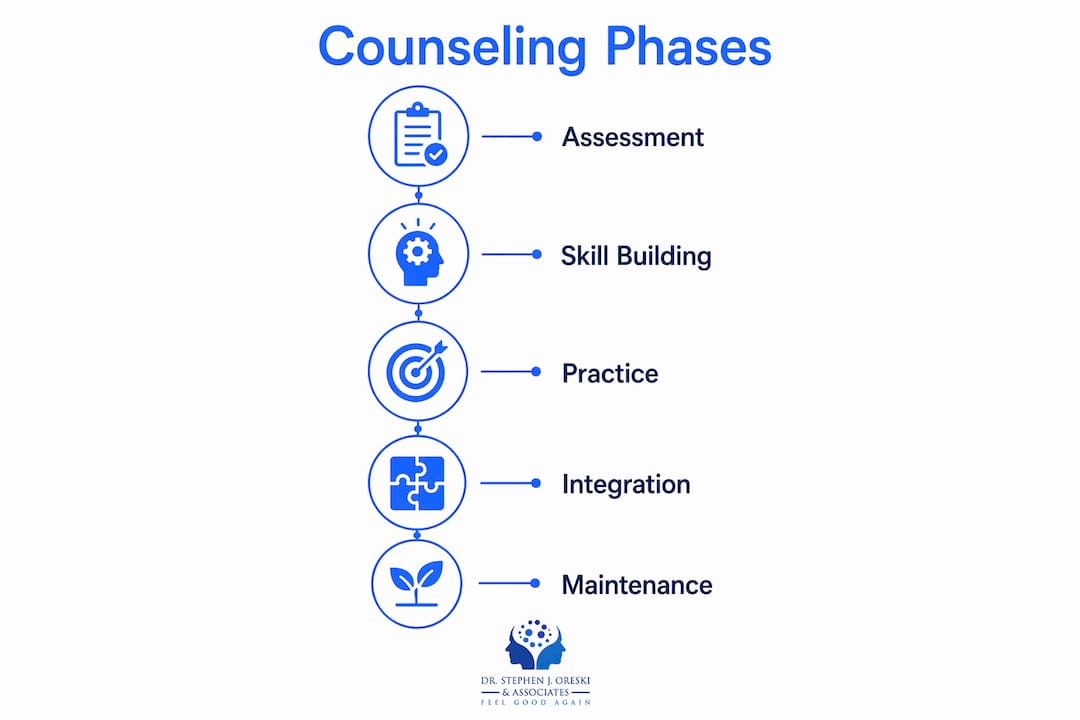
The full session process at Bergencountytherapist walks through each of these phases in detail for couples considering where to start.
How do marriage and family therapists differ from other counselors?
Marriage and family therapists, commonly called MFTs, are a specific licensed credential within relationship counseling. They are not interchangeable with general counselors or psychologists, though there is overlap in what they treat.
The key distinction is their framework. MFTs use a systemic approach that examines how individuals are shaped by their relationships rather than focusing only on individual psychology. A general therapist might ask, “What does this person think and feel?” An MFT asks, “How does this person’s behavior affect and get affected by the people around them?”
| Feature | Marriage and Family Therapist | General Counselor |
|---|---|---|
| Primary focus | Relational systems and family dynamics | Individual thoughts and behaviors |
| Scope | Individuals, couples, and families | Primarily individuals |
| Framework | Systemic | Cognitive or behavioral |
| Licensure | State-licensed MFT credential | Varies by specialty |
MFT work may extend beyond the couple to incorporate wider family context, which affects treatment plans and therapeutic focus. If your conflict involves in-laws, children, or extended family dynamics, an MFT is often the better fit. Bergencountytherapist’s guide on choosing the right therapist breaks down these credential differences clearly.
What issues can relationship counselors address?
Relationship counselors treat a broader range of problems than most people expect. The work goes well beyond “we argue too much.”
Common issues addressed in couples and relationship counseling include:
- Communication breakdown. Chronic misunderstanding, stonewalling, or emotional withdrawal.
- Infidelity and trust repair. Processing betrayal and rebuilding trust after an affair.
- Life transitions. Adjusting to parenthood, job loss, relocation, or retirement as a couple.
- Sexual concerns. Addressing mismatched desire, intimacy avoidance, or sexual dysfunction within the relationship context.
- Mental health within relationships. Counselors address depression, anxiety, and behavioral disorders framed within family and relational systems, not just as individual conditions.
- Parenting conflicts. Disagreements about discipline, roles, or co-parenting after separation.
- Trauma and abuse. Counselors trained in trauma work with couples where one or both partners carry unresolved trauma affecting the relationship.
Marriage and family therapy is often short-term and goal-oriented, with many cases completing within 20 to 50 sessions. That range reflects the variety of issues treated. A couple addressing communication habits may finish in 12 sessions. A couple rebuilding after infidelity may need considerably more time.
Key Takeaways
Relationship counselors teach concrete skills and guide couples through structured phases to change the patterns driving conflict, not just the symptoms.
| Point | Details |
|---|---|
| Core role | Counselors identify negative cycles and teach communication and conflict-resolution skills. |
| Session structure | Therapy moves through assessment, goal setting, skill-building, and progress review. |
| MFT distinction | Marriage and family therapists use a systemic framework covering couples and family dynamics. |
| Issues treated | Counselors address communication, infidelity, mental health, trauma, and life transitions. |
| Realistic timeline | Most goal-oriented therapy is completed within 20–50 sessions, depending on complexity. |
What most people get wrong about relationship counseling
People walk into counseling expecting the therapist to referee. They want someone to confirm that their partner is the problem. That is not what happens, and honestly, it is not what helps.
What I have seen work time and again is when both partners arrive willing to examine their own roles in the dynamic. The counselor’s job is to redirect focus from “winning arguments” to understanding the cycle both people are caught in. That shift is uncomfortable at first. It requires you to look at your own behavior, not just your partner’s.
The other misconception is that talking about problems is the therapy. It is not. Structured skill-building is the therapy. Talking without a framework just rehearses the same arguments in a nicer room. The sessions that produce real change are the ones where couples practice new behaviors in real time and get immediate feedback from the counselor.
My advice: go in with specific goals, not just a general sense that things are bad. The more clearly you can define what you want to change, the faster the work moves. And choose a counselor whose approach you understand before you commit. Ask them directly how they structure sessions and what methods they use.
— Dr Stephen Oreski LCSW
Relationship counseling at Bergencountytherapist
Dr. Stephen Oreski and his team at Bergencountytherapist work with couples, individuals, and families across Bergen County and online. The practice offers a range of psychotherapy options tailored to each couple’s specific challenges, from communication repair to trauma-informed care.
Every new client starts with a free consultation to match them with the right therapist and approach. Whether you are dealing with recurring conflict, a major breach of trust, or simply want to strengthen your relationship before problems deepen, the team provides structured, evidence-based support. You can also get started with therapy directly through the website, with both in-person and online appointments available.
FAQ
What does a relationship counselor actually do in a session?
A relationship counselor identifies negative interaction patterns, teaches communication and conflict-resolution skills, and guides couples through structured practice. Sessions are confidential and goal-oriented, not open-ended conversations.
How is couples counseling different from individual therapy?
Couples counseling treats the relationship as the focus, not either individual. The counselor works with both partners together to change shared patterns, whereas individual therapy focuses on one person’s thoughts, feelings, and behaviors.
How long does relationship counseling typically take?
Most goal-oriented relationship therapy is completed in 20 to 50 sessions, though simpler communication issues may resolve more quickly. The timeline depends on the complexity of the issues and how consistently both partners engage.
Can relationship counseling help if only one partner wants to go?
One partner attending alone can still produce meaningful change. Individual work on communication habits and personal patterns often shifts the dynamic even without the other partner present.
What types of relationship therapy are most common?
The most widely used approaches include Emotionally Focused Therapy, the Gottman Method, and Cognitive Behavioral Couples Therapy. Each targets different aspects of relational dysfunction, from emotional bonding to thought patterns driving conflict. Bergencountytherapist’s overview of types of couples therapy explains how each method works.