

Family counselors treat the entire family system, focusing on improving communication and resolving conflicts. They use diverse therapy models like EFT and Structural Therapy, adapting approaches to meet the family’s needs. Sessions are active and typically last six months, with benefits extending even if some members do not attend.
A family counselor is a licensed mental health professional who helps families address emotional, behavioral, and relational challenges through systems-focused therapy. Unlike individual therapy, which centers on one person’s inner world, family counseling treats the family unit as the patient. The goal is to improve communication, resolve conflict, and support the emotional health of every member. Approaches like Emotionally Focused Therapy (EFT) and Cognitive Behavioral Family Therapy (CBFT) are standard tools in this work. Family therapy addresses systemic issues, improves communication, reduces blame, and builds empathy across the entire household.
What does a family counselor do in practice?
A family counselor facilitates structured conversations that help family members understand each other rather than win arguments. The counselor identifies patterns in how the family communicates, sets boundaries, and responds to conflict. That systemic view separates family counseling from individual therapy, where the focus stays on one person’s thoughts and feelings.

Common family therapy models include Structural, Bowenian, Emotionally Focused, Cognitive Behavioral, and Narrative therapies. Each model targets a different layer of family functioning. A counselor may combine two or more approaches depending on what the family needs most.
| Therapy Model | Key Feature | Best Used For |
|---|---|---|
| Structural Therapy | Reorganizes family roles and boundaries | Enmeshment, parenting conflicts |
| Bowenian Therapy | Reduces emotional reactivity across generations | Multigenerational patterns, anxiety |
| Emotionally Focused Therapy (EFT) | Builds secure emotional bonds | Couples, parent-child disconnection |
| Cognitive Behavioral Family Therapy (CBFT) | Changes thought patterns driving behavior | Behavioral issues, depression |
| Narrative Therapy | Rewrites limiting family stories | Trauma, identity conflicts |
Real sessions look nothing like a lecture. A counselor using Narrative Therapy might ask each member to describe the family’s story from their own point of view. A Structural Therapy session might involve the counselor physically repositioning who speaks to whom to break a rigid dynamic.
Pro Tip: Ask your counselor in the first session which therapy model they use and why it fits your family’s situation. A clear answer signals both competence and a tailored plan.
What to expect from a typical family counseling session
Standard family therapy sessions last 50–90 minutes, with 6 to 8 sessions common over six months. That timeline is not a fixed rule. Complex situations, such as divorce, grief, or a child’s behavioral crisis, often require more time.
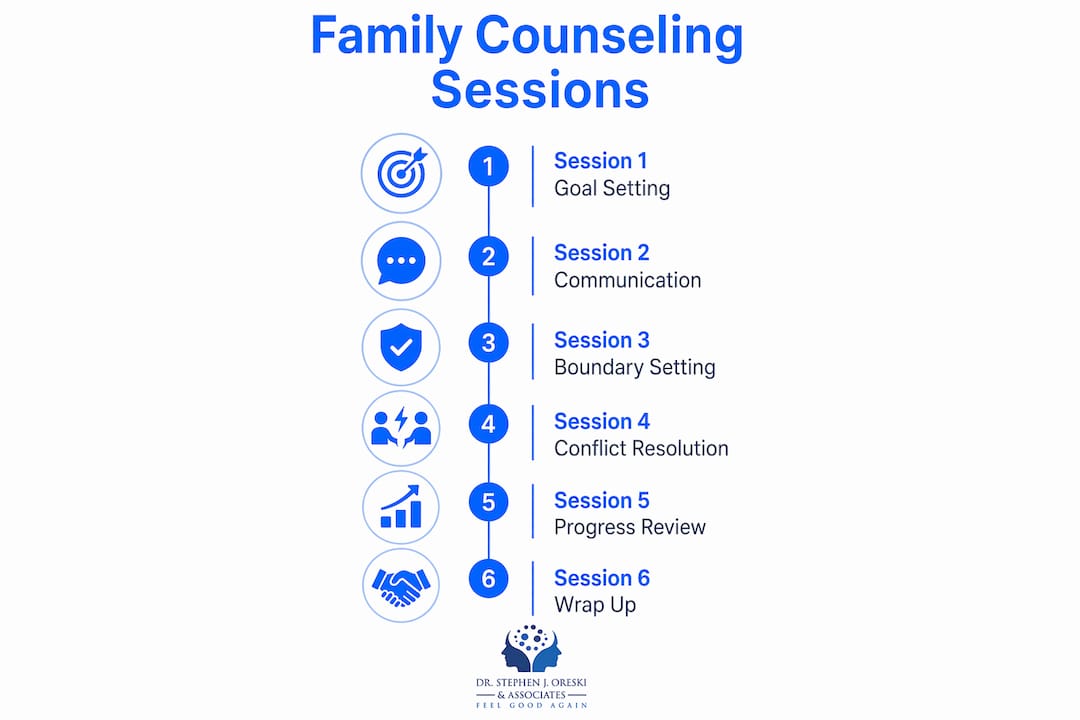
Sessions are active, not passive. Families practice new communication and boundary-setting techniques live during the session so they can apply those skills at home immediately. The counselor may pause a conversation mid-sentence to redirect how two members are speaking to each other.
Therapists sometimes divide session time between the full family and smaller sub-groups. Parents may meet alone first to align on a parenting approach, then the children join. This structure allows the counselor to address issues at the appropriate level without putting children in the middle of adult conflicts. In more complex cases, a Reflecting Team of additional therapists observes the session and offers feedback, giving the family multiple professional perspectives at once.
Common session activities include:
- Practicing active listening with structured turn-taking
- Identifying and naming emotional triggers in real time
- Role-playing difficult conversations in a safe setting
- Setting household boundaries with the counselor as a witness
- Reviewing homework from the previous session
Pro Tip: Write down one specific goal or question before your first session. Families who arrive with a concrete concern move faster than those who wait for the counselor to define the problem.
How family counseling supports healing and stronger relationships
The most significant shift family counseling creates is to move blame from one person to the system. When a teenager acts out, the counselor does not treat the teen as the problem. The counselor examines how every member’s behavior contributes to the pattern. That reframe alone reduces defensiveness and opens the door to real change.
EFT yields 70–73% recovery in distressed couples, with 90% showing significant improvements in their relationships. Those numbers reflect what happens when emotional bonds are the direct target of therapy rather than a side effect. Family counseling is also significantly more effective than individual therapy at improving interpersonal relationships within the family. That finding matters because many families default to sending one member to individual therapy when the relational system is the actual source of distress.
The benefits of family counseling extend well beyond conflict resolution:
- Clearer, more respectful communication between all members
- Stronger empathy across generational and personality differences
- Healthier navigation of major transitions like divorce, remarriage, or loss
- Reduced anxiety and depression linked to chronic family conflict
- Better behavioral outcomes for children and teens
One often-overlooked benefit: therapy remains effective even if one family member refuses to attend. When active members change their reactive patterns, the entire system shifts. The absent member’s behavior often changes without them ever entering a session.
Family counselor vs. family therapist: what is the difference?
The terms family counselor and family therapist overlap significantly, and many professionals use them interchangeably. The practical distinction lies in licensing and training depth. A Licensed Marriage and Family Therapist (LMFT) holds a graduate degree with supervised clinical hours focused specifically on relational systems. A family counselor may hold a license as a Licensed Professional Counselor (LPC) or Licensed Clinical Social Worker (LCSW) and specialize in family work.
| Professional | Core Focus | When to Choose |
|---|---|---|
| Family Therapist (LMFT) | Relational systems, family dynamics | Ongoing relational or structural issues |
| Family Counselor (LPC/LCSW) | Emotional support, coping, communication | Situational stress, life transitions |
| Individual Therapist | One person’s internal experience | Personal trauma, mental health diagnosis |
| Couples Therapist | Two-person relationship dynamics | Partner conflict, intimacy issues |
Choosing between a family counselor and an individual therapist depends on where the problem lives. If the conflict exists between people, family therapy is the right fit. If one person carries a diagnosis like depression or PTSD that drives the family tension, combining individual therapy with family sessions often produces the best results.
Key Takeaways
A family counselor treats the family system, not just one person, making it the most direct path to lasting relational change.
| Point | Details |
|---|---|
| Systemic focus | Counselors address patterns across the whole family, not one member’s behavior in isolation. |
| Multiple therapy models | Approaches like EFT, CBFT, and Structural Therapy target different relational problems. |
| Active sessions | Families practice communication and boundary skills live during each session. |
| Strong evidence base | EFT shows 70–73% recovery rates, and family therapy outperforms individual therapy for relational issues. |
| Flexible attendance | Therapy produces results even when not every family member participates from the start. |
What I’ve learned from working with families in therapy
Family counseling is the only therapy format where the room itself is the patient. I have watched families arrive convinced that one person is the source of every problem, only to discover within three sessions that the pattern belongs to everyone. That shift is not comfortable. It is, however, the moment real progress begins.
The counselor’s role is closer to that of a translator of emotional languages than a referee. Each family member speaks from a different emotional vocabulary shaped by personality, birth order, and past experience. The counselor’s job is to make those languages mutually intelligible without flattening anyone’s experience.
What I consistently tell families: commit to the process before you evaluate the results. Six sessions feel short, but the consistent participation required for real outcomes means showing up even when a session feels unproductive. The sessions that feel stuck are often the ones that break something open a week later. Patience is not passive here. It is part of the work.
— Stephen
Family counseling services at Bergencountytherapist
Bergencountytherapist, led by Dr. Stephen Oreski and his team, offers family counseling for Bergen County residents and clients across New Jersey through both in-person and online family therapy sessions. The practice works with families navigating conflict, behavioral challenges, grief, and major life transitions.

Every family receives a personalized treatment plan tailored to their specific dynamics, not a one-size-fits-all approach. Free consultations are available to help you identify the right fit before committing to a full course of therapy. If you are ready to learn how mental health tracking can support your family’s progress between sessions, that resource is also available on the Bergencountytherapist website.
FAQ
What does a family counselor do differently from a therapist?
A family counselor focuses on the relational system between members rather than one person’s internal experience. The goal is to change communication and interaction patterns across the entire family unit.
How long does family counseling typically take?
Sessions run for 50–90 minutes, and most families complete 6-8 sessions over six months. Complex situations like divorce or trauma often require a longer commitment.
What are the signs you need family counseling?
Persistent conflict, communication breakdowns, a child’s behavioral changes, or a major family transition like divorce or loss are all clear signs that family counseling can help.
Can family therapy work if one person refuses to attend?
Yes. When active members change their reactive patterns, the entire family system shifts. An absent member’s behavior often improves without them attending a single session.
What questions should I ask a family counselor before starting?
Ask which therapy model they use, how they measure progress, and how they handle situations where one member dominates the session. Clear answers to those three questions tell you a great deal about how the counselor works.