

- Codependency is a learned pattern where a person’s self-worth depends on managing others’ needs, often at their own expense. It manifests in various relationship types, causing emotional exhaustion and mental health issues like anxiety and depression. Recovery involves building boundaries, reconnecting with personal needs, and seeking therapy to unlearn these patterns and restore authentic self-identity.
Caring deeply about someone you love is healthy. But when caring becomes consuming, when another person’s feelings dictate your mood, your choices, and your sense of worth, something more complicated is happening. A codependent person isn’t simply devoted or selfless. Codependency is a learned emotional and behavioral pattern that erodes your sense of self over time, often without you realizing it’s happening. Understanding what it actually means and what it looks like in real relationships is where real change starts.
Table of Contents
- Key takeaways
- What is a codependent person, really?
- How codependency develops
- Codependency across relationship types and its emotional toll
- Codependency versus related concepts
- Strategies for moving forward from codependency
- My perspective on what actually helps
- Ready to do the deeper work?
- FAQ
Key takeaways
| Point | Details |
|---|---|
| Codependency is learned | It develops from early relational experiences and can be passed down through generations. |
| Identity becomes entangled | A codependent person often builds their self-worth around being needed by someone else. |
| It goes beyond romance | Codependent patterns appear in friendships, family dynamics, and even workplace relationships. |
| Healthy love looks different | Interdependency preserves both people’s identities; codependency erodes one person’s autonomy. |
| Recovery is possible | Therapy focused on boundaries, identity, and emotional regulation produces real and lasting change. |
What is a codependent person, really?
The word gets misused constantly. People call themselves codependent when they mean they miss their partner or when they feel hurt by conflict. That is not what codependency means. A codependent person is someone whose emotional life revolves around another person’s needs, problems, or emotional state, at the direct expense of their own well-being.
At the core of this pattern is an identity built around being needed. The codependent person often believes, at some level, that their job is to fix, save, or manage the other person. Without that role, they feel purposeless or unlovable. That is the distinction that matters most.
Common traits of a codependent person include:
- Low self-esteem is tied to how well they are taking care of others
- People-pleasing behavior that prevents honest communication
- Difficulty setting or keeping boundaries, because saying no feels like abandonment or failure
- Mood shifts based on the other person’s emotional state, not their own internal experience
- Excessive caretaking, including covering for someone else’s mistakes or responsibilities
- Neglect of personal needs, friendships, and goals in favor of the relationship
What separates this from healthy support is the compulsion behind it. Compelled caretaking means the helper feels they must manage the other person’s problems to keep the relationship intact. A supportive partner helps because they want to. A codependent person helps because they are afraid of what happens if they don’t.
Pro Tip: If you find yourself unable to relax until the other person in your life is okay, that emotional fusion is worth paying attention to.
How codependency develops
Nobody is born codependent. These patterns form through experience, usually early experience in families where emotional needs were unmet or where instability was normal.
Codependency is a learned behavior passed down generationally, most often in households where a parent struggled with addiction, mental illness, abuse, or chronic emotional unavailability. Children in these environments learn to survive by constantly reading the room. They become hypervigilant to other people’s moods, suppress their own needs, and derive safety from managing others’ feelings.
Key contributors to codependent development include:
- Growing up with a parent whose behavior was unpredictable or harmful
- Learning that love was conditional on being helpful, quiet, or “good.”
- Witnessing enabling behavior modeled as normal caregiving
- Experiencing emotional neglect that taught you your needs were secondary
- Exposure to addiction dynamics in the family, where one person’s crisis consumed all household energy
Trauma plays a significant role here. When early relationships teach you that closeness means sacrifice, your nervous system internalizes that as truth. Codependency, in many cases, is an adaptive response that outlived the circumstances that created it.
Codependency across relationship types and its emotional toll

Most people associate codependency with romantic partnerships. But codependency affects friendships, family dynamics, and work relationships just as frequently. An adult child who cannot stop solving their parent’s financial crises is codependent. A friend who feels personally responsible for keeping everyone in their social circle emotionally stable is codependent. A manager who cannot let any task be someone else’s responsibility may be exhibiting the same pattern.
The emotional cost is significant. Consider how codependency typically progresses:
- You prioritize the other person’s needs and gradually abandon your own
- Your sense of self becomes defined by your role as a helper or caretaker
- You begin to feel resentful, exhausted, and invisible
- The relationship becomes unbalanced, with one person consistently struggling and the other persistently rescuing
- Anxiety and depression grow because your well-being is entirely dependent on someone else’s state
That relational imbalance creates exhaustion for the helper and reinforces the other person’s helplessness. Neither person grows. Neither person is truly known.
Codependency symptoms often include anxiety, depression, chronic fatigue, and a loss of personal identity. These are not just relational problems. They are mental health consequences that accumulate over time and deserve real attention.
Codependency versus related concepts
One of the most common questions people have is whether codependency is a mental health diagnosis. It is not. Codependency does not appear in the DSM-5, the clinical manual therapists use to diagnose mental health conditions. This does not mean it isn’t real or that it doesn’t cause serious harm. It means therapists treat it as a relational pattern, often one that overlaps with anxiety, depression, or trauma.
Here is how codependency compares to related concepts:
| Concept | Key feature | How it differs from codependency |
|---|---|---|
| Codependency | Self-worth tied to caretaking others | Compulsive helping driven by fear of abandonment or need to be needed |
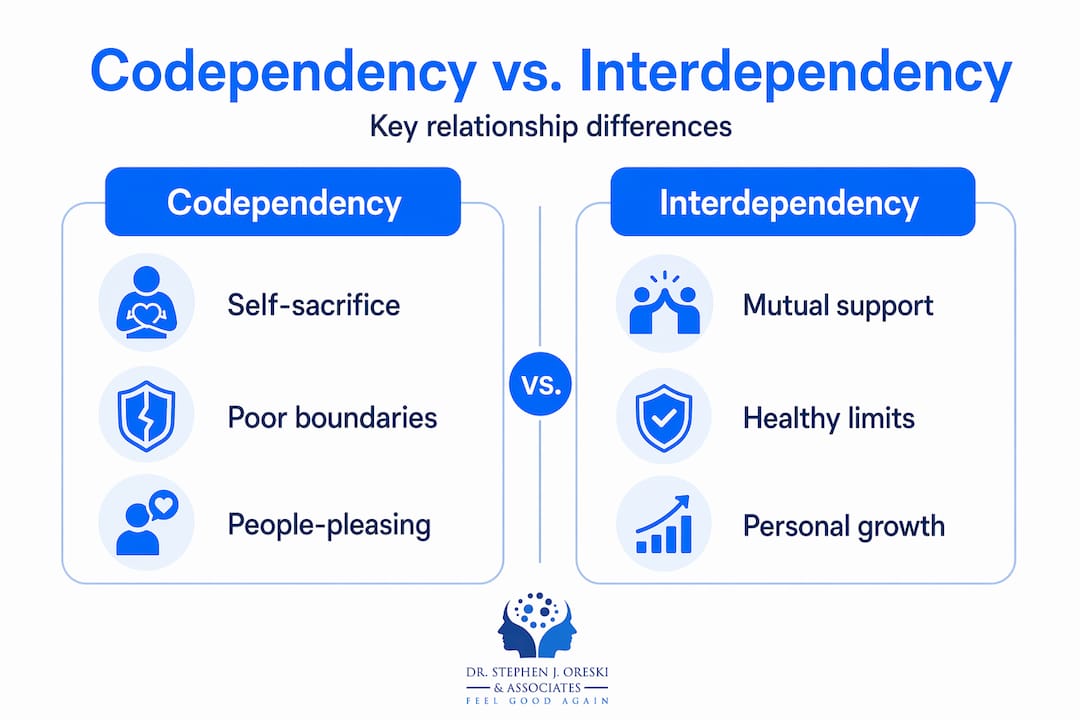
| Healthy interdependence | Mutual support with preserved autonomy | Both people maintain their own identities and needs within the relationship |
| Dependent Personality Disorder | Pervasive need to be cared for | The person seeks care for themselves, not compulsively for others |
| Being a caring partner | Empathy and support | Comes from genuine love, not fear; does not involve losing personal identity |
Healthy interdependency allows both people to grow while maintaining personal selfhood. That is the goal. It is not independence or emotional distance. It is a genuine connection where neither person has to disappear.
Pro Tip: Ask yourself: “Do I help because I genuinely want to, or because I feel afraid of what will happen if I don’t?” Your honest answer reveals a lot.
Strategies for moving forward from codependency
Recognizing codependent patterns is the first step. The next is understanding that change takes consistent, supported effort. These patterns are deeply wired, and they will not resolve simply by deciding to “do better.”
Practical approaches that therapists focus on include:
- Building personal boundaries as an act of self-respect, not rejection. Learning the types of boundaries that healthy relationships rely on is foundational.
- Reconnecting with your own needs, interests, and values that have been sidelined
- Practicing letting others experience consequences rather than rescuing them from discomfort
- Developing emotional regulation skills so your internal state isn’t entirely determined by someone else’s mood
- Exploring the roots of the pattern through therapy, particularly if early trauma or family dysfunction is involved
- Working on communication skills so you can express your needs without fear of rejection
Therapists address codependency by integrating boundary work, identity recovery, and emotional regulation, not by treating it as a fixed diagnosis. That means treatment is flexible and personalized to your specific relational history. Progress is real, but it benefits enormously from professional guidance.
My perspective on what actually helps
In my clinical experience, the moment that changes everything for most people is not when they understand codependency intellectually. It is when they realize their identity has quietly been replaced by a role.
I have worked with people who could not name a single thing they genuinely enjoyed anymore. Every preference, every plan, every emotional response had been shaped around the other person for so long that their own self had gone quiet. That recognition, while painful, is also the opening.
What I have found actually works is not just teaching people to set limits. It is helping them rediscover who they are without the caretaking role. That process takes courage. Clients often feel guilt, fear, and grief before they feel relief. But the relief does come.
If you see yourself in any of this, please know that codependency is not a flaw in your character. It is a learned response that made sense once. And it can be unlearned.
— Dr Stephen Oreski LCSW
Ready to do the deeper work?
If this article brought something into focus for you, you do not have to sit with it alone. At Bergencountytherapist, Dr. Stephen Oreski and his team work with adults navigating codependency, relationship patterns, trauma, and emotional exhaustion every day.

Whether you are just starting to recognize these patterns or have been carrying them for years, individual therapy offers a private, focused space to do real work. The practice also provides childhood trauma therapy for those whose codependency traces back to early family experiences. Free consultations are available, both in-person and virtually, for Bergen County residents.
FAQ
What does it mean to be a codependent person?
A codependent person is someone whose self-worth and emotional stability depend on managing, rescuing, or taking care of another person. This pattern is driven by fear and learned behavior, not genuine choice.
What are the main signs of codependency?
Common signs include low self-esteem, difficulty setting boundaries, people-pleasing, excessive caretaking, mood shifts based on others’ feelings, and neglect of personal needs.
Is codependency the same as loving someone deeply?
No. Love and codependency feel similar but function very differently. Healthy interdependence preserves both people’s identities, while codependency causes one person to lose their sense of self in the relationship.
Can codependency appear outside of romantic relationships?
Yes. Codependent patterns are common in family relationships, close friendships, and even workplace dynamics where one person takes consistent responsibility for another’s emotional state or problems.
Can codependency be treated?
Absolutely. While codependency is not a formal DSM-5 diagnosis, therapists treat it effectively by focusing on boundary setting, identity work, and emotional regulation, often alongside related concerns like anxiety or trauma.