

TL;DR:
- Childhood attachment patterns influence adult relationships and emotional wellbeing.
- There are four main attachment styles: secure, avoidant, resistant, and disorganized.
- Attachment styles are modifiable through life experiences and therapy, not fixed Destiny.
Most people think childhood attachment is simply about babies needing comfort. That idea barely scratches the surface. Attachment theory reveals how your earliest bonds with caregivers shape your emotional wiring, your sense of safety, and even the way you show up in adult relationships. Whether you struggle with closeness, shut down under stress, or constantly fear being abandoned, attachment theory offers a real explanation for why those patterns exist. This article breaks down the science, the four main styles, real-life impacts, and how you can use this knowledge for genuine personal growth.
Table of Contents
- How attachment theory began and what it means
- Attachment styles: Secure, avoidant, resistant, and disorganized
- Impact of attachment: From childhood to adulthood
- Limits and criticisms: Is attachment destiny?
- A fresh take: Attachment theory’s real-life value and traps
- Explore support and further resources
- Frequently asked questions
Key Takeaways
| Point | Details |
|---|---|
| Attachment shapes behavior | Early bonds with caregivers influence our emotions and social connections throughout life. |
| Four main styles | Secure, avoidant, resistant, and disorganized attachment describe different patterns of relating to others. |
| Not destiny | Attachment style is not fixed; growth, healing, and change are always possible. |
| Powerful in relationships | Awareness of your style can support better partnerships and personal growth. |
How attachment theory began and what it means
John Bowlby, a British psychiatrist, developed attachment theory in the mid-20th century after observing children separated from their mothers in hospitals and orphanages. He challenged the idea that children bonded with caregivers purely for food. His conclusion was striking: children are biologically wired to seek closeness for emotional safety, not just survival.
At the core of Bowlby’s model are two central ideas:
- Secure base: A caregiver who provides stability so the child can confidently explore the world.
- Safe haven: A caregiver the child returns to when frightened, stressed, or overwhelmed.
These aren’t just childhood concepts. They describe patterns your nervous system learned early and still runs on today.
“The attachment system triggers proximity-seeking behaviors, with caregivers acting as a secure base and safe haven.”
When a caregiver is reliably available and responsive, the child learns that relationships are safe and that emotions can be managed. When caregivers are inconsistent or frightening, the child’s attachment system stays on high alert. This is where emotional regulation gets disrupted, sometimes for decades.
These early patterns don’t just disappear at age five. They quietly shape how you handle stress, how you relate to partners, and even how you engage with psychotherapy and emotional wellbeing as an adult. Understanding this is the first step toward changing it.
Attachment styles: Secure, avoidant, resistant, and disorganized
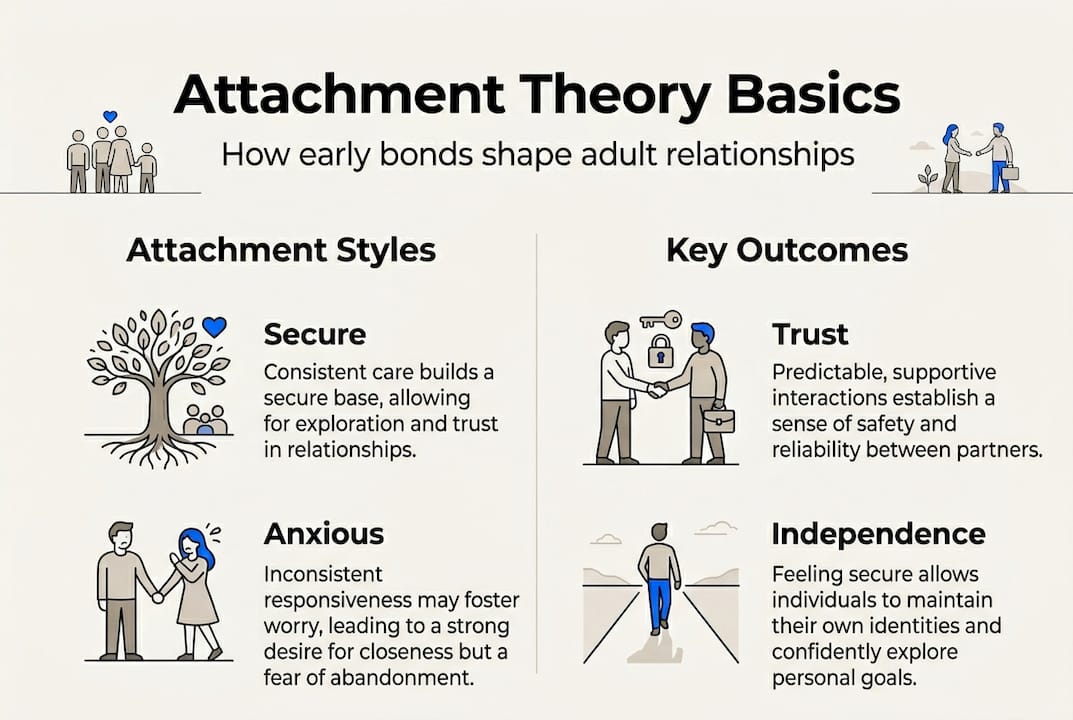
Researcher Mary Ainsworth built on Bowlby’s work by creating a lab procedure called the Strange Situation. In this test, toddlers were briefly separated from their caregivers and then reunited. How the child responded revealed their attachment pattern.
Ainsworth’s Strange Situation identified four distinct attachment styles:
- Secure (roughly 60-65% of children): These children are upset when the caregiver leaves but quickly soothed when they return. They use the caregiver as a base for exploration.
- Avoidant (roughly 20% of children): These children show little distress at separation and ignore the caregiver on return. They’ve learned not to rely on others.
- Resistant or ambivalent (roughly 10-15%): These children are very distressed at separation but difficult to comfort on reunion. They’re caught between seeking closeness and resisting it.
- Disorganized (roughly 5-10%): These children show confused or contradictory behaviors. Often associated with trauma or frightening caregiving.
| Style | Emotional response | Prevalence |
|---|---|---|
| Secure | Confident, manageable distress | ~60-65% |
| Avoidant | Suppressed, self-reliant | ~20% |
| Resistant | Heightened, clingy | ~10-15% |
| Disorganized | Chaotic, fearful | ~5-10% |
Researchers note that children with autism spectrum differences or histories of maltreatment may present differently in the Strange Situation, and their results require careful interpretation. Learning about positive child behavior patterns can help caregivers recognize when a child may need additional support. If you’re concerned about signs of childhood trauma, those observations matter deeply.
Impact of attachment: From childhood to adulthood
Knowing your attachment style can be eye-opening, but how much does it actually shape your life? Here’s what research shows.
SSP secure attachment predicts better socioemotional outcomes in childhood, and adult researchers have extended this into four parallel styles: secure, anxious, dismissive, and fearful. These adult styles profoundly influence romantic relationships, parenting, and how you handle conflict.
A major review found that secure attachment links to better social and behavioral adjustment, though associations are modest rather than absolute. In other words, your attachment style creates tendencies, not guarantees.

| Adult style | Relationship pattern | Core fear |
|---|---|---|
| Secure | Trusting, communicative | Low |
| Anxious | Clingy, hyper-vigilant | Abandonment |
| Dismissive | Emotionally distant | Dependence |
| Fearful | Avoids closeness and rejection | Both |
Attachment patterns also interact heavily with trauma history. Understanding how trauma affects relationships helps explain why some adults repeat painful cycles even when they desperately want to change. And attachment doesn’t stop at romantic relationships. It shapes how parents relate to their children, sometimes transmitting patterns across generations. Reviewing parenting challenges for adults can shed light on how these cycles begin.
Pro Tip: Reflecting on how you respond when a partner is unavailable or distant is one of the fastest ways to get a gut-level read on your attachment style.
Limits and criticisms: Is attachment destiny?
Attachment shapes tendencies, but what are its real limits and are criticisms valid?
Several researchers have pushed back on attachment theory, and those critiques deserve honest attention.
- Cultural bias: The Strange Situation was developed in Western contexts. Some findings don’t translate. For example, resistant style rates are higher in Japan and Germany, possibly reflecting cultural norms around parenting rather than problematic attachment.
- Overemphasis on the mother: Early theory focused heavily on mothers as the primary attachment figure, largely ignoring fathers, extended family, and peer relationships.
- Genes and temperament: The theory may underestimate how a child’s inborn temperament shapes their responses to caregiving.
- Modest predictive power: Attachment style in infancy only modestly predicts outcomes in later childhood or adult life.
“Cultural bias in assessment, limitations on predictive power, and the non-deterministic nature of attachment highlight important boundaries for the theory.”
This is genuinely good news. Attachment is not destiny. Life experiences, meaningful relationships, and therapeutic work can all shift deeply ingrained patterns. A skilled therapist familiar with countertransference in therapy can help you navigate those old relational templates safely.
A fresh take: Attachment theory’s real-life value and traps
With strengths and criticisms in mind, here’s a practical lens for using attachment theory in everyday life.
Attachment theory is one of the most useful frameworks we have, but it becomes a trap the moment you use it as a fixed identity. In our clinical experience, people sometimes get stuck saying “I’m anxiously attached” as if that ends the conversation. It doesn’t. Labels explain patterns; they don’t excuse them or make them permanent.
The real power lies in using your attachment insight as a starting point for action. Focus less on why you’re wired this way and more on what you want to do differently. Healing attachment wounds, especially in the context of healing trauma in relationships, happens through new relational experiences, not just intellectual understanding.
Explore support and further resources
If you want to put these insights into action, here’s how professional support and guides can help.
Understanding attachment theory is a meaningful first step, but real change often happens in relationship, including the therapeutic one. Exploring therapy options tailored to emotional and relational growth can make these insights feel lived rather than just learned. If in-person sessions aren’t accessible, the online therapy benefits of privacy and flexibility open the door for many more people. For those navigating depression alongside attachment struggles, our depression therapy resources offer targeted support.

Reaching out for a free consultation is a simple, low-pressure first step toward breaking old patterns.
Frequently asked questions
What is the main idea behind attachment theory?
Attachment theory explains how early bonds with caregivers shape our emotional security and influence relationships throughout life by activating proximity-seeking and secure base behaviors from birth.
How do I know my attachment style?
Your attachment style often shows in how you handle closeness, conflict, and separation. Four main styles are identified through observation or questionnaires, and adult styles developed by Hazan and Shaver can be explored with a therapist or validated self-report tools.
Does attachment style change over time?
Yes. Attachment is not deterministic, and with self-awareness, new experiences, or therapy, your relational patterns can shift meaningfully over time.
Is attachment style genetic or learned?
Both play a role. Caregiving experiences are primary, but genes and temperament also influence how a person responds to those early relationships.
Are certain attachment styles more common in different cultures?
Yes. Cultural differences affect how attachment styles are expressed and measured, with resistant styles appearing more frequently in countries like Japan and Germany.