

- Codependency addiction is a learned pattern where individuals neglect their needs to control or rescue others, often stemming from childhood experiences. Recognized through emotional and behavioral symptoms, it involves an anxious attachment style that fosters enabling behaviors, prolonging addiction and eroding personal identity. Recovery requires consistent somatic practices, boundary setting, and the development of secure attachment over 6 to 12 months, supported by therapy and group work.
Codependency addiction is a learned, chronic pattern often called “relationship addiction,” where a person compulsively neglects their own needs to manage, rescue, or control another person. Mental health professionals recognize it through 20 distinct behavioral and emotional symptoms, even though it carries no formal DSM-5 diagnosis. The pattern shows up most visibly in caretaking, fear of abandonment, identity loss, and an inability to function emotionally without another person’s approval. Understanding codependency addiction is the first step toward breaking a cycle that quietly erodes your sense of self and the quality of every relationship you have.

What is codependency addiction, exactly?
Codependent addiction is defined by one core feature: your emotional stability depends entirely on someone else’s mood, choices, or well-being. According to attachment science, codependency stems from nervous system survival mode activation, meaning your brain treats another person’s distress as a direct threat to your own safety. That is why it feels compulsive rather than chosen.
The pattern typically develops in childhood, often in homes where a parent struggled with addiction, mental illness, or emotional unavailability. You learned that love meant caretaking. You learned that your needs came second. By adulthood, that wiring runs automatically, making codependency feel like empathy or devotion when it is actually a loss of personal sovereignty.
What separates codependency from genuine care is the cost. Genuine care does not require you to abandon yourself. Codependency does. Researchers note that codependents focus 90%+ of their attention externally rather than maintaining the balanced internal-external awareness that healthy relationships require. That imbalance is the defining marker.
What are the signs and symptoms of codependency?
Recognizing codependency symptoms in yourself is harder than it sounds, because many of the behaviors look like virtues from the outside. The signs of codependency include a consistent pattern of emotional and behavioral responses that prioritize others at your own expense.
The most common indicators include:
- Compulsive caretaking. You feel responsible for solving other people’s problems, even when they have not asked for help.
- Poor or absent boundaries. Saying no produces intense guilt or fear, so you rarely do it.
- Low self-esteem tied to external approval. Your sense of worth rises and falls based on whether others are pleased with you.
- Fear of abandonment. You tolerate harmful behavior to avoid being left, often staying far longer than is healthy.
- Enabling behaviors. You cover for, make excuses for, or shield someone from the consequences of their own choices.
- Emotional fusion. Your mood mirrors the other person’s mood so closely that you lose track of your own emotional state.
- Identity loss. Your hobbies, opinions, and goals have gradually been replaced by the other person’s preferences.
Pro Tip: Keep a one-week journal tracking how often your mood shifts in direct response to someone else’s behavior. If the answer is “constantly,” that pattern alone is worth exploring with a therapist.
Understanding codependency relationships explained through this lens makes it easier to see why the person experiencing it rarely identifies it as a problem. It feels like love. It feels like loyalty. The cost only becomes visible over time.
How does enabling behavior sustain codependency and addiction?
Enabling is the mechanism that locks codependency and addiction together. It is defined as any behavior that shields an addicted or dysfunctional person from experiencing the natural consequences of their actions. The codependent believes they are helping. The addicted person never hits a bottom that motivates change. Both stay stuck.
The 4-stage enabling progression follows a predictable path that typically unfolds over 12 to 24 months or longer:
- Dysfunction impact. The codependent first notices the problem and begins absorbing its effects, covering bills, managing crises, or smoothing over conflicts.
- Rescue attempts. Active efforts begin to fix or control the other person’s behavior, often framed as support.
- Removal of consequences. The codependent systematically eliminates the natural fallout of the addicted person’s choices, calling in sick for them, paying legal fees, or lying to family members.
- Escalation. The addiction worsens as consequences disappear. The codependent’s investment deepens in parallel, often to the point of financial, physical, or emotional depletion.
| Stage | Codependent behavior | Effect on the addicted person |
|---|---|---|
| Dysfunction impact | Absorbing consequences silently | Problem remains invisible |
| Rescue attempts | Fixing and controlling | No internal motivation to change |
| Consequence removal | Covering up and protecting | Addiction accelerates safely |
| Escalation | Full identity merger with “helping” | Recovery is delayed indefinitely |
Enabling delays recovery for both people. The person with the addiction loses access to the natural feedback that drives change. The codependent loses access to their own life. Recognizing this cycle is not about blame. It is about seeing the system clearly enough to step out of it.
Does codependency only happen in addiction relationships?
Codependency is not limited to relationships where one partner struggles with substance abuse. It appears with equal intensity around difficult bosses, emotionally volatile parents, adult children, and even close friendships. The attachment science behind codependency shows that the pattern is rooted in anxious attachment, a nervous system response that hyperactivates around perceived relational threat regardless of whether substances are involved.
The distinction between empathy and pathological codependency matters here. Empathy means you can feel what another person feels and then return to yourself. Codependency means you cannot return. You remain fused with the other person’s emotional state, scanning their face for cues, adjusting your behavior to manage their reactions, and measuring your own worth by their responses.
“Codependency appears as love but actually undermines intimacy by making one partner the caretaker and shrinking the relationship’s emotional richness.” — Empathi
The goal of recovery is not independence or emotional detachment. Healing codependency means developing secure attachment, a state where you can be genuinely close to someone while remaining a distinct, grounded person. Therapists call this “sovereignty.” It is the capacity to love without losing yourself.
Pro Tip: Ask yourself: “When this person is upset, do I feel responsible for fixing it?” If yes is your automatic answer, that is anxious attachment at work, not just empathy.
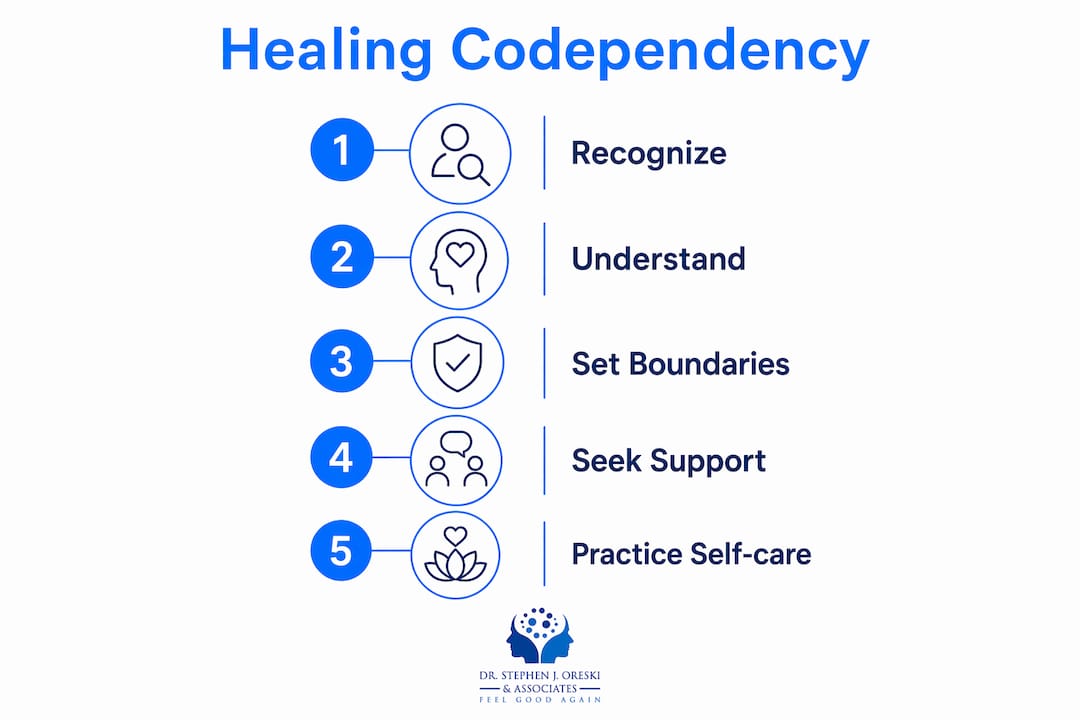
Practical steps for overcoming codependency addiction
Codependency recovery tips that actually work are specific, not vague. “Love yourself more” is not a strategy. The evidence-based recovery process involves 6 to 8 core practices, and most people need 6 to 12 months of consistent effort before the changes feel stable.
The most effective practices include:
- Somatic awareness (the 75/25 rule). Spend 75% of your attention on your own internal experience and 25% on the other person during interactions. This directly counters the 90%+ external focus that defines codependency.
- Boundaries without over-explaining. Effective boundaries are brief and firm. “I can’t do that” is a complete sentence. Lengthy explanations are a plea for approval, which weakens the boundary entirely.
- Scheduled personal time. Block time for your own interests, friendships, and goals. Treat it as non-negotiable rather than something you earn by first meeting everyone else’s needs.
- Rebuilding personal identity. Reconnect with opinions, preferences, and goals that exist independently of the relationship. This is slower than it sounds and often requires professional support.
Recovery is nonlinear by nature. Setbacks are not failures. They are the expected texture of this kind of change. When you set a boundary and your nervous system responds with a racing heart or gut-level dread, that is not a sign you are doing it wrong. It is a sign your nervous system still perceives self-advocacy as a threat. Gradual, repeated exposure is what rewires it.
Therapy options worth considering include individual therapy focused on attachment patterns, Codependents Anonymous (CoDA) support groups, and couples therapy with a clinician trained in attachment theory. Somatic and attachment-focused therapies consistently outperform purely cognitive approaches for this pattern, because the problem lives in the body and the relational field, not just in thought patterns. For couples navigating this together, communication strategies in recovery can provide a practical framework alongside individual work.
Key takeaways
Codependency addiction is a nervous system pattern rooted in anxious attachment, sustained by enabling, and healed through consistent somatic and relational practice over months, not weeks.
| Point | Details |
|---|---|
| Core definition | Codependency is a chronic pattern of neglecting your own needs to manage or rescue another person. |
| Enabling sustains the cycle | Removing consequences from an addicted person delays their recovery and deepens the codependent’s loss of self. |
| Broader than addiction | Codependency occurs with bosses, parents, and friends, not only with partners who have substance use disorders. |
| Recovery takes time | Sustained change typically requires 6 to 12 months of consistent practice in somatic awareness and boundary work. |
| Goal is secure attachment | Recovery means becoming capable of genuine closeness while remaining a grounded, distinct individual. |
What I’ve learned after years of working with codependency
Codependency is one of the most misunderstood patterns I work with. Clients arrive describing themselves as “too caring” or “too sensitive,” and they are genuinely confused about why their relationships keep breaking down. The confusion is understandable. Codependency wears the face of devotion.
What I have observed consistently is that cognitive insight alone does not move the needle. A client can understand codependency perfectly and still feel physically incapable of holding a boundary when the moment arrives. That gap between knowing and doing is where somatic work becomes non-negotiable. The nervous system has to learn, not just the mind.
I also push back on the idea that recovery means becoming less relational or more guarded. The clients who make the most lasting progress are the ones who become more genuinely connected, not less. They stop performing care and start offering it from a place of actual choice. That shift changes everything about how their relationships feel.
Setbacks are part of the process. I tell every client: the goal is not a straight line. The goal is for each setback to teach you something the previous one did not.
— Dr. Stephen Oreski LCSW
Ready to break the codependency cycle?
If what you have read here sounds familiar, you are not alone, and you do not have to figure this out without support.

At Bergencountytherapist, Dr. Stephen Oreski and his team specialize in helping individuals and couples identify and heal codependent patterns through evidence-based, attachment-informed therapy. Whether you are just beginning to recognize the signs or have been working on this for years, professional support accelerates the process significantly. Explore the psychotherapy options available at the practice and take the first step toward relationships that do not cost you yourself. Free consultations are available for new clients, both in-person and online.
FAQ
What is the difference between codependency and being caring?
Genuine care allows you to return to yourself after supporting someone. Codependency means your emotional state remains fused with the other person’s, and you feel responsible for managing their feelings and outcomes.
Can codependency exist without a partner who has an addiction?
Yes. Codependency occurs in relationships with emotionally volatile parents, difficult bosses, adult children, and close friends. The pattern is rooted in anxious attachment, not specifically in substance abuse dynamics.
How long does it take to overcome codependency?
Most people need 6 to 12 months of consistent practice in somatic awareness, boundary work, and identity rebuilding before changes feel stable. Recovery is nonlinear, and setbacks are a normal part of the process.
What therapy works best for codependency recovery?
Somatic and attachment-focused therapies outperform purely cognitive approaches because codependency is stored in the nervous system and relational patterns, not only in conscious thought. Couples therapy and Codependents Anonymous groups also support recovery effectively.
Is codependency a mental health diagnosis?
Codependency is not a formal DSM-5 diagnosis, but it is widely recognized by mental health professionals as a significant behavioral pattern with 20 identified symptoms that meaningfully impair relationships and individual well-being.