

TL;DR:
- Cognitive dissonance causes mental discomfort when beliefs and actions conflict.
- Recognizing and addressing dissonance can promote personal growth and healthier habits.
- Using discomfort as a signal, not an obstacle, fosters emotional resilience and change.
You make a choice, and almost immediately something feels off. Maybe you bought something you couldn’t really afford, or you stayed in a situation you knew wasn’t right for you. That nagging, uncomfortable feeling pulling at you from the inside? That’s cognitive dissonance: the mental discomfort that comes from holding beliefs, values, or behaviors that contradict each other. It happens to everyone, from Bergen County commuters weighing work-life balance to parents questioning their own parenting choices. This article breaks down what cognitive dissonance actually means, what the science says, and how you can use that discomfort as a tool rather than letting it quietly run your life.
Table of Contents
- What is cognitive dissonance?
- Classic studies and how dissonance works
- Why cognitive dissonance matters for decision-making and emotional well-being
- Dissonance in real life: Coping strategies and practical steps
- Perspective: What most articles get wrong about cognitive dissonance
- Find support for life’s conflicts in Bergen County
- Frequently asked questions
Key Takeaways
| Point | Details |
|---|---|
| Definition and cause | Cognitive dissonance is the stress you feel when your beliefs and behaviors don’t match. |
| Impact on daily life | Dissonance shapes decisions, emotional well-being, and relationships—even in subtle ways. |
| Classic studies | Research proves small incentives can drive bigger attitude changes to reduce discomfort. |
| Practical coping | Journaling, therapy, and self-reflection can help resolve tension and boost resilience. |
| Growth opportunity | Treating dissonance as a signal—rather than a problem—can lead to real personal growth. |
What is cognitive dissonance?
Cognitive dissonance is a term that sounds clinical but describes something deeply human. At its core, it’s the mental tension you feel when two things you believe, or something you believe and something you do, don’t line up. Think of it like holding two puzzle pieces that should fit together but simply don’t.
Psychologist Leon Festinger introduced this concept in 1957 after observing a doomsday cult whose members doubled down on their beliefs even after their predictions failed. His insight was that people are strongly motivated to maintain internal consistency. When that consistency breaks down, the brain treats it like a problem that needs solving.
“Cognitive dissonance is the mental discomfort or psychological tension arising from holding two or more inconsistent cognitions.”
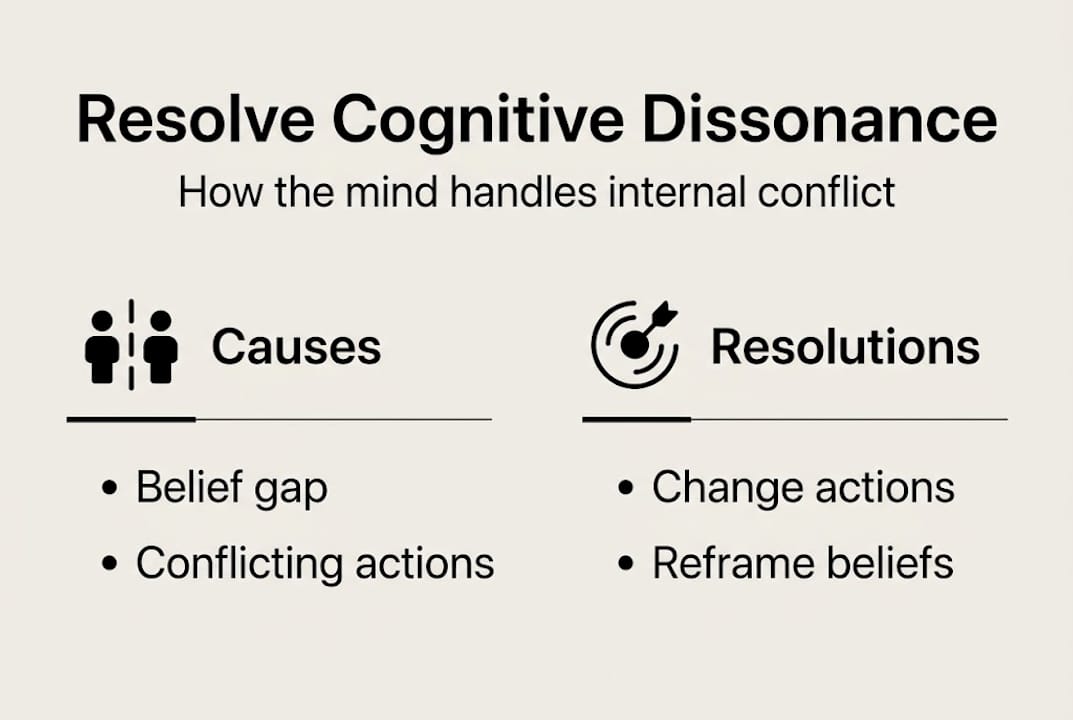
The key word here is motivated. According to research, dissonance motivates reduction through changing your beliefs, adjusting your behavior, adding new justifications, or simply deciding the conflict doesn’t matter. Your brain doesn’t just sit with the discomfort. It actively tries to resolve it, sometimes in ways that aren’t helpful.
Common signs you might be experiencing cognitive dissonance include:
- Feeling stressed or guilty after making a decision
- Rationalizing choices you know aren’t aligned with your values
- Avoiding information that challenges what you already believe
- Difficulty making decisions when two important values conflict
- Feeling irritable or defensive when someone questions your choices
Supporting your mental health between sessions starts with recognizing these subtle signals. When you notice them, you’re already one step ahead.
Classic studies and how dissonance works
With the basics covered, you might wonder how scientists actually test cognitive dissonance in real life. The most famous example is the $1 vs. $20 experiment.

In 1959, Festinger and Carlsmith asked participants to perform a dull, repetitive task and then tell the next person waiting that the task was actually fun and exciting. Some were paid $1 to lie. Others were paid $20. The results were surprising.
| Group | Payment | Reported Enjoyment |
|---|---|---|
| Low reward | $1 | High (attitude shifted) |
| High reward | $20 | Low (no attitude shift) |
The $1 group reported higher enjoyment than the $20 group. Why? Because the $1 payment wasn’t enough to justify lying, so their brains resolved the discomfort by actually convincing themselves the task was enjoyable. The $20 group had a clear external justification, so no attitude change was needed.
Here’s how researchers typically evoke and measure dissonance in studies:
- Participants are asked to act against their stated beliefs (induced compliance)
- Researchers measure attitude change before and after the behavior
- Physiological markers like arousal or discomfort are sometimes tracked
- Self-report scales capture feelings of tension or inconsistency
- Follow-up tasks test whether attitude shifts persist over time
Statistic to note: Significant attitude change in the low-reward condition was confirmed at p<0.05, making it one of psychology’s most cited findings, though some replications have produced mixed results.
More recent parallels appear in digital behavior research, where people hold strong privacy values but routinely share personal data online. This modern version of dissonance shows the concept is just as relevant today as it was in 1959. Understanding how cognitive behavioral therapy addresses thought-behavior gaps draws directly from this research tradition.
Why cognitive dissonance matters for decision-making and emotional well-being
Understanding the science, it’s important to see how dissonance actually shows up in your daily decisions and emotional life. The tension between what you value and what you do shapes far more of your choices than you might realize.
Consider these common value-behavior conflicts many Bergen County individuals face:
- Believing in healthy eating but regularly skipping meals or relying on fast food under stress
- Valuing family time but consistently working late or bringing work home
- Wanting financial security but making impulse purchases to manage stress
- Supporting honesty in relationships but avoiding difficult conversations to keep the peace
- Believing in self-care but feeling guilty whenever you prioritize your own needs
Here’s where it gets interesting. Dissonance doesn’t always push you toward better choices. Sometimes it pushes you toward better rationalizations.
| Outcome | How dissonance is resolved | Result |
|---|---|---|
| Positive growth | Changing behavior to match values | Healthier habits, stronger relationships |
| Negative reinforcement | Rationalizing the behavior | Bad habits persist, self-esteem erodes |
| Avoidance | Ignoring the conflict entirely | Anxiety builds, decisions feel harder |
Recognizing dissonance in value-behavior gaps, like believing in health but continuing to smoke, is what prompts real emotional change. Without that recognition, dissonance can sustain bad habits if the conflict is simply rationalized away.
Pro Tip: Awareness is the first step. Before you can change a pattern, you have to notice the gap between what you believe and what you’re actually doing. Even 60 seconds of honest reflection after a decision can reveal a lot.
Exploring the counseling benefits of working with a therapist can be especially helpful here, as can understanding how guiding child behavior in families often surfaces the same value conflicts in parents.
Dissonance in real life: Coping strategies and practical steps
With dissonance so common in everyday life, what practical steps can you take to address it? The good news is that you have more tools than you think.
- Name the conflict clearly. Write down the two things that feel inconsistent. Vague discomfort is harder to address than a specific tension you can see on paper.
- Journal the gap. Spend five minutes writing about why the conflict exists. Journaling inconsistencies and reflecting on them helps externalize what’s happening internally.
- Talk to someone you trust. Saying the conflict out loud to another person often reveals which side matters more to you.
- Run a small behavioral experiment. Choose one small action aligned with your values and observe how it feels. This builds evidence that change is possible.
- Practice self-affirmation. Remind yourself of your broader values and strengths. This reduces the threat the conflict poses to your identity.
- Seek professional support. When the conflict is deep or persistent, therapy provides a structured space to work through it without judgment.
Research shows that dissonance is strongest when the inconsistency threatens your sense of identity. That’s why certain conflicts feel so much more distressing than others. It’s not just about the behavior. It’s about who you believe you are.
Pro Tip: Practice naming the exact conflict. Not “I feel bad about my choices” but “I believe I’m a good parent, and I yelled at my kids this morning.” Specificity is what makes change possible.
Looking at affirming therapy examples can help you understand how therapists work with identity-level conflicts. If you’re considering professional support, therapy preparation tips can help you walk in feeling ready.
Perspective: What most articles get wrong about cognitive dissonance
Most articles treat cognitive dissonance as a problem to eliminate. Get rid of the discomfort, resolve the conflict, move on. But that framing misses something important.
In our experience working with Bergen County clients, the people who grow the most aren’t the ones who quickly resolve every internal tension. They’re the ones who learn to sit with it long enough to understand what it’s actually telling them. Dissonance is a signal, not a malfunction.
The uncomfortable truth is that a life with no cognitive dissonance is a life that has stopped growing. Every time you push yourself to do something harder, kinder, or more honest than before, you’ll feel some friction. That friction is the gap between who you are now and who you want to become.
The goal isn’t to eliminate that gap. The goal is to use it. Supporting your mental health strategies means learning to treat discomfort as information, not as something to escape.
Find support for life’s conflicts in Bergen County
If you’ve recognized yourself in any of these patterns, you’re already doing something important: paying attention. Sometimes self-reflection and journaling are enough to shift things. But when the conflicts run deeper, or when they keep showing up no matter what you try, working with a therapist makes a real difference.

At Bergen County Therapist, Dr. Stephen Oreski and his team offer a range of therapy options tailored to where you are right now. Whether you’re navigating relationship tension, personal values conflicts, or long-standing emotional patterns, personalized support is available both in-person and online. If you’re ready to take the next step, you can start therapy with a free consultation and find the right fit for your needs.
Frequently asked questions
What causes cognitive dissonance?
Cognitive dissonance is caused by holding conflicting beliefs or acting in ways that contradict your core values, creating internal psychological tension that your brain is driven to resolve.
How can you reduce cognitive dissonance in daily life?
You can reduce dissonance by changing your beliefs, adjusting your behavior, adding new justifications, or seeking support through journaling or therapy, since dissonance motivates reduction through several different pathways.
Is cognitive dissonance good or bad?
Cognitive dissonance can support personal growth when you respond to it honestly, but it can also sustain bad habits if you rationalize the conflict away instead of addressing it directly.
What’s a simple example of cognitive dissonance?
A classic example is knowing that smoking is harmful but continuing to smoke, which creates stress and often leads to rationalizations like “I’ll quit soon” to reduce the discomfort.
How does cognitive dissonance affect relationships?
Dissonance in relationships often shows up as tension or avoidance when your actions don’t match your values, but motivating reduction through honest conversation or couples therapy can lead to healthier patterns.