

TL;DR:
- EMDR is an evidence-based therapy that reduces trauma symptoms without extensive talking about details.
- It uses bilateral stimulation and follows a structured protocol, typically in 6 to 12 sessions.
- EMDR is particularly effective for single-event trauma and PTSD, but may require stabilization for complex cases.
Many people assume that healing from trauma means spending years talking about painful memories in exhaustive detail. That assumption stops a lot of people from ever picking up the phone to call a therapist. EMDR, recognized as effective for trauma by major health organizations including the World Health Organization and the American Psychological Association, works differently. It does not require you to narrate every detail of what happened to you. If you are a Bergen County resident wondering whether EMDR could help you or someone you love, this article will walk you through exactly what it is, how it works, what the research says, and whether it fits your situation.
Table of Contents
- What is EMDR and how does it work?
- The EMDR therapy process: What to expect
- Does research back up EMDR? Evidence and controversies
- Who should (and shouldn’t) consider EMDR in Bergen County?
- Our perspective: How to choose the right trauma therapy in Bergen County
- Ready to explore EMDR therapy? Next steps for Bergen County residents
- Frequently asked questions
Key Takeaways
| Point | Details |
|---|---|
| Efficient trauma therapy | EMDR helps individuals process traumatic memories efficiently, often with less talking than traditional methods. |
| Backed by research | Major organizations like APA and WHO recommend EMDR for PTSD treatment based on robust evidence. |
| Not for everyone | EMDR is not suitable for people with certain mental health conditions or crises and requires a qualified therapist. |
| Process is structured | EMDR therapy follows an 8-phase protocol and typically lasts 6-12 sessions for effective results. |
| Local options available | Qualified EMDR therapists are accessible in Bergen County for those seeking trauma-focused care. |
What is EMDR and how does it work?
EMDR stands for Eye Movement Desensitization and Reprocessing, a psychotherapy developed in the late 1980s by psychologist Francine Shapiro for treating trauma, particularly post-traumatic stress disorder (PTSD). Shapiro noticed that moving her eyes back and forth while thinking about a distressing memory seemed to reduce its emotional intensity. That observation became the foundation for a structured, evidence-based treatment used worldwide today.
The theory behind EMDR is called the Adaptive Information Processing (AIP) model. The idea is straightforward: when a traumatic event overwhelms the brain’s natural processing system, the memory gets stored in a raw, unprocessed form. Sights, sounds, smells, and feelings from the original event stay locked in your nervous system, ready to fire at full intensity whenever something triggers them. EMDR uses bilateral stimulation (side-to-side eye movements, taps, or tones alternating between left and right) to help the brain reprocess those frozen memories so they lose their grip on you.
Some researchers believe this bilateral rhythm mirrors what happens during REM sleep, the stage when your brain naturally sorts and files the day’s experiences. Whether or not that comparison holds up perfectly in every study, the practical effect is measurable: distressing memories become less vivid and less emotionally charged after successful EMDR treatment.
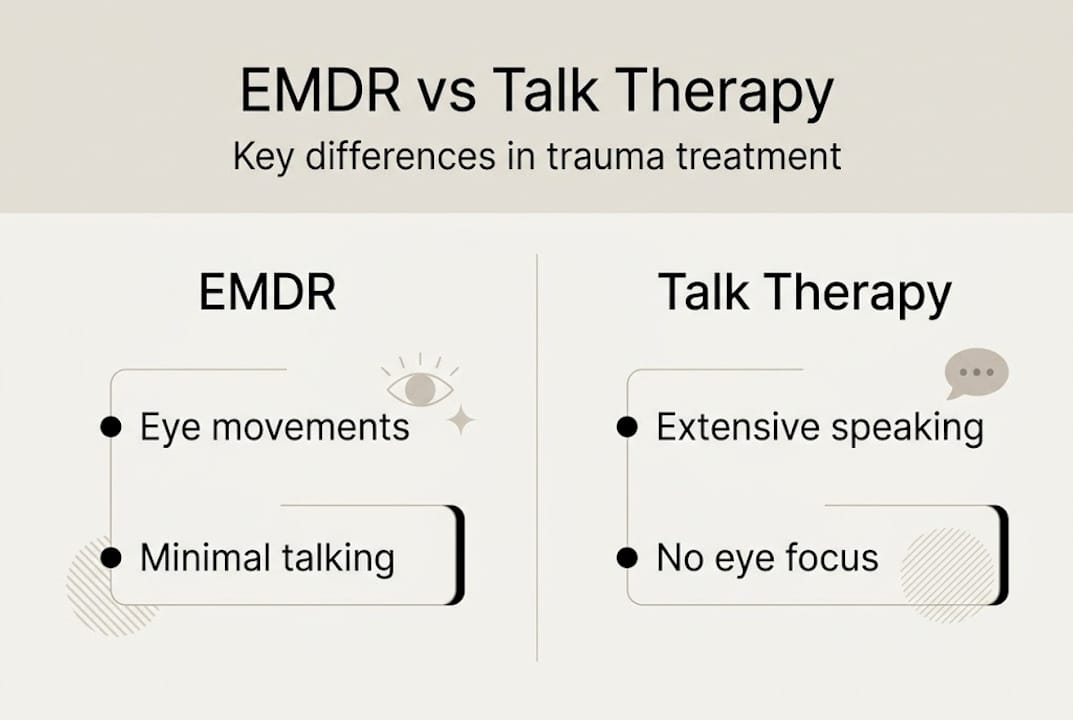
Here is a quick look at how EMDR compares to a traditional talk therapy format:
| Feature | EMDR | Traditional talk therapy |
|---|---|---|
| Verbal retelling required | Minimal | Extensive |
| Uses bilateral stimulation | Yes | No |
| Structured protocol | Yes (8 phases) | Varies |
| Typical focus | Specific memories | Patterns and insight |
| Session format | Active processing | Reflective dialogue |
What makes EMDR particularly accessible for many clients is that you do not have to find the exact right words to describe your experience. The processing happens through the structured protocol, not through storytelling.
Key elements you will encounter in an EMDR session include:
- A specific traumatic memory or image selected for processing
- A negative belief you hold about yourself connected to that memory
- A preferred positive belief you want to replace it with
- A body scan to identify where you feel distress physically
- Sets of bilateral stimulation while you hold the memory in mind
You can explore local EMDR therapy options to see what working with a trained specialist in Bergen County actually looks like in practice.
Pro Tip: If you have avoided therapy because you are afraid of being forced to talk through every painful detail, EMDR may feel surprisingly manageable. Less verbal narration does not mean less healing. For many people, it means more.
The EMDR therapy process: What to expect
EMDR follows a clear, structured protocol that gives both therapist and client a reliable roadmap. The 8-phase protocol covers history-taking, preparation, assessment, desensitization, installation, body scan, closure, and reevaluation. Each session runs 60 to 90 minutes, and most people complete treatment in 6 to 12 sessions, though complex trauma may require more.
Here is how each phase unfolds:
- History-taking: Your therapist gathers background information, identifies target memories, and maps out a treatment plan tailored to you.
- Preparation: You learn coping and stabilization skills so you can manage any emotional intensity that arises between sessions.
- Assessment: Together, you select a specific memory to process, identify the negative belief attached to it, and rate your current distress level.
- Desensitization: This is the core processing phase. You hold the target memory in mind while following bilateral stimulation until the distress rating drops significantly.
- Installation: You reinforce the positive belief (for example, “I am safe now”) until it feels genuinely true in your body.
- Body scan: Your therapist guides you through a check of physical sensations to make sure no residual tension remains.
- Closure: Each session ends with stabilization exercises to make sure you leave feeling grounded and safe.
- Reevaluation: At the start of each new session, your therapist checks how the processed memory feels and decides what to target next.
This table gives Bergen County clients a realistic sense of the treatment timeline:
| Phase | When it happens | Purpose |
|---|---|---|
| History and preparation | Sessions 1 to 2 | Build safety and select targets |
| Active processing | Sessions 3 onward | Reprocess traumatic memories |
| Reevaluation | Each subsequent session | Confirm progress and adjust targets |
| Completion | Varies by complexity | All targets cleared, symptoms resolved |
For a deeper look at finding the right provider for this process, our comprehensive guide to EMDR in Bergen County walks through what to look for. If you are also weighing different providers, our resource on choosing a trauma therapist is worth reading before your first appointment.

Pro Tip: Keep a simple journal between sessions. Note any dreams, unexpected emotions, or memories that surface. This information helps your therapist refine targets and track your progress more precisely.
Does research back up EMDR? Evidence and controversies
The short answer is yes, but with important nuance. EMDR is recognized by WHO, APA, and the VA as an effective treatment for PTSD. Meta-analyses show large effect sizes compared to waitlist controls, with a standardized mean difference around 1.57, and results comparable to trauma-focused cognitive behavioral therapy (TF-CBT). That is not a minor endorsement. These are the same institutions that set clinical standards for mental health treatment globally.
Here is how EMDR stacks up against other common approaches:
| Therapy | Effectiveness for PTSD | Session intensity | Verbal exposure required |
|---|---|---|---|
| EMDR | High | Moderate | Low |
| TF-CBT | High | High | High |
| Prolonged Exposure | High | High | Very high |
| Standard CBT | Moderate | Moderate | Moderate |
“EMDR produces large reductions in PTSD symptoms and is recommended as a first-line treatment alongside trauma-focused CBT by major international health bodies.”
However, the research is not without debate. Some critics argue that the bilateral stimulation may not be necessary for EMDR’s effects. The so-called “purple hat” critique suggests that any structured trauma exposure, even without the eye movements, might produce similar results. In other words, the processing protocol itself may do the heavy lifting, not the bilateral component.
This is a legitimate scientific debate worth taking seriously. What it does not change is the real-world outcome data: clients who complete EMDR frequently report meaningful reductions in trauma symptoms. The mechanism is still being studied, but the results hold up.
Major endorsing bodies include:
- World Health Organization (WHO)
- American Psychological Association (APA)
- Department of Veterans Affairs (VA)
- International Society for Traumatic Stress Studies (ISTSS)
For Bergen County residents managing PTSD, reviewing PTSD therapy options alongside EMDR is smart planning. And if you are already familiar with Cognitive Behavioral Therapy, knowing how it compares helps you and your therapist build the right plan together.
Who should (and shouldn’t) consider EMDR in Bergen County?
EMDR is not a one-size-fits-all solution, and a good therapist will tell you that directly. It tends to work best for people with a clearly defined traumatic event or a specific cluster of PTSD symptoms tied to identifiable memories. Single-event trauma, such as a car accident, a violent incident, or a medical emergency, responds particularly well to EMDR.
EMDR is a strong fit if you:
- Have been diagnosed with PTSD or significant trauma symptoms
- Want a structured, time-limited treatment approach
- Prefer less verbal retelling of traumatic events
- Have tried talk therapy but feel stuck
- Experience intrusive memories, nightmares, or hypervigilance
For complex or chronic trauma, such as childhood abuse spanning years, EMDR may still be helpful but often works best when sequenced after stabilization work or combined with other approaches. Your therapist might spend several sessions building safety and coping skills before introducing active EMDR processing. That is not a failure of the method; it is responsible clinical practice.
Certain situations require caution. People with active psychosis, severe dissociation, uncontrolled bipolar disorder, severe substance abuse, or an ongoing mental health crisis are generally not good candidates for EMDR until those conditions are stabilized. Jumping into trauma processing before a person has adequate emotional stability can be destabilizing rather than healing.
In Bergen County, qualified EMDR providers are available both in-person and through telehealth platforms. When you find an EMDR therapist in Bergen County, confirm that they have completed formal EMDR training recognized by a credentialing body. You can also compare top therapy options in Bergen County to see how EMDR fits into the broader landscape of available care.
Pro Tip: Ask any prospective therapist directly: “Have you completed EMDR training through an EMDRIA-approved program?” A qualified provider will not hesitate to answer and will welcome the question.
Our perspective: How to choose the right trauma therapy in Bergen County
Here is something most EMDR articles will not tell you: the modality matters less than the fit. We have seen clients arrive convinced that EMDR is the only answer because they read about it online, and we have also seen clients resist it based on misunderstandings. Both starting points can get in the way of real progress.
EMDR is a powerful tool for specific presentations. It genuinely shines with single-event trauma and PTSD rooted in identifiable memories. But for someone navigating deep-rooted attachment wounds or chronic relational trauma, jumping straight into EMDR without adequate preparation can feel destabilizing. In those cases, a period of stabilization, sometimes using CBT or somatic approaches, often produces better long-term results.
What we consistently see is that realistic expectations matter as much as technique. Some people feel significant relief after a handful of sessions. Others need more time. Neither outcome reflects the quality of the therapist or the validity of the method. Bergen County residents deserve honest guidance, not just enthusiasm about any single approach.
If you are evaluating your options, the top EMDR therapists worth working with are the ones who tell you honestly when EMDR is the right fit and when it is not.
Ready to explore EMDR therapy? Next steps for Bergen County residents
If what you have read resonates with your experience, the next step does not have to feel overwhelming. EMDR is available in Bergen County through qualified, trained specialists who can assess whether it is the right fit for your specific situation.

At Bergen County Therapist, Dr. Stephen Oreski and the team offer individualized trauma treatment, including EMDR, tailored to where you are right now. You can learn about EMDR therapy on our services page or explore psychotherapy options more broadly if you are still deciding. Free consultations are available, so you can ask every question you have before committing to anything. Reaching out is not a commitment. It is simply information gathering, and you deserve to make that decision with full clarity.
Frequently asked questions
How long does EMDR therapy typically take?
EMDR treatment typically involves 6 to 12 sessions of 60 to 90 minutes each, though individual needs, trauma complexity, and treatment goals can extend that timeline for some clients.
What does a typical EMDR session involve?
A session centers on holding a specific traumatic memory in mind while engaging in bilateral stimulation via eye movements, taps, or tones, followed by installation of a positive belief and a closure phase to ensure you leave feeling grounded.
Is EMDR effective for all types of trauma?
EMDR works best for single-event trauma and PTSD, but for complex or chronic trauma cases it is often combined with stabilization work or other therapy approaches for the best outcomes.
Who should avoid EMDR therapy?
People with active psychosis, severe dissociation, uncontrolled bipolar disorder, or severe ongoing substance use should stabilize those conditions before starting EMDR processing.
How do I find a qualified EMDR therapist in Bergen County?
Look for therapists who completed training through an APA or WHO-endorsed program and ask directly about their EMDR credentials and experience with your specific type of trauma before scheduling.