

TL;DR:
- Formative feedback provides real-time guidance during processes, helping individuals adjust, grow, and reach goals more effectively. It is distinct from summative feedback, which evaluates performance only after completion and often lacks ongoing support. Its success relies on timely, specific, and trusting communication that fosters self-direction and meaningful improvement.
Most people associate feedback with finality. A grade on a test. A performance review at work. A therapist’s closing summary at the end of treatment. But waiting until the end to learn how you’re doing is like checking a map only after you’ve already gotten lost. Formative feedback flips this idea entirely. It gives you guidance during the process, not just after it, so you can course-correct, grow stronger, and reach your goals with far less wasted effort. Whether you’re a parent in Bergen County trying to support your child, an individual working through therapy, or someone just trying to grow personally, understanding formative feedback can genuinely change how you develop.
Table of Contents
- Understanding formative feedback: Definition and core features
- How formative feedback works: The feedback loop in action
- Why timing and quality matter: Making feedback effective
- Real-world examples: Formative feedback in therapy and family life
- What most people get wrong (and how to make formative feedback work for you)
- Take the next step: Supportive therapy in Bergen County
- Frequently asked questions
Key Takeaways
| Point | Details |
|---|---|
| Feedback for growth | Formative feedback guides improvement throughout the process, not just at the end. |
| Timing and personalization | The effectiveness of feedback depends on when and how it’s delivered. |
| Therapy and home use | Actionable feedback empowers change in therapy, family, and everyday life. |
| Beware of pitfalls | Feedback that is vague or negative can demotivate instead of helping. |
Understanding formative feedback: Definition and core features
Formative feedback is not a complicated concept, but it is often misunderstood. In simple terms, formative feedback is information gathered during learning or ongoing work, used to close the gap between current performance and intended goals, so learners and instructors or therapists can make adjustments in real time. The key phrase is “in real time.” This is what separates it from summative feedback.
Summative feedback, by contrast, comes after the process is complete. Think of a final exam grade, an annual job evaluation, or a therapy discharge summary. Summative feedback tells you how you did. Formative feedback tells you how to do better while you still can.
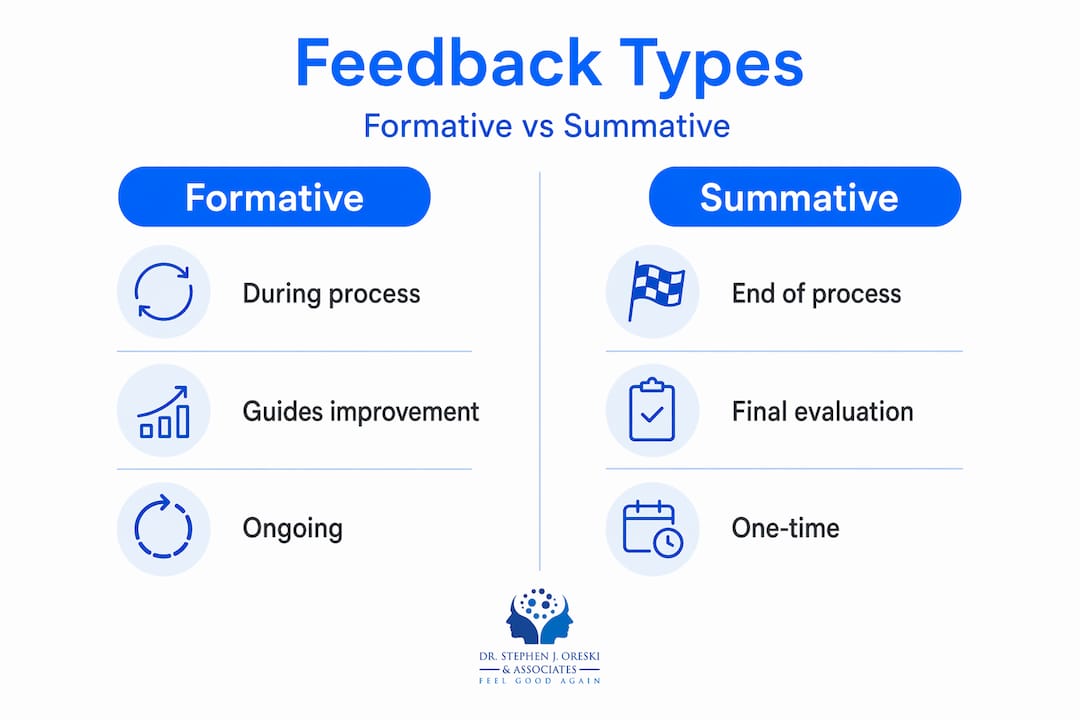
Here is a quick comparison to make this concrete:
| Feature | Formative feedback | Summative feedback |
|---|---|---|
| Timing | During the process | After the process ends |
| Purpose | Guide and adjust | Evaluate and judge |
| Outcome | Improved performance | Score or final verdict |
| Tone | Supportive, ongoing | Conclusive |
| Who benefits most | Learner/client in progress | Evaluator/record keeping |
Formative feedback shows up in many settings you might already recognize:
- Schools: Teachers checking in on student understanding mid-lesson
- Therapy sessions: Therapists adjusting their approach based on a client’s response during a session
- Family communication: Parents noticing a child’s emotional cues and adapting their support accordingly
- Counseling: Ongoing check-ins that build toward personal goals
As NWEA defines it, formative assessment is a planned, ongoing process used by all students and teachers during learning and teaching to elicit and use evidence of student learning to improve student understanding and support students to become self-directed learners. That last part matters. Self-direction is the ultimate goal. Good formative feedback doesn’t create dependency. It builds the internal capacity to recognize and correct your own gaps over time. You can explore more about how this process connects to the benefits of counseling when it’s grounded in real-time responsiveness.
How formative feedback works: The feedback loop in action
Formative feedback isn’t a single comment. It’s a loop, repeated again and again throughout a learning or healing process. Here is how it works step by step:
- Gather evidence about where the person currently is, through observation, questions, check-ins, or direct conversation.
- Compare that evidence to the goal, whether that’s a therapeutic milestone, a skill being built, or a behavior being changed.
- Provide specific, actionable guidance about what to do next. Not just “good job” or “that was wrong,” but a clear direction forward.
- Adjust before the next step, so the person can try again with new information.
This feedback loop works precisely because it prevents small problems from compounding into large failures. In therapy, this might look like a therapist who is halfway through a session noticing that their client seems shut down rather than engaged. Instead of pressing forward with the original plan, the therapist pauses to check in, adjusts the approach to something more grounding, and the client leaves the session feeling genuinely supported rather than overwhelmed.
Here is how this loop maps across three key settings:
| Setting | Evidence gathered | Goal compared | Guidance given | Adjustment made |
|---|---|---|---|---|
| Education | Quiz or class discussion | Grade-level standard | “Try rephrasing your argument” | Next lesson shifts focus |
| Therapy | Client’s tone and body language | Session goals | “Let’s slow down here” | Technique changes mid-session |
| Family | Child’s emotional response | Healthy attachment | “I see you’re frustrated” | Parent adjusts communication style |

Pro Tip: When giving or receiving formative feedback, make it specific. “You seemed to shut down when we talked about that” is far more useful than “you weren’t very present today.” Specificity creates a clear action point.
You can find this approach beautifully modeled in affirming therapy examples where responsiveness to the client in the moment is central to good care. For teens especially, support strategies that rely on real-time check-ins tend to produce far better engagement than static, one-size-fits-all plans.
Why timing and quality matter: Making feedback effective
Here is something most people get wrong. They assume that more feedback, given faster, is always better. Research actually tells a more nuanced story. Effective formative feedback is commonly characterized as timely and actionable, but its impact depends heavily on feedback timing and context.
Giving feedback immediately after an emotional moment in therapy, for example, might not land well if the person hasn’t had a moment to settle. Timing must fit the person and the situation, not just the clock.
What makes formative feedback work well?
- Timeliness: Given close enough to the moment that it’s still relevant and useful
- Clarity: Specific enough that the person knows exactly what to adjust
- Tailoring: Adapted to the person’s readiness, learning style, and emotional state
- Relational trust: Delivered within a relationship where the person feels safe enough to hear and use it
- Action orientation: Focused on what to do next, not just what went wrong
And what makes it harmful? Research consistently shows that negative or vague feedback can reduce motivation and increase avoidance. A parent who says “you always do this wrong” in frustration has technically given feedback, but it closes the door rather than opening it.
Feedback that is not actionable or not received in a trusting relationship is not just useless. It can actively set someone back.
Pro Tip: After receiving feedback, ask yourself or your loved one one simple question: “Do I know what to do differently next time?” If the answer is no, ask for clarification. Good feedback should always leave a clear next step. Explore more mental health growth strategies and how between-session support can reinforce what you’re working on in real time.
Real-world examples: Formative feedback in therapy and family life
Theory is useful. Real examples are better. Here are three concrete situations where formative feedback made a meaningful difference.
- In individual therapy: A client working on anxiety notices partway through a session that breathing exercises are not landing. Their therapist, reading the subtle cues, shifts to a grounding technique instead. The client feels heard. Progress continues without the session becoming another source of stress.
- In a family conversation: A parent asks their teenager how the new homework routine is working. The teen says it feels overwhelming. Rather than defending the plan, the parent adjusts the schedule together with the teen. Trust grows. The strategy actually gets used.
- In a couples session: One partner admits that direct conflict discussions escalate too quickly. The therapist introduces a structured check-in tool to use before disagreements heat up. Feedback before the problem repeats, not after it explodes.
High-quality, tailored feedback positively affects achievement, motivation, and engagement. This is not just true in classrooms. It’s true in every relationship and every growth context.
“The most powerful single modifier of achievement is feedback.” This idea, long recognized in educational psychology, applies just as powerfully to individual therapy and reflective practice as it does to learning.
What most people get wrong (and how to make formative feedback work for you)
Here’s an uncomfortable truth we’ve seen play out repeatedly in therapeutic and family settings. People believe that giving more feedback more often will automatically produce better results. It won’t. In fact, feedback overload, especially when it’s critical and vague, often makes people less willing to try, not more.
The real power of formative feedback lies in three things: relationship, clarity, and timing. Not volume.
What NOT to do:
- Give feedback when someone is still emotionally activated and not ready to hear it
- Use vague language like “you need to do better” without explaining what better actually looks like
- Make feedback about character rather than behavior (“you’re so disorganized” vs. “let’s build a system that helps you track your tasks”)
- Forget to follow up, because feedback without a check-in loop is just a comment, not a process
We’ve seen the most meaningful breakthroughs in therapy come not from big, dramatic confrontations but from small, well-timed adjustments. A therapist who notices a client’s energy shift and simply names it creates a moment of safety that opens more growth than any perfectly crafted intervention. The same is true for parents and partners. Small, attuned affirming approaches delivered at the right moment consistently outperform intensive criticism delivered poorly.
Pro Tip: Build trust before expecting feedback to land. If someone doesn’t feel safe with you, they won’t absorb what you’re offering, no matter how accurate it is.
Take the next step: Supportive therapy in Bergen County
Growth doesn’t happen at the end of a process. It happens in the middle, with the right guidance at the right time.
At Bergen County Therapist, our team uses formative feedback principles to create a collaborative, goal-oriented environment where clients feel genuinely supported every step of the way. Whether you’re exploring psychotherapy options for the first time or looking for the right fit, we help you build real momentum. Flexible online therapy makes support accessible from anywhere in Bergen County. If you’re not sure where to start, our guidance on choosing the right therapy can help you match your needs with the approach that fits best. Reach out for a free consultation today.
Frequently asked questions
How is formative feedback different from summative feedback?
Formative feedback happens during learning to guide improvement, while summative feedback is a final judgment at the end of a process. As research confirms, formative feedback is used to close the gap between current performance and intended goals during learning.
What makes formative feedback effective?
It must be timely, specific, and actionable, focusing on next steps rather than just what’s wrong. Effective formative feedback is timely and actionable, with its impact depending on feedback timing, quality, and context.
Can formative feedback be used outside schools or therapy?
Yes, formative feedback can benefit work, parenting, and relationships by helping people adapt and grow in real time. It applies across settings to close learning gaps and adjust responses wherever growth is happening.
What happens if feedback is too negative or vague?
Negative or unclear feedback can reduce motivation and even cause people to avoid trying. Studies confirm that vague feedback can reduce motivation and increase avoidance, making the situation actively worse than no feedback at all.