

TL;DR:
- Most people believe staying connected with an ex eases breakup recovery, but it actually delays emotional healing if done in the first 28 days.
- The no contact rule involves deliberately stopping all communication with an ex to prioritize personal recovery and self-respect.
- It is essential for those leaving manipulative or abusive relationships, helping to rebuild identity and emotional safety through structured boundaries and self-care.
Most people assume that staying connected with an ex makes the transition easier. Checking in, staying friends, keeping tabs on social media — it all feels like the compassionate, mature thing to do. But contact in the first 28 days after a breakup actually slows emotional recovery. This guide explains what the no contact rule really is, why it works, and how you can apply it to support your own healing — not as a game-playing tactic, but as a genuine act of self-respect.
Table of Contents
- What is no contact?
- How does no contact work? Steps and common challenges
- The science behind no contact: Healing and recovery
- Making no contact work for you: Tips and self-care strategies
- Perspective: What most people get wrong about no contact
- When to seek professional support
- Frequently asked questions
Key Takeaways
| Point | Details |
|---|---|
| No contact defined | It means intentionally avoiding all forms of communication with your ex after a breakup to focus on healing. |
| Speeds emotional recovery | Studies show no contact helps most people feel better in about three months. |
| Growth over reconciliation | Success of no contact is measured by your personal growth, not by an ex’s reactions. |
| Practical steps matter | Following clear steps and self-care routines makes it easier to sustain no contact. |
| Support is available | Professional support can help when maintaining no contact is especially challenging. |
What is no contact?
No contact is exactly what it sounds like: a deliberate, intentional decision to stop all communication with your ex after a breakup. That means no calls, no texts, no sliding into their DMs, no watching their Instagram stories, and no “accidentally” showing up at their favorite coffee shop. Every channel of contact gets closed — at least temporarily.
Here’s what no contact actually covers:
- Phone calls and voicemails
- Text messages, even innocent ones like “just checking in”
- Social media interactions, including likes, comments, and story views
- Email or messaging apps like WhatsApp
- In-person meetings, even those framed as “friendly catch-ups”
- Asking mutual friends for updates
One of the biggest misconceptions floating around is that no contact is a manipulation tactic. It’s often framed online as a way to make your ex miss you, which gives it a reputation it doesn’t deserve. As one clinical insight puts it:
No contact prioritizes personal emotional recovery over reconciliation tactics.
This distinction matters enormously. When you practice no contact with the goal of making your ex come back, you’re setting yourself up for disappointment, because your emotional state stays dependent on someone else’s actions. When you practice it for your own healing, the outcome is in your hands.
If your relationship involved patterns of manipulation or control, understanding no contact becomes even more critical. Those navigating healing after a narcissist breakup often find that any contact with a former partner restarts cycles of emotional confusion and self-doubt. The boundary isn’t just helpful in those cases — it’s essential.

How does no contact work? Steps and common challenges
Knowing what no contact is and actually living it are two very different things. Here’s a practical, step-by-step approach to making it real:
- Make a clear declaration. Decide the date your no contact period begins. Write it down. Tell a trusted friend. Making it official, even just to yourself, sets a psychological anchor.
- Disconnect digitally. Unfollow, mute, or block your ex on all platforms. This isn’t dramatic — it’s protective. Seeing their posts keeps the wound open.
- Set physical boundaries. If you share a workplace or social circle, decide in advance how you’ll handle encounters. A brief, polite acknowledgment and exit is fine. Lingering conversations are not.
- Build your support system. Identify two or three people you can call when you feel the urge to reach out. Having an alternative outlet changes everything.
The most common challenges people face include accidental contact (bumping into an ex at a shared event), pressure from mutual friends who think you’re being “cold,” and the very human impulse to send one last message that starts with “I just wanted to say…”
If your breakup involved more serious dynamics, these challenges can feel even heavier. Understanding the warning signs of abusive relationships can help you recognize whether what felt like love was actually a pattern of control. For survivors of domestic harm, resources like domestic violence recovery tips offer structured support for rebuilding after leaving.
What happens if you break no contact? Be honest with yourself, reset, and move forward. Breaches are common but recoverable — the key is to restart immediately rather than spiral into guilt or use one slip as an excuse to abandon the effort entirely.
Pro Tip: Write a short script for accidental encounters before they happen. Something like, “Good to see you, take care,” practiced out loud, removes the anxiety of improvising in a vulnerable moment. Think of it like supporting a mental reset — preparation is what makes the difference.
The hardest moment isn’t starting no contact. It’s the third week, when the initial adrenaline wears off and the silence feels unbearable. That’s exactly when the healing is happening.
The science behind no contact: Healing and recovery
It’s one thing to hear that no contact helps. It’s another to understand why it works, and what the research actually says.
Empirical studies show roughly 3 months of no contact for significant emotional improvement, though early contact with an ex measurably slows that process. Think about what’s happening neurologically: your brain processes a romantic relationship similarly to an addiction. Seeing or hearing from an ex triggers the same reward pathways that kept you attached in the first place. Each contact resets the emotional clock.
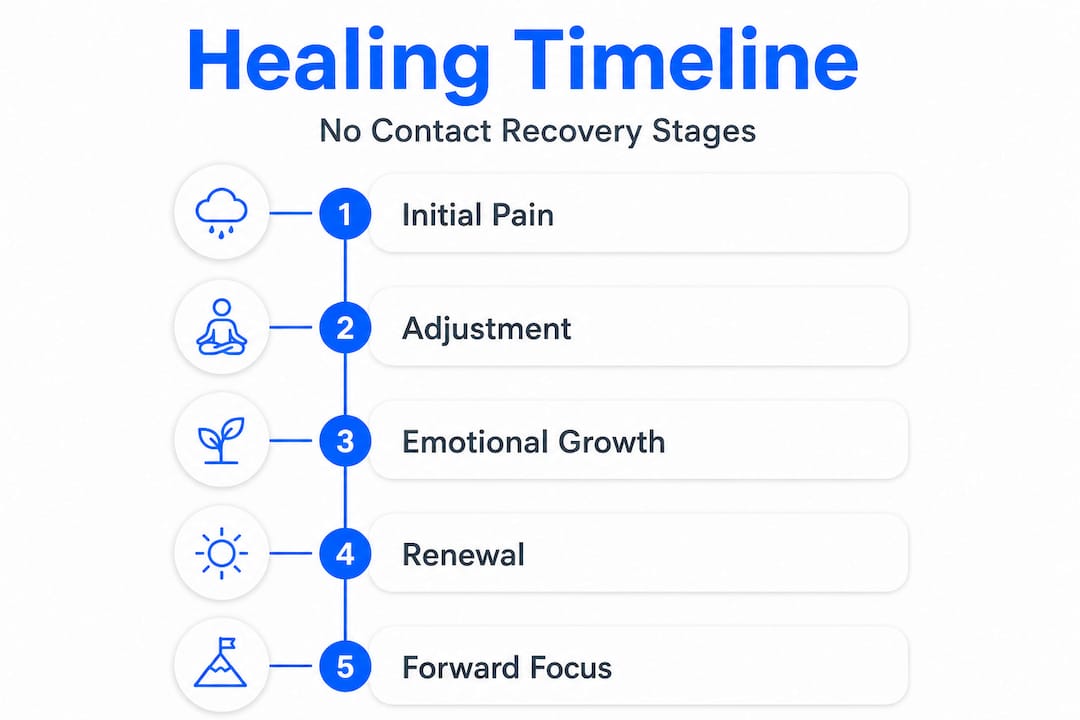
Here’s a general timeline of what emotional recovery looks like during no contact:
| Phase | Timeframe | What you might feel |
|---|---|---|
| Immediate pain | Days 1 to 14 | Grief, anxiety, urge to reach out |
| Gradual clarity | Weeks 3 to 6 | Quieter mind, moments of relief |
| Emotional stabilization | Months 2 to 3 | Improved mood, renewed focus |
| Renewed identity | Month 3 and beyond | Confidence, forward momentum |
The milestones matter because they reframe no contact as a process, not a punishment. You’re not sitting in silence waiting for your ex to notice. You’re moving through predictable, manageable stages of recovery.
It’s worth noting that reconciliation rates after no contact vary widely, from 40 to 70 percent depending on the relationship, but that’s not the point. Those who have experienced betrayal and are recovering from infidelity especially need to measure success by internal growth, not by whether an ex returns. And for those who left toxic or one-sided relationships, therapy after narcissist relationships can accelerate recovery significantly.
Key benefits research consistently supports:
- Reduced emotional reactivity over time
- Improved self-esteem without the push and pull of intermittent contact
- Clearer perspective on whether the relationship was actually healthy
- Greater readiness for future relationships built on secure attachment
Making no contact work for you: Tips and self-care strategies
Understanding the science is helpful. But what do you actually do with all that quiet time?
True success is measured by personal growth, not an ex’s response — and that means filling your days with things that belong to you, not to the relationship you’re leaving behind.
Here’s what actually works:
- Journal daily. Not about your ex, but about yourself. What do you want? What did you learn? Who are you outside of that relationship?
- Reconnect with hobbies. Think about what you stopped doing when you were with your ex. Pick one of those things up again this week.
- Move your body. Exercise is one of the most well-supported interventions for grief and anxiety. Even a 20-minute walk matters.
- Limit social media overall. Checking your ex’s profile isn’t the only danger — doom-scrolling in general keeps your nervous system activated. Consider using tools that help you prioritize offline time for your mental well-being.
- Reach out to your support network. Isolation amplifies pain. Connection softens it.
Mindset is equally important. Explore effective self-care strategies that anchor you in the present rather than the past. Apply mental health tips for growth that shift your focus from “getting over someone” to “becoming someone you’re proud of.” If the relationship involved a narcissistic partner, specific coping strategies for narcissist recovery can help you untangle the confusion that often lingers long after separation.
Resources on mastering personal and emotional growth remind us that the real goal isn’t moving on — it’s moving forward with greater self-awareness.
Pro Tip: Set a milestone calendar. Mark week one, week four, and the three-month mark. Give yourself something small to acknowledge each one — a meal you love, a day trip, a new book. Recovery deserves celebration, not just endurance.
Perspective: What most people get wrong about no contact
Here’s the uncomfortable truth most advice articles skip: no contact isn’t primarily about your ex at all.
Most people enter no contact hoping their ex will notice the silence and come back. So they track whether they’ve been viewed on LinkedIn, analyze whether their ex watched their story, and quietly perform “moving on” for an audience of one. That’s not no contact. That’s still a relationship, just conducted in silence.
Real no contact asks something harder. It asks you to turn toward yourself. The absence of your ex creates a space, and for most people, that space is terrifying at first because it forces you to sit with questions you’ve been avoiding. Who am I without this relationship? What do I actually need? Was I happy, or just comfortable?
Understanding the effects of emotional abuse on mental health reveals how much identity can become tangled up in a relationship, especially one that diminished your sense of self over time. No contact, in those cases, isn’t just healing. It’s reclamation.
We believe the most powerful reframe is this: no contact is not what you’re doing to your ex. It is what you’re doing for yourself. It is an act of self-love that says, “I deserve the space to figure out who I am and what I want.” That shift, from withdrawal as absence to withdrawal as presence with yourself, is where lasting change begins.
When to seek professional support
The emotional work of no contact can surface things that feel too big to manage alone — grief, anger, confusion, or patterns you keep repeating. That’s a signal, not a weakness.

At Bergen County Therapist, Dr. Stephen Oreski and his team specialize in helping people rebuild their emotional lives after difficult relationships. Whether you prefer exploring the different types of psychotherapy available or you’re ready to take action and start therapy for support today, personalized care is within reach. For those who find in-person visits difficult, the benefits of online therapy make getting started simple, private, and flexible. You don’t have to do this alone — and you shouldn’t have to.
Frequently asked questions
How long should you do no contact after a breakup?
Research suggests about three months of no contact leads to significant emotional recovery for most people, based on empirical benchmarks from positive psychology studies.
What if I break no contact?
Breaches are common and recoverable — simply restart the period immediately without self-judgment, treating the slip as information rather than failure.
Does no contact always work to get your ex back?
No contact focuses on your healing first; while reconciliation rates vary between 40 and 70 percent, it is never guaranteed and should not be the primary goal.
Is no contact useful after an abusive relationship?
Absolutely. No contact is especially critical after abuse because prioritizing personal recovery over any contact restores emotional safety and helps break the cycles of control and confusion left behind.