

TL;DR:
- Toxic codependency is an emotional enmeshment pattern where one person’s identity depends on another’s needs. It erodes individuality, fosters compulsive caregiving, and causes chronic anxiety. Recovery involves therapy, self-awareness, and practicing boundaries over 1 to 2 years.
Toxic codependency is defined as a relational pattern where one person’s emotional stability, identity, and self-worth become excessively organized around another person’s needs and approval. Clinically, therapists recognize it as a form of emotional enmeshment where the “Me” collapses into the relationship, leaving little sense of a separate self. Unlike healthy closeness, this pattern erodes individuality, creates compulsive caretaking, and generates chronic anxiety. Understanding what is toxic codependency is the first step toward reclaiming your emotional health.
What is toxic codependency? Signs and behavioral patterns
Toxic codependency produces a recognizable set of behaviors that most people mistake for devotion or love. The clearest signal is hypervigilance: constantly monitoring another person’s mood, needs, and reactions while ignoring your own. A codependent person organizes their decisions and emotional stability around someone else’s state, mistaking emotional fusion for love. That confusion is what makes the pattern so hard to see from the inside.
What does a codependent relationship look like in practice? Consider a partner who cancels their own plans every time the other person seems upset, or a parent who cannot tolerate their adult child’s discomfort and rushes to fix every problem. These behaviors feel caring. They are actually forms of self-abandonment.
Common signs of codependency include:
- Hypervigilance: Scanning others’ emotions constantly while losing touch with your own feelings
- Over-responsibility: Believing it is your job to manage another person’s emotional state
- People-pleasing: Saying yes when you mean no, to avoid conflict or rejection
- Enabling: Protecting someone from the natural consequences of their choices
- Identity loss: Defining yourself primarily through your role in the relationship
Many codependent behaviors like caretaking are survival strategies rooted in early attachment experiences, not character flaws. The nervous system learned that staying alert to others’ needs was the safest way to maintain connection. That wiring does not make you broken. It makes you human, with patterns worth examining.
Pro Tip: Keep a simple daily log for one week. Each time you make a decision, ask: “Am I doing this because I want to, or because I fear what happens if I don’t?” The pattern will become visible quickly.
How do therapists identify codependency?
Toxic codependency is not a formal DSM-5 or ICD diagnosis. That absence has real consequences. Without a diagnostic code, insurance coverage for treatment can be inconsistent, and many people go years without a clear name for what they are experiencing. Therapists instead treat it as a complex relational pattern requiring clinical attention.
The most widely used clinical framework is the four-item diagnostic rule. Therapists look for at least one of these four indicators:
- Negative self-perception: Persistent feelings of shame, inadequacy, or unworthiness tied to the relationship
- Hypervigilance: Chronic alertness to another person’s emotional state at the expense of one’s own
- Protective action: Compulsive behaviors designed to prevent another person’s distress or anger
- Emotional enmeshment: Inability to distinguish your own feelings from the other person’s feelings
The presence of even one indicator often signifies active codependency, according to therapists who use this framework. That low threshold reflects how pervasive the pattern tends to be once it takes hold. Therapy for codependency focuses on relational dynamics rather than labeling, which means the work centers on rebuilding your relationship with yourself alongside your relationships with others.
How does toxic codependency differ from healthy interdependence?
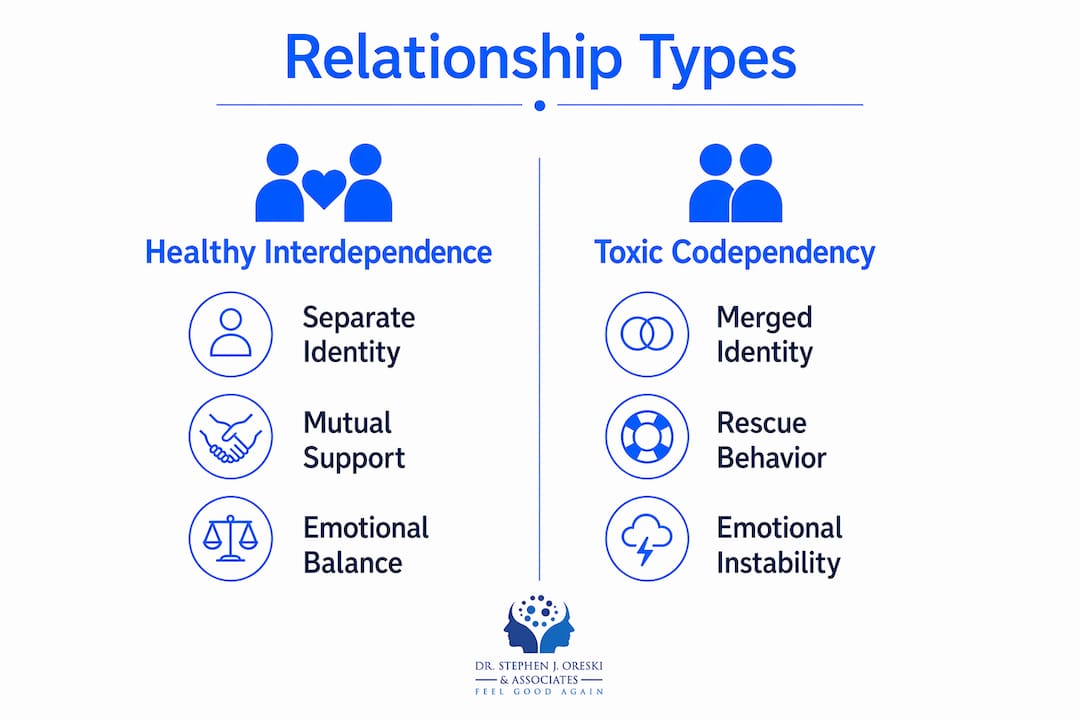
Healthy relationships require interdependence. Two people rely on each other, influence each other, and care deeply about each other’s wellbeing. That is not codependency. The difference lies in whether each person retains a separate, functioning identity inside the relationship.
One useful clinical framework is the “Three Sovereign Entities” model: Me, You, and Us. In a healthy relationship, all three exist simultaneously. Each person has their own emotional life, preferences, and boundaries. The “Us” is built from two whole people, not from one person dissolving into the other. Toxic codependency collapses the “Me” entirely, leaving only “You” and “Us.”
| Feature | Healthy interdependence | Toxic codependency |
|---|---|---|
| Identity | Separate and intact | Merged or lost |
| Emotional regulation | Self-managed, with support | Dependent on partner’s state |
| Boundaries | Clear and respected | Absent or resented |
| Conflict | Navigated with communication | Avoided at personal cost |
| Motivation for care | Genuine desire | Fear of abandonment or rejection |
Codependency looks like love but degrades relationships by eroding individuality, attraction, and real intimacy. That is the uncomfortable truth. The more you abandon yourself to keep someone else comfortable, the less real connection is actually possible.
Pro Tip: Ask yourself: “Can I hold my own opinion when my partner disagrees, without feeling like the relationship is at risk?” If the answer is no, that is worth exploring with a therapist.
Practical steps to begin recovering from codependent patterns
Recovery from toxic codependency is not about becoming self-sufficient or emotionally closed off. Attachment science confirms that the goal is secure attachment, which balances genuine connection with personal autonomy. You are not trying to need people less. You are learning to stay connected to yourself while staying connected to others.

The recovery timeline is realistic but requires patience. Most people see consistent improvements within 3–6 months of therapy and support group engagement. Deeper healing of long-standing patterns typically takes 1–2 years. That is not a discouraging fact. It is a realistic one that helps you set expectations and stay committed.
Practical steps that support recovery include:
- Name the pattern without shame: Recognizing codependent behavior is progress, not failure
- Practice the “recovery gap” concept: The goal is to notice self-abandonment quickly and return to yourself, not to achieve perfect boundaries immediately
- Set one small boundary per week: Start with low-stakes situations to build the skill before applying it to high-stakes relationships
- Seek individual therapy early: Professional support accelerates the process significantly
- Apply learning outside sessions: Real healing happens in daily choices, not only in therapy rooms
One of the most important shifts in recovery is understanding that waiting to feel ready before changing codependent patterns delays progress. Action precedes readiness. You will not feel comfortable setting a boundary before you set it. The discomfort comes first, and the confidence follows.
Pro Tip: After any interaction where you feel anxious or resentful, pause and ask: “What did I need in that moment that I didn’t give myself?” That question builds the self-awareness that recovery depends on.
Key Takeaways
Toxic codependency is a learned relational pattern driven by fear of abandonment, and it is fully recoverable through consistent therapeutic work and daily self-awareness practice.
| Point | Details |
|---|---|
| Core definition | Toxic codependency is emotional enmeshment where one person’s identity collapses into another’s needs. |
| No formal diagnosis | DSM-5 and ICD do not classify codependency, making clinical recognition and treatment access inconsistent. |
| Four clinical indicators | Therapists look for negative self-perception, hypervigilance, protective action, or emotional enmeshment. |
| Healthy vs. toxic | Healthy interdependence preserves the “Me, You, Us” model; codependency erases the “Me.” |
| Recovery timeline | Consistent improvements appear within 3–6 months; deeper healing takes 1–2 years of sustained effort. |
What I’ve learned from working with codependency in real relationships
Codependency shows up differently depending on the relationship. I see it between romantic partners, between parents and adult children, between close friends, and even between colleagues. The surface behaviors vary. The core fear is always the same: if I stop managing this person’s experience, they will leave, fall apart, or stop loving me.
What strikes me most is how invisible the pattern is to the person living it. The behaviors feel like love. They feel like loyalty. The nervous system has genuinely mislabeled alarm signals as connection signals, and that makes the work both complex and deeply compassionate. I never approach codependency as a personal failing. It is a survival strategy that outlived its usefulness.
The most meaningful shift I witness in clients is not when they set a boundary perfectly. It is when they notice they abandoned themselves and choose to return. That moment of noticing, without self-punishment, is where real recovery lives. You can explore warning signs in your own relationships as a starting point, but the deeper work is always about rebuilding your relationship with yourself first.
— Stephen
Support for codependency and emotional health at Bergencountytherapist
Recognizing a codependent pattern is meaningful progress. Taking the next step with professional support is what makes that recognition count.

At Bergencountytherapist, Dr. Stephen Oreski and his team work with individuals navigating codependency, boundary issues, and relational patterns that affect emotional wellbeing. Therapy is tailored to your specific situation, whether you are in a relationship that feels consuming, recovering from one, or trying to understand your own patterns more clearly. You can also use tools like mental health tracking to monitor your progress between sessions. A free consultation is available to help you find the right fit and take the first step at your own pace.
FAQ
What is toxic codependency in simple terms?
Toxic codependency is a relational pattern where one person loses their sense of self by organizing their emotions, decisions, and identity around another person’s needs and approval. It differs from healthy closeness because it involves self-abandonment rather than genuine mutual care.
What does a codependent person look like in daily life?
A codependent person typically struggles to say no, feels responsible for others’ emotions, and experiences anxiety when they are not needed or approved of. They often prioritize others excessively while neglecting their own needs, preferences, and wellbeing.
Is codependency a mental health diagnosis?
Codependency is not listed in the DSM-5 or ICD as a formal diagnosis. Therapists treat it as a recognized relational pattern with clinical significance, using behavioral indicators rather than a diagnostic code to guide treatment.
How long does it take to recover from codependency?
Most people see consistent improvements within 3–6 months of therapy and support. Deeper healing of long-standing patterns typically requires 1–2 years of sustained effort, including applying new behaviors in real relationships outside of therapy sessions.
Can codependency exist in non-romantic relationships?
Codependency appears in any close relationship, including those between parents and adult children, siblings, and close friends. The pattern is defined by emotional enmeshment and loss of self, not by the type of relationship involved.