

TL;DR:
- Many couples mistakenly view marriage counseling as a last resort, preventing early intervention that can preserve relationships. It improves communication, rebuilds emotional intimacy, and offers practical tools for managing conflicts before they escalate. Starting therapy proactively helps establish healthier patterns, leading to stronger bonds and more effective conflict resolution over time.
Many couples assume marriage counseling is a last resort, something you turn to when everything else has failed. That misunderstanding stops a lot of people from getting help early, when it matters most. What can marriage counseling do? Far more than save a relationship from the edge. It can sharpen how you communicate, rebuild emotional closeness, and give you practical tools to navigate the moments that usually spiral. For couples in Bergen County, this kind of support is closer and more accessible than you might think, and it works best when you start before things feel impossible.
Table of Contents
- What marriage counseling really is and who it helps
- Key benefits marriage counseling offers to couples seeking connection and communication
- Why starting marriage counseling early makes a difference
- How marriage counseling addresses real-life issues couples often face in Bergen County
- What to expect during marriage counseling: process and typical steps
- Why waiting to seek marriage counseling can deepen problems and how you can shift that mindset
- Find supportive marriage counseling in Bergen County to strengthen your relationship
- Frequently asked questions
What marriage counseling really is and who it helps
Marriage counseling, also called couples therapy or marriage therapy, is a form of psychotherapy focused on the relationship itself rather than either individual. A licensed marriage and family therapist is a licensed mental health professional trained to work with couples and families to improve relationship dynamics and mental well-being. That distinction matters. These therapists are not generalists who happen to see couples. They are trained specifically in relational dynamics, meaning they understand how patterns between two people form, reinforce, and either break down or grow stronger over time.
What does marriage counseling consist of in practice? Sessions typically involve both partners meeting with the therapist together, though some approaches include brief individual sessions to give each person space to speak openly. A therapist assesses where the relationship currently struggles, what strengths already exist, and what goals both partners share. The focus is usually short-term and practical, oriented toward improving daily functioning in the relationship.
Counseling addresses a wide range of issues, including:
- Repeated arguments that never reach resolution
- Communication breakdowns where partners feel unheard or dismissed
- Life transitions such as having children, job changes, or caring for aging parents
- Mental health challenges in one or both partners that affect the relationship
- Emotional distance or loss of intimacy over time
- Trust repair after betrayal or dishonesty
Understanding the benefits of marriage counseling goes a long way toward reducing the hesitation many couples feel before making that first appointment.
Key benefits marriage counseling offers to couples seeking connection and communication
What does marriage counseling do at its core? It gives couples a structured, neutral space where difficult conversations can happen without escalating into the same tired fights. Couples therapy provides a structured space for partners to work through conflict, improve communication, and strengthen their bond with a trained therapist. That structure is not incidental. It is the whole point.
Many couples discover in therapy that their arguments are not really about the surface issue. The fight about dishes is rarely about dishes. Therapy helps partners slow down reactive patterns, recognize what they are actually feeling, and respond from that more honest place rather than from frustration or defensiveness.
Counseling around high-stakes topics like money, health, and family reduces defensiveness and prevents cycles of disconnection from taking hold. A therapist can guide that conversation in ways that neither partner can do alone, because when emotions are high, neither person is in a position to be the fair witness.
Here is what improving communication in marriage through counseling typically looks like in practice:
- Learning to express needs without blame or attack
- Practicing listening skills that actually make your partner feel heard
- Identifying the emotional triggers beneath surface arguments
- Building shared language for talking about difficult subjects
- Developing conflict resolution strategies you can use outside sessions
Pro Tip: Ask your therapist to teach you one specific communication tool in your first three sessions. Concrete skills give you traction early and build confidence that therapy is working.
The cumulative effect is stronger emotional bonds, rebuilt trust, and a relationship that feels less like a battlefield and more like a partnership. Therapists working from an emotionally focused approach also help partners recognize and break cycles that erode connection over time, which is central to building a strong foundation in couples therapy.

Why starting marriage counseling early makes a difference
One of the most important things research tells us about couples therapy is that timing is everything. Starting therapy earlier, rather than waiting for a crisis, is associated with more progress in the relationship. The reason is straightforward: patterns become habits, and habits become identity. The longer a destructive communication cycle runs unchecked, the more it feels like just who you are as a couple.
Early sessions focus on skill-building before resentment calcifies. Here is what that progression typically looks like:
- Recognize the pattern early. Something feels off, conversations keep going wrong, or you feel more distant than usual.
- Book an initial assessment. A therapist maps your communication style and identifies early tension points.
- Set specific, shared goals. Both partners agree on what a better relationship looks like to them.
- Build skills proactively. Practice listening, expressing needs, and managing conflict while stakes are lower.
- Track progress regularly. Therapists adjust the approach based on what is and is not working.
The average person receiving couples therapy is better off at the end of treatment than 70 to 80 percent of individuals who do not participate in therapy. Starting early maximizes that advantage.
A practical conflict resolution workflow can also help couples practice what they learn in sessions between appointments, reinforcing progress week to week.
How marriage counseling addresses real-life issues couples often face in Bergen County
Bergen County couples navigate real pressures, long commutes, demanding careers, aging parents, and the financial weight of living in one of New Jersey’s most expensive regions. These are not abstract stressors. They show up in kitchens, bedrooms, and car rides home.
Couples therapy helps with discussions around money, health, family, caregiving, and major life transitions, preventing cycles of defensiveness and disconnection. Here is how that applies across common challenges:
| Challenge | How counseling helps |
|---|---|
| Financial stress | Surfaces different money values and builds shared decision-making |
| Infidelity or betrayal | Guides trust repair with structure and accountability |
| Caregiving for parents | Clarifies roles and prevents resentment from building silently |
| Retirement and role changes | Redefines shared purpose after major identity shifts |
| Parenting disagreements | Creates aligned approaches that feel fair to both partners |
| Intimacy and distance | Rebuilds emotional and physical closeness over time |
Marriage counseling helps partners work through past resentments or infidelity that might otherwise linger and damage the relationship long-term. That is not a simple fix, but it is a real one, and it requires a space where both partners feel safe enough to be honest.
Support for life transitions is particularly valuable for couples facing major changes, because transitions often expose gaps in how partners communicate and cope. For couples struggling with physical or emotional distance, exploring intimacy support alongside traditional counseling can deepen the work.
Pro Tip: If financial stress is your main source of conflict, mention it explicitly in your first session. Therapists can frame money conversations in ways that reduce blame and help both partners feel financially heard.
What to expect during marriage counseling: process and typical steps
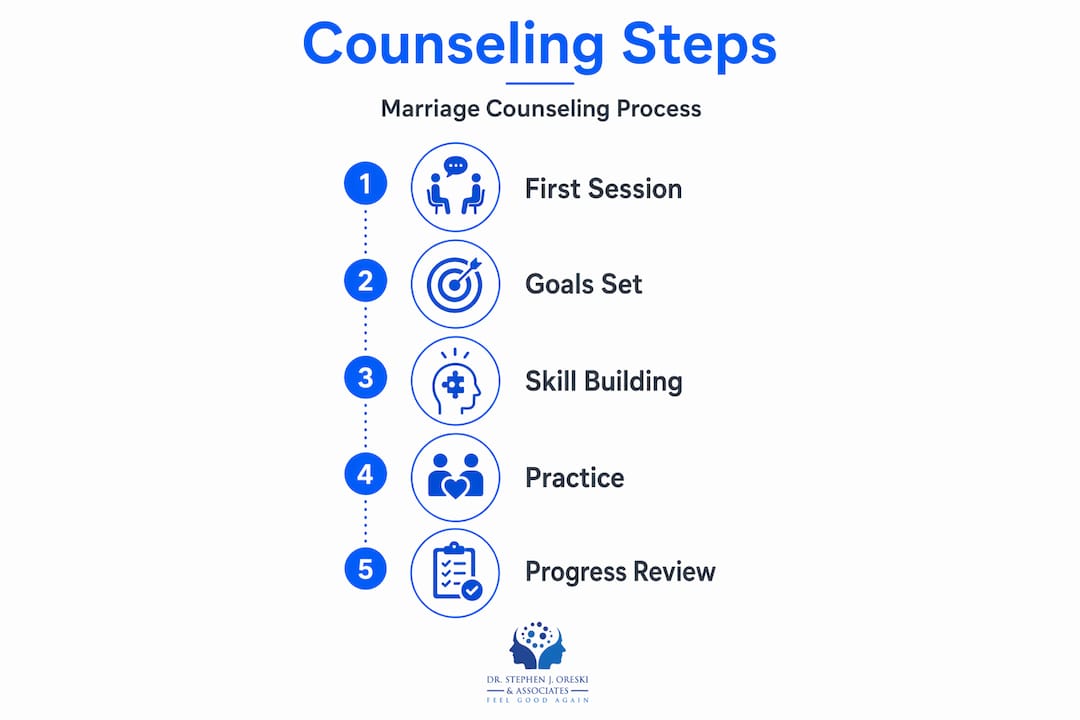
If you have never been to couples therapy, the first session can feel intimidating. Knowing the process helps. Counseling typically starts by assessing communication and conflict resolution skills, then works through issues step by step with therapist guidance.
Here is what that looks like in practice:
- Session one: Intake and history. Your therapist learns about your relationship background, current struggles, and each partner’s perspective.
- Goal setting. You and your therapist define what success looks like, specifically and realistically.
- Skill introduction. The therapist teaches communication and listening frameworks tailored to your patterns.
- Practice and feedback. Sessions include real conversations with therapist coaching in the moment.
- Progress review. Periodically, you assess what has improved and where more work is needed.
What is marriage counseling like emotionally? Expect some discomfort early on. The first few sessions often surface things that have been avoided. That is not failure. That is the process working. Understanding the full couples therapy process before you begin takes away a lot of the anxiety that keeps people from starting couples therapy in the first place.
Pro Tip: Come to your first session with one specific example of a conversation that went wrong. Concrete examples give your therapist something real to work with immediately.
Why waiting to seek marriage counseling can deepen problems and how you can shift that mindset
Here is the uncomfortable truth most relationship advice skips: the couples who wait the longest to get help are often the ones who needed it earliest. Many couples delay seeing a therapist until problems feel overwhelming, but early intervention leads to better outcomes and prevents entrenched resentment. By the time couples finally make the call, some patterns have been running for years.
The reason people wait is almost always cultural. Therapy still carries stigma in some communities. Asking for help feels like admitting defeat. And there is a deeply ingrained belief that a strong relationship means one that does not need outside support. That belief causes more damage than any single argument.
Reframe it this way: going to therapy is not a sign your relationship is broken. It is a sign you take your relationship seriously enough to invest in it. Athletes train with coaches. Executives work with mentors. Treating your marriage with the same intentionality is not weakness. It is the opposite.
The couples who benefit most from counseling are often not the ones in crisis. They are the ones who recognized something worth protecting and acted before the damage became structural. Good conflict resolution strategies learned early become habits that pay dividends for decades.
Find supportive marriage counseling in Bergen County to strengthen your relationship
Now you have a clear understanding of what marriage counseling can do and how to take the next step toward a healthier relationship.
At Bergen County Therapist, Dr. Stephen Oreski and his team work with couples across Bergen County to improve communication, resolve conflict, and rebuild emotional connection. The approach is personalized, meaning your therapy is built around your specific relationship, not a one-size approach that ignores your real life.
If you are ready to learn more about how to start couples therapy or want to understand the couples therapy process before committing, both resources walk you through exactly what to expect. Free consultations are available, and both in-person and online sessions serve couples throughout Bergen County. The first step is the hardest, and it is worth taking.
Frequently asked questions
What issues can marriage counseling help with besides communication problems?
Marriage counseling can assist with a wide range of challenges including financial stress, life transitions, infidelity, caregiving disputes, and rebuilding trust after betrayal, not just communication breakdowns.
How long does marriage counseling usually last?
Marriage and family therapy is typically short-term and solution-focused, often spanning several weeks to a few months depending on the couple’s goals and how quickly patterns shift.
Is marriage counseling only for couples in crisis?
No. Couples therapy is useful both during difficult periods and when partners simply want to deepen connection, improve daily communication, or navigate a major life transition before problems escalate.
What qualifications should I look for in a marriage counselor?
Look for a licensed marriage and family therapist (LMFT), a professional trained specifically to work with couples and families who has met your state’s licensure requirements.