

- Marriage counseling involves couples therapy to improve communication and rebuild emotional bonds. It usually requires 8 to 20 sessions, with progress often noticeable between sessions 8 and 12. Honest engagement and addressing underlying patterns are essential for meaningful change.
Marriage counseling is a form of psychotherapy in which a licensed therapist guides both partners to improve communication, resolve conflict, and rebuild emotional connection. The formal clinical term is couples therapy, and it treats the relationship itself as the patient, not either individual. Knowing what to expect from marriage counseling before you walk in removes the fear of the unknown and helps you engage more honestly from session one. Methods like Emotionally Focused Therapy (EFT) and the Gottman Method are the two most widely used evidence-based approaches. Both require active participation, emotional honesty, and a willingness to sit with discomfort.
What happens in the first marriage counseling sessions?
The first session sets the entire tone for therapy. Initial assessment sessions last about 60 minutes and focus on gathering your relationship history, identifying core challenges, and setting collaborative goals. Your therapist is not there to judge either of you. The goal is to understand how your relationship works, not to assign fault.
Many practices using the Gottman Method structure the first four sessions as a formal assessment phase. This typically includes a joint session, individual sessions with each partner, and a final feedback meeting where the therapist presents a treatment plan. That structure gives both of you a chance to speak privately and honestly without worrying about your partner’s reaction in the room.
The therapist will ask targeted questions about how you argue, what triggers conflict, how you repair after a fight, and where emotional distance has grown. Early sessions explore emotional safety, intimacy, and communication breakdowns in detail. This is not small talk. Expect to go deeper than you anticipated.
- Joint intake session: Both partners share their perspective on the relationship’s history and current problems.
- Individual sessions: Each partner meets separately with the therapist to share what they may not say in front of their partner.
- Feedback session: The therapist presents findings and proposes a treatment plan with shared goals.
- Goal alignment: Both partners agree on what they want therapy to accomplish, which guides every session that follows.
Pro Tip: Write down three specific moments from the past year that felt like turning points in your relationship, positive or negative. Bringing concrete examples to the first session helps your therapist understand your dynamic faster.
How does couples therapy actually work session to session?
Once the assessment ends, the real work begins. The relationship is the client, not either individual partner. Nancy Ryan, LMFT, describes this shift clearly: the therapist’s focus moves entirely onto couple patterns rather than individual behavior judgments. That means your therapist is watching how you two interact, not building a case against either of you.

One of the most effective techniques in couples therapy is what therapists call “slowing the tape.” This means interrupting arguments midstream to analyze the physiological and emotional reactions happening in real time. Your therapist may stop a conversation mid-sentence to ask, “What just happened in your body right there?” That pause is not an interruption. It is the intervention.
Common techniques you will encounter include:
- Emotionally Focused Therapy (EFT): Identifies negative interaction cycles and helps partners express underlying attachment needs instead of surface-level complaints.
- Gottman Method: Uses research-based tools to build friendship, manage conflict, and create shared meaning in the relationship.
- Between-session exercises: Homework assignments like daily check-ins, structured conversations, or journaling to reinforce what you practice in the room.
- Real-time pattern interruption: The therapist pauses live conversations to identify emotional flooding, withdrawal, or escalation before they spiral.
“Effective therapy exposes truths behind recurring patterns, even if uncomfortable.” — Therapist Aaron Platt
Sessions can feel destabilizing. Difficult sessions often leave couples feeling quieter or more disconnected than when they arrived. That is not a sign therapy is failing. It is a sign the work is reaching suppressed emotions that surface-level conversations never touched.
How many sessions does marriage counseling take?
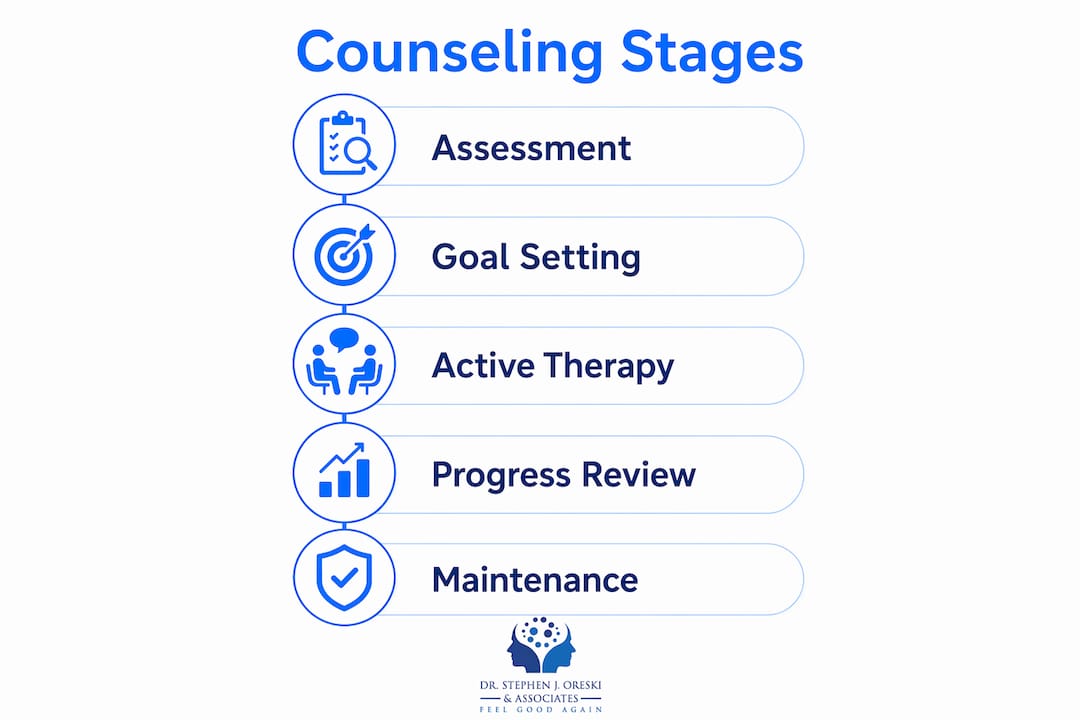
Couples therapy is not a quick fix, and any therapist who promises otherwise is not being honest with you. EFT and similar models typically require 8–20 sessions, with the range depending on how complex your issues are and how consistently you both engage. Most couples notice meaningful shifts around sessions 8–12.
| Stage | Typical session range | What you notice |
|---|---|---|
| Assessment and goal setting | Sessions 1–4 | Clarity on patterns, shared language for problems |
| Active skill building | Sessions 5–12 | Improved communication, faster conflict recovery |
| Consolidation | Sessions 13–20 | Increased trust, emotional warmth, reduced reactivity |
About 70% of couples who attend counseling stay together after therapy and report improved relationship quality. That number reflects couples who engage consistently, not those who attend sporadically or drop out early.
Progress does not look like zero conflict. It looks like shorter recovery times after arguments, more willingness to be vulnerable, and a growing sense that you are on the same team again.
Pro Tip: Track one small positive interaction per day between sessions. Couples who notice incremental improvements stay more motivated during the slower middle phase of therapy.
What are the biggest misconceptions about marriage counseling?
The most common mistake couples make is treating therapy like a courtroom. Each partner arrives hoping the therapist will confirm they are right. Effective therapists block these attempts entirely and redirect focus onto the cycle driving the conflict, not who started it.
Therapist Aaron Platt warns specifically against conflict-avoidant therapy that prioritizes politeness over truth. A therapist who only keeps the peace is not doing the job. Real progress requires exposing the patterns underneath the arguments, and that process is uncomfortable by design.
Avoid these common pitfalls:
- Weaponizing sessions: Using what your partner shared in therapy against them outside the room destroys trust and derails progress.
- Expecting the therapist to fix you: The therapist provides tools and observations. You do the actual work.
- Treating discomfort as failure: Feeling raw after a session means the work is real. Numbness is the warning sign, not emotion.
- Withholding information: Therapist Figs O’Sullivan emphasizes that nervous system regulation is foundational before problem-solving. If you are hiding key truths, your nervous system stays activated and the therapy stalls.
For couples who want to build on what they learn in sessions, conflict-resolution strategies can reinforce the skills their therapist introduces.
Key Takeaways
Marriage counseling works when both partners treat the relationship as the client, commit to honest engagement, and accept that meaningful change takes 8–20 structured sessions.
| Point | Details |
|---|---|
| The relationship is the client | Therapy targets interaction patterns, not individual blame or diagnosis. |
| Assessment comes first | The first 1–4 sessions focus on history, goals, and a shared treatment plan. |
| Discomfort signals progress | Feeling unsettled after sessions means suppressed emotions are finally surfacing. |
| Realistic timelines matter | Most couples see meaningful shifts between sessions 8 and 12. |
| Honesty drives outcomes | Withholding information keeps nervous systems activated and stalls real change. |
What I have learned after years of working with couples
Most couples arrive at my door expecting me to tell them who is right. That expectation is the first thing we have to dismantle together. The relationship has its own patterns, its own rhythms of escalation and withdrawal, and those patterns are usually older than the current argument. They often predate the marriage itself.
What surprises couples most is how physical the work is. Before we can solve anything, both partners need their nervous systems calm enough to actually hear each other. You cannot problem-solve when your body is in threat mode. That is not a metaphor. It is biology, and it is why the early sessions focus on slowing things down rather than solving things fast.
I also want to be honest about discomfort. The sessions that feel the worst are often the most productive. When a couple leaves my office quieter than they came in, I take that as a sign we touched something real. The couples who worry me are the ones who leave every session feeling fine. Fine usually means we stayed on the surface.
If you are considering pre-marriage counseling or are already in a difficult stretch, the single most important thing you can bring is honesty. Not politeness. Not a prepared argument. Just a genuine willingness to look at what is actually happening between you.
— Stephen
Ready to take the next step with Bergencountytherapist?
Bergencountytherapist, led by Dr. Stephen Oreski and his team, offers couples therapy, individual counseling, and online therapy options for Bergen County residents and beyond. Whether you are just starting to consider counseling or have been thinking about it for months, a free consultation is the lowest-pressure way to understand what the process looks like for your specific situation.
If you are unsure which type of support fits your needs, the right type of therapy guide at Bergencountytherapist walks you through the decision clearly. You can also use the mental health tracking tools on the site to monitor your own patterns before and during therapy, giving you and your therapist better data to work with from the start.
FAQ
What does marriage counseling consist of?
Marriage counseling consists of joint sessions with a licensed therapist focused on communication patterns, conflict cycles, and emotional connection. Most programs include an assessment phase, active skill-building sessions, and between-session exercises.
How long does couples therapy usually take?
Couples therapy typically runs 8–20 sessions, with most couples noticing visible shifts around sessions 8–12 depending on engagement and issue complexity.
Is it normal to feel worse after a session?
Yes. Feeling more disconnected after a difficult session is a common sign that therapy is addressing deep, suppressed emotions rather than staying on the surface.
What is the success rate of couples therapy?
About 70% of couples who complete counseling stay together and report improved relationship quality, particularly when both partners engage consistently.
Do both partners have to attend every session?
Most couples therapy models require both partners at joint sessions, though individual sessions are often included during the assessment phase to allow each person to speak privately with the therapist.