

- Premarital counseling is a valuable, proactive investment that builds essential communication and relationship skills before marriage. Starting 6 to 9 months early allows couples to explore sensitive topics deeply, reducing future conflict and enhancing long-term resilience. Choosing the right counselor and engaging in tailored sessions prepares couples with practical tools that last well beyond the wedding day.
Premarital counseling is one of the most practical investments you can make before your wedding day. Yet many couples skip it because they assume it’s only for troubled relationships. That’s the wrong framing entirely. Knowing what to expect in premarital counseling helps you walk in prepared, engaged, and ready to get real value from the process. This article breaks down how sessions are structured, what topics you’ll cover, how to pick the right counselor, and why the skills you build before the wedding tend to matter far more than the vows themselves.
Table of Contents
- Key takeaways
- What to expect in premarital counseling: timing and why it matters
- What happens in premarital counseling sessions
- Building tools that outlast the wedding day
- How to choose the right premarital counselor
- My honest take on why couples wait too long
- Start your premarital counseling with Bergencountytherapist
- FAQ
Key takeaways
| Point | Details |
|---|---|
| Start 6 to 9 months early | Beginning counseling well before the wedding gives you time to process and apply what you learn. |
| Expect at least four sessions | Most couples complete four or more tailored sessions covering communication, finances, intimacy, and values. |
| It’s a proactive tool | Premarital counseling is not crisis intervention. It builds a shared relationship framework before problems arise. |
| Therapist fit matters | Interview multiple counselors to find someone whose approach and experience align with your relationship style. |
| Skills outlast the wedding day | The communication methods you develop in counseling serve your marriage for years, not just months. |
What to expect in premarital counseling: timing and why it matters
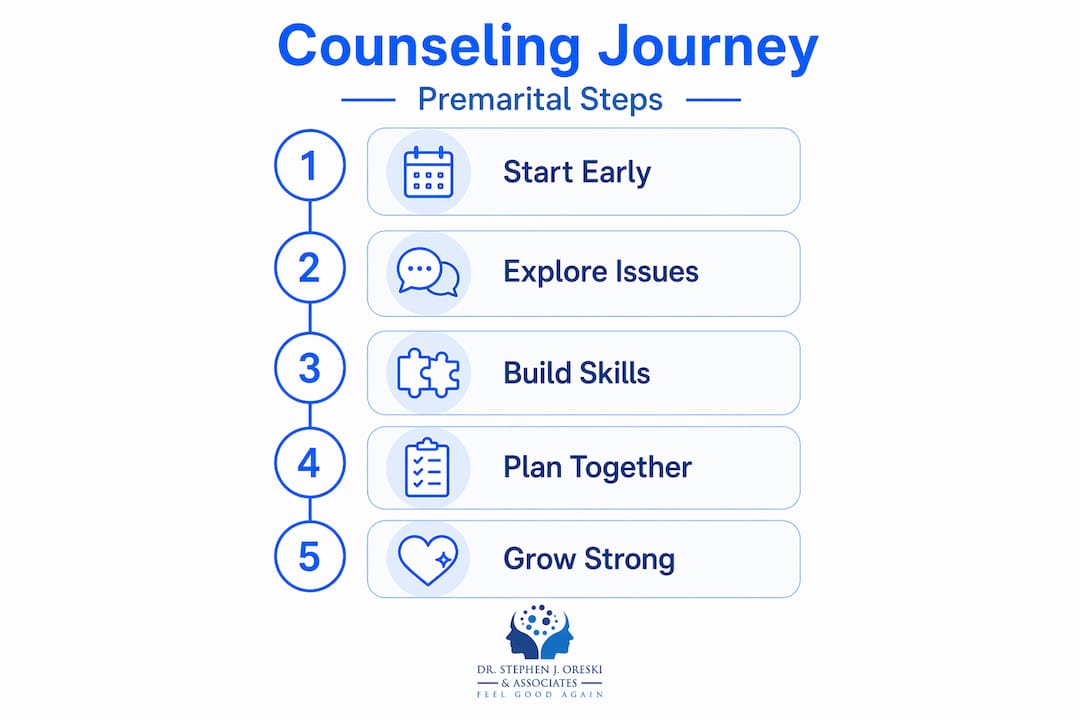
Most couples book premarital counseling as a checkbox item a month before the wedding. That’s the single biggest mistake you can make with the process. Experts recommend starting premarital counseling 6 to 9 months before the wedding. That timeframe isn’t arbitrary. It gives you and your partner space to sit with what comes up in sessions, have follow-up conversations on your own, and revisit difficult topics without the pressure of a looming ceremony.
When couples start early, sessions feel like genuine exploration rather than rushed homework. You have time to reflect on what you’re learning about each other without the stress of catering menus and seating charts crowding out the real work.
The trend is shifting in this direction. There has been a 20% increase in couples seeking premarital counseling recently, with some even delaying their wedding dates by up to 12 months to fully commit to the process. Younger generations increasingly see counseling before marriage as a sign of maturity and intentionality, not a warning sign about the relationship.
Here’s what happens when you start on time:
- You finish sessions weeks before the wedding, not the night before
- You have time to practice the communication tools your counselor teaches
- You enter the marriage with clarity on major decisions already discussed
- You reduce the stress of trying to process heavy topics while planning the event
Pro Tip: Book your first counseling session the same week you book your venue. That timing sets the right priorities from day one.
If you want guidance on when to begin and what early sessions look like, Bergencountytherapist has resources specifically designed for engaged couples at this stage.
What happens in premarital counseling sessions
This is where most of the confusion lives. People imagine sitting across from a therapist who asks probing questions about childhood trauma while one partner cries. That’s not what pre-marriage counseling actually looks like for most couples.
Sessions typically recommend at least four meetings, customized to what each couple needs. Some couples go through six or eight sessions if there are specific areas they want to dig into. The counselor’s role is to create a structured space where both partners can speak honestly and feel heard. They’re not there to judge your relationship or predict your future. They’re there to guide productive conversations you might not have otherwise.
Common premarital counseling topics covered across sessions include:
- Communication styles: How you each express needs, frustration, and appreciation
- Conflict resolution: What your current patterns look like and how to improve them
- Finances: Income management, debt, spending habits, and long-term financial goals
- Intimacy and physical connection: Expectations, differences, and how to stay connected over time
- Family dynamics: Boundaries with parents and in-laws, family traditions, and loyalty conflicts
- Core values and beliefs: Religion, parenting philosophy, career priorities, and lifestyle expectations
What makes premarital counseling sessions different from regular couples therapy is the forward-facing lens. You’re not processing a recent fight. You’re building a shared framework for the fights you haven’t had yet.
| Topic | Why it matters before marriage |
|---|---|
| Finances | Money conflicts are a leading cause of divorce; surfacing differences early prevents resentment |
| Family boundaries | Unaddressed loyalty conflicts with in-laws create recurring friction |
| Intimacy expectations | Mismatched expectations evolve over time and need explicit conversation |
| Communication styles | Most couples assume they communicate well until they actually disagree about something serious |
Pro Tip: Write down three questions you’ve been avoiding asking your partner before each session. Counseling is one of the few places where those conversations become easier, not harder.
Counseling helps couples identify potential friction points like finances, in-laws, and communication styles before they escalate into patterns that are much harder to change.
Building tools that outlast the wedding day
Here’s the part most articles miss. What is premarital therapy actually building? Not just conversational fluency. The goal is a shared toolkit: a set of strategies both partners can reach for when things get hard.
Think of it this way. You’ll both change significantly over the first ten years of marriage. Careers shift. Health changes. Children arrive, or don’t. The person you marry at 29 looks very different at 39. What you’re really building in counseling is the adaptive capacity to grow together instead of apart.

The goal of premarital counseling, as framed by therapists who specialize in it, is not to predict every future challenge but to develop communication strategies and emotional intelligence for long-term resilience. That framing changes how you approach each session.
Here’s a practical sequence of what that toolkit development looks like:
- Identify your communication patterns. You each come in with habits formed long before you met. Counseling makes those habits visible.
- Learn to name feelings without blame. This is harder than it sounds and far more useful than any specific conflict resolution script.
- Discuss future scenarios explicitly. What happens if one of you wants to move for a job? What if a parent needs care? Talking through hypotheticals now builds decision-making muscle.
- Set expectations with clear eyes. Premarital counseling helps couples enter marriage with realistic expectations grounded in mutual respect, not just optimism.
“Couples who build a shared language during counseling navigate inevitable future changes far more effectively than those who rely on love alone.” — Psychology Today
Counseling also prepares couples for the long-term adaptation required by marriage, well beyond initial plans and early assumptions. That’s the part that actually protects the relationship.
How to choose the right premarital counselor
Finding a counselor you both feel comfortable with is non-negotiable. A therapist who makes one partner feel judged or silenced will undermine the entire process. Interviewing multiple therapists and evaluating their approach and experience with premarital work is the most reliable way to find the right fit.
Here’s what to look for and ask:
- Experience with premarital work specifically. General couples therapists are not always trained in the premarital counseling process. Ask directly how many couples they’ve worked with before marriage.
- Approach and structure. Some counselors use formal assessment tools. Others prefer open conversation. Know which fits your style before you commit.
- Values alignment. If faith, cultural background, or specific life philosophies matter to you, make sure the counselor can work within that context without imposing their own.
- Comfort level after the first session. One trial session tells you a great deal. If something feels off, trust that signal and keep looking.
You can review the premarital counseling benefits outlined by Bergencountytherapist to get a clearer picture of what a structured, supportive experience looks like before committing to a provider.
Pro Tip: Ask any potential counselor: “What do you do when partners strongly disagree during a session?” Their answer tells you exactly how they handle conflict, which is the core of what you’re hiring them for.
My honest take on why couples wait too long
I’ve worked with engaged couples for years, and the pattern I see most often isn’t couples who don’t want counseling. It’s couples who want it but keep pushing the start date back. There’s always a reason: the venue deposit is due, one partner travels for work, they haven’t found the “right” therapist yet.
What I’ve learned is that the couples who benefit most are the ones who start before they think they need to. They come in curious, not defensive. They haven’t built up resentment yet. The conversations are more open, and the tools stick better because there’s no crisis urgency drowning out the learning.
Premarital counseling is increasingly seen as a love investment rather than a red flag. That shift in perception is accurate and long overdue. In my experience, the couples who show up to counseling before marriage are not the ones who doubt their relationship. They’re the ones who take it seriously enough to prepare.
The couples I worry about are the ones who assume love and good intentions are enough. They are not a substitute for shared language and practiced communication. Those skills are built, not assumed.
— Dr Stephen Oreski LCSW
Start your premarital counseling with Bergencountytherapist
If you’re engaged and wondering how to start this process, Bergencountytherapist offers counseling services tailored to couples preparing for marriage. Dr. Stephen Oreski and his team specialize in helping partners build the communication tools, realistic expectations, and emotional groundwork that make marriages last. Sessions are available both in person in Bergen County and virtually, so access is flexible regardless of your schedule. You can also explore mental health tracking resources to support your overall wellbeing throughout the engagement period. Reach out for a free consultation and take the step that sets your marriage up from the start, not after problems appear.
FAQ
What is premarital counseling exactly?
Premarital counseling is structured therapy for engaged couples that covers communication, finances, intimacy, and values before marriage. The goal is to build practical relationship skills, not to fix an existing problem.
How many sessions does premarital counseling take?
Most counselors recommend at least four sessions, though the number is tailored to each couple’s needs and concerns. Some couples complete six to eight sessions depending on the topics they want to explore.
When should couples start premarital counseling?
Experts recommend starting 6 to 9 months before the wedding to allow enough time for meaningful conversation and reflection without the pressure of last-minute wedding planning.
What topics are covered in premarital counseling?
Common topics include communication styles, conflict resolution, finances, family boundaries, intimacy expectations, and core values. Sessions are customized to each couple’s specific dynamics and concerns.
Is premarital counseling only for couples with problems?
No. Premarital counseling is a proactive process designed for couples who want to enter marriage with clarity and shared tools. Most couples who attend are in healthy relationships and want to keep them that way.