

TL;DR:
- A licensed marriage and family therapist (LMFT) with specialized training provides the most effective marriage counseling. Evidence-based models like EFT, Gottman, or CBT yield better results, especially when matched to specific relationship issues. Choosing a therapist with significant couples caseloads and proper training is crucial for meaningful progress.
A Licensed Marriage and Family Therapist (LMFT) is the most qualified professional for marriage counseling, though any licensed clinician with specialized training in evidence-based couples therapy methods delivers comparable results. Knowing what type of therapist is best for marriage counseling matters because credentials alone do not predict outcomes. Specialization does. Research shows 70–75% of couples in evidence-based therapy like Emotionally Focused Therapy (EFT) move from distress to recovery, with up to 90% showing clinically significant improvement. The earlier you seek help, the better your odds.
What makes an LMFT different from other therapists?
A Licensed Marriage and Family Therapist holds a graduate degree specifically focused on relational and family systems. That distinction matters. While a general therapist might treat one person’s depression or anxiety, an LMFT is trained to treat the relationship itself as the client.

LMFTs complete supervised clinical hours working with couples and families before licensure. Their curriculum covers attachment theory, communication patterns, and systemic dynamics that a generalist therapist may never study in depth. Specialized couples training consistently produces better outcomes than general therapy without couples-specific education.
Common issues LMFTs address include:
- Chronic conflict and communication breakdown
- Infidelity and trust repair
- Parenting disagreements and blended family stress
- Emotional distance and disconnection
- Pre-marital concerns and life transition stress
Pro Tip: Ask any prospective therapist what percentage of their weekly caseload is couples. A therapist seeing couples daily thinks and practices very differently from one who sees a couple once a month.
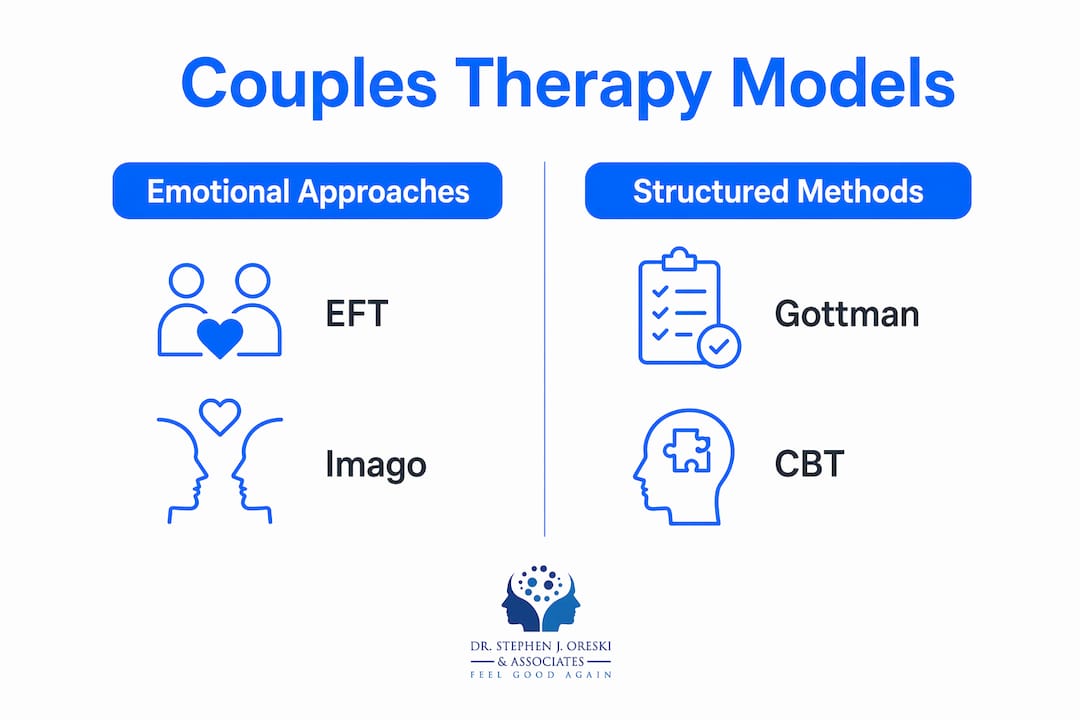
How do evidence-based therapy models compare for couples?
Not all marriage counseling uses the same approach. EFT, Gottman Method, and Imago Relationship Therapy are the three most widely practiced evidence-based models. Each targets a different layer of relationship dysfunction, so matching the model to your specific challenge is as important as choosing the right therapist type.
Emotionally Focused Therapy (EFT) targets the attachment bond between partners. It helps couples identify negative interaction cycles and replace them with secure, responsive connection. EFT is especially effective for couples dealing with emotional withdrawal or anxious pursuit patterns.
The Gottman Method uses a structured, research-based framework built on decades of observational data. The Gottman Institute endorses Certified Gottman Therapists as the gold standard, contrasting them with generic coaches who lack graduate-level clinical oversight. This model works well for couples who respond to concrete tools and measurable progress.
Cognitive Behavioral Therapy (CBT) for couples addresses distorted thinking patterns that fuel conflict. It is practical and skill-focused, making it a good fit for couples whose arguments stem from misinterpretation rather than deep emotional wounds.
| Therapy Model | Best For | Key Focus |
|---|---|---|
| Emotionally Focused Therapy (EFT) | Emotional disconnection, attachment wounds | Rebuilding secure bonding cycles |
| Gottman Method | Communication breakdown, conflict patterns | Research-based skill building |
| CBT for Couples | Negative thinking, reactive conflict | Cognitive restructuring and behavior change |
| Imago Relationship Therapy | Childhood wounds affecting the relationship | Empathy and conscious partnership |
Pro Tip: Before your first session, explore the types of couples therapy available so you can ask your therapist which model they use and why it fits your situation.
What other licensed clinicians can provide effective marriage counseling?
An LMFT is not the only path to quality couples therapy. LPCs, LCSWs, and psychologists with advanced couples therapy training can treat marriage problems just as effectively. The title matters less than the training behind it.
Here is how each clinician type fits into the picture:
- Licensed Professional Counselor (LPC): Trained in mental health counseling with a broad scope. An LPC who has completed post-graduate training in EFT or the Gottman Method is a strong choice for couples therapy.
- Licensed Clinical Social Worker (LCSW): Brings a systems perspective that naturally aligns with relational work. LCSWs with couples specialization are particularly effective when social stressors like finances or family conflict are driving marital strain.
- Psychologist (Ph.D. or Psy.D.): Offers the deepest clinical training and is especially valuable when one or both partners carry significant mental health diagnoses alongside relationship difficulties.
- Relationship Coach: Not a licensed clinician. Coaches lack graduate-level clinical oversight and are not equipped to treat clinical-level relationship distress. The Gottman Institute specifically distinguishes certified therapists from coaches for this reason.
One critical note: in situations involving domestic violence or coercive control, traditional couples counseling is inappropriate and can increase risk. Safety planning must come first.
How do you evaluate and choose the right marriage counselor?
Choosing the best therapist for couples means going beyond a Google search. The consultation call is your primary evaluation tool. Limit your intake questions to 3–5 high-impact queries since consultations typically run 15–20 minutes. Use that time well.
Ask these questions to assess therapist fit:
- What percentage of your caseload is couples? A therapist who sees couples regularly thinks relationally. One who rarely does may default to individual therapy frameworks.
- Which therapy model do you use with couples, and why? A trained specialist will answer this clearly. Vague answers signal limited specialization.
- How do you measure progress in couples therapy? Look for structured check-ins, not just subjective impressions.
- What is your policy on individual sessions with one partner? Ethical therapists maintain neutrality and avoid seeing one partner individually to prevent conflicts of interest.
- What are your fees, insurance policies, and cancellation terms? Practical fit matters. Therapy that becomes financially unsustainable stops working.
If after three to four sessions you feel unheard, judged, or that the therapist is taking sides, that is a signal to reassess. Therapeutic alliance is one of the strongest predictors of outcome. A poor fit is not a reason to quit therapy. It is a reason to find a better match.
Pro Tip: Review the key questions to ask before your first consultation so you walk in prepared, not reactive.
Key takeaways
The best therapist for marriage counseling is a licensed specialist trained in evidence-based couples therapy, not simply any therapist willing to see two people at once.
| Point | Details |
|---|---|
| Prioritize specialization over title | LMFTs, LPCs, LCSWs, and psychologists all qualify if they have advanced couples training. |
| Match the model to your problem | EFT suits emotional disconnection; Gottman Method suits communication breakdown; CBT suits reactive conflict. |
| Ask about caseload percentage | A therapist who sees couples regularly delivers better outcomes than a generalist. |
| Use the consultation strategically | Limit questions to 3–5 focused queries covering approach, progress tracking, and policies. |
| Know when therapy is not appropriate | Domestic violence situations require safety planning, not couples counseling. |
What i’ve learned after years of watching couples choose the wrong therapist
The most common mistake I see couples make is choosing a therapist based on convenience rather than qualification. They find someone nearby, check that insurance is accepted, and book. Six months later, they tell me therapy “didn’t work.” In most of those cases, they saw a generalist who had no specific training in couples dynamics.
The second mistake is expecting the first session to feel like relief. Early sessions are diagnostic, not curative. A skilled therapist is mapping your interaction cycles in those first meetings, not handing out communication scripts. Couples who understand this stay in therapy long enough for it to work.
One thing I want to be direct about: the therapist’s job is not to decide who is right. The role is to restructure how you relate to each other at a deeper level than the surface argument. If your therapist is playing referee, that is a red flag, not a therapeutic technique.
Finally, individual therapy alongside couples work is often underused. When both partners are also doing their own work, the couples sessions move faster. Individual counseling can strengthen your marriage in ways that joint sessions alone cannot reach. I recommend it often, and the results speak for themselves.
— Stephen
Ready to find the right therapist for your relationship?
At Bergencountytherapist, Dr. Stephen Oreski and his team include specialists trained in EFT, the Gottman Method, and other evidence-based approaches to couples therapy. Whether you are navigating conflict, rebuilding trust, or simply feeling disconnected, the right match matters.
Bergencountytherapist offers both in-person and online couples therapy for couples across Bergen County and beyond. A free initial consultation helps you assess fit before committing. Explore the full range of psychotherapy options available through the practice and take the first step toward a relationship that works for both of you.
FAQ
What type of therapist is best for marriage counseling?
A Licensed Marriage and Family Therapist (LMFT) is the most specialized choice, though LPCs, LCSWs, and psychologists with advanced couples training are equally effective. Specialization in evidence-based methods like EFT or the Gottman Method matters more than the specific license title.
How long does marriage counseling typically take?
Most couples see meaningful progress within 12–20 sessions, though this varies by the severity of the issues and the therapy model used. EFT, for example, typically runs 8–20 sessions for moderate relational distress.
What are the main advantages of couples therapy?
Research shows up to 90% of couples in evidence-based couples therapy show clinically significant improvement. The advantages include improved communication, restored emotional connection, and tools for managing future conflict.
Can a regular therapist do marriage counseling?
A general therapist can see couples, but outcomes are stronger with a clinician who has couples-specific training. Ask directly about their training in EFT, Gottman Method, or other relational models before committing.
When is couples therapy not appropriate?
Couples therapy is not appropriate when domestic violence or coercive control is present. In those cases, safety planning takes priority and individual support is the safer starting point.