

- Recovery from narcissistic abuse involves reconditioning neurological patterns like trauma bonding and anxiety.
- Building education, support networks, and boundaries are essential foundations for effective healing.
- Engaging in therapy, practicing no-contact, and rebuilding routines help rewiring the brain and restore self-trust.
Leaving a relationship with a narcissist rarely feels like freedom at first. Instead, many survivors describe a fog of self-doubt, anxiety, and an unsettling pull back toward the person who hurt them. That pull is not a weakness. It is a neurobiological response to prolonged emotional abuse, and understanding it changes everything. This guide walks you through the science behind narcissistic abuse, the foundational tools you need before healing can begin, and a clear set of coping strategies grounded in research. If you have been wondering why “just move on” advice never worked, you are about to find out why, and what actually does.
Table of Contents
- Understanding the effects of narcissistic abuse
- Setting the foundation: What you need for effective recovery
- Step-by-step coping strategies for narcissist recovery
- Verifying your progress and preventing setbacks
- A deeper perspective: Why real recovery is more than disconnection
- Find professional support for lasting recovery
- Frequently asked questions
Key Takeaways
| Point | Details |
|---|---|
| Narcissistic abuse changes the brain | Understanding the neurobiological effects of trauma bonding is critical to real healing. |
| Preparation boosts recovery success | Solid boundaries, education, and support are essential before deep therapeutic work. |
| Step-by-step action works best | Breaking recovery into manageable steps leads to steady progress and stability. |
| Progress requires patience | Setbacks are normal; tracking improvements keeps you motivated and realistic. |
| Professional help accelerates healing | Therapy and evidence-based coping strategies make lasting recovery possible. |
Understanding the effects of narcissistic abuse
One of the most disorienting parts of recovering from a narcissistic relationship is not knowing why you feel so stuck. You left. You know the relationship was harmful. Yet the grief, confusion, and self-blame persist. This is not a character flaw. It is the result of specific psychological and neurological changes that happen during prolonged narcissistic abuse.
The most important concept to understand is trauma bonding. Abuse rewires the brain via trauma bonding, creating a neurochemical addiction that mirrors the cycle of withdrawal and craving seen in substance dependence. The unpredictable pattern of idealization followed by devaluation floods your brain with stress hormones and reward chemicals in alternating waves. Over time, your nervous system becomes conditioned to seek relief from the very source of pain.
Beyond trauma bonding, survivors commonly experience a cluster of lasting effects:
- Anxiety and hypervigilance: Constantly scanning for threats, even in safe environments
- Intrusive memories: Flashbacks or rumination that interrupt daily functioning
- Eroded self-worth: Internalized criticism that feels like your own inner voice
- Decision paralysis: Deep distrust of your own judgment after years of gaslighting
- Emotional numbness: Disconnection from your own feelings as a protective response
These are not signs of weakness. They are signs that your mind and body have adapted to survive a genuinely threatening environment. The emotional abuse effects on mental health are well-documented and can persist long after the relationship ends.
“Recovery from narcissistic abuse is not simply about time passing. It requires actively addressing the neurological and psychological patterns that abuse created.”
| Effect | How it shows up | Why it happens |
|---|---|---|
| Trauma bonding | Longing for the abuser | Neurochemical conditioning |
| Anxiety | Constant worry, physical tension | Hyperactivated stress response |
| Low self-worth | Self-blame, people-pleasing | Internalized criticism over time |
| Intrusive memories | Flashbacks, rumination | Unprocessed traumatic memories |
| Distrust of self | Second-guessing decisions | Repeated gaslighting |
With this foundation, you can better recognize why common advice often falls short. Next, let’s detail what you need to start real recovery.
Setting the foundation: What you need for effective recovery
Before you can apply coping strategies effectively, you need the right conditions in place. Think of this as clearing the ground before planting. Jumping into healing techniques without a foundation is like trying to build on unstable soil.
Three core prerequisites make the biggest difference:
- Education about abuse patterns: Understanding narcissistic behavior removes self-blame and helps you recognize manipulation tactics if they resurface.
- A reliable support network: Isolation is a tool narcissists use. Rebuilding connections with safe, trustworthy people counteracts that damage.
- Individualized boundaries: Boundaries are not just rules you set for others. They are agreements you make with yourself about what you will and will not tolerate.
One of the most debated questions in recovery is whether to pursue strict no-contact or modified contact. Some experts emphasize strict no-contact; others propose perspective-shifting if required, especially when co-parenting or shared workplaces make total separation impossible.
| Approach | Pros | Cons |
|---|---|---|
| Strict no-contact | Fastest neurological reset, clearest boundaries | Not always possible (children, shared work) |
| Modified contact | Workable when separation is impossible | Requires strong boundaries and emotional regulation |
Whichever path fits your situation, the goal is the same: reduce the narcissist’s access to your emotional state. Explore coping tips for narcissist recovery to find approaches that match your specific circumstances.
Pro Tip: Create a “safe space audit.” Go through your phone, social media accounts, and physical spaces. Remove photos, block accounts, and delete message threads that keep you emotionally tethered. This is not about anger. It is about protecting your nervous system while it heals.

Understanding why seeking therapy after a narcissist matters here too. Professional support is not just helpful at this stage. For many survivors, it is the difference between circling the same pain and actually moving through it.
Step-by-step coping strategies for narcissist recovery
With your foundation in place, here are the core strategies that research and clinical practice consistently support. These are not quick fixes. They are practices that compound over time.
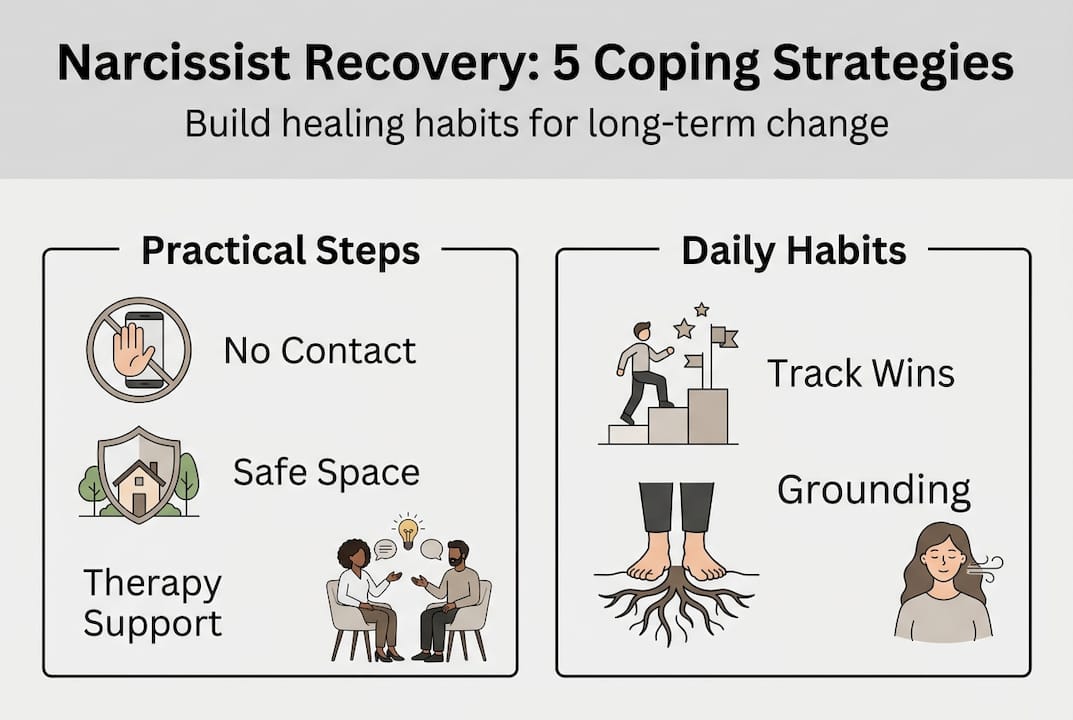
- Practice no-contact or structured contact. Limit or eliminate communication with the narcissist. Every interaction reactivates the trauma bond and delays neurological healing. If contact is unavoidable, use written communication only and keep it strictly factual.
- Engage in trauma-informed therapy. Research-backed therapies specifically target intrusive memories and rebuilding self-trust. EMDR (Eye Movement Desensitization and Reprocessing) and CBT (Cognitive Behavioral Therapy) are two well-supported options for narcissistic abuse survivors. A trained therapist helps you process what self-help alone often cannot reach.
- Use structured journaling. Write about specific incidents not to relive them, but to externalize them. Getting thoughts out of your head and onto paper reduces their emotional charge. Try a simple format: what happened, how it made you feel, and what you now understand about it.
- Build a mindfulness practice. Narcissistic abuse pulls your attention into the past (rumination) or the future (anxiety). Mindfulness anchors you in the present. Even five minutes of focused breathing daily has measurable effects on stress hormone levels.
- Rebuild daily routines. Narcissistic relationships often disrupt sleep, eating, and exercise patterns. Re-establishing predictable routines signals safety to your nervous system. Start small: consistent wake times, one daily walk, regular meals.
For a more detailed roadmap, step-by-step healing after a narcissist offers structured guidance. You can also explore the emotional healing workflow after narcissism for a framework that maps the recovery process visually.
Pro Tip: Track one small win every day. It does not need to be dramatic. Choosing not to check the narcissist’s social media, completing a journaling session, or saying no to something that does not serve you all count. Small, consistent actions are the actual engine of recovery.
Handling setbacks is part of the process. When a trigger hits, use grounding techniques: name five things you can see, four you can touch, three you can hear. This interrupts the stress response before it escalates. Learn more about healing from narcissistic relationships to deepen your toolkit.
Verifying your progress and preventing setbacks
One of the hardest parts of recovery is knowing whether you are actually getting better or just getting used to the pain. Progress in narcissistic abuse recovery is rarely linear, but there are reliable markers to watch for.
Self-assessment checklist:
- You trust your own perceptions more consistently
- Intrusive thoughts about the relationship are less frequent and less intense
- You feel genuine enjoyment in activities again
- You can set limits with others without excessive guilt
- You no longer feel responsible for the narcissist’s emotions
- Your sleep and appetite have stabilized
“Recovery is a process of rewiring the brain, not a quick fix. Expecting overnight change creates unnecessary setbacks.”
| Healthy progress indicator | Unhealthy progress indicator |
|---|---|
| Increased self-trust | Still seeking the narcissist’s approval |
| Lower anxiety levels | Anxiety spikes around reminders of the relationship |
| Reconnecting with others | Continued isolation or fear of new relationships |
| Accepting the relationship was harmful | Minimizing or excusing the abuse |
| Consistent daily functioning | Frequent emotional crashes with no clear trigger |
Ongoing maintenance matters as much as initial recovery work. Regular therapy check-ins, even after you feel stable, help catch backsliding early. Support groups, either in person or online, provide community with people who genuinely understand what you experienced. Understanding the benefits of therapy after a narcissist can help you stay committed to the process even when progress feels slow.
Relapse prevention also means knowing your triggers. Common ones include anniversaries of the relationship, seeing the narcissist’s social media, or entering new romantic relationships. Having a written plan for these moments, including who to call and what grounding strategies to use, dramatically reduces their impact. Resources on healing after a narcissist breakup can support this planning process.
A deeper perspective: Why real recovery is more than disconnection
Most mainstream advice on narcissistic abuse recovery centers on one instruction: go no-contact. And yes, reducing access is critical. But in our experience working with survivors, the people who heal most fully are not just those who cut ties. They are the ones who do the harder internal work of rebuilding who they are.
No-contact is not the only approach. Perspective-shifting can be important, but long-term outcomes are individual. What this means practically is that healing is not a destination you reach by putting distance between yourself and the narcissist. It is a process of reclaiming your own narrative, your values, your instincts, and your sense of self.
Survivor identity can become its own trap. When your entire self-concept organizes around what was done to you, healing stalls. The goal is not to forget or minimize the abuse. It is to integrate the experience into a larger story where you are the main character moving forward, not the victim frozen in the past. Explore step-by-step healing from narcissistic relationships as a guide for that internal journey.
Find professional support for lasting recovery
Understanding the strategies is a powerful first step. But knowledge alone rarely heals the deep wounds that narcissistic abuse leaves behind. Therapy addresses not just the symptoms but the root patterns, helping you rebuild self-trust at a neurological level, not just an intellectual one.

At Bergen County Therapist, our team specializes in helping survivors like you move from surviving to genuinely thriving. Whether you are just beginning to process what happened or you have been working on recovery for a while and feel stuck, trauma therapy offers a structured, compassionate path forward. You can also explore psychotherapy options to find the approach that fits your needs. Reaching out is not a sign that you have failed at healing on your own. It is the most direct route to the life you deserve.
Frequently asked questions
What is trauma bonding and how does it affect recovery?
Trauma bonding is a neurochemical attachment to an abuser that makes leaving and healing feel physically and emotionally difficult. Because abuse rewires the brain through this process, recovery requires targeted strategies rather than willpower alone.
Is no contact always necessary for narcissist recovery?
No contact is strongly recommended for most survivors, but some experts argue that firm boundaries and perspective-shifting can support healing when total separation is not possible, such as in co-parenting situations.
What are the signs I’m making progress in recovery?
Improved self-confidence, reduced anxiety, fewer intrusive thoughts, and greater trust in your own decisions are all reliable signs. Recovery involves rewiring brain pathways, so these changes tend to build gradually rather than appear all at once.
How long does narcissist recovery usually take?
The timeline varies widely depending on the length of the relationship, available support, and whether professional therapy is involved. Many survivors report meaningful improvement within 6 to 12 months of consistent, dedicated work.
Should I try to help the narcissist change?
Focusing energy on changing the narcissist typically delays your own healing and rarely produces lasting results. Hope for narcissist change via perspective-taking is unproven long-term, and your recovery deserves to be the priority.