

Some grief doesn’t get a funeral, a casserole, or a single “I’m sorry for your loss.” It just sits with you, unspoken, while the world moves on as if nothing happened. Disenfranchised grief is grief that is not openly acknowledged, socially validated, or publicly supported, and millions of people carry it alone without ever knowing there’s a name for what they feel. Whether you’re mourning a pet, a relationship that others didn’t take seriously, or a loss tied to stigma, this guide will help you understand why your grief is real, what causes it, how it affects your emotional health, and where to find support that actually fits.
Table of Contents
- What is disenfranchised grief?
- Common causes and examples of disenfranchised grief
- How disenfranchised grief impacts emotional health
- Supporting yourself and others through disenfranchised grief
- Why most people overlook disenfranchised grief and what truly helps
- Find expert support for your grief journey
- Frequently asked questions
Key Takeaways
| Point | Details |
|---|---|
| Grief can go unrecognized | Disenfranchised grief describes loss that society does not recognize or validate, making it harder to seek support. |
| Common but overlooked | Many experience disenfranchised grief after relationship endings, pet loss, stigmatized death, or ambiguous situations. |
| Real emotional impact | This type of grief increases the risk for depression, isolation, and prolonged mourning without proper support. |
| Support is available | Therapy, support groups, and personal rituals can help validate and process disenfranchised grief effectively. |
What is disenfranchised grief?
Grief is a natural human response to loss. But not all grief is treated equally. When a loss isn’t recognized by the people around you or by society at large, your right to mourn is quietly taken away. That’s the core of disenfranchised grief: a loss that is real to you but invisible to everyone else.
The term was coined by Dr. Kenneth J. Doka in 1989, a sociologist and grief researcher who noticed that certain mourners were systematically excluded from social support. Doka observed that grief rules, the unspoken social norms about who gets to grieve and how, left many people without the comfort or rituals that help others heal.
“Disenfranchised grief is grief that is not openly acknowledged, socially validated, or publicly supported.” — WebMD
This type of grief is often confused with complicated grief, but they are not the same thing. Complicated grief refers to an intense, prolonged mourning process that disrupts daily functioning. Disenfranchised grief, by contrast, is defined by its social context, not the severity of symptoms. You can experience disenfranchised grief that never becomes complicated, or complicated grief that also happens to be disenfranchised.
Common examples include grieving the death of an ex-partner (“You were broken up anyway”), mourning a beloved pet (“It was just a dog”), or processing the loss of a pregnancy that others didn’t know about. Losses through stigmatized causes, like suicide or overdose, often fall into this category too, because people around the mourner may feel uncomfortable or judgmental rather than supportive.
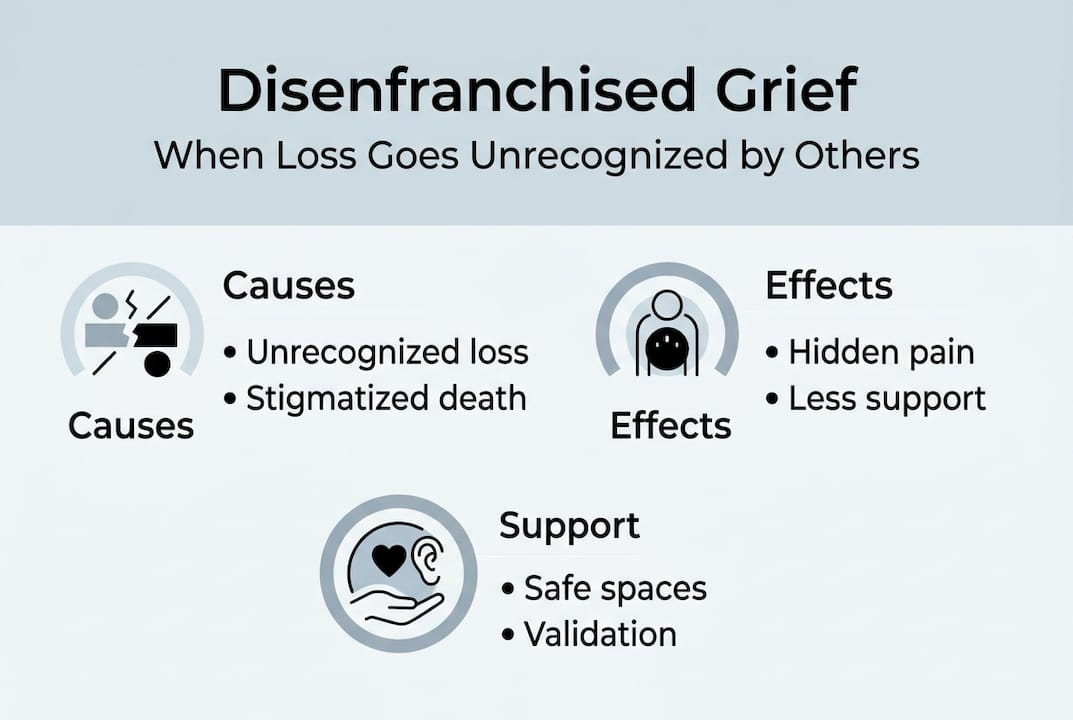
What makes disenfranchised grief particularly painful is the double burden it creates. You’re not only dealing with the loss itself, but also with the message, spoken or unspoken, that your pain doesn’t count. That message is false. And recognizing it as false is where healing begins.
Common causes and examples of disenfranchised grief
With an understanding of what disenfranchised grief is, it’s important to explore the types of losses and relationships that commonly go unacknowledged. Causes include unrecognized relationships, stigmatized deaths, and non-death losses such as miscarriage or job loss. These categories help explain why so many people feel their grief is dismissed.
Unrecognized relationships are one of the most common sources. Society tends to validate grief only within certain relationship structures, typically immediate family. But people form deep bonds outside those structures all the time.
Common unrecognized relationships include:
- Ex-partners, especially after a long relationship
- Online friends or communities
- Coworkers or mentors
- Stepchildren or step-parents
- Pets
- Estranged family members
Stigmatized losses are another major category. When someone dies by suicide, overdose, or from an illness tied to social stigma, survivors often face silence or judgment instead of compassion. This makes it harder to grieve openly and can compound feelings of shame.
Non-death losses are frequently overlooked entirely. Grief isn’t only about death. Losing a job, going through a divorce, experiencing infertility, or moving away from a place you loved can all trigger genuine grief responses that others minimize or dismiss.
Here’s a quick breakdown of loss types and how they’re typically received:
| Loss type | Social recognition | Risk of disenfranchisement |
|---|---|---|
| Death of a spouse | High | Low |
| Death of a pet | Low | High |
| Miscarriage | Medium | Medium to high |
| Divorce | Medium | Medium |
| Job loss | Low | High |
| Loss through suicide | Low to medium | High |
Cultural background also plays a role. Some cultures have rich rituals for losses that Western norms ignore, while others may stigmatize forms of grief that are openly supported elsewhere. There’s no universal rulebook for grief, which is part of why grief therapy for families can be so valuable in navigating these differences. Ambiguous loss, such as grieving a loved one with dementia who is still physically present, adds another layer of complexity that rarely receives the recognition it deserves.
How disenfranchised grief impacts emotional health
Understanding the sources makes it easier to grasp why disenfranchised grief carries such emotional weight and how its effects can differ from more recognized forms of loss. It leads to intensified reactions like depression, anger, and isolation due to lack of social support and rituals. Without community acknowledgment, the normal grief process gets disrupted.

When you grieve openly, you benefit from rituals, funerals, memorial services, time off work, and the steady stream of condolences that signal to your nervous system: your pain is real, and people see it. Disenfranchised grievers don’t get that. The absence of these rituals means the grief has nowhere to go. It turns inward.
The emotional consequences can include:
| Recognized grief | Disenfranchised grief |
|---|---|
| Social support available | Social support absent or withheld |
| Rituals help process loss | No rituals; grief stays private |
| Feelings validated by others | Feelings minimized or dismissed |
| Mourning period socially accepted | Mourner expected to “move on” quickly |
Research backs this up. 16% of adolescents meet complicated grief criteria after losing a peer, a loss that is often disenfranchised, compared to 7 to 9% in general bereavement studies. That gap is significant. It tells us that when grief goes unrecognized, the risk of long-term complications rises sharply.
For adults, the risks include prolonged grief disorder, depression, anxiety, and even physical health consequences tied to chronic stress. Exploring therapy options for grief early can make a real difference in preventing these outcomes.
Pro Tip: Recognizing that your grief is valid, even when others don’t, is not a small step. It’s the foundation of every other step toward healing. Say it out loud if you need to: “My loss is real, and I am allowed to grieve it.”
For people already managing other mental health challenges, disenfranchised grief can worsen existing symptoms. If you’ve been feeling stuck or like you can’t move forward, managing grief with professional guidance may help you break that cycle.
Supporting yourself and others through disenfranchised grief
With the impact clear, the focus now turns to tangible steps for self-care and support when traditional avenues aren’t available. Social disenfranchisement prevents access to communal rituals and support, prolonging private grieving and risking mental health issues. That means you may need to build your own support structures, and that’s okay.
Here’s a practical approach to supporting yourself:
- Name the grief. Call it what it is. Saying “I am grieving” gives your experience language and legitimacy, even if no one else has offered that to you yet.
- Create your own rituals. Light a candle, write a letter, plant something, or hold a private memorial. Rituals don’t need an audience to be meaningful.
- Find a safe person. You don’t need a crowd. One person who listens without judgment can change everything. Share your story with someone you trust.
- Join a community. A grief support group can connect you with others who understand losses that the broader world tends to overlook.
- Seek professional support. A therapist who understands disenfranchised grief can help you process what you’re carrying and move through it. Knowing how to find a grief therapist is a practical first step.
If you want to support someone else going through this, the most powerful thing you can do is simply acknowledge their loss. Don’t minimize it, don’t compare it, and don’t rush them. Specific language matters more than you might think.
Pro Tip: Instead of saying “I know it’s hard, but you’ll be okay,” try “I know how much that relationship meant to you, and I’m here.” That shift from reassurance to recognition can break through the isolation faster than almost anything else.
Avoid asking questions that imply their grief is disproportionate. Questions like “Weren’t you two broken up?” or “Can’t you just get another pet?” reinforce disenfranchisement. Presence and validation are the tools that actually help.
Why most people overlook disenfranchised grief and what truly helps
Here’s what we’ve seen again and again in our work: people don’t dismiss disenfranchised grief because they’re cruel. They dismiss it because grief makes them uncomfortable, and losses without clear social scripts give them an easy exit. “It was just a breakup” is a way of saying “I don’t know how to sit with this pain with you.”
The problem is that awareness alone doesn’t fix it. Telling someone their grief is valid is a start, but it’s only the first layer. What actually moves the needle is sustained, active presence. It’s checking in two weeks later, not just the day after. It’s asking “How are you really doing?” and waiting for the real answer.
We believe the most healing happens when private pain is invited into a safe space, even if that space is just one trusted person or one good therapist. Society may not have a ritual for your loss, but that doesn’t mean your loss is without meaning. Exploring healing grief techniques with a professional can help you build the container that society failed to provide. Real progress comes when we stop waiting for permission to grieve and start creating the conditions for healing ourselves.
Find expert support for your grief journey
If you’ve recognized yourself in any part of this article, you don’t have to keep carrying this alone. Disenfranchised grief can feel profoundly isolating, but professional support can help you process what you’ve been holding and move toward genuine healing.

At Bergen County Therapist, our team works with individuals navigating all forms of grief, including the kind that others haven’t acknowledged. Whether you’re dealing with loss tied to trauma, depression, or a relationship others didn’t recognize, we offer trauma therapy, depression therapy, and a full range of psychotherapy options tailored to your experience.
Reach out today for a free consultation and take the first step toward feeling heard.
Frequently asked questions
How can I tell if my grief is disenfranchised?
If your grief feels ignored or not taken seriously by others, or if you’re denied social support or rituals, it may be disenfranchised. Grief that isn’t openly acknowledged or publicly supported is a key marker of this experience.
Is disenfranchised grief common?
Yes, many people experience it after losses that aren’t socially recognized. Unrecognized relationships and stigmatized losses, like losing a pet or going through a breakup, are among the most frequent triggers.
Does disenfranchised grief require therapy?
Therapy can be extremely helpful, especially if you’re feeling isolated, persistently sad, or unable to heal with time. Social disenfranchisement prolongs private grieving and increases the risk of lasting mental health issues.
What are examples of non-death losses that cause disenfranchised grief?
Job loss, divorce, and relocating to a new place can all cause grief that others may not recognize. Non-death losses like miscarriage are also commonly overlooked despite the deep emotional impact they carry.
How does disenfranchised grief differ from complicated grief?
Disenfranchised grief is defined by a lack of social acknowledgment, while complicated grief involves prolonged, intense mourning regardless of how others respond. Research shows 16% of adolescents experiencing disenfranchised peer loss meet complicated grief criteria, compared to 7 to 9% in general bereavement populations.