

Growing up with a narcissistic mother leaves marks that don’t fade when you leave home. The effects of a narcissistic mother reach into adulthood, shaping how you see yourself, how you attach to others, and how loudly that critical inner voice runs in the background of your daily life. A 2024 study of 512 adults found that maternal narcissistic traits directly predict depression and anxiety in adult children, with self-criticism as the key internal mechanism. This is not about blame. It is about understanding what happened so you can start to undo it.
The core effects tend to cluster around a few recognizable patterns:
- Chronic self-criticism and a harsh internal voice that sounds like your mother
- Low self-esteem rooted in conditional love and emotional invalidation
- Anxious or insecure attachment in adult relationships
- Difficulty identifying your own needs and setting boundaries
- Persistent shame, perfectionism, and fear of failure
- Depression, anxiety, and identity confusion
- Codependency and people-pleasing as survival strategies
These aren’t character flaws. They are adaptations, learned responses to an environment where love came with conditions and your emotional reality was routinely dismissed.
What are the most common psychological symptoms?
Children raised by narcissistic mothers develop a recognizable set of emotional and behavioral patterns, though the specific presentation varies between daughters and sons.
Adult children frequently carry chronic shame and perfectionism tied directly to conditional love and excessive maternal criticism. The internal logic goes like this: if you were good enough, smart enough, or compliant enough, maybe the love would be consistent. It never was, so the child concludes the problem is them. That belief doesn’t dissolve at 18.
Common symptoms include:
- Extreme self-criticism: An internalized maternal voice that judges, monitors, and punishes perceived failures
- Low self-esteem: A core belief of being fundamentally inadequate, often masked by high achievement
- Poor boundaries: Difficulty saying no, recognizing personal limits, or distinguishing your needs from others’
- People-pleasing: Compulsive caretaking of others’ emotions, often at personal expense
- Identity confusion: Uncertainty about who you are outside of what others need from you
- Perfectionism: Using flawless performance as a shield against criticism and rejection
- Codependency: Organizing your emotional life around managing another person’s moods and needs
- Shame: A pervasive sense of being defective, not just having done something wrong
Daughters of narcissistic mothers often bear the brunt of direct competition and criticism around appearance, achievement, and femininity. Sons more commonly experience emotional neglect or are used as extensions of the mother’s ego, which can produce its own version of identity fragmentation and difficulty with emotional intimacy. The effects of having a narcissistic mother differ in texture between sons and daughters, but the underlying wound, feeling unseen and conditionally loved, is shared.
How does maternal narcissism disrupt attachment and mental health?

Secure attachment requires a caregiver who responds consistently, validates emotions, and tolerates the child’s separateness. A narcissistic mother does none of these reliably. The result is an attachment system that stays on high alert, scanning for signs of rejection or withdrawal.
A longitudinal study tracking 59 parent-child dyads found that parental pathological narcissism predicted increased child depression one year later, with anxious attachment as the mediating mechanism. Children didn’t just become sad. They became anxiously attached first, and that attachment pattern then drove the depression. The sequence matters for treatment.
“Vulnerable narcissism in mothers causes more consistent psychological harm to children than grandiose narcissism, increasing child maladjustment and attachment instability.” A 2024 study of 252 mother-child dyads confirmed that the covert, self-doubting subtype of maternal narcissism, not the loud, entitled version most people picture, produces the most persistent damage.
This distinction is clinically significant. A mother who presents as fragile, victimized, and emotionally needy can be just as damaging as one who is overtly controlling, and often harder for the child to name as harmful. Emotional invalidation, the repeated message that your feelings are wrong, exaggerated, or inconvenient, teaches children to distrust their own perceptions. That mistrust doesn’t stay contained to childhood. It shows up in adult relationships as difficulty trusting your own judgment, chronic second-guessing, and vulnerability to further manipulation.
The long-term mental health picture for adult children of narcissistic mothers frequently includes clinical depression, generalized anxiety, and in some cases, complex post-traumatic stress. The impact of narcissistic parenting on mental health is not subtle, and it is not something people simply grow out of without support.
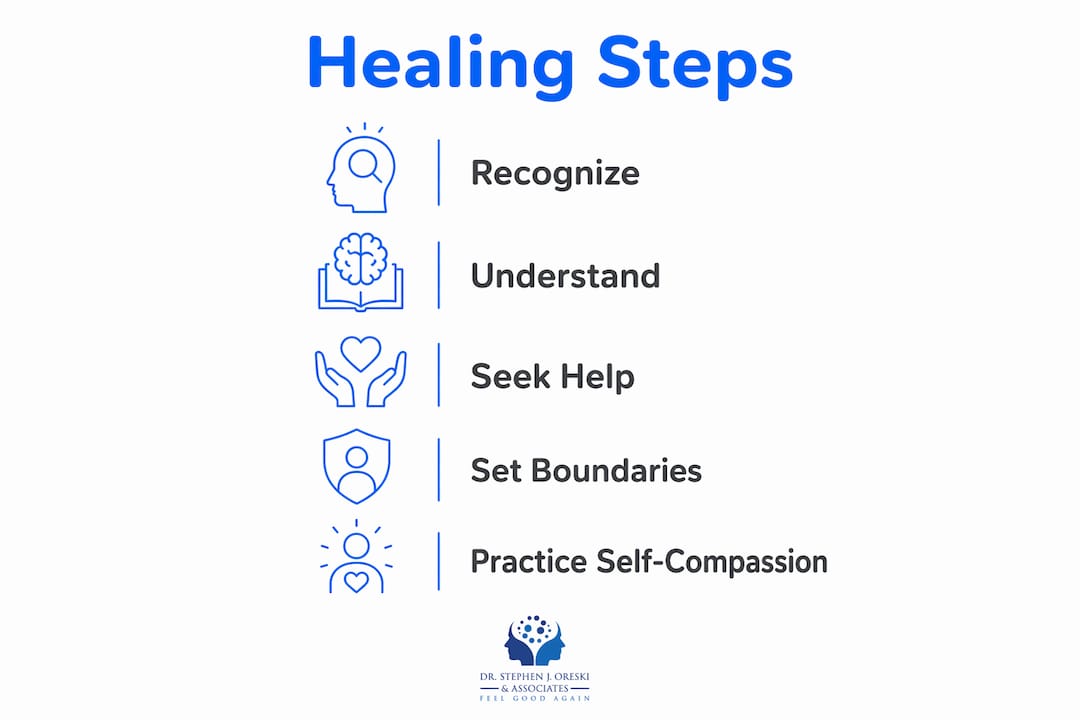
How can adult children of narcissistic mothers heal?
Healing from the effects of narcissistic parenting is possible, but it requires more than insight. Understanding what happened is the starting point, not the destination.

Trauma-informed therapy is the most effective route for most adult children. Schema therapy and psychodynamic approaches directly target the early maladaptive schemas formed in response to narcissistic maternal behavior, particularly schemas around emotional deprivation, defectiveness, and shame. Schema therapy names the patterns, traces them to their origin, and works to replace them with healthier emotional responses. Psychodynamic therapy goes deeper into the relational history, helping you understand how the past is playing out in present relationships.
One of the most overlooked parts of recovery is grief. Therapists who specialize in this area note that grieving the parent you needed but never had is a crucial step, one that many adult children skip because it feels disloyal or pointless. The grief is real. You are mourning a relationship that existed in proximity but not in substance. Skipping it tends to leave the wound open.
Practical healing strategies include:
- Reparenting yourself: Deliberately offering yourself the validation, consistency, and compassion your mother couldn’t provide
- Boundary setting: Learning to identify your limits and communicate them without guilt or over-explanation
- Self-validation: Practicing the skill of trusting your own emotional responses rather than outsourcing that judgment
- Challenging the internalized critic: Recognizing when the harsh internal voice is your mother’s, not an accurate assessment of reality
- Support groups: Connecting with others who share this experience, which reduces isolation and normalizes the recovery process
Developing self-compassion and firm boundaries are skills, not personality traits. They can be learned, practiced, and strengthened over time with the right support.
Research shows that psychological parentification, the dynamic where a child takes on emotional caretaking responsibilities for the parent, mediates the development of codependency and boundary problems in adulthood. Therapy that directly addresses this pattern, naming it, tracing its effects, and building new relational skills, tends to produce the most durable recovery.
Pro Tip: When the inner critic fires up, try asking: “Is this my voice, or is this something I was taught to believe?” That one question creates enough distance to start examining the thought rather than obeying it.
Resources like the Adult Children of Narcissistic Parents community, along with books such as Will I Ever Be Good Enough? by Dr. Karyl McBride, offer structured self-help alongside professional support. For many people, healing emotional wounds after narcissistic abuse is a layered process that benefits from both individual therapy and peer connection.
Should you reconnect with a narcissistic mother?
Reconnection is one of the most personal decisions an adult child faces, and there is no universal right answer. The question isn’t really whether reconnection is possible. It’s whether it’s safe for you at this point in your healing.
Guidance from clinical literature consistently advises evaluating both the potential benefits and the real risk of retraumatization before attempting contact. A mother who has shown no insight into her behavior, who continues to gaslight, manipulate, or dismiss your emotional reality, is unlikely to provide a different experience simply because time has passed.
Practical considerations before reconnecting:
- Assess your current stability: Are you in a solid enough place in your healing that contact won’t destabilize you?
- Identify your expectations: Are you hoping for an apology or acknowledgment that is unlikely to come?
- Plan your boundaries in advance: Know specifically what you will and won’t tolerate, and what you’ll do if those limits are crossed
- Have therapeutic support in place: Reconnection attempts are best navigated with a therapist who knows your history
- Consider limited contact as a middle option: Full reconnection and complete estrangement are not the only choices
Scenarios where reconnection carries higher risk include situations where the mother is still actively manipulative, where you are early in your healing process, or where previous contact attempts have consistently led to emotional setbacks. Estrangement, when chosen thoughtfully, is a legitimate form of self-protection, not a failure of forgiveness.
How do intergenerational patterns of narcissistic behavior form and break?
Narcissistic parenting rarely appears from nowhere. It tends to travel through family systems, shaped by the grandmother’s parenting, the family’s emotional culture, and unresolved trauma passed down through generations. Understanding this doesn’t excuse the harm, but it does explain why the pattern repeats.
Adult children of narcissistic mothers face a specific risk: without awareness and intervention, they may replicate some of the same dynamics with their own children. Not because they are narcissistic themselves, but because the relational patterns they learned, prioritizing others’ emotions, struggling with boundaries, defaulting to control when anxious, can resurface under the stress of parenting.
Breaking the cycle requires deliberate work. Therapy that focuses on childhood trauma and attachment repair gives parents the tools to respond to their children’s emotional needs in ways they themselves never experienced. Practices like reflective parenting, where you pause to consider what your child is feeling before reacting, directly counteract the emotional dismissiveness that characterizes narcissistic parenting. The goal isn’t perfection. It’s repair, the ability to recognize when you’ve missed your child emotionally and come back to reconnect.
Recognizing the pattern in yourself is not a sign that you’ve become your mother. It’s a sign that you’re paying attention, which is exactly what she couldn’t do.
How gaslighting and manipulation shape a child’s reality
Gaslighting is the tactic that makes narcissistic maternal abuse particularly hard to name and recover from. It works by systematically undermining the child’s trust in their own perceptions. “That never happened.” “You’re too sensitive.” “I was just joking, you always overreact.” Over time, the child stops trusting their own emotional read on situations and starts deferring to the mother’s version of reality.
This has lasting consequences. Adults who were gaslit as children often struggle to trust their own judgment in relationships, second-guess their emotional responses, and remain vulnerable to similar manipulation from partners or authority figures. The impact on mental health can be significant, particularly when the gaslighting was consistent and the child had no other adult to validate their experience.
Other common manipulation tactics used by narcissistic mothers include:
- Triangulation: Pitting siblings or family members against each other to maintain control
- Guilt induction: Using emotional distress or martyrdom to prevent the child from asserting independence
- Love withdrawal: Withholding affection or approval as punishment for non-compliance
- Enmeshment: Blurring the boundary between mother and child so the child has no separate emotional identity
- Scapegoating: Designating one child as the family’s problem, absorbing blame that belongs to the parent
Recognizing these tactics for what they are, deliberate or unconscious strategies to maintain control, is often the first moment of real clarity for adult children. That clarity can feel disorienting at first, because it requires revising the story you’ve told yourself about your childhood. But it also opens the door to coping strategies that actually work, because you’re finally addressing the real problem.
If you’re ready to work through these patterns with professional support, Bergencountytherapist offers trauma-informed individual therapy with clinicians who specialize in narcissistic abuse recovery. Dr. Stephen Oreski and his team provide personalized treatment plans, including psychotherapy options tailored to adult children navigating the long-term effects of narcissistic parenting. Free consultations are available in person and online.

Start your healing process with a free consultation today.
Key Takeaways
Adult children of narcissistic mothers most commonly struggle with self-criticism, anxious attachment, and shame, all of which are treatable through trauma-informed therapy and deliberate boundary work.
| Point | Details |
|---|---|
| Self-criticism is the core mechanism | A recent study involving adults found self-criticism mediates the link between maternal narcissism and depression and anxiety. |
| Anxious attachment drives depression | In a longitudinal study of 59 parent-child dyads, anxious attachment mediated the effect of parental narcissism on child depression. |
| Vulnerable narcissism causes more harm | A 2024 study of 252 mother-child dyads found maternal vulnerable narcissism produces more consistent damage than the grandiose subtype. |
| Grief is part of recovery | Mourning the parent you needed but never had is a clinically recognized step that many adult children skip, slowing their healing. |
| Intergenerational patterns can be broken | Reflective parenting practices and childhood trauma therapy help adult children avoid replicating narcissistic dynamics with their own children. |
FAQ
What happens to children of a narcissistic mother?
Children of narcissistic mothers commonly develop anxious attachment, chronic self-criticism, low self-esteem, and difficulty with boundaries. Research links maternal narcissism to increased rates of depression and anxiety in both children and adults.
What attachment style do daughters of narcissistic mothers develop?
Daughters of narcissistic mothers most often develop anxious attachment, though avoidant attachment also occurs. A longitudinal study of 59 parent-child dyads found that anxious attachment specifically mediates the relationship between parental narcissism and childhood depression.
Can the effects of narcissistic parenting be treated?
Yes. Trauma-informed approaches including schema therapy and psychodynamic therapy directly target the early maladaptive schemas formed in response to narcissistic maternal behavior, with strong clinical outcomes for survivors.
How does gaslighting by a narcissistic mother affect adult life?
Repeated gaslighting teaches children to distrust their own perceptions, a pattern that persists into adulthood as difficulty trusting personal judgment, chronic self-doubt, and vulnerability to manipulation in adult relationships.
Is it possible to break the intergenerational cycle of narcissistic parenting?
Yes, with awareness and therapeutic support. Reflective parenting practices and childhood trauma therapy give adult children the tools to respond to their own children’s emotional needs in ways that break the inherited pattern.