

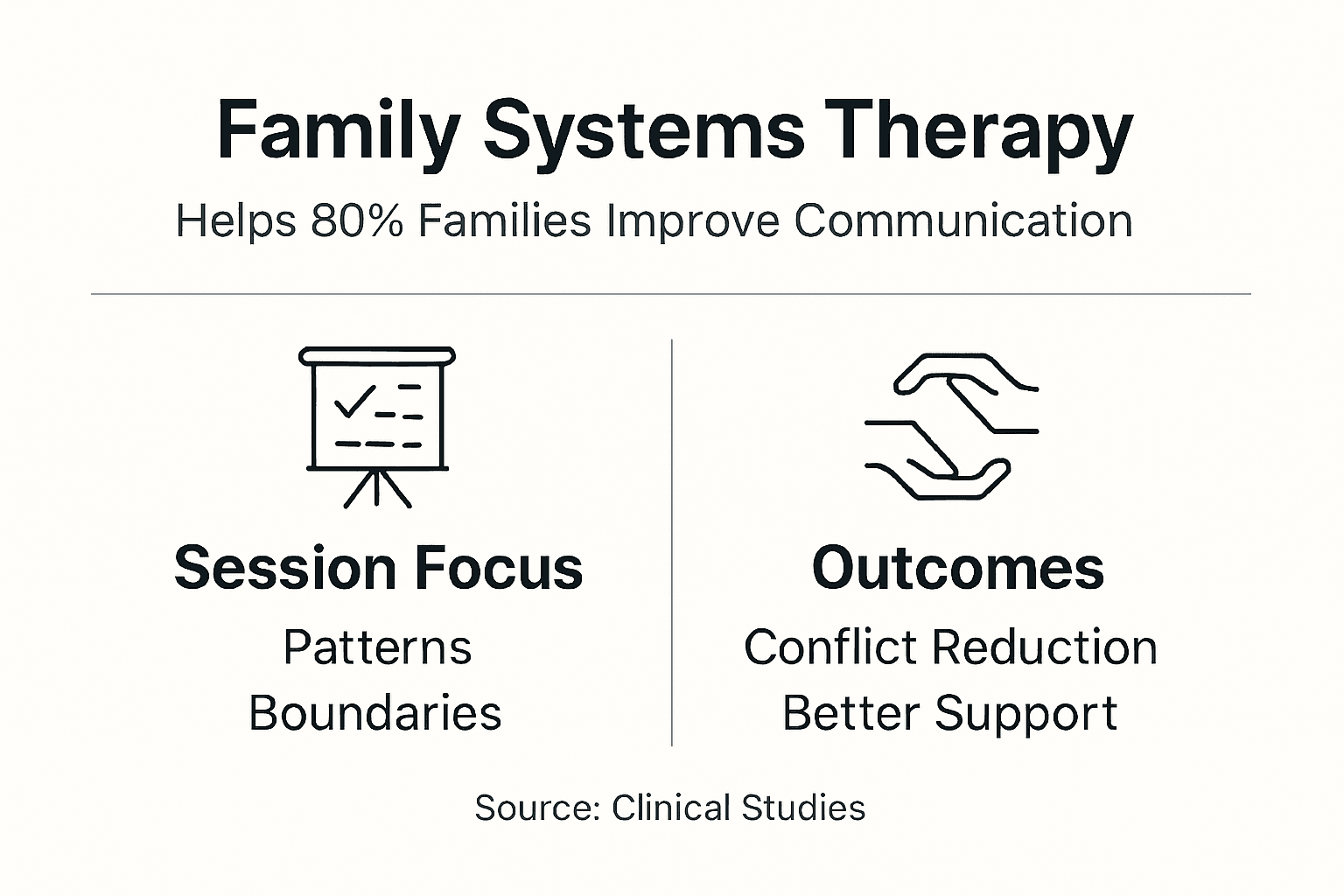
Family systems therapy transforms how families heal by focusing on relational patterns instead of blaming individuals. Research shows systemic family therapy improves symptoms and communication in up to 80% of families. This article explains core principles, therapy models, real applications, and how to know if this approach fits your family’s needs in Bergen County.
Table of Contents
- Introduction To Family Systems Therapy
- Core Principles Of Family Systems Therapy
- Major Family Systems Therapy Models
- Applications And Effectiveness Of Family Systems Therapy
- Common Misconceptions About Family Systems Therapy
- Therapeutic Techniques And How Family Systems Therapy Works
- Cultural Sensitivity And Inclusivity In Family Systems Therapy
- Limitations, Challenges, And When To Seek Family Systems Therapy
- Get Support With Family Systems Therapy In Bergen County
- Frequently Asked Questions About Family Systems Therapy
Key Takeaways
| Point | Details |
|---|---|
| Family systems therapy views families as interconnected emotional units, not isolated individuals | Therapy targets relational patterns to create lasting change across the whole family system |
| Core principles include differentiation of self, emotional interdependence, and family homeostasis | Understanding these concepts helps families recognize and shift unhelpful patterns |
| Multiple evidence-based models like Bowenian, IFS, and structural therapy address different family needs | Each model offers unique techniques to improve boundaries, communication, and emotional health |
| Meta-analytic data confirms 70-80% of families experience sustained symptom reduction and better communication | Therapy effectively treats substance use, depression, behavioral issues, and chronic conflict |
| Modern systemic therapy embraces diverse family structures and adapts to cultural contexts | Culturally sensitive approaches improve engagement and outcomes for all family compositions |
Introduction to Family Systems Therapy
Family systems therapy views the family as an emotional unit and focuses on patterns across the whole family rather than individuals alone. This approach emerged from Murray Bowen’s groundbreaking work in the 1950s, which recognized that emotional problems develop and persist through relational dynamics, not individual deficits. When one person struggles, the entire family system feels the impact.
Viewing families holistically proves more effective than treating isolated symptoms because problems rarely exist in a vacuum. A teenager’s anxiety might reflect unresolved parental conflict. A parent’s depression could stem from multigenerational communication patterns. By examining these connections, therapy creates change that ripples through the entire family.
Families often seek help when they face persistent issues that resist individual efforts:
- Chronic conflict and communication breakdowns that escalate over time
- Behavioral problems in children or teens that disrupt family harmony
- Substance use issues affecting multiple family members
- Emotional distance or enmeshment creating relationship strain
- Transitions like divorce, remarriage, or loss requiring family adaptation
Understanding family therapy benefits starts with recognizing that your family operates as a system where each member’s actions influence everyone else. This insight opens pathways to healing that individual therapy alone cannot provide.
Core Principles of Family Systems Therapy
Murray Bowen outlined eight key principles including differentiation of self and family homeostasis to explain systemic emotional processes. These concepts form the foundation for understanding how families function and where interventions create the most impact.
- Differentiation of self describes your ability to maintain individual identity while staying emotionally connected to family. Higher differentiation means you can think clearly during emotional intensity without reactive behavior.
- Emotional interdependence recognizes that family members’ feelings and behaviors constantly influence each other, creating feedback loops that either support or undermine wellbeing.
- Family homeostasis refers to the system’s tendency to maintain stability, even when patterns prove unhealthy. Families resist change to preserve familiar equilibrium.
- Subsystems are smaller units within families, like the parental dyad or sibling group, each with distinct boundaries and roles that shape overall family function.
Family homeostasis explains why positive changes sometimes meet resistance. When one person starts therapy and behaves differently, other family members may unconsciously push back to restore familiar patterns. This natural resistance doesn’t reflect bad intentions but the system’s automatic drive for stability.

Recognizing these principles helps families manage emotional reactivity more effectively. When you understand how anxiety spreads through family systems or how triangulation diverts conflict, you gain tools to interrupt unhelpful cycles before they escalate.
Pro Tip: Pay attention to repeated patterns in your family interactions, especially during stress. Noticing these early signals allows you to address issues in therapy before they become entrenched, improving outcomes significantly.
Knowing what to expect in family therapy helps you prepare for the work of shifting these deep relational patterns together.
Major Family Systems Therapy Models
Several therapy models within the family systems framework offer distinct approaches tailored to different family needs and situations.
Bowenian therapy emphasizes differentiation of self and examines multigenerational transmission of emotional patterns. Therapists help families understand how anxiety and coping strategies pass through generations, creating present-day challenges. This model works particularly well for families wanting to break longstanding dysfunctional cycles.
Internal Family Systems (IFS) takes a different angle. IFS therapy focuses on internal parts and has empirical support from randomized controlled trials since the 1980s. While originally designed for individual work, IFS applies to family therapy by helping members understand their internal parts and respond to each other with more self-compassion and clarity.
Structural family therapy concentrates on family organization, examining subsystems, hierarchies, and boundaries. Therapists actively intervene to restructure problematic patterns, helping families establish clearer roles and healthier boundaries between parents, children, and extended family.
Strategic family therapy uses targeted interventions to disrupt specific problem patterns quickly. Therapists assign tasks or reframe situations to shift how families interact around presenting issues.
| Model | Primary Focus | Typical Applications | Session Style |
|---|---|---|---|
| Bowenian | Differentiation, multigenerational patterns | Chronic anxiety, family cutoffs, emotional reactivity | Reflective, educational |
| IFS | Internal parts, self-leadership, compassion | Trauma, internal conflict, emotional regulation | Experiential, compassionate |
| Structural | Boundaries, subsystems, hierarchy | Behavioral issues, unclear roles, enmeshment | Active, directive |
| Strategic | Problem-solving, symptom interruption | Specific conflicts, power struggles | Task-oriented, brief |
Choosing the right model depends on your family’s specific needs, preferences, and the therapist’s training. Many practitioners integrate techniques from multiple approaches to create personalized treatment.
Applications and Effectiveness of Family Systems Therapy
Family systems therapy effectively addresses substance use disorders, depression, and child behavioral issues by targeting relational patterns. Meta-analytic data shows sustained symptom reduction and improved communication in 70-80% of families after therapy. This evidence base demonstrates that systemic approaches produce measurable, lasting results.
| Clinical Issue | Improvement Rate | Key Outcomes |
|---|---|---|
| Substance use disorders | 65-75% | Reduced use, improved family support, better coping |
| Depression (adolescent/adult) | 70-80% | Decreased symptoms, enhanced family connection |
| Child behavioral problems | 75-85% | Reduced acting out, clearer boundaries, improved parenting |
| Chronic family conflict | 70-80% | Better communication, conflict resolution skills |
| Eating disorders | 60-70% | Symptom reduction, healthier family dynamics |
Therapy creates benefits that extend beyond symptom relief:
- Enhanced emotional regulation across all family members
- Improved conflict resolution skills that prevent future crises
- Stronger boundaries that respect individual needs while maintaining connection
- Deeper understanding of how family patterns perpetuate problems
- Greater resilience during life transitions and stressors
The advantages of family therapy become particularly evident when families face complex challenges involving multiple members. Rather than treating each person separately, systemic work addresses root causes embedded in relational dynamics.
Pro Tip: Combining family systems therapy with individual counseling often produces the best results for complex issues like trauma or severe mental health conditions. The family work improves your support system while individual therapy addresses personal healing needs.
Understanding the clinical effectiveness of systemic approaches helps you make informed decisions about seeking treatment.
Common Misconceptions About Family Systems Therapy
Several misunderstandings prevent families from accessing helpful systemic therapy.
Myth: Therapy blames parents or specific family members. Reality: Family systems therapy explicitly avoids blame. The approach examines patterns and interactions, not individual fault. Everyone contributes to family dynamics, and everyone participates in change.
Myth: Only traditional nuclear families benefit from systemic therapy. Reality: Modern family systems therapy embraces all family structures, including single-parent households, blended families, LGBTQIA families, and extended kinship networks. Therapists adapt techniques to honor each family’s unique composition and values.
Myth: Family therapy provides quick fixes. Reality: Systemic change takes time because you’re reshaping deeply ingrained relational patterns, not just addressing surface symptoms. Most families need several months of consistent work to achieve lasting transformation.
Myth: Therapy focuses only on problems and deficits. Reality: Effective family systems therapy builds on existing family strengths and resources. Therapists help you identify what already works well and expand those positive patterns throughout your relationships.
Myth: One family member can skip sessions without affecting progress. Reality: While not everyone must attend every session, consistent participation from key family members proves essential. When someone regularly opts out, it often signals resistance that becomes a therapeutic focus itself.
Clarity about these misconceptions helps you approach therapy with realistic expectations and openness to the process.
Therapeutic Techniques and How Family Systems Therapy Works
Therapists use specific tools to help families understand and change their relational dynamics.
Genograms map family relationships across generations, revealing patterns of mental health issues, relationship styles, and coping strategies. This visual tool helps you see how current problems connect to multigenerational themes you might not have recognized.
Circular questioning explores how each person’s behavior affects others and vice versa. Instead of linear cause and effect thinking, you learn to recognize feedback loops that maintain problems. For example, a therapist might ask how Mom’s anxiety influences Dad’s withdrawal, which then increases Mom’s anxiety.
Boundary work clarifies appropriate limits between family subsystems. Parents learn to maintain a strong dyad while allowing children age-appropriate autonomy. Extended family members find ways to stay involved without overstepping.
Reframing shifts how families interpret behaviors and situations. A teenager’s rebellion might reframe as a bid for connection. A parent’s strictness might reframe as anxiety about their child’s safety. New perspectives open new possibilities for response.
Typical therapy progression follows these steps:
- Assessment phase where therapist observes family interactions and gathers history
- Pattern identification highlighting specific cycles maintaining problems
- Intervention planning targeting key leverage points for change
- Active practice of new communication and behavior patterns
- Consolidation and relapse prevention as family integrates changes
Pro Tip: Practice new communication skills between sessions, not just during appointments. Real change happens when you apply therapy insights to daily interactions, even when conversations feel awkward at first.
Understanding the family therapy session process reduces anxiety about starting treatment. Learning specific conflict resolution techniques gives you concrete skills to improve relationships immediately.
Cultural Sensitivity and Inclusivity in Family Systems Therapy
Modern systemic therapy recognizes diverse family structures and adapts techniques to respect cultural values and norms. This flexibility proves essential for effective treatment in culturally diverse areas like Bergen County.
Therapists trained in cultural humility:
- Acknowledge their own cultural biases and remain open to learning from clients
- Adapt therapeutic goals to align with family values rather than imposing mainstream norms
- Recognize how cultural identity, immigration experiences, and discrimination affect family dynamics
- Honor diverse family structures including same-sex parents, multigenerational households, chosen families, and communal parenting arrangements
Culturally sensitive therapy improves engagement and outcomes because families feel understood and respected. When therapists validate your cultural context, you’re more likely to share openly and commit to the therapeutic process.
Practical adaptations include:
- Involving extended family or community members when culturally appropriate
- Adjusting communication styles to match cultural norms around directness, hierarchy, and emotional expression
- Recognizing how cultural values about family loyalty, individual autonomy, and mental health shape presenting problems
- Addressing systemic barriers like language access, discrimination, or economic stress affecting family wellbeing
The family therapy benefits for LGBTQIA+ individuals and families illustrate how affirming, knowledgeable therapy creates safety for addressing unique challenges. Understanding cultural sensitivity in practice helps you find therapists who will honor your family’s identity and values.
Limitations, Challenges, and When to Seek Family Systems Therapy
Realistic expectations help you navigate therapy successfully.
Resistance from family homeostasis means progress sometimes feels slow or uneven. When you change behavior, other family members may unconsciously resist to maintain familiar patterns. This resistance is normal, not a sign of failure.
Multiple member commitment poses practical challenges. Scheduling sessions with busy families proves difficult. Some members may initially refuse participation, requiring therapist skill to engage them gradually.
Ideal scenarios for family systems therapy include:
- Chronic conflict or communication breakdowns despite individual efforts
- Behavioral or emotional problems in children or teens
- Relationship transitions like blending families or caring for aging parents
- Substance use affecting family dynamics
- Multigenerational patterns you want to interrupt
Limitations become apparent in certain situations. Acute psychiatric crises requiring immediate stabilization need crisis intervention first. Safety concerns like active domestic violence require individual safety planning before family work begins. Some issues genuinely stem from individual neurobiology or trauma and respond better to individual treatment, though family support remains valuable.
Pro Tip: Discuss readiness openly with a therapist during initial consultation. Not every family member needs equal enthusiasm, but basic willingness to participate and examine relational patterns proves essential for progress.
Honest assessment of your family’s readiness and fit for systemic therapy helps you make informed treatment decisions.
Get Support with Family Systems Therapy in Bergen County
If your family struggles with communication, conflict, or emotional health challenges, professional family systems therapy can help. Dr. Oreski & Associates offers experienced, compassionate support tailored to your family’s unique needs. Our team specializes in evidence-based approaches that create lasting relational change.

Whether you need individual therapy for healing, family therapy to resolve conflicts, or want to learn more about family therapy benefits, we’re here to guide you.
Frequently Asked Questions About Family Systems Therapy
What issues can family systems therapy best address?
Family systems therapy works particularly well for chronic conflict, communication breakdowns, child behavioral problems, substance use issues, and emotional distance or enmeshment. It’s most effective when problems involve multiple family members or persist despite individual treatment efforts.
How long does family systems therapy usually take?
Most families participate in therapy for three to six months, attending weekly or biweekly sessions. Complex multigenerational patterns or severe issues may require longer treatment. Your therapist will discuss expected timeline during initial assessment.
Is family systems therapy suitable for non-traditional families?
Absolutely. Modern systemic therapy embraces all family structures including single-parent households, blended families, LGBTQIA families, multigenerational homes, and chosen families. Therapists adapt techniques to honor your unique family composition and cultural values.
How do I prepare my family for therapy sessions?
Discuss therapy openly, emphasizing that everyone contributes to family patterns without blame. Frame sessions as opportunities to strengthen relationships and solve problems together. Prepare children age-appropriately, explaining that the therapist helps families communicate better and feel closer.
Can family systems therapy work with individual counseling?
Yes, combining family and individual therapy often produces excellent results. Individual work addresses personal healing needs while family sessions improve your support system and relational patterns. Coordinate care by ensuring both therapists communicate with your permission.