

Feeling tense before therapy is more common than many people realize, especially for adults in Bergen County who want support but worry about what to expect in the therapist’s office. Facing therapy-related anxiety does not mean you are weak or unprepared. In fact, identifying your personal triggers and practicing simple calming techniques can help you walk into your session with more comfort and control. Discover practical, research-backed ways to transform your therapy experience into one that feels safe and productive from the very first step.
5 Natural Steps to Manage Therapy Anxiety Effectively
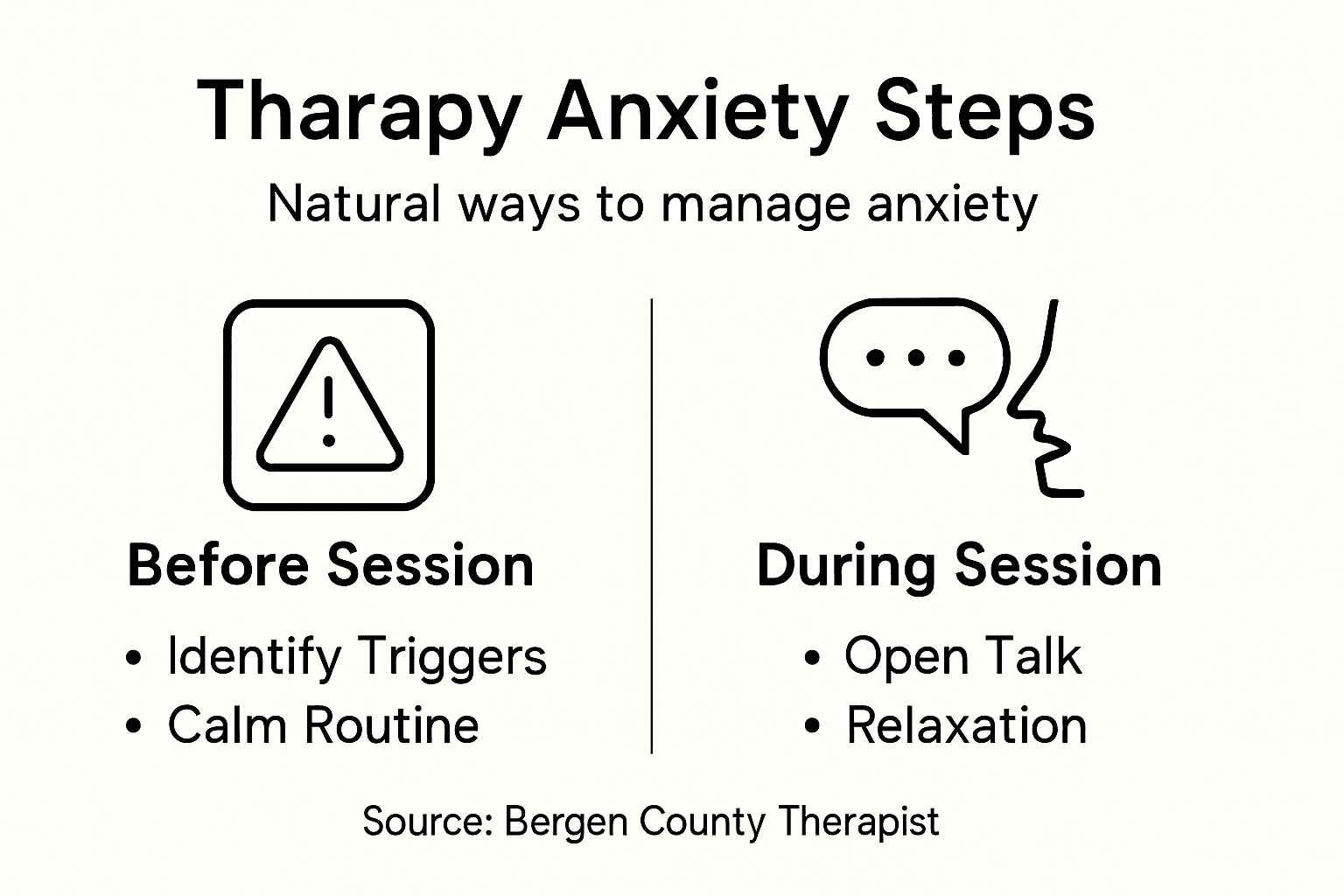
- Step 1: Identify Personal Triggers Before Your Therapy Session
- Step 2: Prepare Calming Routines To Ease Pre-Session Stress
- Step 3: Communicate Openly With Your Therapist About Anxiety
- Step 4: Practice Relaxation Techniques During The Session
- Step 5: Review Progress And Adjust Management Strategies
Quick Summary
| Key Insight | Explanation |
|---|---|
| 1. Identify Personal Triggers | Track your anxiety patterns and triggers in a journal. This awareness helps you and your therapist strategize effectively. |
| 2. Prepare for Sessions | Establish a calming pre-therapy routine to ease anxiety and enhance your readiness for meaningful conversation. |
| 3. Communicate Openly | Be honest with your therapist about your feelings and experiences to foster a collaborative therapeutic relationship. |
| 4. Practice Relaxation Techniques | Utilize deep breathing or progressive muscle relaxation during sessions to manage physical tension and anxiety. |
| 5. Review Progress Regularly | Regularly discuss what strategies are working in therapy. Adjust as needed to ensure your treatment continues to be effective. |
Step 1: Identify personal triggers before your therapy session
Before you walk into your therapist’s office, understanding what sets off your anxiety or emotional reactions can transform how you experience therapy. Identifying your personal triggers isn’t about being perfect or having all the answers ready. It’s about giving yourself and your therapist a practical roadmap of what situations, conversations, or feelings tend to make things harder for you.
Start by paying attention to the patterns in your life over the next week or two. Notice when you feel your anxiety spike, when your mood shifts suddenly, or when you find yourself reacting more intensely than you might expect. These moments are clues. Maybe it’s a particular type of conversation with your partner. Perhaps it’s being in crowded spaces. It could be something someone says that reminds you of a past experience. Some people find that certain times of day, specific topics, or even particular environments trigger their anxiety. The key is observing without judgment. You’re not trying to fix anything yet. You’re just noticing.
One of the most effective ways to capture these patterns is to keep a simple journal or even just notes on your phone. When something happens that throws you off balance, write down what was happening, who was involved, what you were feeling, and what you think triggered the reaction. You don’t need to write paragraphs. A few quick notes work fine. Over time, these small observations reveal patterns. Maybe you notice that your anxiety spikes when you feel criticized at work. Or perhaps unstructured free time makes you restless. Research shows that when you track your thoughts, emotions, and triggers this way, both you and your therapist can develop strategies to manage these reactions more effectively, which actually reduces your anxiety before sessions even begin.
Think about your vulnerabilities too. Everyone has certain sensitivities based on their history, personality, or past experiences. If you grew up in a chaotic household, loud voices might trigger you more easily. If you’ve experienced rejection, social situations might feel more threatening. Your triggers aren’t random. They connect to what matters most to you and where you feel most vulnerable. Understanding this connection helps you realize that your reactions make sense, which is often the first step toward managing them.
Here’s a summary of common types of personal triggers and their potential origins:
| Trigger Type | Example Situation | Possible Origin |
|---|---|---|
| Social interactions | Criticism at work | Fear of rejection |
| Sensory environments | Loud voices in public | Chaotic childhood |
| Time-based triggers | Late evenings | Daily fatigue |
| Conversation topic | Discussing past trauma | Unresolved experiences |
When you sit down with your therapist, bring this awareness with you. Share what you’ve noticed. Tell them about the situations that consistently throw you off, the conversations that leave you feeling anxious, or the times when your symptoms seem worse. This isn’t homework they’re grading. This is you being a partner in your own treatment. The more specific information you can share, the faster your therapist can help you develop real, practical responses to these triggers rather than just reacting the same way every time.
Pro tipWrite down three specific situations from the past month when you felt most anxious or emotionally triggered, including exactly what happened and how your body felt, then bring these examples to your first session so your therapist understands your triggers concretely rather than abstractly.
Step 2: Prepare calming routines to ease pre-session stress
The hour before your therapy session sets the tone for everything that happens in that room. Instead of rushing from work or other obligations straight into your therapist’s office, you can create a deliberate transition that settles your nervous system and prepares your mind for meaningful work. A calming routine doesn’t need to be complicated or time-consuming. It’s simply a series of intentional activities that shift you from the noise and stress of daily life into a state where you’re actually ready to be present.

Start with something that feels manageable for your schedule. If you have 30 minutes before your appointment, you might begin with five minutes of deep breathing. Slow, deliberate breathing tells your body that you’re safe, which naturally lowers your stress response. Then move into something physical like gentle stretching or a short walk. You don’t need to exercise intensely. The point is to move your body in a way that feels good and releases some of the tension you’re carrying. Follow this with an activity that calms your mind. Some people listen to music that soothes them. Others journal about what they hope to discuss in therapy. A few minutes of this kind of preparation helps you transition mentally from your regular day into a more reflective, open state. Research shows that when you establish these kinds of pre-session rituals like mindful breathing and gentle stretching, you actually enhance your receptivity and effectiveness during the session itself.
The beauty of a calming routine is that it becomes a signal to your body and mind. After you’ve done it several times, your nervous system starts to recognize the pattern and begins relaxing automatically. You’re essentially training yourself to enter a therapeutic mindset. If you’re someone who struggles with self-soothing or managing anxiety before appointments, practices like deep breathing, gentle yoga, and listening to calming music all work to reduce that pre-session anxiety significantly. When you regularly practice these techniques, you build emotional regulation skills that carry into the session and beyond. Over time, you’ll notice that you arrive at therapy sessions feeling more relaxed and composed rather than wound up and defensive.
Consider what actually works for you personally. Maybe you’re someone who finds calm through strategies to manage your anxiety disorder that you’ve discovered work well. Or perhaps you need something more structured. The key is consistency. Pick a routine you can realistically do before most of your sessions, and stick with it. Your therapist might even suggest adjustments or additions based on what you learn about yourself. The investment of 15 to 30 minutes before your appointment pays dividends in how much you get out of the session.
Pro tipCreate a simple pre-session playlist of three to five songs that calm you, and start playing it in your car or at home at least 20 minutes before your appointment so your brain associates those songs with entering a therapeutic state, making it easier to settle down each time.
Step 3: Communicate openly with your therapist about anxiety
Your therapist can only help you with what they understand about your experience. Open communication about your anxiety is essential to building an effective therapeutic partnership. When you share the distinct patterns of your anxiety, how it shows up in your body, what thoughts accompany it, and when it tends to peak, your therapist gains the clarity needed to develop strategies that actually work for your situation instead of generic advice that might not fit.
Start by being honest about what you’re feeling right now, even before diving into deeper work. Tell your therapist if you’re nervous about therapy itself. Many people experience therapy anxiety, and saying it out loud removes the shame and secrecy that often makes anxiety worse. Describe what your anxiety feels like in concrete terms. Does your chest tighten? Do your thoughts race? Do you feel numb or disconnected? Does your stomach hurt? The more specific you can be, the better. Your therapist isn’t looking for perfect descriptions. They’re looking for authentic information about your experience. When you communicate openly about these details, you and your therapist can work together to understand the distinct features and patterns of your anxiety, which enhances mutual understanding and empowers you through genuine therapeutic collaboration.
Don’t worry about seeming difficult or demanding when you share what you need. If something your therapist suggests doesn’t feel right, say so. If a particular approach makes your anxiety worse instead of better, tell them. If you’re struggling to open up about certain topics, that’s valuable information too. Your therapist actually needs this feedback to adjust their approach. Think of it like a conversation with a doctor about medication. If a prescription causes side effects, you report it so they can try something different. Therapy works the same way. You’re not failing if something doesn’t click immediately. You’re providing essential data that helps your therapist understand you better. Understanding anxiety disorders and how they show up uniquely in you allows your therapist to tailor their methods to your needs.
Also communicate about your goals and what success looks like to you. Maybe you want to feel less anxious in social situations. Maybe you want to sleep better. Maybe you want to stop avoiding certain places or activities. Sharing these goals gives your therapist direction and helps you both measure progress. As you move through therapy, keep communicating about what’s working and what isn’t. This ongoing conversation is what transforms therapy from something that happens to you into something you actively participate in creating. Your voice matters, and your therapist needs to hear it.
Pro tipBefore your session, jot down three things you want to mention about your anxiety, even if they seem small or disconnected, so you don’t forget them in the moment and so your therapist gets the full picture of what you’re experiencing between sessions.
Step 4: Practice relaxation techniques during the session
Your body holds tension and anxiety in physical ways. When you’re nervous about therapy, your shoulders might creep up toward your ears, your jaw might clench, or your breathing might become shallow and rapid. Learning to recognize and release these physical responses during your session actually changes what’s happening in your nervous system. Relaxation techniques are not distractions from therapy. They’re tools that calm your body enough so your mind can engage more fully with the therapeutic work.
One of the simplest techniques to start with is deep breathing. When you notice yourself feeling tense or anxious during your session, pause and take a slow breath in through your nose for a count of four, hold it for a moment, then exhale through your mouth for a count of four. Do this three to five times. This shift in your breathing tells your nervous system that you’re safe, which naturally lowers your heart rate and relaxes your muscles. Another powerful technique is progressive muscle relaxation, where you deliberately tense and then release different muscle groups. You might start with your hands by making fists, holding for a few seconds, then relaxing them completely. Move through your arms, shoulders, face, and legs. This teaches your body the difference between tension and relaxation, making it easier to notice and release stress as it builds. Visualization is another option. Close your eyes and imagine yourself in a place that feels calm and safe. What do you see, hear, and feel? Let your mind settle into that space for a minute or two. All of these techniques bring about your body’s relaxation response, which lowers your heart rate, slows your breathing, and reduces the muscle tension that accompanies anxiety.
Your therapist might guide you through some relaxation practices during your sessions, or they might encourage you to use them on your own when you feel overwhelmed. Some people find it helpful to practice grounding techniques that help you stay present when anxiety starts to spike. Others benefit from guided imagery that helps calm their nervous system. The key is experimentation. What works for one person might feel awkward for another, and that’s completely normal. When you practice these in-session relaxation techniques regularly, you develop greater emotional control and focus, which improves both your therapy work and your daily life. Over time, your body recognizes these cues and begins to relax more quickly, almost automatically.
You can also learn grounding techniques that really work to anchor yourself in the present moment when anxiety threatens to take over. The more you practice these techniques during therapy, the more available they become to you outside the session when you need them most. Your therapist can show you variations and help you find the specific techniques that resonate with your nervous system.
Compare these popular relaxation techniques to find what works best in therapy:
| Technique | How It Helps | Best For |
|---|---|---|
| Deep breathing | Calms nervous system | Rapid anxiety relief |
| Progressive muscle relax. | Releases body tension | Physical stress symptoms |
| Visualization | Shifts mental focus | Emotional overwhelm |
| Grounding exercises | Anchors in present | Panic or dissociation |
Pro tipPractice one relaxation technique for five minutes every day outside of therapy so your body becomes familiar with it, then when you use it during a session or moment of anxiety, your nervous system recognizes the signal and relaxes more quickly.
Step 5: Review progress and adjust management strategies
Therapy isn’t static. What works beautifully for managing your anxiety in month one might feel less effective in month three, or you might discover new strategies that work even better. Regular progress review is what keeps therapy moving forward instead of stalling. By checking in with your therapist about how your anxiety management strategies are actually performing in real life, you give both of you the information needed to fine-tune your approach and address challenges that emerge along the way.
Start by tracking what you notice between sessions. Are the relaxation techniques you learned becoming easier to use? When you identify your triggers, are you able to respond differently, or do you still feel stuck in old patterns? How has your anxiety changed since you started therapy? Some people notice their anxiety is less intense. Others find it happens less frequently. Still others realize their anxiety is the same intensity but bothers them less because they understand it better now. All of these are progress. During your sessions, bring these observations to your therapist and discuss them openly. Tell them what’s working. Tell them what’s not. Research shows that ongoing progress feedback helps clinicians monitor how well your treatment is actually working for you specifically, and regular review of your anxiety symptoms and therapy outcomes allows both of you to adjust your treatment plan when needed. This feedback loop is patient-centered communication at its best because it means your therapy adapts to your actual experience rather than following a one-size-fits-all script.
As your therapy progresses, be willing to shift strategies. Maybe deep breathing worked great for the first few weeks but now you need something more intensive like progressive muscle relaxation. Maybe journaling about your triggers stopped feeling helpful because you’ve identified the patterns and now need to focus on changing your responses. Your therapist might suggest trying a different therapeutic approach or adding new techniques to your toolkit. These adjustments aren’t signs of failure. They’re signs of progress because you’re responding to your changing needs. When you consistently review treatment goals and adjust your techniques based on what you’re learning, your therapy becomes significantly more effective at addressing your evolving symptoms and challenges.
Also pay attention to how the strategies you’re developing are translating into your daily life. Are you sleeping better? Feeling more confident in social situations? Finding it easier to focus at work? These real-world improvements matter more than anything else. They’re the true measure of whether your therapy anxiety management is actually working. If you’re not seeing these kinds of changes after a reasonable amount of time, that’s information worth discussing with your therapist. Maybe your approach needs adjustment. Maybe you need additional support. Maybe the timing is just right to explore something new. The key is keeping that conversation open and honest.
Pro tipEvery four to six weeks, write down three specific areas where you’ve noticed change in your anxiety or your ability to manage it, then review these notes during your session so you can celebrate concrete progress and your therapist can see exactly what’s working to build on it.
Take Control of Therapy Anxiety with Expert Support
Managing anxiety about therapy is a real challenge many face before and during sessions. This article highlights key strategies like identifying triggers, preparing calming routines, and using relaxation techniques to ease your mind. If you find yourself overwhelmed by therapy anxiety or want personalized guidance to make each session more effective, you are not alone. Understanding your unique anxiety patterns and openly communicating with your therapist are essential steps toward lasting relief.
Discover how specialized care at Bergen County Therapist can help you apply these natural anxiety management methods with professional support. Our team led by Dr. Stephen Oreski offers tailored treatment plans that focus on your specific challenges and goals. Explore resources like our Anxiety Archives – Dr. Stephen Oreski & Associates and anxiety diorder Archives – Dr. Stephen Oreski & Associates to learn more about managing your symptoms effectively. Take the next step toward calmer therapy experiences and greater mental wellness today by scheduling a free consultation through our easy online platform.
Frequently Asked Questions
How can I identify my personal triggers before therapy?
To identify your personal triggers, pay attention to moments when your anxiety spikes or your mood shifts. Keep a journal or notes on your phone, writing down specific situations and feelings whenever something triggers you.
What calming routines can I practice before my therapy session?
To ease pre-session stress, create a calming routine that includes activities like deep breathing, stretching, or gentle walks. Spend at least 15-30 minutes before your appointment doing these activities to prepare your mind and body for therapy.
How can I communicate my anxiety effectively to my therapist?
Open communication is essential; start by sharing your feelings and specific symptoms of anxiety during sessions. Write down key points or observations about your anxiety before your appointment, and don’t hesitate to provide feedback about what feels helpful or unhelpful.
What relaxation techniques can I use during therapy to manage anxiety?
During therapy, practice techniques such as deep breathing, progressive muscle relaxation, or visualization to help reduce tension. Implement one or more techniques for a few minutes when you feel anxious to help your body and mind engage more fully with the session.
How often should I review my progress in therapy?
You should review your progress regularly, ideally every four to six weeks. During these check-ins, discuss what strategies are working and what might need adjustment, collecting observations on your anxiety symptoms and overall treatment outcomes.
What should I do if my anxiety management strategies stop working?
If your strategies stop working, be proactive and discuss this with your therapist. Consider adjusting your techniques based on current experiences or symptoms to enhance the effectiveness of your therapy.
Recommended
- Strategies to Calm Your Anxiety Disorder –
- The Many Forms of Anxiety and What to Do About It – Dr. Stephen Oreski & Associates
- Types of Therapy for Anxiety: What Works and Why
- Types of Anxiety Disorders – Dr. Stephen Oreski & Associates
- Tandvårdsrädsla – Diva Tandklinik
- Understanding How Stress Can Cause Hair Loss | MyHair