

Something feels off in your relationship, but you can’t quite name it. Maybe you leave conversations feeling confused, ashamed, or like you’re always the problem. That experience is more common than most people realize, and it often points to narcissistic patterns that are difficult to identify without a clear framework. Narcissistic personality disorder is a recognized psychological condition with specific, established criteria. Understanding those criteria can be the difference between years of self-doubt and finally seeing your situation clearly. This guide walks you through the core signs, how they show up in real relationships, and what you can do next to protect your mental health.
Table of Contents
- Core signs of narcissistic patterns
- How narcissistic patterns unfold in relationships
- Different faces: overt vs. covert narcissism
- Prevalence and why recognition matters
- Practical next steps if you recognize narcissistic patterns
- Find support and move forward
- Frequently asked questions
Key Takeaways
| Point | Details |
|---|---|
| Spot key traits early | Recognizing core narcissistic behaviors empowers you to act quickly and protect your wellbeing. |
| Know the relationship cycle | Patterns like love bombing and devaluation are red flags that signal narcissistic patterns. |
| Look for both overt and covert signs | Narcissism can be obvious or subtle, requiring careful attention to shifting behaviors. |
| Seek support promptly | Professional help and healthy boundaries lead to safer, more satisfying relationships. |
Core signs of narcissistic patterns
Narcissistic patterns are not just about someone being selfish or difficult on a bad day. They are consistent, enduring behaviors that show up across many situations and relationships. The DSM-5 requires at least five out of nine specific traits to identify narcissistic personality disorder (NPD), which is the clinical term for a diagnosable condition involving these patterns.
Those nine traits include grandiosity (an inflated sense of self-importance), a constant need for admiration, a strong sense of entitlement, exploiting others for personal gain, a lack of empathy, envy of others or believing others envy them, and arrogant behavior or attitudes. Not every person with narcissistic patterns will have a formal diagnosis, but recognizing these traits in someone’s consistent behavior is still meaningful and worth taking seriously.
It’s important to separate high self-esteem from narcissism. A confident person can acknowledge others’ needs and accept criticism. Someone with narcissistic patterns cannot. The key difference is empathy and flexibility. Explore narcissist behavior examples to see how these traits translate into everyday actions.
Quick comparison: high self-esteem vs. narcissistic patterns
| Trait | High self-esteem | Narcissistic pattern |
|---|---|---|
| Handles criticism | Accepts and reflects | Reacts with rage or dismissal |
| Empathy | Genuine and consistent | Absent or performed |
| Relationships | Mutual and reciprocal | One-sided and controlling |
| Self-image | Stable and realistic | Fragile and inflated |
Pro Tip: Keep a simple journal of recurring interactions. If you notice the same hurtful dynamic repeating week after week, that pattern itself is important data.
How narcissistic patterns unfold in relationships
With the core traits clear, it’s crucial to see how these play out in real-life relationships. Narcissistic behavior rarely announces itself. It tends to build gradually, which is exactly what makes it so disorienting.

Relationships with narcissists often cycle through three distinct phases: love bombing, devaluation, and discard. Love bombing is the intense early phase of excessive flattery, attention, and affection designed to create fast emotional attachment. Devaluation follows, where criticism, contempt, and emotional withdrawal replace the warmth. The discard phase involves the narcissist pulling away or ending the relationship, sometimes abruptly.
Here is how these patterns typically unfold step by step:
- Love bombing floods you with attention and makes you feel uniquely special.
- Gradual criticism begins, often framed as concern or humor.
- Gaslighting makes you question your own memory and perception.
- Blame-shifting ensures you feel responsible for every conflict.
- Isolation cuts you off from friends and family who might offer perspective.
- Devaluation replaces early praise with contempt or indifference.
- Discard or hoovering ends the cycle, only to restart it if you return.
“I kept thinking I was overreacting. It took me years to realize the confusion itself was part of the pattern.”
These behaviors are not random. They serve to keep you emotionally off-balance and dependent. Recognizing abusive relationship warning signs early can help you act before the emotional damage deepens. You can also review toxic relationship signs to see if multiple patterns are present at once.
Pro Tip: If you find yourself constantly apologizing but never receiving a genuine apology in return, that imbalance is a red flag worth examining.
Different faces: overt vs. covert narcissism
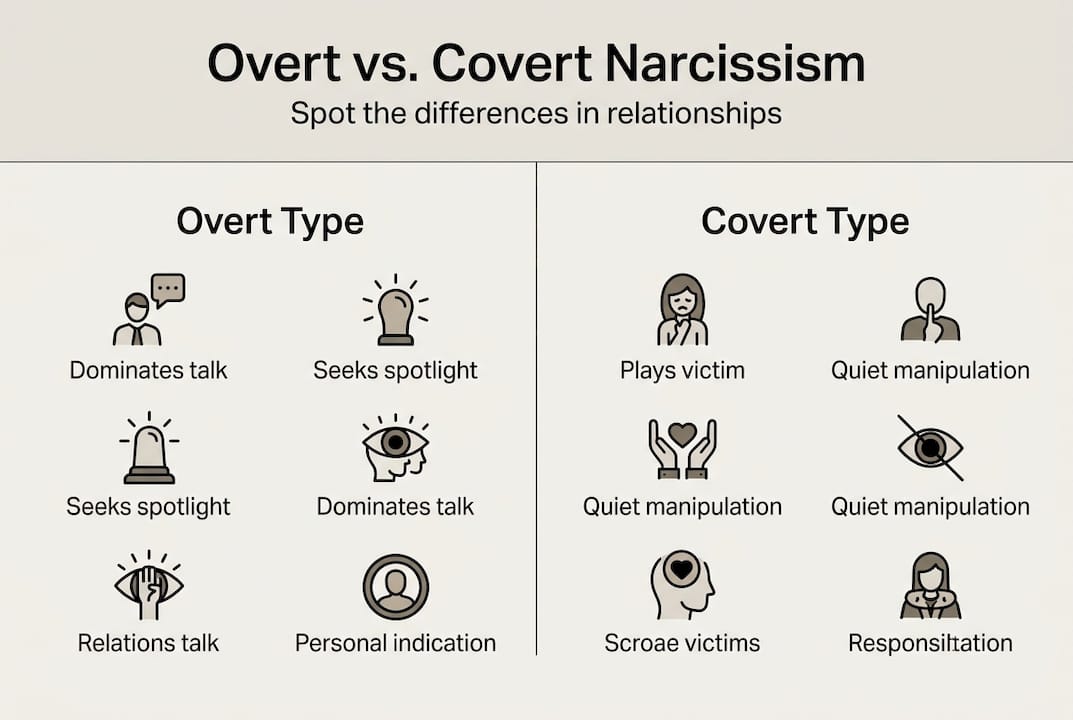
Individual narcissists may look very different in how they express these patterns. Not every narcissist is loud, boastful, or obviously arrogant. Narcissism exists on a spectrum with two primary subtypes: overt (grandiose) and covert (vulnerable).
Overt narcissism is what most people picture. This person dominates conversations, expects special treatment, and reacts to any perceived slight with anger or contempt. They are easy to spot because their entitlement is visible.
Covert narcissism is far more subtle and often harder to recognize. This person may appear shy, self-deprecating, or even victimized. But underneath, the same core traits are present: a fragile ego, a need for admiration, and a lack of genuine empathy. They manipulate through guilt, passive aggression, and playing the victim.
Overt vs. covert narcissism at a glance
| Feature | Overt narcissism | Covert narcissism |
|---|---|---|
| Presentation | Bold, arrogant, demanding | Quiet, self-pitying, withdrawn |
| Manipulation style | Direct and aggressive | Subtle and guilt-based |
| Reaction to criticism | Rage or contempt | Sulking or playing victim |
| Empathy | Openly dismissive | Selectively performed |
Some individuals shift between both types depending on the situation. Understanding which pattern you are dealing with matters because your response strategy will differ. Learning more about responding to narcissism can help you navigate both types more effectively.
- Overt types often need firm, clear boundaries stated directly.
- Covert types may require you to stop engaging with guilt-based narratives.
- Both types benefit from you having outside support and perspective.
- Neither type is likely to change without significant self-awareness and professional help.
Prevalence and why recognition matters
Understanding how often narcissism appears and its impact adds urgency to mastering recognition skills. This is not a rare or fringe issue. NPD affects between 0.5% and 5% of the US population, with higher rates among men. That range means millions of Americans are living with or alongside this condition right now.
The relational costs are significant. Research shows that narcissism is associated with greater relationship insecurity, higher rates of aggression, and lower overall relationship satisfaction for both partners. These are not minor inconveniences. They are measurable, lasting harms.
Impact of narcissistic patterns on relationship outcomes
| Outcome | Impact level |
|---|---|
| Emotional insecurity | High |
| Partner self-esteem | Significantly reduced |
| Relationship satisfaction | Low |
| Risk of emotional abuse | Elevated |
| Social isolation | Common |
Recognizing these patterns early is not about labeling someone. It is about protecting yourself. The sooner you identify what is happening, the sooner you can begin setting boundaries and seeking support. Reading about therapy benefits after narcissism can show you what recovery actually looks like. Many people also find that structured guidance on healing after narcissistic abuse gives them a clear path forward when everything feels overwhelming.
- Emotional confusion and self-doubt are common early effects.
- Chronic stress from these relationships can affect physical health over time.
- Isolation from support networks makes recovery harder and longer.
- Early recognition shortens the time spent in harmful dynamics.
Practical next steps if you recognize narcissistic patterns
Now that you’ve learned what to look for and why it matters, let’s talk about how you can take charge and protect your wellbeing. Recognition is powerful, but it needs to be followed by action.
- Document the patterns. Write down specific incidents, including dates, what was said, and how it made you feel. This creates clarity and counters gaslighting.
- Name your boundaries. Decide what behavior you will no longer accept and practice stating it clearly and calmly.
- Rebuild your support network. Reconnect with friends, family, or community members who offer honest, caring perspective.
- Limit JADE responses. JADE stands for Justify, Argue, Defend, Explain. Narcissistic individuals use these conversations to exhaust and manipulate you.
- Seek professional support. A therapist who understands narcissistic dynamics can help you process what happened and build healthier patterns going forward.
Taking action and seeking support measurably improves outcomes for people affected by narcissistic relationships. You do not have to figure this out alone. A structured approach to healing narcissistic relationships can make the process feel less overwhelming. Practical coping with narcissistic patterns strategies give you tools to use right now, while longer-term recovery after narcissistic abuse work helps you rebuild your sense of self.
Pro Tip: Before confronting a narcissistic person, talk through your plan with a therapist or trusted friend first. Going in without preparation often leads to more confusion, not resolution.
Find support and move forward
Recognizing narcissistic patterns is a courageous first step, and you deserve real support as you move forward. At Bergen County Therapist, Dr. Stephen Oreski and his team specialize in helping individuals untangle exactly these kinds of painful relationship dynamics.

If you are not sure where to begin, start by tracking your mental health to get a clearer picture of how these patterns are affecting you day to day. From there, exploring psychotherapy options can help you find the right therapeutic approach for your situation. If you are also experiencing depression as a result of these relationship dynamics, specialized depression therapy in Paramus is available and accessible. Free consultations make it easy to take that first step without pressure.
Frequently asked questions
What is the difference between narcissistic traits and narcissistic personality disorder?
Narcissistic traits exist on a spectrum and many people show one or two without having a disorder. NPD is a diagnosable condition requiring at least five of nine DSM-5 traits that are persistent and cause significant impairment.
Are there subtle signs of narcissistic behavior I might miss?
Yes. Covert narcissism includes subtler patterns like playing the victim, hypersensitivity to perceived slights, and quietly inflicting self-doubt in others, all of which are easy to overlook or excuse.
Does narcissism only affect romantic relationships?
No. Narcissistic patterns affect families, friendships, and workplaces just as significantly as romantic partnerships, often with similar cycles of manipulation and emotional harm.
How common is narcissism?
Narcissistic personality disorder affects 0.5% to 5% of the US population and is diagnosed more frequently in men, though it affects people of all genders and backgrounds.
Can people with narcissistic behaviors change?
Change is possible but genuinely difficult. It requires sustained self-awareness and professional help, and treatment can help manage narcissistic behaviors over time, though meaningful improvement is rarely quick.