

Trauma bonding feels like love, but it’s actually fear disguised as attachment. This confusing emotional tie forms when abuse cycles mix with moments of kindness, hijacking your brain’s natural attachment systems. If you’ve wondered why leaving feels impossible despite the pain, understanding trauma bonding’s psychological roots can clarify your experience and guide you toward effective healing options available in Bergen County.
Trauma Bonding Guide Overview: Causes, Symptoms & Recovery
- Introduction To Trauma Bonding
- Understanding Trauma Bonding: Mechanisms And Causes
- Signs And Symptoms Of Trauma Bonding
- Common Misconceptions About Trauma Bonding
- Therapeutic Options For Healing Trauma Bonds
- Impact Of Trauma Bonding On Mental Health
- Recognizing And Breaking Free From Trauma Bonds: Practical Steps
- Find Expert Help For Trauma Bonding Recovery In Bergen County
- Frequently Asked Questions
Key takeaways
| Point | Details |
|---|---|
| Trauma bonding creates confusing attachment | Cyclical abuse combined with intermittent positive reinforcement hijacks normal brain attachment processes, making victims feel emotionally tied to abusers. |
| Recognizing signs aids recovery | Common symptoms include misplaced loyalty, denial of harm, shame, and intense fear of abandonment that impairs clear decision-making. |
| Evidence-based therapies break bonds | CBT, EMDR, and group support help rewire conditioned responses and rebuild emotional autonomy for lasting recovery. |
| Misunderstanding delays healing | Confusing trauma bonding with love or simple codependence prevents victims from seeking appropriate trauma-informed care. |
| Mental health impacts require integrated care | Unresolved trauma bonds fuel higher rates of PTSD, anxiety, and depression, necessitating comprehensive therapeutic intervention. |
Introduction to trauma bonding
Trauma bonding is an emotional attachment formed between a victim and abuser through repeated cycles of abuse followed by intermittent positive reinforcement. Unlike healthy relationships built on mutual respect and consistent care, trauma bonds develop when someone experiencing harm receives unpredictable moments of affection, apology, or relief. This pattern creates powerful psychological obstacles that trap victims in relationships they consciously recognize as harmful.
The cyclical nature of trauma bonding distinguishes it fundamentally from healthy emotional connections. Abusive episodes create fear and distress, while sporadic kindness or remorse from the abuser triggers relief and hope. Your brain interprets these relief moments as rewards, strengthening the emotional bond despite ongoing harm. This conditioning process makes leaving feel terrifying rather than liberating.
Key elements that differentiate trauma bonding from healthy attachments include:
- Power imbalance where one person dominates and controls the other
- Cyclical pattern alternating between abuse and apparent care or remorse
- The victim’s growing sense of loyalty and protective feelings toward the abuser
- Intermittent reinforcement creates unpredictable reward responses
- Progressive isolation from outside support systems
- Increasing emotional dependence despite worsening treatment
Recognizing these patterns helps you understand why ending the relationship feels so complicated. Trauma bonds don’t reflect your weakness or the relationship’s genuine value. They represent your brain’s conditioned response to an exploitative pattern designed to maintain control over you.
Understanding trauma bonding: mechanisms and causes
The cycle of abuse creates trauma bonds through a specific neurobiological process. When your abuser inflicts harm, your brain’s stress response activates, flooding your system with cortisol. Then, when brief moments of kindness appear, your brain releases dopamine, creating relief and reward sensations. This alternating pattern trains your brain to associate the abuser with both threat and comfort, forming a paradoxical attachment.
Neurobiological research links trauma bonding to dysregulation in brain regions associated with attachment, stress, and reward processing such as the amygdala and prefrontal cortex. The amygdala processes fear and emotional responses, while the prefrontal cortex handles rational decision-making. When these systems become dysregulated through repeated abuse cycles, your ability to assess danger accurately and make protective choices becomes compromised.

Intermittent reinforcement creates particularly strong behavioral conditioning. Unpredictable rewards produce more persistent behavior patterns than consistent rewards. When you can’t predict whether your partner will respond with violence or affection, your brain stays hyperalert and increasingly invested in reading signals and earning positive responses. This mechanism explains why trauma bonds often feel more intense than healthy relationships.
Factors that distinguish trauma bonding from healthy attachment:
- Fear-based rather than trust-based emotional connection
- Loyalty driven by survival instinct rather than genuine affection
- Relief mistaken for love when abuse temporarily stops
- Escalating tolerance for harmful behavior over time
- Diminished self-worth and identity outside the relationship
| Brain Region | Role in Trauma Bonding | Impact on Behavior |
|---|---|---|
| Amygdala | Processes fear and emotional responses | Heightened fear response mixed with attachment cues |
| Prefrontal Cortex | Manages rational decision making | Impaired judgment and risk assessment |
| Reward System | Releases dopamine during relief moments | Creates powerful cravings for abuser contact |
| Hippocampus | Consolidates memory and context | Difficulty accurately recalling abuse patterns |
Pro Tip: Understanding the neurobiological basis empowers you to seek examples of trauma therapy specifically designed to address these brain changes rather than blaming yourself for staying.
Signs and symptoms of trauma bonding
Recognizing trauma bonding symptoms helps you distinguish conditioned attachment from genuine emotional connection. These signs often develop gradually, making them difficult to identify without a clear understanding of the pattern.
Common behavioral and emotional symptoms include:
- Defending or making excuses for the abuser’s harmful actions to others
- Feeling intense loyalty despite recognizing the relationship causes harm
- Experiencing overwhelming shame about the relationship but staying anyway
- Dreading abandonment more than continued abuse
- Difficulty trusting your own perceptions and memories
- Feeling responsible for the abuser’s emotions and behaviors
- Isolating from friends and family who express concern
- Experiencing physical symptoms like anxiety, insomnia, or hypervigilance
Research shows that approximately 63% of individuals in abusive relationships report experiencing trauma bonding symptoms that significantly impair their ability to leave. This prevalence demonstrates how common and powerful these neurobiological responses become when abuse patterns persist.
Trauma bonding impairs decision making by creating cognitive dissonance. You simultaneously recognize the relationship’s harm while feeling unable to imagine life without your partner. This internal conflict generates exhaustion, confusion, and paralysis rather than clarity and action. Your brain’s conditioned responses override your conscious understanding, making how trauma affects relationships particularly complex.
Warning signs suggesting trauma bonding rather than healthy attachment:
- You feel worse about yourself since the relationship began
- Relief from abuse feels like love or caring
- You rationalize or minimize clear patterns of harm
- Fear of your partner’s reaction controls your choices
- Outside observers consistently express concern about your well-being
Common misconceptions about trauma bonding
Misunderstanding trauma bonding delays recognition and appropriate help-seeking. Dispelling these myths helps you accurately assess your situation and validate your experiences.
Myth: Trauma bonding represents true love. Reality: Trauma bonds are rooted in fear and manipulation, not genuine love or healthy emotional connection. Real love creates safety, respects boundaries, and supports your wellbeing consistently. Trauma bonds generate anxiety, confusion, and diminishing self-worth despite intense feelings.
Myth: Victims can leave easily if they try harder. Reality: Neurobiological conditioning creates powerful barriers beyond willpower. Your brain’s reward and fear systems have been systematically manipulated through intermittent reinforcement, making separation feel threatening rather than freeing. Blaming yourself for staying ignores the complex psychological mechanisms at work.
Myth: Trauma bonding equals general codependence. Reality: While both involve problematic attachment patterns, trauma bonding specifically results from abuse cycles combined with intermittent positive reinforcement. Codependence can exist without abuse. Trauma bonding requires the presence of harm, power imbalance, and manipulation, creating fear-based attachment.
“The confusion victims experience stems from their brain’s inability to reconcile genuine danger with moments of perceived care. This isn’t weakness or poor judgment but rather a predictable neurobiological response to calculated emotional manipulation designed to maintain control.”
Victims often misinterpret abusive behavior as care due to conditioned emotional responses. When your brain associates relief from abuse with love, distinguishing healthy from harmful relationships becomes extraordinarily difficult. Understanding how trauma affects relationships helps you recognize these patterns aren’t personal failures but predictable responses to systematic manipulation.
Therapeutic options for healing trauma bonds
Evidence-based therapies effectively address trauma bonding by targeting the neurobiological conditioning and distorted cognitions sustaining these attachments. Breaking trauma bonds requires specialized approaches that recognize the complex interplay of fear, attachment, and survival responses.
Cognitive Behavioral Therapy (CBT) helps you identify and challenge distorted thought patterns that maintain trauma bonds. You’ll learn to recognize cognitive distortions like minimization, rationalization, and misplaced responsibility while developing healthier thinking patterns that support protective decision-making.
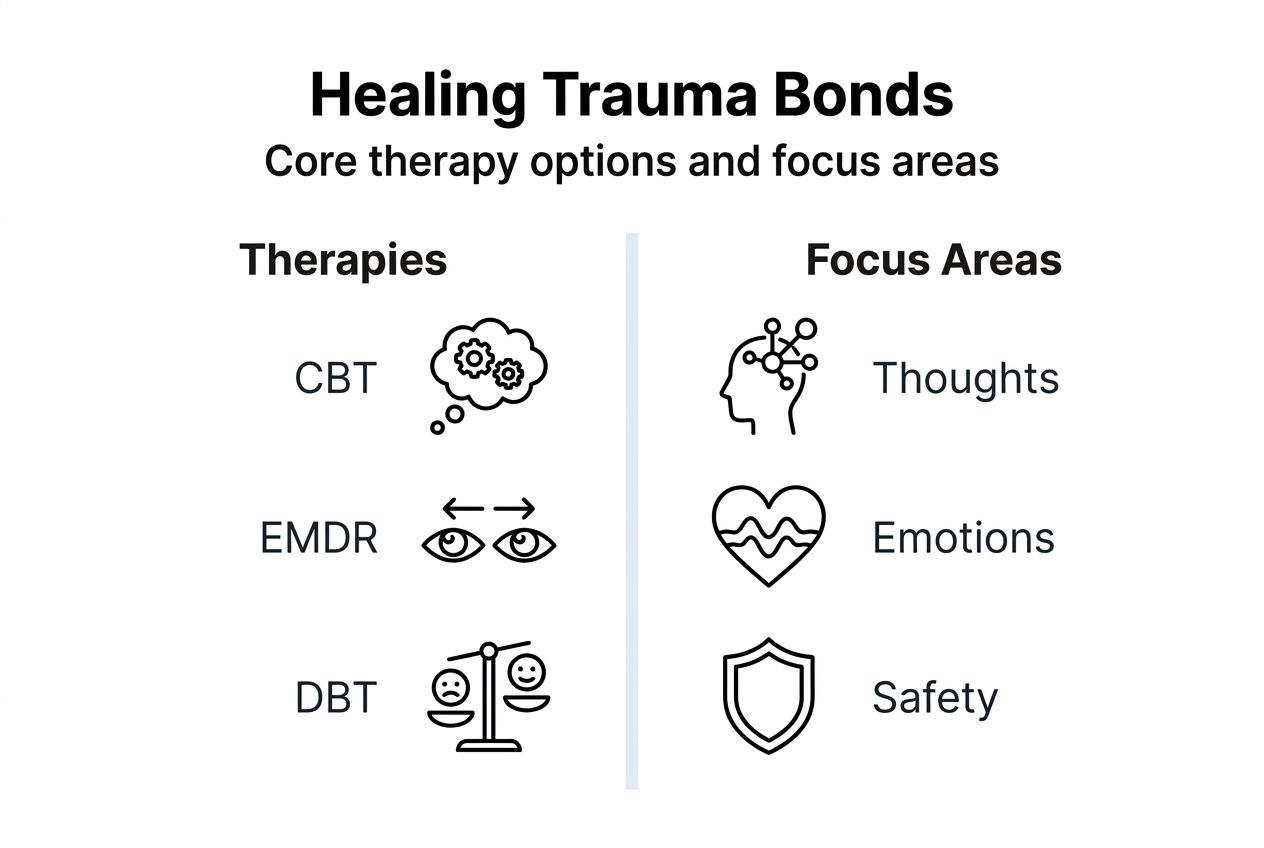
Eye Movement Desensitization and Reprocessing (EMDR) processes traumatic memories contributing to trauma bonds by reducing their emotional intensity. This approach helps your brain reprocess abuse experiences, weakening the conditioned fear and attachment responses that keep you tied to your abuser.
Dialectical Behavior Therapy (DBT) builds emotional regulation skills and distress tolerance essential for managing the intense feelings that arise when breaking trauma bonds. You’ll develop concrete strategies for handling urges to return to the relationship and coping with the grief and fear that emerge during separation.
| Therapy Type | Primary Focus | Timeline | Best For |
|---|---|---|---|
| CBT | Challenging distorted cognitions | 12-20 sessions | Identifying thought patterns sustaining bonds |
| EMDR | Processing traumatic memories | 8-12 sessions | Reducing emotional charge of abuse memories |
| DBT | Building emotional regulation skills | 6-12 months | Managing intense separation distress |
| Group Therapy | Peer support and validation | Ongoing | Reducing isolation and shame |
Combining individual therapy with support groups enhances recovery outcomes. Group settings provide validation, reduce isolation, and offer perspectives from others navigating similar experiences. Hearing how others recognize and break trauma bonds normalizes your experience and provides hope.
Steps to start therapy for trauma bonding:
- Acknowledge that your relationship patterns may involve trauma bonding requiring professional support
- Research trauma-informed therapists experienced with childhood trauma therapy approaches applicable to adult attachment issues
- Schedule initial consultations to assess fit and discuss your specific situation
- Commit to consistent attendance even when treatment feels uncomfortable or you doubt the process
- Consider adding group therapy trauma benefits to your individual treatment plan
- Plan for a 6-12 month recovery timeline with ongoing support as needed
Pro Tip: Choosing trauma-informed approaches and engaging community support through your trauma therapy guide bergen county resources significantly enhances healing success and reduces relapse risk.
Impact of trauma bonding on mental health
Unresolved trauma bonds create cascading mental health consequences extending far beyond the primary relationship. Addressing these broader impacts requires integrated therapeutic approaches that treat both the trauma bond and resulting psychological conditions.
Mental health disorders commonly linked to trauma bonding:
- Post-Traumatic Stress Disorder (PTSD): Intrusive memories, hypervigilance, avoidance behaviors, and emotional numbness stemming from ongoing abuse exposure
- Anxiety Disorders: Chronic worry, panic attacks, and generalized anxiety fueled by unpredictable relationship dynamics and conditioned fear responses
- Major Depressive Disorder: Persistent sadness, hopelessness, worthlessness, and loss of interest resulting from prolonged abuse and isolation
- Complex PTSD: Difficulties with emotional regulation, self-concept, and relationships extending beyond standard PTSD symptoms
- Substance Use Disorders: Self-medication attempts to manage overwhelming emotions and trauma symptoms
Victims experience higher PTSD, anxiety, and depression rates due to trauma bonding complications. The combination of ongoing abuse exposure, neurobiological changes, and social isolation creates perfect conditions for developing multiple co-occurring mental health conditions requiring comprehensive treatment.
Trauma bonding complicates recovery by creating attachment to the source of trauma itself. Traditional trauma treatment assumes safety from the traumatic stressor, but trauma bonds generate ongoing contact and emotional investment in the abuser. This dynamic prolongs symptom duration and increases treatment complexity compared to trauma from non-attachment sources.
Integrated therapy addressing both trauma bonds and co-occurring mental health issues produces better outcomes than treating conditions in isolation. Your therapist should simultaneously work on breaking trauma bond patterns while managing depression, anxiety, or PTSD symptoms. This comprehensive approach recognizes how these conditions reinforce each other and require coordinated intervention strategies.
Recognizing and breaking free from trauma bonds: practical steps
Translating knowledge into action requires concrete steps you can follow toward healing. Breaking trauma bonds involves both professional support and personal commitment to changing established patterns.
Step 1: Recognize trauma bond patterns and symptoms. Review the signs discussed earlier and honestly assess which apply to your relationship. Document specific incidents showing abuse cycles followed by temporary kindness. Write down how you feel before, during, and after contact with your partner. This record helps you see patterns your brain minimizes or forgets due to trauma responses.
Step 2: Seek trauma-informed therapy tailored to individual needs. Contact therapists specializing in trauma and abusive relationships in Bergen County. Explain your situation during initial consultations and ask about their experience treating trauma bonds specifically. Verify they use evidence-based approaches like CBT, EMDR, or DBT rather than generic relationship counseling. Access How to start trauma therapy guide resources for detailed preparation steps.
Step 3: Engage in peer support or group therapy for sustained recovery. Join support groups for survivors of abusive relationships where you’ll find validation and practical strategies from others with similar experiences. These connections reduce shame, provide accountability, and offer hope during difficult recovery phases. Consider both in-person and online options based on your comfort level and schedule.
Step 4: Create safety plans before attempting separation. Work with your therapist to develop concrete strategies for managing urges to return and coping with the intense emotions that arise. Identify safe people you can contact during crises and concrete self-care practices that help regulate your nervous system.
Step 5: Expect non-linear progress with setbacks. Breaking trauma bonds rarely follows a straight path. You may experience strong urges to return, doubt your decision, or actually resume contact temporarily. These setbacks don’t mean failure but rather reflect the powerful conditioning you’re working to overcome. Each time you recognize the pattern and recommit to healing, you strengthen new neural pathways.
Pro Tip: Prioritize psychotherapy treatment before attempting separation to reduce relapse risk. Professional support helps you understand your patterns, build coping skills, and create safety plans essential for successful, permanent separation.
Find expert help for trauma bonding recovery in Bergen County
Breaking trauma bonds requires specialized support from professionals who understand the complex neurobiological and psychological mechanisms sustaining these attachments. Dr. Stephen Oreski & Associates offers comprehensive trauma therapy services specifically designed for Bergen County residents navigating the challenging process of recognizing and healing from trauma bonds.

Our team provides evidence-based approaches, including CBT, EMDR, and group therapy proven effective for trauma bonding recovery. We understand that leaving an abusive relationship represents only the first step, with the deeper work involving rewiring conditioned responses and rebuilding your sense of self outside the trauma bond. Our trauma therapy guide Bergen County resources help you understand what to expect from treatment and how to prepare for your healing journey.
Whether you’re still in the relationship, trying to understand your confusion, or recently separated and struggling with intense urges to return, our trauma-informed therapists create safe, non-judgmental spaces for your recovery. We combine individual therapy tailored to your specific situation with group support options that reduce isolation and provide peer validation essential for sustained healing. Taking the first step by learning how to start trauma therapy helps you move from confusion to clarity about your situation and available support. Schedule a consultation to discuss your situation and explore psychotherapy treatment options that can help you break free from trauma bonds and reclaim your emotional autonomy.
Frequently asked questions
What is trauma bonding?
Trauma bonding is an emotional attachment to an abuser formed through repeated cycles of abuse followed by intermittent positive reinforcement. Unlike healthy love, based on consistent care and mutual respect, trauma bonds develop when your brain associates relief from abuse with affection, creating powerful, fear-based attachment that makes leaving feel impossible despite recognizing the relationship’s harm.
Why do victims feel attached to abusers despite harm?
Victims feel attached because intermittent reinforcement creates powerful neurobiological conditioning. When abuse alternates unpredictably with kindness, your brain releases dopamine during relief moments, creating reward responses that strengthen attachment to the abuser. This conditioning hijacks normal attachment systems, making your brain interpret the relationship as essential for survival rather than recognizing it as the source of harm.
How can therapy help break trauma bonds?
Therapy breaks trauma bonds by addressing the neurobiological conditioning and distorted cognitions sustaining these attachments. CBT challenges thought patterns that rationalize abuse, EMDR processes traumatic memories reducing their emotional intensity, and DBT builds emotional regulation skills for managing separation distress. Combined with group support, these evidence-based approaches help you rewire conditioned responses and rebuild autonomy.
What signs distinguish trauma bonds from healthy love?
Trauma bonds involve fear-based attachment where relief from abuse feels like love, loyalty driven by survival instinct rather than genuine affection, defending harmful behaviors to others, and worsening self-worth over time. Healthy love creates consistent safety, respects boundaries, supports your wellbeing, and enhances rather than diminishes your sense of self. If fear of your partner’s reaction controls your choices, you’re experiencing trauma bonding rather than love.
What are the initial steps to find help locally?
Start by acknowledging your relationship patterns may involve trauma bonding requiring professional support. Research trauma-informed therapists in Bergen County experienced with abuse and attachment issues. Schedule initial consultations to discuss your situation and assess fit. Contact support groups for abuse survivors to reduce isolation. Create safety plans with professional guidance before attempting separation to manage the intense emotions and urges that arise during recovery.