

After narcissistic rage, the relationship typically moves into a predictable aftermath: a tense cool-down that shifts into charm, silence, discard, or hoovering. None of these phases mean the danger has passed, so safety and documentation come first, not conversation or repair.
If you’re reading this an hour after an outburst, here’s what matters most right now. If you feel physically unsafe, leave the space or call 911. If you need to talk through what just happened, the National Domestic Violence Hotline is available 24/7, even for situations that don’t involve physical violence. Write down what happened while it’s fresh: time, words used, what triggered it, whether anyone else witnessed it. This isn’t about building a legal case necessarily. It’s about having an accurate record before the next phase, whichever one it turns out to be, starts rewriting the story in your head.
What you’re likely feeling right now, a racing heart, trouble focusing, an urge to apologize even though you didn’t do anything wrong, has a name in clinical literature: hypervigilance, a nervous-system state produced by repeated exposure to unpredictable threat. That reaction is treatable. Approaches like CBT and DBT address it directly, and understanding the pattern you’re in is the first step toward getting out of it.
Key Takeaways
Recovery after narcissistic rage depends on prioritizing physical safety and documentation immediately, then pursuing trauma-informed therapy to address the nervous-system and psychological effects of the cycle.
| Point | Details |
|---|---|
| Aftermath follows predictable patterns | Expect charm, silence, discard, smear, or hoovering, not a single fixed response. |
| Safety outranks understanding motive | Leave unsafe situations or call emergency services before analyzing why the rage happened. |
| Document while memory is fresh | Save screenshots, dated notes, or voice memos immediately after an episode. |
| Timelines vary widely | Cycles can repeat over days or stretch across months depending on personality and contact. |
| Recovery is staged, not instant | Stabilization comes first, then grief processing, then identity rebuilding. |
| Bergencountytherapist offers a stabilization-first path | Trauma-informed CBT, DBT, and online or in-person sessions start with a free consultation. |
Table of Contents
- What Happens After Narcissistic Rage: The Immediate Aftermath
- Why These Reactions Happen: The Psychology Behind the Cycle
- How Long Does the Aftermath Last?
- Effects on the Person Who Experienced the Rage
- How to Respond in the Immediate Aftermath
- Healing and Recovery: What Therapy Actually Involves
- If They Come Back: Recognizing Hoovering
- Red Flags That Signal Escalation or Danger
- What I Tell Clients Right After a Rage Episode
- If You Need Support Now: How Bergencountytherapist Can Help
- Sources
- FAQ
What Happens After Narcissistic Rage: The Immediate Aftermath
The hours and days right after an explosion tend to follow one of a handful of scripts. Recognizing which one you’re in matters more than most survivors realize, because each pattern carries a different risk and a different trap.
- The charm offensive (honeymoon phase). The same person who was screaming an hour ago shows up with flowers, an unusually vulnerable apology, or sudden interest in your feelings. It can feel like relief, and that’s exactly the problem.
- The silent treatment. No apology, no acknowledgment, just cold withdrawal that can last hours or stretch into days, leaving you to wonder what you did wrong.
- Discard. A more permanent-feeling version of withdrawal, where the person acts as though the relationship or friendship is over, sometimes abruptly blocking contact.
- Smear and retaliation. The narcissist gets ahead of the story, telling mutual friends, family, or coworkers a version of events that paints you as the unstable or aggressive one.
- Hoovering. Days, weeks, or months later, contact resumes. Sometimes it’s a text that seems innocent. Sometimes it’s a full campaign of remorse.
- Withdrawal with future threats. A quieter but chilling variant: vague warnings about what will happen “next time,” without a full outburst.
Here’s a composite example that shows up constantly in survivor accounts: a partner explodes over a minor scheduling conflict, disappears for two days, then arrives with an expensive gift and a tearful confession about how hard their childhood was. The relief you feel isn’t imagined. It’s real, and it’s also exactly how intermittent reinforcement deepens a trauma bond: the brain starts treating relief from fear as a reward, which makes the relationship harder to leave, not easier.
Pro Tip: Treat the honeymoon phase like a weather pattern, not a personality change. Write down the date and what triggered the original rage. If you look back in three months and the same trigger caused the same explosion, you have your answer about whether anything actually changed.
Why These Reactions Happen: The Psychology Behind the Cycle
The behaviors above aren’t random, and they aren’t really about you. They’re defensive maneuvers built around a fragile sense of self that can’t tolerate criticism, disagreement, or being ignored.
Clinicians describe several mechanisms working together:
- Narcissistic injury. A perceived slight, even a small one like being interrupted or questioned, registers as a threat to identity, not just an inconvenience.
- Shame-driven defense. Rage often functions as armor against an unbearable feeling of inadequacy the person can’t consciously access or admit to.
- Splitting. People and situations get sorted into “all good” or “all bad” with no middle ground, which is why you can go from idealized partner to villain within a single conversation.
- Intermittent reinforcement. Because the calm and affection after rage feel disproportionately good compared to the fear that preceded them, the relief itself becomes neurologically rewarding, reinforcing your attachment to someone who just frightened you.
You can picture the pattern as a loop rather than a straight line: tension builds, an outburst releases it, a repair phase follows that restores calm, and the restored calm quietly resets the tension that starts building again. Psychology Today’s description of the narcissistic cycle of abuse frames this loop as fundamentally different from normal conflict resolution, because the goal isn’t mutual understanding. It’s regaining control.
Trauma bond is the term for the attachment that forms inside that loop. It isn’t weakness or poor judgment. It’s a predictable outcome of a nervous system trying to make sense of danger that keeps resolving into relief.
How Long Does the Aftermath Last?
There’s no fixed clock on any of this, which is often the hardest part for people trying to plan their next move.
- Minutes to hours. The acute explosion itself, the yelling, insults, or door slamming, typically burns out within this window.
- Days to weeks. The immediate aftermath phase, whichever version you’re experiencing (honeymoon, silence, smear), usually plays out over this stretch.
- Weeks to months. The full cycle can repeat itself, sometimes with the same triggers recurring almost identically each time.
Several factors stretch or shrink that timeline. Personality subtype matters: a more vulnerable, insecure narcissistic presentation may cycle faster into apology, while a grandiose presentation may hold out longer in silence or blame. How threatened the person felt by whatever triggered the rage plays a role too, along with how close the relationship is. A spouse or parent has more emotional leverage than a coworker, which tends to extend both the intensity and the duration of the cycle. And critically, whether contact continues at all resets the clock every time.
None of this variability changes the priority order. If there’s any risk to your physical safety, that consideration outranks predicting the next phase.
Effects on the Person Who Experienced the Rage
The short-term reaction to a rage episode often looks like shock: a strange numbness, difficulty forming sentences, or replaying the scene on a loop. Dissociation is common too, that sense of watching the argument from outside your own body. Self-blame tends to creep in fast, especially if the person has used splitting or smear tactics to convince you the explosion was your fault. Sleep is frequently the first casualty, with racing thoughts keeping you up long after the confrontation ended.

Left unaddressed, these short-term reactions can calcify into something more durable. Clinical sources link ongoing exposure to this cycle with chronic anxiety, depression, and elevated risk of substance use as a coping mechanism. Complex PTSD symptoms, hyperarousal, emotional flashbacks, a persistently negative self-view, show up often in survivors who’ve lived through repeated cycles rather than a single incident. Trust becomes harder to extend even outside the relationship that damaged it, and many survivors describe struggling to read new relationships accurately for years afterward.
Peer-reviewed trauma physiology research explains part of why this lingers biologically: chronic exposure to unpredictable threat sensitizes the brain’s threat-detection systems and impairs the prefrontal regulation needed to calm them back down. That’s the neuroscience behind why you might flinch at a raised voice years later, even from someone who’s never hurt you.
A short symptom checklist worth reviewing honestly:
- Persistent anxiety or dread specifically tied to the relationship
- Intrusive memories or flashbacks of specific rage episodes
- Difficulty trusting your own perception of events
- Physical symptoms: chest tightness, stomach issues, tension headaches
- Withdrawal from friends or activities you used to enjoy
If you’re experiencing thoughts of self-harm, ongoing threats to your safety, or symptoms that are interfering with basic functioning, that’s the point to seek professional support without waiting to see if it improves on its own. Additional trauma research supports the same conclusion: these are physiological responses to real threat exposure, not signs of personal weakness.
How to Respond in the Immediate Aftermath
The instinct to fix things right after a rage episode is strong, and it’s almost always the wrong move. Therapists who work with survivors consistently advise against trying to resolve anything in the moment; the person is often still operating from ego defense, not genuine reflection, which means any conversation you have is unlikely to land the way you’d hope.
Here’s a practical sequence to follow instead:
- Secure physical safety first. If there’s any risk of violence, leave the space. Get yourself, and any children or pets, somewhere safe before doing anything else.
- Create distance rather than arguing back. Guidance for handling active rage is consistent: don’t defend yourself in the moment, and put physical space between you and the person if you can do so safely.
- Limit contact for a defined window. Even a few hours of no communication interrupts the reactive cycle and gives your nervous system room to settle.
- Document what happened while it’s fresh. Screenshots of messages, a dated note with specifics, or a voice memo to yourself all count. Documentation habits matter later even if you never plan to use them formally.
- Identify your safe exits in advance. Know which room has a lockable door, which neighbor you could knock on, or which friend lives closest, before you need that information under stress.
A simple safety-plan template you can build in ten minutes: one trusted person to call, one physical location you can go to on short notice, a small emergency kit (phone charger, some cash, copies of important documents), and a note in your phone with the date and details of the last three incidents. None of this requires you to have decided whether to leave the relationship. It just means you’re not improvising during the next crisis.
A few things worth holding onto:
- You are not responsible for managing the other person’s emotional state.
- Silence from you is not provocation, whatever they claim.
- If law enforcement involvement becomes necessary, prior documentation makes that conversation faster and clearer.
- The National Domestic Violence Hotline can help you think through a safety plan even if you’re unsure whether what you’re experiencing “counts.”
Healing and Recovery: What Therapy Actually Involves
Recovery from this kind of cycle isn’t a single conversation or a breakthrough moment. It tends to move in stages, and the order matters.
Trauma-informed therapy typically starts with safety and stabilization before touching the harder material. Meaningful trauma processing generally can’t happen while your nervous system is still bracing for the next incident, which is why a good therapist will spend real time on grounding and regulation before asking you to revisit painful memories in detail. Cognitive behavioral therapy (CBT) helps identify and interrupt the self-blaming thought patterns that often outlast the relationship itself. Dialectical behavior therapy (DBT) builds distress tolerance and emotional regulation skills, useful for the intense swings many survivors experience during recovery. EMDR (eye movement desensitization and reprocessing) targets specific traumatic memories directly, often reducing their emotional charge over a defined series of sessions. Nervous-system-based approaches, body-focused techniques that address the physiological hypervigilance discussed earlier, round out a comprehensive plan.

What a first few sessions typically look like: an intake focused on current safety, not a deep dive into history. Pacing that respects your capacity rather than pushing for disclosure before you’re ready. Early work on nervous-system regulation, simple grounding skills you can use outside of sessions. Grief processing comes later, because there’s often real grief involved, for the relationship you thought you had, not just the one that actually existed. Boundary-setting work and longer-term identity rebuilding, reconnecting with the parts of yourself that got sidelined during the relationship, tend to come after the acute symptoms settle.
Timeline expectations vary by person, but a reasonable general pattern: measurable symptom reduction, better sleep, fewer intrusive thoughts, often develops over a period of months of consistent work. Deeper identity rebuilding, trusting your own judgment again, feeling like yourself in new relationships, usually takes longer and isn’t something to rush.
Pro Tip: If you’re not sure you’re ready for full trauma processing, that’s fine. Ask a prospective therapist how they handle stabilization first. A good clinician will have a clear answer, not vague reassurance.
If you’re weighing whether to start this process, Bergencountytherapist’s therapy consultation options walk through what a first conversation typically covers, and the step-by-step recovery guide breaks the process into stages that match what’s described above.
If They Come Back: Recognizing Hoovering
Contact resuming after a discard or silent period, sometimes called hoovering, usually follows a recognizable script. Watch for a sudden, dramatic apology that arrives with no history of similar reflection. A staged crisis (health scare, job loss, family emergency) that conveniently requires your involvement right when things had gone quiet. A resurgence of the same intense attention and flattery that marked the early relationship, sometimes called love-bombing. Or claims of change, therapy, self-help books, a new outlook, offered as evidence with no track record behind them yet.
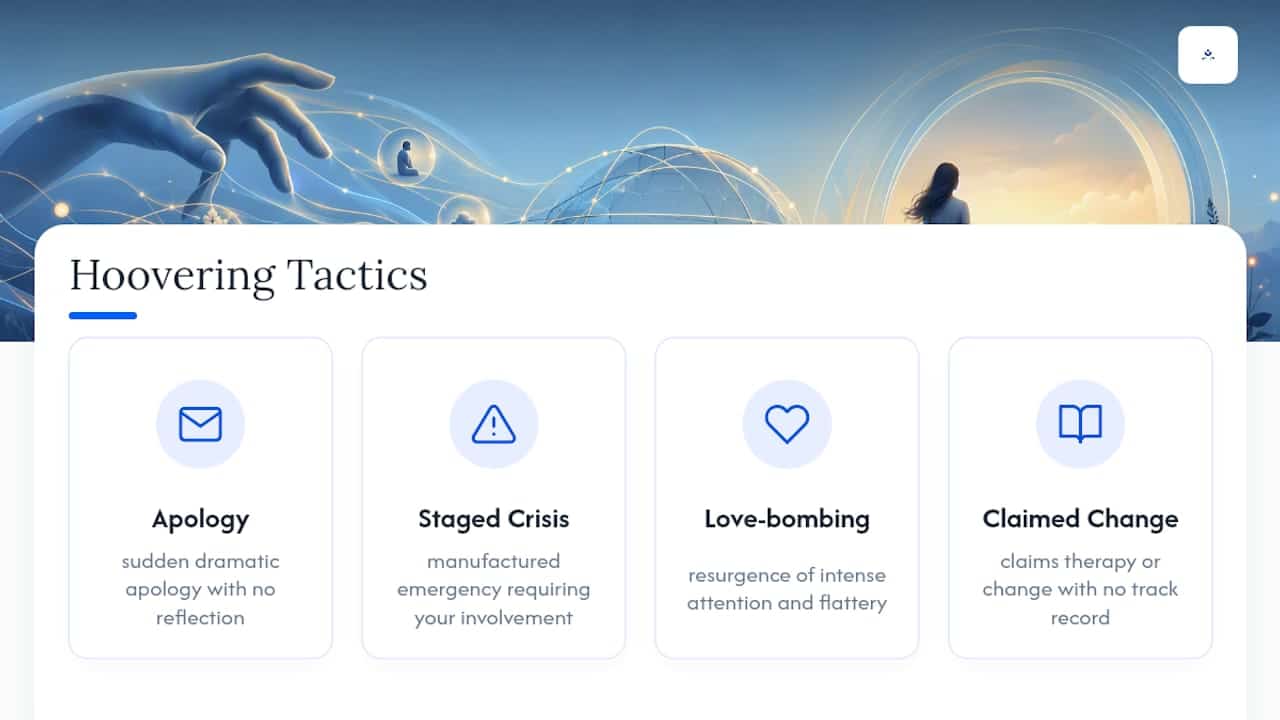
Before responding to any of it, a short set of questions helps: Is there any physical safety risk in re-engaging, even briefly? Has there been a documented pattern of change over time, or just a promise of one? What happened the last three times you gave this same benefit of the doubt?
If you do choose limited contact, keep your language flat and short. Something like “I’m not available to discuss this right now” or “I need space and I’m not changing that” doesn’t invite debate the way a longer explanation does. You don’t owe a detailed justification for maintaining distance.
Red Flags That Signal Escalation or Danger
Some post-rage behaviors move past emotional harm into territory that requires immediate action. Take these seriously if you notice them: credible threats of harm, whether spoken or written. Property damage during or after an argument. Signs of stalking, showing up uninvited, tracking your location, contacting people you know without your involvement. Any reference to weapons, even indirect. Escalating behavior specifically after you’ve tried to separate or set a boundary. Legal harassment, repeated frivolous complaints or threats to misuse the legal system against you. Threats directed at children or pets as leverage.
Research on stress responses to repeated threat confirms what safety planners already know: risk during and after separation from an abusive dynamic is a documented pattern, not an exaggeration. If you’re seeing any of the signs above, contact the National Domestic Violence Hotline or local law enforcement, and keep documentation (screenshots, photos, dated notes) in a place the other person can’t access.
What I Tell Clients Right After a Rage Episode
The first thing I want a client to hear isn’t advice, it’s validation: what you experienced was real, and your reaction to it makes sense. Rage from a narcissistic partner or parent isn’t something you provoked, no matter what was said in the moment. My immediate focus is always safety first, then stabilization. I’ll often walk someone through a simple grounding exercise right there in session: name five things you can see, four you can touch, three you can hear. It sounds almost too simple, but it interrupts the nervous system’s fight-or-flight loop enough to think clearly again. From there, we build toward a longer plan, but that first session isn’t about analyzing the relationship. It’s about helping you feel safe enough in your own body to think straight.
If You Need Support Now: How Bergencountytherapist Can Help
Bergencountytherapist gives you a faster, more direct path to trauma-informed care than searching through directories or waiting weeks for a callback: a free consultation gets you talking to a real clinician about your specific situation, often within days.

The practice offers trauma therapy built around the stabilization-first approach described above, using CBT, DBT, and body-based trauma-informed techniques depending on what you need. Sessions are available both in-person and online, which matters if safety, scheduling, or simply not wanting to sit in a waiting room is a factor for you right now. If you’re not sure where to start, the trauma therapy guide outlines what a typical course of treatment looks like, timeline included.
One clarification before you reach out: this practice is not an emergency service. If you’re in immediate danger, call 911 or the National Domestic Violence Hotline first. For everything that comes after the immediate crisis, the ongoing work of recovery, booking a free consultation is the next concrete step.
Sources
- NCBI / PMC article (relevant trauma/stress physiology literature)
- NCBI / PMC article (trauma / clinical findings)
- Stopping the honeymoon phase of narcissistic abuse — PsychCentral
- Narcissistic Rage: What Triggers It and How to Stay Safe (2026) — Simply Psychology
- Narcissistic Rage: What It Is, Why It Happens, and How to Stay Safe — NarcissisticAbuseRehab
This article is general information, not a substitute for advice from a qualified doctor. Consult a qualified healthcare professional about your own circumstances before acting on anything here.
FAQ
How Do You Recover From Narcissistic Rage?
Recovery starts with physical and emotional safety, followed by nervous-system stabilization through trauma-informed therapy, then longer-term work on grief, boundaries, and identity rebuilding, often with modalities like CBT, DBT, or EMDR.
How Long Does the Aftermath of Narcissistic Rage Usually Last?
The acute explosion typically lasts minutes to hours, while the surrounding cycle, including honeymoon or silent phases, can stretch from days to months depending on the relationship and whether contact continues.
Is the Honeymoon Phase After Rage a Sign of Real Change?
Not usually. Clinicians describe it as a form of intermittent reinforcement that deepens the trauma bond rather than genuine reconciliation, so real change is measured by sustained behavior over time, not a single apology.
Should I Try to Talk Things Through Right After an Outburst?
No. Therapists generally advise against attempting to resolve anything in the moment, since the person is often still in a defensive state, and disengaging to ground yourself is the safer priority.
When Should I Seek Professional Help After Narcissistic Rage?
Seek support if you notice ongoing anxiety, intrusive memories, sleep disruption, or any thoughts of self-harm, and reach out sooner rather than later if there’s an active safety threat.