

Emotional manipulation often hides in plain sight, disguised as care or concern in our closest relationships. You might feel guilty for setting boundaries, confused about reality, or responsible for someone else’s emotions without understanding why. Emotional manipulation is a form of psychological influence using emotions to control others’ behavior or feelings for the manipulator’s benefit, often covertly through tactics like guilt-tripping, gaslighting, and blame-shifting. This guide reveals what emotional manipulation truly is, how it operates beneath awareness, and practical steps to recognize and respond to it in Bergen County relationships. Understanding these patterns protects your mental wellness and strengthens your connections.
Table of Contents
- Key takeaways
- Understanding emotional manipulation: definition and mechanisms
- Effects on relationships and mental wellness
- Distinguishing manipulation from healthy influence
- Recognizing and responding to emotional manipulation in Bergen County
- How therapy can help you overcome emotional manipulation
- Frequently asked questions about emotional manipulation
Key Takeaways
| Point | Details |
|---|---|
| Covert manipulation defined | Emotional manipulation is a covert system that uses feelings to control others while staying below conscious awareness. |
| Guilt tripping and gaslighting | Common tactics include guilt tripping and gaslighting to distort reality and emotions. |
| Relationship quality and mental health | Repeated manipulation erodes relationship quality and harms mental wellness over time. |
| Healthy influence versus manipulation | Healthy influence respects boundaries and autonomy, while manipulation pressures choices through emotional tactics. |
Understanding emotional manipulation: definition and mechanisms
Emotional manipulation operates as a covert system of control that exploits your feelings to serve someone else’s agenda. Unlike direct requests or honest persuasion, manipulation works below your conscious awareness, making you question your perceptions and doubt your judgment.
The mechanics involve a sequence: building trust, gathering information on vulnerabilities, activating emotions like guilt or fear, and controlling reality interpretation. This four-step process allows manipulators to maintain plausible deniability while systematically influencing your choices. They first establish themselves as trustworthy, then carefully observe what triggers your emotional responses. Once they understand your vulnerabilities, they activate specific emotions at strategic moments to steer your behavior.
Common tactics include several distinct approaches:
- Guilt-tripping: making you feel responsible for their emotions or circumstances
- Gaslighting: denying your reality and making you question your memory or sanity
- Blame-shifting: redirecting accountability for their actions onto you
- Love-bombing followed by withdrawal: creating emotional dependency through inconsistent affection
Consider how manipulation unfolds in a typical relationship scenario:
- Partner shares vulnerable information, creating apparent intimacy and trust
- Partner observes you feel guilty when disappointing others or saying no
- Partner expresses hurt feelings when you make plans without them
- You cancel your plans, feeling responsible for their emotional state
- Partner subtly reinforces this pattern, gradually controlling your social life
This sequence demonstrates how manipulation operates through emotional activation rather than direct demands. The manipulator never explicitly forbids your plans but creates an emotional environment where you restrict yourself. Understanding what is emotional abuse helps distinguish these patterns from normal relationship dynamics.
The psychological sophistication lies in how manipulators frame their tactics as care or sensitivity. They position themselves as victims of your choices, making you the apparent aggressor for pursuing normal independence. This reversal keeps you focused on managing their emotions rather than recognizing the control pattern.
Pro Tip: When someone consistently makes you feel responsible for their emotional state, ask yourself whether you have actual power over their feelings or if they’re assigning you that role.
Effects on relationships and mental wellness
The damage from emotional manipulation extends far beyond individual incidents, systematically degrading both relationship quality and mental health over time. Research reveals concrete patterns showing how manipulation erodes the foundation of healthy connections.

Meta-analysis shows manipulation negatively correlates with relational quality (r = -0.215, N=10,874), meaning as manipulation increases, relationship satisfaction and trust decline measurably. This finding across thousands of relationships confirms what many experience but struggle to name. The correlation holds across different relationship types, demonstrating that manipulation damages romantic partnerships, friendships, and family bonds equally.
| Impact area | Effect | Severity |
|---|---|---|
| Relational quality | Correlation coefficient -0.215 | Moderate negative |
| Depression risk | Elevated rates in manipulation victims | High |
| Anxiety disorders | Increased prevalence | Moderate to high |
| Self-worth erosion | Progressive decline over time | Severe |
| Reality perception | Distorted through gaslighting | Variable |
Mental health consequences manifest in specific, measurable ways. Victims of ongoing manipulation show elevated rates of depression as they internalize blame and lose confidence in their judgment. Gaslighting creates a particularly insidious effect, where you begin questioning your own perceptions and memories, leading to paranoia and chronic self-doubt.
Recognize these signs indicating emotional abuse effects on mental health in your relationships:
- You constantly second-guess your memory of conversations or events
- You feel guilty for normal activities like seeing friends or pursuing hobbies
- You walk on eggshells to avoid triggering their emotional reactions
- You feel confused about who’s responsible when conflicts arise
- You’ve become isolated from your support network without clear reasons
The cumulative effect creates a reality where you focus entirely on the manipulator’s needs while neglecting your own. This imbalance doesn’t happen overnight but develops through repeated patterns that gradually normalize abnormal dynamics. Understanding signs of abusive relationship patterns helps you recognize when concern has crossed into control.
Experts emphasize the subtle nature of emotional damage: “Manipulation wounds don’t leave visible scars, but they fundamentally alter how victims see themselves and trust their own experiences. The psychological impact often outlasts the relationship itself, requiring intentional healing work to restore healthy self-perception.”
This invisible harm explains why many people struggle to identify manipulation even while experiencing its effects. Without physical evidence, you might minimize the damage or accept the manipulator’s framing that you’re overreacting.
Distinguishing manipulation from healthy influence
Understanding the boundary between harmful manipulation and beneficial influence protects you from both missing red flags and becoming overly suspicious of normal interactions. The distinction centers on transparency, intent, and mutual benefit.
Manipulation is covert, deceptive, exploitative; persuasion is transparent and mutually beneficial. This fundamental difference means healthy influence operates in the open, where both parties understand what’s happening and why. Manipulation requires secrecy and misdirection to function because it wouldn’t work if you fully understood the manipulator’s true intent.
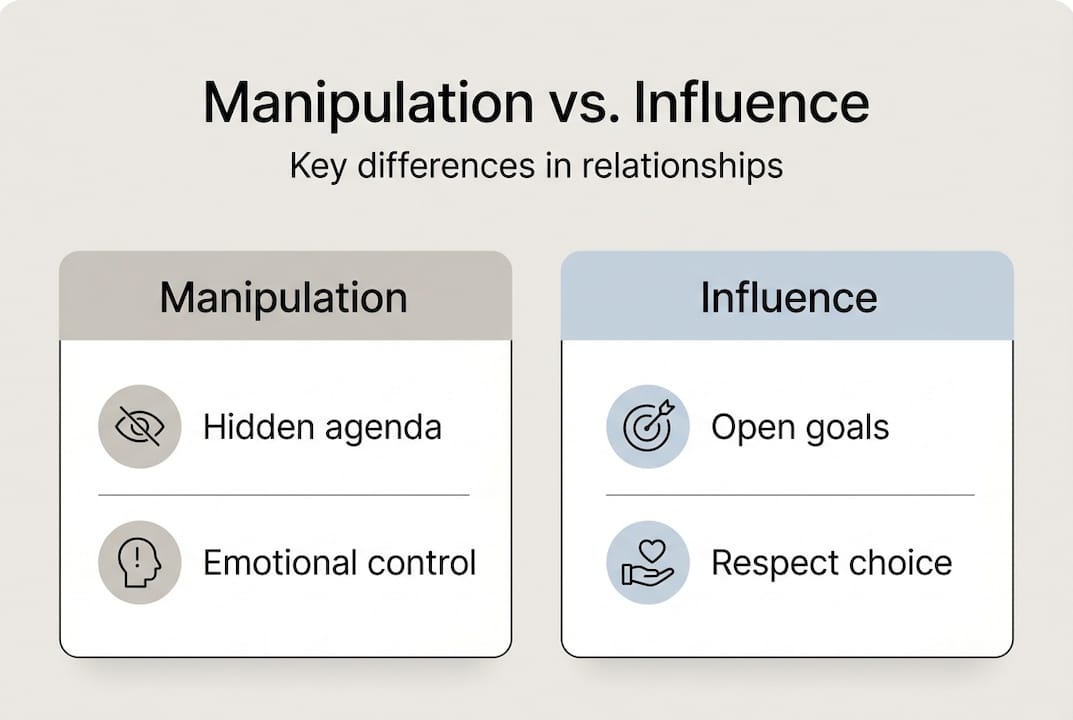
| Aspect | Manipulation | Healthy influence |
|---|---|---|
| Transparency | Hidden agenda, covert tactics | Open communication, clear intent |
| Emotional tactics | Guilt, fear, obligation | Genuine emotion, authentic sharing |
| Benefit distribution | One-sided gain | Mutual benefit or clearly stated trade-offs |
| Information sharing | Selective, distorted | Complete, honest |
| Respect for autonomy | Undermined through pressure | Preserved, choice honored |
| Long-term outcome | Resentment, dependence | Gratitude, empowerment |
Red flags indicating manipulation rather than healthy influence include:
- Secrecy about motives or selective information sharing
- Emotional pressure that intensifies when you hesitate
- Framing your boundaries as betrayal or lack of care
- Inconsistency between words and actions over time
- Making you feel obligated rather than inspired
Pro Tip: Apply the time horizon test when evaluating influence. Ask yourself whether you’ll feel grateful for this decision in six months or resentful that you were pressured. Healthy influence leads to lasting appreciation; manipulation breeds eventual resentment.
Healthy influence acknowledges your right to decline without penalty. A friend might share why they’d love your company at an event while accepting your decision either way. A manipulator frames your absence as abandonment, making you responsible for their disappointment. The difference lies not in the request itself but in how they handle your response.
Understanding abuse recovery concepts helps you recognize that rebuilding trust in your judgment after manipulation requires relearning these distinctions. You might initially struggle to differentiate genuine care from manipulation tactics because the patterns became normalized.
Consider how awareness transforms relationships. When you recognize manipulation attempts, you can address them directly or create distance as needed. When you identify healthy influence, you can engage confidently, knowing the interaction respects your autonomy. This clarity supports stronger, more authentic connections built on mutual respect rather than emotional control.
Recognizing and responding to emotional manipulation in Bergen County
Identifying manipulation early and responding effectively protects your mental wellness and relationship quality. Specific warning signs and practical strategies empower you to take action before patterns become entrenched.
Early warning signs to watch for include:
- Persistent guilt-tripping when you prioritize your needs or set boundaries
- Gaslighting that makes you question your memory of events or conversations
- Blame-shifting where they avoid accountability by making you the problem
- Emotional volatility that keeps you focused on managing their feelings
- Isolation tactics that gradually distance you from friends and family
Once you recognize these patterns, take concrete steps to protect yourself. Setting clear boundaries forms the foundation of your response. State your limits directly without justifying or over-explaining. A simple “I’m not available that day” works better than lengthy explanations that provide ammunition for further manipulation.
Seeking mental health support through therapy offers expert guidance for both recognizing manipulation and healing its effects. Professional counselors help you rebuild trust in your perceptions and develop strategies for maintaining boundaries. In Bergen County, various psychotherapy options address manipulation’s impact on mental wellness.
Practical coping strategies include:
- Document conversations and events to counter gaslighting attempts
- Build emotional intelligence to recognize when feelings are being exploited
- Maintain connections with trusted friends who provide reality checks
- Practice self-compassion when you slip back into old patterns
- Seek professional support to process the relationship dynamics
Pro Tip: Build self-awareness through journaling about interactions that leave you feeling confused or guilty. Patterns emerge more clearly when you review multiple incidents together rather than evaluating each in isolation.
Local resources for therapy and mental health counseling help you regain control and restore your sense of reality. Understanding effects of emotional abuse validates your experience and confirms that seeking help is appropriate. The abuse recovery steps process supports gradual healing and rebuilding of healthy relationship patterns.
For personal relationships in Bergen County, recognize early signs like guilt-tripping or gaslighting to set boundaries and seek therapy. Empirical data shows manipulation harms relational quality, supporting mental wellness through awareness and professional intervention. You might also benefit from grief and bereavement support when processing the loss of relationships you thought were healthy.
Responding effectively requires both immediate boundary-setting and longer-term healing work. You cannot change the manipulator’s behavior, but you can change how you respond and whether you continue engaging. Some relationships improve with clear boundaries; others reveal themselves as fundamentally incompatible with your wellness.
How therapy can help you overcome emotional manipulation
Professional therapy provides essential support for recognizing manipulation patterns and healing their psychological effects. If you’re experiencing confusion about your relationships or struggling with guilt when setting boundaries, working with a trained therapist offers clarity and practical tools.
Therapy creates a safe space where you can explore relationship dynamics without judgment and rebuild trust in your perceptions. Various psychotherapy options suit different needs, from individual sessions focused on personal healing to couples therapy when both partners commit to healthier patterns. Cognitive behavioral approaches help you identify and challenge distorted thinking patterns that manipulation creates.
Getting started with psychotherapy treatment in Bergen County connects you with experienced professionals who understand how emotional manipulation damages mental health and relationship quality. Therapists specializing in emotional abuse support guide you through recovery while validating your experiences and teaching boundary-setting skills. Reaching out for professional help demonstrates strength and commitment to your wellness, not weakness or overreaction.
Frequently asked questions about emotional manipulation
What exactly is emotional manipulation?
Emotional manipulation is covert psychological control where someone uses your feelings against you to serve their agenda. Unlike honest influence, it operates through tactics like guilt-tripping and gaslighting that work below your awareness. Understanding definition of emotional abuse helps you recognize when care has crossed into control.
What are the earliest signs of emotional manipulation?
The earliest signs include feeling guilty for normal boundaries, questioning your memory of events, and walking on eggshells around someone’s reactions. You might notice yourself constantly apologizing or feeling responsible for their emotional state. These patterns often start subtly and intensify over time as the manipulator tests your boundaries.
How does manipulation differ from normal persuasion?
Manipulation is hidden and exploitative, while persuasion is transparent and respects your autonomy. Healthy persuasion presents clear information and accepts your decision either way. Manipulation uses emotional pressure, withholds information, and frames your boundaries as betrayal or lack of caring.
Can emotional manipulation cause lasting mental health damage?
Yes, ongoing manipulation correlates with depression, anxiety, and eroded self-worth that can persist long after the relationship ends. Gaslighting particularly damages your ability to trust your own perceptions and memories. Professional therapy helps address these effects and rebuild healthy self-perception.
Where can I get help for emotional manipulation in Bergen County?
Local therapists specializing in emotional abuse and relationship dynamics provide professional support for recognizing and healing from manipulation. Individual therapy, support groups, and couples counseling when appropriate all offer pathways to recovery. Reaching out for a consultation is the first step toward reclaiming your mental wellness and relationship quality.