

Nar-Anon Family Groups are a worldwide, 12-step peer fellowship for family members and friends affected by someone else’s drug addiction. The program runs on the Twelve Steps, Twelve Traditions, and Twelve Concepts, and the only requirement to join is that someone’s addiction has touched your life. You don’t need the person to be in treatment, or even to admit there’s a problem.
If you need help right now:
- Find a meeting: Visit nar-anon.org and use the meeting search tool.
- Mental health support in Bergen County: Contact Bergencountytherapist for a free consultation with Dr. Stephen Oreski & Associates.
- Crisis line: Call or text 988 (National Suicide & Crisis Lifeline) if you or someone you know is in danger. Call 911 for immediate emergencies.
Table of Contents
- What is Nar-Anon and who is it for?
- How does a Nar-Anon meeting actually work?
- How does Nar-Anon differ from NA and professional therapy?
- What can Nar-Anon realistically deliver — and what are its limits?
- How to find Nar-Anon meetings near you
- Tips for attending your first Nar-Anon meeting
- A clinical perspective on when Nar-Anon is enough
- Key Takeaways
- A note from the practice
- Professional therapy alongside Nar-Anon
- Useful sources
- FAQ
What is Nar-Anon and who is it for?
Nar-Anon is open to anyone whose life has been affected by another person’s drug use — spouses, parents, adult children, siblings, friends, and coworkers all belong. You don’t have to be a blood relative. The fellowship’s only membership requirement is that a problem of addiction exists in a relative or friend.
Meetings are free. The program is self-supporting through voluntary “seventh tradition” contributions, but no one is ever required to give anything. Narateen, a related program, offers age-appropriate peer support for adolescents affected by someone else’s addiction.
The core framework rests on three pillars:
- Twelve Steps — a personal recovery path adapted from Narcotics Anonymous
- Twelve Traditions — guidelines that keep the group unified and focused
- Twelve Concepts — principles governing how the fellowship serves its members
One clarification that matters for newcomers: Nar-Anon is spiritual, not religious. The “Higher Power” language is intentionally broad, so people of any belief system — or none — can participate without feeling excluded.
Meetings are peer-led, not clinician-led. That distinction matters: Nar-Anon complements professional care but does not replace it.
How does a Nar-Anon meeting actually work?
A typical meeting runs 60–90 minutes and follows a predictable structure, which helps newcomers feel less anxious walking in.
- Opening readings from the Twelve Steps or Twelve Traditions
- Member sharing of experience, strength, and hope (no cross-talk or advice-giving)
- Optional literature study or topic discussion
- Announcements and voluntary contributions
- Closing reading
Confidentiality is the foundation. What’s shared in the room stays in the room, and anonymity is protected for everyone present. Meetings take place in community centers, churches, treatment facilities, and increasingly in virtual rooms accessible by phone or video — so geography is rarely a barrier.
The tone is non-judgmental. Nobody will push you to speak, and nobody will offer unsolicited advice about what you should do with your loved one.

Pro Tip: Arrive five minutes early, introduce yourself as a newcomer, and simply listen during your first meeting. If you’re not ready to share, say “I pass” — that’s completely accepted and respected.
How does Nar-Anon differ from NA and professional therapy?
This is where a lot of people get confused, and the confusion is understandable.
| Resource | Who it serves | Led by | Clinical care? |
|---|---|---|---|
| Nar-Anon | Family and friends of people with drug addiction | Peers | No |
| Narcotics Anonymous (NA) | The person recovering from drug addiction | Peers | No |
| Licensed therapy | Individual, couple, or family with clinical needs | Licensed clinician | Yes |
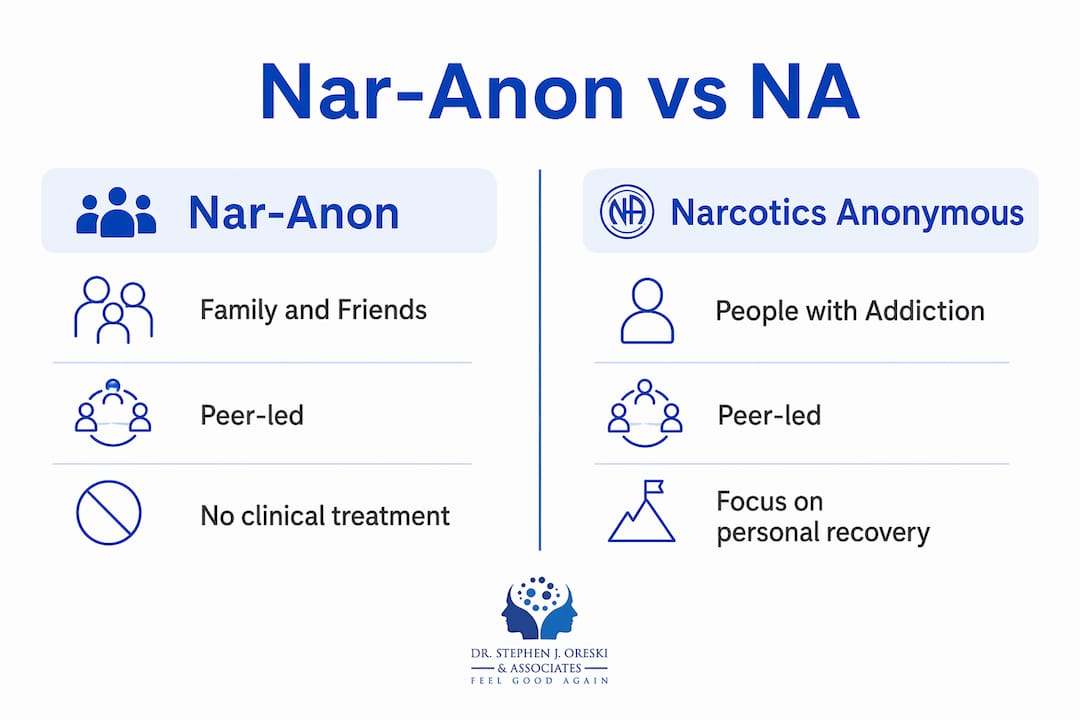
Nar-Anon and NA are separate organizations that cooperate but are not affiliated. The separation is intentional: each room is a place to speak freely about your own experience without the other group present. A family member in Nar-Anon and their loved one in NA can both attend meetings the same week — in different rooms, focused on their own recovery.
Professional therapy goes further than either fellowship. A licensed clinician can diagnose, create individualized treatment plans, manage medication referrals, and provide trauma-informed care. Nar-Anon addresses coping, boundary-setting, and peer connection. Therapy addresses the clinical layer underneath.
Where they overlap: many clinicians recommend combining peer support with therapy because peer groups reduce isolation while therapy provides the individualized treatment planning that a group setting cannot.
What can Nar-Anon realistically deliver — and what are its limits?
Nar-Anon’s core message is built around what recovery specialists call the Three C’s: you didn’t Cause it, can’t Control it, and can’t Cure it. That reframe alone shifts a lot of the guilt and shame family members carry.
Primary benefits:
- Reduced enabling behavior and clearer personal boundaries
- Peer validation from people who genuinely understand the experience
- Practical coping tools for guilt, anger, and codependency
- A consistent, free, and accessible support structure
Limitations:
- No clinical diagnosis, medication management, or psychiatric evaluation
- Not a substitute for licensed therapy when trauma, serious mental illness, or crisis is present
- Not crisis care — it cannot replace emergency services
Red flags that suggest professional care is needed alongside or instead of Nar-Anon: suicidal ideation, active self-harm, symptoms of serious mental illness, or child safety concerns. In those situations, a licensed therapist or psychiatrist should be involved immediately.
How to find Nar-Anon meetings near you
The fastest path to a meeting is the official Nar-Anon website’s meeting search tool at nar-anon.org.
- Go to nar-anon.org and click “Find a Meeting.”
- Enter your zip code or city to see in-person options near you.
- Filter by virtual meetings if you prefer phone or video attendance.
- Contact your local intergroup directly if search results are sparse — they often know of unlisted groups.
Before attending, check a few things:
- Open vs. closed: Open meetings welcome anyone; closed meetings are for members only.
- Format: Speaker meetings feature one person’s story; discussion meetings involve group sharing.
- Accessibility: Confirm location, parking, and any virtual access details.
- Narateen availability: If you have a teenager who needs support, ask whether a Narateen group meets nearby.
If a meeting ever feels unsafe or unwelcoming, leave and try a different group. Meeting cultures vary, and finding the right fit sometimes takes a few tries.
Tips for attending your first Nar-Anon meeting
Walking into any new group is uncomfortable. A little preparation helps.
Do:
- Arrive a few minutes early and let someone know it’s your first time
- Listen more than you speak — absorbing others’ stories is valuable on its own
- Say “I pass” if you’re not ready to share; no explanation needed
- Respect anonymity — what you hear stays with you
Don’t:
- Try to diagnose or strategize about the person with addiction during the meeting
- Share identifying medical details about others
- Bring young children to adult meetings — check Narateen options for teens instead
Emotional preparation matters too. Set a simple intention before you go (“I’m here to listen and learn”), and plan something grounding afterward — a walk, a call with a friend, or a quiet meal. The first meeting can stir up more than you expect.
Pro Tip: Print or save a short list of meeting norms before you go: anonymity, confidentiality, no cross-talk, and the pass option. Reading it in the parking lot takes 30 seconds and makes the room feel less foreign.
One concept that surprises many newcomers is “detaching with love” — the practice of stepping back from trying to control the addict’s choices while still caring about them. It’s counterintuitive at first, and that’s exactly why hearing it from peers who’ve lived it lands differently than reading it in a book.
A clinical perspective on when Nar-Anon is enough
Nar-Anon fills a real gap. Peer support reduces isolation, normalizes the family experience of addiction, and gives members a consistent place to practice the boundaries they’re learning. For many people, that’s genuinely enough to stabilize their own wellbeing while their loved one navigates recovery.
The clinical threshold shifts when the family member’s own mental health is compromised. Persistent depression, anxiety disorders, PTSD symptoms from living with active addiction, or a history of trauma all warrant more than peer support. Nar-Anon is explicitly non-professional and does not provide diagnosis or treatment — and that’s not a flaw, it’s a design feature. The fellowship was never meant to carry that weight.
At Bergencountytherapist, Dr. Stephen Oreski & Associates works with Bergen County residents navigating exactly this combination. Family therapy and individual therapy can run alongside Nar-Anon attendance — they address different layers of the same problem.
Pro Tip: If you’re already attending Nar-Anon and feel stuck, that’s a signal worth paying attention to. Peer support and clinical therapy aren’t competing options — they work better together.
When to consider a clinical referral:
- Symptoms of depression, anxiety, or PTSD that aren’t improving
- Difficulty functioning at work, in relationships, or as a caregiver
- Suicidal thoughts or self-harm (seek help immediately)
- A child in the home who may need assessment or support
Bergencountytherapist offers online therapy for families and in-person sessions in Bergen County, with a free consultation to get started.
Key Takeaways
Nar-Anon is a free, peer-led 12-step fellowship for family and friends of people with drug addiction — not a replacement for licensed therapy, but a powerful complement to it.
| Point | Details |
|---|---|
| Who it’s for | Anyone affected by a loved one’s drug addiction — family, friends, or coworkers. |
| Cost and access | Meetings are free, anonymous, and available in person, by phone, and online. |
| Core message | The Three C’s: you didn’t Cause it, can’t Control it, and can’t Cure it. |
| When therapy is needed | Persistent depression, trauma symptoms, or crisis require a licensed clinician, not peer support alone. |
| Bergencountytherapist | Dr. Stephen Oreski & Associates offers family and individual therapy in Bergen County, with a free consultation available. |
A note from the practice
Loving someone with an addiction is exhausting in a way that’s hard to explain to people who haven’t lived it. Nar-Anon gives you a room full of people who don’t need the explanation. That matters. And when the weight becomes clinical — when sleep disappears, when anxiety takes over, when the past starts bleeding into the present — that’s when a therapist becomes part of the toolkit too. At Bergencountytherapist, we see both layers regularly, and we know how to work alongside peer support rather than against it. Care here is confidential, nonjudgmental, and built around what you actually need.
Professional therapy alongside Nar-Anon
Nar-Anon is peer support, not licensed treatment. When clinical issues are present, a therapist adds what the fellowship cannot: individualized assessment, trauma-focused care, and a treatment plan built around your specific situation.
Bergencountytherapist offers individual therapy, family therapy, and online therapy options for Bergen County residents. Whether you’re attending Nar-Anon and want clinical support alongside it, or you’re not sure where to start, the practice offers a free initial consultation to help you figure out the right fit. Dr. Stephen Oreski & Associates provides psychotherapy options tailored to the full range of challenges that come with loving someone in active addiction. Ready to take the next step? Book a free consultation and find out what clinical support looks like for your situation.
This article is general information, not professional advice. For guidance specific to your situation, consult a licensed mental health professional.
Useful sources
Vetted resources for verifying facts and locating meetings:
- Nar-Anon Family Groups — Official Website — definition, principles, and meeting search
- What Is Nar-Anon? — Nar-Anon Family Groups — membership rules, the Three C’s, and program overview
- Nar-Anon FAQ — Nar-Anon Family Groups — meeting logistics, cost, and clinical boundaries
- Our Principles — Nar-Anon Family Groups — Twelve Steps, Traditions, and Concepts
- Nar-Anon — AddictionHelp — recovery specialist summary and comparison with NA and Al-Anon
- Bergencountytherapist — Family and Individual Therapy — clinical support for Bergen County residents
- Substance use disorder context — clinical background on addiction for family members
| Resource | Type | Cost |
|---|---|---|
| Nar-Anon meetings | Peer support, 12-step | Free (voluntary donations) |
| Narateen meetings | Peer support for teens | Free |
| National Suicide & Crisis Lifeline (988) | Crisis line | Free |
| Bergencountytherapist | Licensed psychotherapy | Varies; free consultation |
The National Suicide & Crisis Lifeline is available 24/7 by calling or texting 988.
FAQ
What is Nar-Anon in simple terms?
Nar-Anon is a free, 12-step peer fellowship for family members and friends affected by someone else’s drug addiction. It focuses on your own recovery and peace of mind, not on fixing or controlling the person with addiction.
How is Nar-Anon different from Narcotics Anonymous?
Narcotics Anonymous (NA) is for the person recovering from drug addiction; Nar-Anon is for their family and friends. The two fellowships cooperate but are separate organizations with different purposes.
Do I have to be religious to attend Nar-Anon?
No. Nar-Anon is spiritual, not religious. The “Higher Power” concept is broad enough to include any belief system or none, and personal beliefs are kept private.
When should I see a therapist instead of relying on Nar-Anon?
If you’re experiencing persistent depression, anxiety, PTSD symptoms, or any thoughts of self-harm, a licensed therapist should be involved. Nar-Anon is peer support and cannot provide clinical diagnosis or treatment. Bergencountytherapist offers a free consultation for Bergen County residents navigating exactly this decision.
How do I find a Nar-Anon meeting near me?
Use the meeting search tool at nar-anon.org and enter your zip code. Virtual meetings by phone and video are also listed there, so location is rarely a barrier.