

TL;DR:
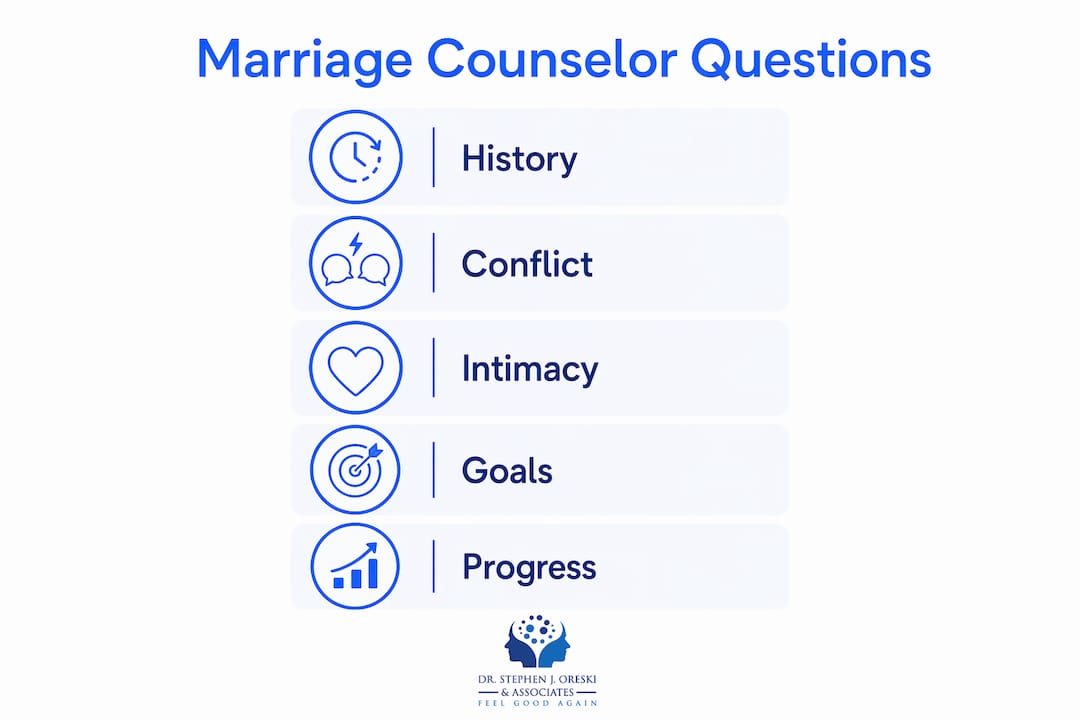
- Marriage counselors ask targeted questions about relationship history, conflict patterns, intimacy, and goals to develop personalized therapy plans. These questions help reveal underlying dynamics, foster honesty, and identify patterns that hinder connection, ultimately guiding couples toward meaningful progress.
Marriage counselors ask targeted questions about relationship history, conflict patterns, communication styles, intimacy, and goals to build a therapy plan that fits your specific situation. These questions are not random. They follow a clinical framework designed to surface the dynamics driving your relationship’s challenges. Knowing what questions does a marriage counselor ask before your first session reduces anxiety and helps you show up ready to engage. A typical first session lasts around 60 minutes with both partners present, covering relationship history and shared goals.
What questions will a marriage counselor ask about your history?
Counselors begin by mapping where you came from as a couple. This context shapes every intervention that follows. Without it, a therapist is working blind.
Typical questions in this phase include:
- “How did you two meet, and what first attracted you to each other?”
- “When did you first notice things starting to feel difficult?”
- “Have you been through major life transitions together, such as moving in, getting married, or having children?”
- “What has kept you together through hard times?”
- “Have you tried counseling before? What happened?”
These questions do more than gather facts. They reveal what the couple values, what they remember fondly, and where the relationship began to fracture. A counselor who hears “we used to laugh all the time” is already identifying a resource to rebuild toward.
The timing of challenges matters as much as the challenges themselves. A couple who struggled after a job loss faces different dynamics than one whose problems began after the birth of a child. Relationship history gives the therapist a timeline to work from.

Pro Tip: Come prepared to recall specific moments, not just general feelings. “Things got hard around year three” is less useful than “we stopped talking after we moved.”
How do marriage counselors inquire about conflict and communication?
Conflict questions are the core of information gathering in counseling. They reveal not just what couples fight about, but how they fight. The pattern matters more than the topic.
Common questions in this category include:
- “What do your arguments typically look like? Who usually starts them?”
- “How do conflicts usually end? Does one of you shut down or walk away?”
- “Do you feel heard when you raise a concern?”
- “What topics feel too dangerous to bring up?”
- “After a fight, how do you repair things?”
Counselors trained in the Gottman Method focus on understanding harmful cycles rather than assigning blame. That reframes the entire conversation. The goal is not to determine who is right. It is to identify the loop both partners are caught in.
One of the most common loops is the pursuit-withdraw dynamic. One partner pushes for connection or resolution. The other pulls back to avoid conflict. Identifying these patterns reduces shame and gives the therapist a clear roadmap for intervention. Naming the cycle takes the blame off the person.
Emotional safety is also assessed here. A counselor will listen for whether one partner feels afraid to speak, dismissed when they do, or chronically unheard. These signals point toward the depth of work needed.
Pro Tip: Over-preparing by rehearsing complaints harms therapy. Therapy is exploration, not performance. Go in open, not scripted.
What role do questions about intimacy and trust play in therapy?
Intimacy questions are where many couples feel most exposed. Counselors approach this area with care, using curiosity rather than judgment. The goal is to open a door, not force one.
Questions in this area often include:
- “How connected do you feel to your partner emotionally right now?”
- “Has physical affection or your sexual relationship changed? When did that shift?”
- “Do you feel emotionally safe being vulnerable with your partner?”
- “Is there anything that has broken your trust? Has it been addressed?”
- “What does closeness look like for each of you?”
Counselors seek to shift couples from individual conflict stories to a shared empathetic narrative. That shift is a major therapeutic milestone. When both partners can describe the same painful moment with empathy for each other, healing becomes possible.
Trust questions often surface issues that couples have avoided for months or years. Infidelity, emotional withdrawal, and unspoken resentments all appear here. A skilled therapist creates enough safety for these topics to emerge without the session becoming a confrontation.
The counselor’s role is to facilitate understanding of relationship cycles, moving couples from blame to genuine connection. Intimacy questions serve that purpose directly.
How do counselors use goal-setting questions to guide therapy?
Goal-setting questions define what success looks like and measure whether therapy is working. They appear early and return throughout the process.
- “What would need to feel different for you to consider this counseling successful?” This question forces both partners to articulate a vision, not just a complaint.
- “On a scale of one to ten, how committed are you to making this relationship work?” Counselors use this to assess motivation honestly. A gap between partners signals important work ahead.
- “What are you willing to change about your own behavior?” This shifts focus from the other person to personal accountability.
- “What does a good week look like for you two right now?” This grounds progress in daily reality rather than abstract ideals.
- “Since last session, what felt different? What stayed the same?” Mid-therapy progress checks track whether interventions are landing.
Counseling sessions generally shift from intake and history in sessions 1–3 to measurable interventions and progress assessments in sessions 4–5. That progression is intentional. Early sessions build the map. Later sessions test whether the couple is moving.
Therapy success correlates strongly with early established mutual commitment and honesty during difficult moments. Couples who answer goal questions honestly, even when the answers are uncomfortable, make faster progress.
Pro Tip: If you and your partner have very different answers to “what does success look like,” say so in session. That gap is exactly what the counselor needs to work with.
Key Takeaways
Marriage counselors ask structured questions across four core areas to build a therapy plan that addresses both partners’ needs and relationship dynamics.
| Point | Details |
|---|---|
| History questions set context | Counselors map relationship milestones and early strengths to identify resources and turning points. |
| Conflict questions reveal patterns | The focus is on cycles like pursuit-withdraw, not on who is right or wrong. |
| Intimacy questions build safety | Counselors use curiosity to surface trust issues and emotional disconnection without judgment. |
| Goal questions define success | Both partners articulate what change looks like, which guides every session that follows. |
| Honesty accelerates progress | Couples who answer difficult questions openly reach meaningful change faster than those who perform. |
What I’ve learned about what couples miss in that first session
After working with couples for years, I can tell you the most common mistake is treating the first session like a hearing. Each partner arrives with their version of events, polished and ready to present. The counselor, they assume, will weigh the evidence and deliver a verdict.
That is not how it works. The questions a counselor asks are not a test you can pass by having the right answers. They are tools for uncovering what neither of you can see clearly from inside the relationship. Therapy often feels worse before it gets better because defenses lower and deeper issues surface. That discomfort is not a sign of failure. It is a sign the work is real.
What I have seen make the biggest difference is not the couple with the least conflict. It is the couple willing to be honest about what they do not understand about themselves. The partners who say “I don’t know why I react that way” are already ahead of the ones who have a perfectly rehearsed explanation for everything.
View the counselor’s questions as a guided map, not a spotlight. They are designed to help you both find your way back to each other.
— Stephen
Couples therapy at Bergencountytherapist: a place to start
Knowing what to expect from a counselor’s questions is one thing. Having the right therapist to ask them is another.
At Bergencountytherapist, Dr. Stephen Oreski and his team offer specialized couples therapy grounded in evidence-based approaches. Sessions are available in person and online, so scheduling works around your life. The team is experienced in the full range of psychotherapy options that support relationship repair, from communication work to trauma-informed care. A free initial consultation helps you find the right fit before committing to a full course of treatment. If you are ready to move from reading about counseling to actually doing it, that first conversation is the place to start.
FAQ
What happens in the first marriage counseling session?
A first session typically lasts 60 minutes with both partners present. The counselor gathers relationship history, identifies key stressors, and begins establishing shared goals.
How should we prepare for marriage counseling questions?
Go in open rather than scripted. Avoid rehearsing complaints and focus instead on being honest about what you feel and what you want the relationship to look like.
Do marriage counselors ask about sex and intimacy?
Yes. Counselors address changes in physical affection, emotional closeness, and trust as part of understanding the full relationship. These questions are asked with care and without judgment.
How do questions change as therapy progresses?
Early sessions focus on history and intake, while later sessions shift to tracking progress and measuring whether specific interventions are working.
What if my partner and I give very different answers?
Different answers are useful data, not a problem. Counselors use those gaps to identify where each partner’s needs and perceptions diverge, which is often the most productive starting point.